Living Between Worlds 4.3 — Networks of Change
Bill Bowie explores how social networks reach tipping points around 25% adoption, and how those thresholds connect to climate action. The conversation covers weak versus strong ties, network bridges, and what it takes to shift behavior at scale.
Chapters
Thank you all for being punctual. I'm going to turn it over to Gil, who will introduce our guest host, our guest star today.
Thank you for that music.
Good. We wanted to get you and get you in the groove.
So here we went around David Bowie, Chet Atkins and Mark Knopfler. We decided, no, let's go with instrumental. And we came up with Zoot Sims, which it's always tasteful to hear Zoot Sims.
And there will be some changes made. Hi folks, I'm Gil Friend. I'm CEO of Natural Logic, managing director of Critical Path Capital, and executive coach at Trim Tab For Trim Tabs, this is Living Between Worlds. This is a monthly conversation about navigating this strange time with Antonio Gramsci called the Time of Monsters. I'm co hosting this call with Ken Homer, who you've just seen. Ken is with Collaborative Conversations. And we have a special guest who I'll introduce in just a few minutes by way of introduction. I've long been fascinated with the question of how change happens, how social change in particular happens, or change in organizations, networks, and so forth. I shared with you, I think back in our January call, a theory of change offered by Yanis Varoufakis, former Greek finance minister, which I found exceptionally rich. We've talked about the book Disclosing New Worlds, Spinoza, Flores and Dreyfus, which we'll come back to again in the future. Professor Cass Sunstein recently published an article on how social change happens and commented that we and why it's often so abrupt and unpredictable. We don't say how we really feel, he wrote, and this makes social change frequent, abrupt and unpredictable. Bill Bowie is with us today to shine some light into that mystery and help us make some sense of the matter of change. Bill, in addition to being a bioregional guy from the Northeast in Vermont, a co op guy and a software guy, has been hanging his hat in an organization called R3O, which has been a strategic disruptor of the sustainability conversation. Bill and his colleague Ralph Thurm and others have been doing some very deeply grounded academic, intellectual work of building roadmaps and documents and protocols to guide the future of the game. He's lately been an unusually outspoken bulldog, taking on what I call the BSAU of esg. You can unpack those acronyms at your leisure. Bill, welcome to the Call.
Oh, nice to be here. Gil, thank you very much for that kind introduction and thanks to you and Ken for the for the invite.
You bet. Bill's going to present for about 15 minutes with some slides Excuse me. Then we'll have an open conversation together, Ken, for probably about. We didn't, we didn't sort out our clock, but probably about 20 minutes or so and then go into, into a series of two breakouts. We'll have a chance to be in smaller groups to explore more deeply a couple of questions that we're going to pose to you, and then we'll come back together for probably about another 30 minutes of conversation in the round together. So with that, Bill, let me turn the mic over to you and take us away.
Sounds great.
Let's see.
So you can see my screen.
Yep, got it.
Great.
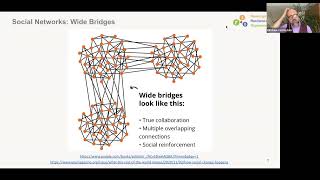
So it's great to see everyone. Great to see some familiar faces and lots of unfamiliar faces. This is a presentation that I actually presented in, in its first instantiation a couple weeks ago or maybe a month or so ago at the R3O Advocation Partners meeting. It's thinking that I've been doing for quite a while and is starting to sort of formulate how we're going to be framing our annual conference coming up in September in Amsterdam and Hybrid Virtual as well. So this is looking at the sort of intersection of social networking, social norms and social tipping points, as well as ecological tipping points, as you'll see. So I'll just start with a quote from Ilya Prigojin is how the interwebs tell me it's pronounced. So what he says is that when a system is far from equilibrium, small islands of coherence have the capacity to shift the entire system. And so it's these notions of tipping points that I want to take a look at. And in particular take a look at some recent research that's coming out from Damon Sentola at the University of Pennsylvania. In particular, this academic research paper on the right experimental evidence for tipping points in social convention from 2018 that was then sort of served as a key foundation point for his 20 called how to Make Big Things Happen. So just a little bit of background. Many of you may have heard of looking at social tipping points or tipping points in social norms. There's been a pretty strong body of theoretical work on that front that has to. My tracking of that literature has brought that tipping point down to as low as 3%. So 3% of a population, if they strongly hold a belief or position that they can tip the rest of that population into that belief. What makes this particular paper on the right novel is that it actually proved this experimentally. That's a little bit of background. But first I'm going to start from the sort of the foundational thinking underneath this that Sentola explains in the book Change, the first thing that he does is he distinguishes between social networks that are in this hub and spokes or fireworks display formulation where these are loose acquaintances, long distance relationships. There's little redundancy or overlap between the relationship. The thing that's good about this is that information travels very quickly, but it's relatively superficial. It's not persuasion. He calls this weak ties in distinction to the more fishing net style of social network where there's an abundance of social redundancy, there's overlap of connections. There's also a deeper level of connection, the trust and intimacy. This is a foundation for cooperation or solidarity. In particular, it's a foundation for making change that is more fundamental. This is what he has to say about strong ties. And this is drawing on a long literature, if you will. Then he takes a look at the notion of linkages between networks. And so he notes that narrow bridges is really what we often see in a kind of viral communication of ideas. So those often happen through these kind of, you know, there's one connector point again that can move information very quickly, but it tends to be superficial kinds of information or kinds of change, if you will. What's much better is this notion of wide bridges, which is where there are multiple lines of interconnection, which means, I think the last bullet here is really key that there's social reinforcement. So in other words, instead of getting information from one source in which you say to yourself, well, if I embrace this, how much risk am I taking? And I think one of the really striking examples that Sentola uses in his book is, is the sort of myth that it was Oprah Winfrey's embrace of Twitter that led Twitter to really explode. What he points out is actually it's the exact opposite that influencers, who we often see to be the key to make social change, they're actually often they embrace something after it's been proven to be not a significant risk for them. So these influencers aren't necessarily the first movers, but they sense that there's enough de risking that has happened through sufficiently dispersed embrace in order for them to embrace it and not due to their position of influence, fall flat on their faces. I think that these are the two levels of concepts that really serve the foundation of the key discovery that Sentola et al came to. What they did is they created an experiment where there was a group of people who all were asked to choose a name for a picture and associate it with that they went through many iterations where they just did that. Then they planted a disruptor into there or a set of disruptors who were going to consciously try to change the norm that had been arrived at organically into a different name. In this instance, to make the experiment relatively simple, they surmised, or they hypothesized a 25% tipping point. Amazingly, they found precisely that they did. 17%, 19%, 20%, 21%. None of those managed to tip the consensus, if you will. But once they got over 25, and each time that they did it beyond 25, they had a rapid tip in the consensus of that group towards the, in this instance, the new name. And so that was the first instance of, you know, moving from the theorizing of these social tipping points into the actual demonstration of it. The notion of tipping points, I think this is. This is one of the best demonstrations of that, is that in both ecological and social systems, this is a system seeks stability and there will be perturbations that will move the system to and fro, but it essentially reverts to its state of stability until there's been sufficient perturbation or potential changes that you get that tipping point and you move to a wholly different state of being very swiftly. Something like, I don't know, Silicon Valley Bank. Just saying. I want to shift now from tipping points in social systems and in particular in social norms, to apply this to the research on tipping points in ecological systems in particular, although, you know, adverse tipping points also apply to social systems, as we know from Donut Economics. But just looking at the literature around ecological tipping points, I think in climate change, the Hothouse Earth study that came out a few years ago from Will Steffen, who sadly passed away recently, is noting that the Earth has been in a stabilized position throughout the Holocene and in fact, an incredibly stabilized position for the past 10,000 years or so. And we're just sort of exiting the Holocene into the Anthropocene, depending on who you ask, as recently as the 1950s or even more recently, that's another conversation that I'd love to have sometime is when the Anthropocene began. But point being that we've been in an incredibly stable situation, that we as human beings are moving the Earth systems out of that stable situation and through we're crossing already we have crossed six of the nine planetary boundaries, and two of the other planetary boundaries that we have crossed are still in peer review. So we've crossed eight of the nine planetary boundaries. Once those get through peer review and the point here is, what they're pointing to is that if we continue on the path that we're on, we will tip into a hothouse earth. We also have the option to move into a stabilized earth if we shift our trajectory. This is perhaps one of the key studies that you would want to look at. This is a recent study from Otto et al. From 2020, who I believe. I'm sorry, I would need to look back at that. I probably could see it if the thing weren't in the way. But this was basically bringing together the research on the kinds of social tipping points that apply to social norms and the ecological tipping points that were on the verge of crossing in a destructive way. They pointed to social tipping interventions or places that you can intervene in a system using Dana Meadows tipping point, excuse me, leverage points, language. What they're saying is that through a number of interventions we could tip into a decarbonized state. In other words, use tipping points as a positive outcome. Like you saw in the last slide. This points to that our business as usual would lead us into the red zone. And what this is pointing to is that it's the purple line. It is through the use of these social tipping interventions that we could embrace the most assertive of the IPCC scenarios, the SSP 1.2, which would result in the stabilization of the Earth systems. So in other words, what they're suggesting is without these social tipping interventions, we are not on trajectory to achieve the Paris goal or the IPCC goal of 1.5 degrees C. Last slide, on this particular paper, where they're just pulling together the various different social tipping elements. These are where there are clusters of social tipping interventions that are focused on various different components of social systems and how they would dynamically interact with mitigating the tipping points in ecological systems, the adverse tipping points. They are also looking at the tipping points that would be more immediate on the lower part into ones that would be longer term. Maybe fossil fuel divestment might be quicker than transforming the education system, for example. I'm ending this with a kind of a provocation, if you will. This is an unpublished work by some folks that I met recently over LinkedIn that did a review of all of the literature on social norms across different social sciences. What they found was that there was little agreement, particularly across disciplines, on what social norms are. But to the degree that they did find coherence, what they recognized was that the common thread specifically appeared to be information that social norms are a way that human cultures have evolved to process that information, to come to agreement or consensus, if you will, not always sort of explicitly, but often in an emergent way. And so they're suggesting that the objective of social coordination and potentially evolutionary adaptation of society itself around sort of essentially how do we transform social norms? At this point that's a largely uncertain question, but we do have indications that it by coordinated leveraging of information sharing that we might be able to do that. So that's my sort of provocation, if you will. And I'll go off of screen share to hand it back to Gil and Ken.
Bill, thank you really Rich and love to hear a lot more from you. But what we'll do now is turn to what your provocations, not more than one, have provoked in the crowd. I've got some questions, but I'm going to hold back for a while and give room for everybody to speak. Please use the zoom hand raising function down in reactions at the bottom of your screen. That will cue you up in sequence and we'll choose you in sequence. Please keep your mic off unless you're actually speaking because it plays havoc with the video otherwise. Kevin Jones, start us off.
Okay, thank you. Let me take my hand down. I really found Santola's book and then I spent a lot of time on his site and his center and the whole idea of complex contagion as the way change happens as opposed to viral. And at the same time I was reading a video game designer, I guess you just said game designers understanding of the dynamics of QAnon as a game. And you know, he said it was mostly small groups of Facebook people who were related to each other and their reality changed when three or four people that were in their small group started to see that QAnon was the truth, if you will, or the lie was true. And I went and did some research with our local firemen and a majority of almost all our firehouses didn't get vaccinated because the reality inside their firehouse was that it was the thing was a risk. There were these small groups that constructed their own reality and that just made real sense to me. Just with my. I went to two different firehouses. I didn't go at all, but I went to two different firehouses and found that to be true.
If I may respond to that, I think that there's a promising side of this research and an equally sort of worrying side in the sense that, you know, yes, the idea here is that small groups can have an outsized influence over widespread opinion. I think that for me this is. I often talk about Normative norms. So in other words, there are social norms that are essentially just an aggregation of different beliefs, and then there are normative in the sense that they are underpinned by ethical norms or scientific understanding. So in other words, it would be the difference between a real norm and a bullshit norm, if you will. I think that. That's why I think we have to be careful about the ability to deploy this kind of thinking, thinking in ways that could actually make necessary and positive change all the harder. And I think that, Kevin, you're absolutely right. We're seeing this being deployed perhaps even more effectively by voices and trends that are not boding well for the survival of humanity.
One other thing the game Designer discovered about QAnon is that there were parts of it that you had to figure out yourself in ways that small groups wanted to gather and collaborate to get the messages from Cube. And so it wasn't didactic. It was they were discovering the truth collaboratively, together in their covenants. And that was pretty interesting. And that let it grow really fast.
I'd like to interject for just a second here, Bill. I'm watching the chat and there's a lot of people talking about different thresholds, percentage thresholds. Can you just clarify, based on Sentola's work, why he's saying 25% is so important? What happens at 25%, where we go from a small number of people influencing to a. When we hit 25%, suddenly there's a quantitative change. Would you address that for the folks in the chat here?
Yeah, I mean, I think that the point of it is that it's the experience of that tipping point where essentially the whole group, at least in this experimental instance, literally the whole group went from thinking that the name of the person in this picture should be Dave, which they had arrived at organically. They arrived at it through an emergent process. Then the experiment was designed such that there was a purposeful attempt to shift from a norm that had been arrived at organically into a new norm. And so it's only when the entire group comes to a consensus that it will shift from Dave to Bob, let's.
Say.
When they were smaller than 25%, the Bob contingent could never manage to sway the hole. So in other words, they didn't trigger a tipping point. For some reason, 25% was that threshold of a tipping point for the social norm changing.
That's like the hundredth monkey at 25%.
That's right.
I think that that's the hundredth monkey, although the hundredth monkey. I Hope people know that that sort of was debunked as an actual occurrence, but it was based on actual observations. But yes, I think that the hundredth monkey is what that means.
Two quick examples in Santola's book. One is Black Lives Matter. The other is gay marriage. As long as the number of people in the culture was under 25%, gay marriage was everywhere. As soon as they had 25%, we saw a very, very rapid adoption. Same thing with Black Lives Matter. It had been used for several years, but suddenly hit 25% and then it was everywhere. So I think that's the main thing that I got from the book was the reason 25% is so critical is it's. It moves from being something out there among a bunch of small groups into this is now a dominant narrative in the culture and it's really gaining strength.
Yeah, one, one quick. My reading of this intolerable book is that the 25% was, was identified in this experimental instance. I don't think that they then tried to extrapolate the 25% to the gay marriage or the, the Black Lives Matter instances. I may, I may have, have not have missed that, but I don't. I think that they were sort of isolating their quantitative or percentage calculation to the experiment itself and are suggesting that that applies broadly. But I don't think that they actually did the maths, if you will.
Well, let me drill in a little bit on that before we go to David and Rick. Next. How big were Sentola's samples?
Oh, shit. Yeah, I was going to look into that. I think that it was groups of about 100, but I'm sorry, I didn't look back at that. Actually, I, I have the book here, but I'm not going to leaf through it right now.
Hundreds, not thousands, is what you're. What I think you're saying.
Yes. Yeah, it was, it was. In other words, I think what they intended was a manageable group.
And second question, maybe more important, which, which was triggered for me when you talked about is this guy Bob or Joe? Are the norms that he's experimenting with things that really matter to people, like, is my firehouse going to get vaccinated? Or abstract, like, what are we going to call this guy on the screen?
I think that's the confounding factor. So I think what they were wanting to do was first establish that such a thing exists. And so I think that that's precisely why they chose something that was something that you could observe a change in it, but it didn't have the potentially confounding factors of significant emotional attachment to it. I think that would be the next layer of experimentation. The way I look at it is that when there are other confounding factors such as societal forces, Reputation forces, power dynamics, et cetera, that certainly does make things different. And we don't have experimental evidence that I'm aware of on those kinds of hypotheses.
And the confounding factor of what people really care about.
Right, Exactly.
Reminds me of Physics 101. Like assume a frictionless pulley.
Right.
Start somewhere. But you have to also have to know that's not the real world. David Schoenbrunn, thank you for being patient. Go ahead. Sure.
I wanted to make the point that you just made, Gil, that the academic study that came up with the 25% number was dealing with things that people don't care about, they have no investment in. And so I have to me that just doesn't stand up as meaningful. On the other hand, I heard a figure today that a recent poll said that 66% of the US population was convinced that Covid came as a result of a lab leak. And that's something that has significance in people's lives. And so I think that's a highly significant finding. And it shows the power of being a of truth coming out from under and intensively manage government narrative that was managed across all media, all social media to a totalitarian level, quite frankly.
Thank you.
Thanks, David. Rick Patella, welcome. Glad to have you here.
Yeah, thank you. I just wanted to highlight a limitation of the notion of tipping points. I think it's somewhat reductionistic and linear and creates a sort of leverage and I put a question there in the chat box there about what can we learn from the differences between constructive and destructive tipping points? Again, I qualify tipping point. I much I much rather think about upward spiral of virtuous actions versus downward spirals into the amoral abyss. They're concurrent phenomena that going on all the time, particularly in dysfunctional polarization culture where we have concurrent movements in the opposite direction. So on the one hand you've got Black Lives Matter. On the other hand we have a phenomenal race, a rise in racism. So to me the tipping point metaphor has some limitations when dealing with the complexities of this. So I think it's much easier to be destructive than constructive. It's a much more daunting task. So I was wondering if you could perhaps elaborate on the differences between those two directions and what can we learn from the dark side that might actually help the light side see the light of day.
Yeah, I could. I could weigh in a little bit on that. I mean, the first thing that I would push back just a little bit on, I generally agree, and I see the value of the direction you're pointing to us. Before getting to that, though, I would say that tipping points is not necessarily a linear or reductionistic sort of pursuit or inquiry. I think that tipping points sort of acknowledge that there's inherent uncertainty. And I think that's why we have to take the 25% tipping point with a kind of grain of salt in terms of sort of being able to pin it at that. I think the key point is that it can be the idea that 50% is once you reach the majority is when you've got a saturation point. That's the main thing for me. The really interesting thing that you're pointing to here, though, in the sort of recognizing that these are complex adaptive systems that we're talking about, is the idea that the influences are not unidirectional, that we're not just, you know, it isn't just the good guys going in one direction, that there are quote unquote, bad guys or destructive influences happening simultaneously. This is, I think, precisely what makes it interesting to apply social tipping points in social norms to the idea of adverse tipping points in ecological and social systems. I think that. Rick, the adverse dynamics that you're talking about are absolutely. They're not socially constructed per se, they're socially influenced. But our Earth systems or our ecological systems are in dire situations according to the research right now, and they're multivariant influences on them. That's one of the things that's really interesting is in the ecological research right now is showing how these actually the influences are cascading. In other words, that it isn't just that we've got a planetary boundary on Earth, one area, such as climate change, it's that the impacts on climate change reinforce and amplify the impacts on biodiversity, et cetera. Rick, I fully embrace your idea that there are multiple factors going into play. I would have to admit that I don't have an answer on the sort of how do we counterbalance the negative versus positive, other than my observations, is that negative influence tends to rely on power asymmetries for reaching tipping, whereas I think that more beneficial approaches tend to focus on a belief in a demonstrable truth or ethics or science, for example. So to the degree that those parts of human endeavors do hold sway, or to the degree that the arc of history bends towards justice is I think, where we can hopefully have some degree of faith.
I'd love to believe that, Bill, but I'm not sure I do. And I wonder about a world where there's, you know, 25% Black Lives Matter and 25% QAnon. How does, or 3% or 5% or whatever the numbers are. It's not like you hit a magic number and everything all of a sudden works out because there are other players in the game. Even on the earth systems, you know, three dimensional surface that you showed, they're multiple, you know, and those tipping points can tip this way or that way. And so it's not, you know, to Rick's point, this is not a mechanistic system. We're not billiard balls.
Absolutely, absolutely.
Thank you, Bill, Elena, Leonard and then Gene and then we're going to go to breakouts.
I wanted to ask about the contribution or potential contribution of bots and how they might be used either by positive or negative forces to influence things and if so, how does one tell the difference?
Yeah, this might be going beyond my own sort of focal point, but I certainly think that we have evidence, there's evidence emerging on the role of bots that has had an adverse impact. I think that this sort of harkens back to the last question, which is, you know, I think bots are more susceptible to people who are not applying as much sort of filtering or cognitive discernment to the information that they are seeing. So it's sort of like the information has a kind of swaying effect that works best when there isn't a critical thinking component to it. Whereas I think bots are less effective for swaying opinion for those who are looking at multiple different resources, independent resources for making their decision making. But that's about as far as I can go on that I think others might have more wisdom than I do on that one.
There's, I'm trying to find a link that I just saw yesterday that on one of the federal comment periods on a major regulatory change, 70, 70% of the comments were bots. So I think, Elena, your question is very apt at what the implications that could be.
And that does bring up that, you know, the chatgpt there's recently been a, an emergence of, in a, an application that can detect whether something came from, from Chat GPT. So I think that, that it's sort of like a, you know, a technological race of, you know, the ability to, to, to purvey and the ability to.
Detect it like Chat GPT in general, Chat GPT's ability to detect CHAT GPT is. Thanks, Gene and Fred, I'm going to ask you to hold till the next round because we need to go to breakouts. Gene Dunaway, go ahead. Welcome.
Yes, I was just one thing idea I speculated about is perhaps there would be such an adverse ecological event or series of them happening at the same time that that would be the tipping point to social change, but that now I'm reflecting on. Would an event of such capacity be so catastrophic that it would basically wouldn't even matter if we made much social change. And I wonder if you have any thoughts that these models say anything about that. Yeah, I mean, I think that's where we've been for arguably about a half century at this point. So if we look at the research, the research shows that humanity has crossed at least the ecological footprint threshold. Interestingly, in 1970, in December of 1970 was the first year that humanity consumed more resources in a year than the Earth regenerated in that same year. That was research that was done in the 90s. And it precisely coincides with the limits to growth research that projected this kind of overshoot and collapse. That's the term that Dana Meadows and her colleagues coined, that when you overshoot your carrying capacity that you go into a state of collapse. Arguably we have been in Overshoot for 50 years. The only reason that we haven't experienced the kinds of collapses that are predicted is because of what William Catton in his book Overshoot called phantom carrying capacity. In other words, we've imported carrying capacity from elsewhere in the system to stave off the inevitable collapses. But to your point, I think that arguably we've been experiencing these collapses on an ongoing basis for a while. There have been ecological tipping points that we have been crossing. It's just they have not aggregated to the degree that they sort of feel destructive enough for us to change our behavior collectively. I firmly believe that if they, you know, they've already reached a point at which we should be changing our behavior. The question is. I think you're asking the right question. I don't necessarily have an answer, but, you know, will we be able to collectively change our behavior in ways that can avert the catastrophic tipping points before they happen? Since tipping points are inherently uncertain, you can't predict when the tip will happen. That makes this knowing that with any kind of certainty an impossible endeavor. The more rational approach would be to avert the tipping point well in advance of when you might cross it.
Thanks, Bill. I'm going to Take us into breakout rooms now. So let me put the question in the chat. As you know, sometimes the chat goes away. So go ahead and copy this question so you'll have it in your chat. What are the communications and movement building strategy implications of a 25% social norm tipping point? What are the communication and movement building strategy implications of a 25% social norm tipping point? I'm going to open the breakout rooms now, about 15 minutes, then we'll come back, we'll do another 15 minutes, and we'll use the last bit of time for another plenary conversation. Here we go. All right. I hope everybody had a good breakout session. I'm not going to spend a lot of time. I'm just going to go ahead and recreate the rooms here and put you into the next one. Let me put the question in the chat. What do the networks you're involved with look like compared to Bill's characterization? So what are the networks that you're involved with look like? And take it from there. Let me recreate the breakout sessions here. Okay, here we go.
That's what this conversation is for, to unmute myself, which I appreciate. And the conversation gave me an opportunity to express more clearly, I thought, than some of the things I have been focused on the notion of social norms that hadn't been in my thinking. But it translated to me, what are the boundaries in which our thought is constrained? And that is Martin Luther King, racism, militarism, materialism, and what I add to that, nationalism. That's the four square of our enclosure that the privatizers have driven our minds into, that we can't get out of, because those are boundaries we can't cross without losing the agreement within our little enclosure that we're all here together. And that's the problem that we have to get above. That is the definition of the war system. And we have to get above that. And to do that is rather than the hierarchy and patriarchy and violence and so on, we need to emphasize the peace system, which is loving and caring and sharing and helping and healing and compassion and empathy. Those are what we need to inject into the conversation. And if we can get 25% of that going, then we begin a tipping point away from the norms of the racism, materialism, etc. Etc. That has us locked. And this is the metaphor of the commons that we are enclosed in those ideas. And I've been struggling in Ann Arbor to create a Central park and civic center as a commons, that the users really have control of. The commonly pooled resources. So drawing from the whole struggle for the commons against the privatizers into our own town, it also translates in a way into seeing that minds that we are locked into this death march, into the calamities of the climate or the wars to come, we have to get out of that war system through these more humane virtues of caring and sharing and helping and healing. And that is the peace system so impressing we need system change. It is from the war system of domination to the peace system of cooperation. And that's what was brought up for me that I expressed there and do again and I thank always for the opportunity to mouth off. Thank you.
Thank you, Alan Dawn.
I am glad to be following you because what both breakout rooms pointed to is that humanity has a self esteem problem. We are greater than we think think, we are more capable than we think. Humanity has a self esteem problem. We've got to raise our way of thinking of who we are as a species because people do want to come together and have a beautiful world. I just want to offer that it came up in both sessions.
Thank you. John Shell.
Yeah.
In one of our groups we talked about how there are two ways to get. Well, maybe more than two. There are at least two ways to get to the 25%. One is you buy your way in, which is not an option for those of us in the movement. But the other is to organize to get to that 3% or 5 or whatever the critical mass is and have that permeate the culture and pull the culture up into the 25%. And that is absolutely doable. We've seen it many times and sometimes with amazing speed, usually after years of organizing. But like you think about the reaction to the Dobbs decision, it was basically instant and it was probably way past 25% of the population and probably way past 60% of the childbearing female portion of the population.
Thank you, Shel. Christine.
Right.
So in our group, you know, we talked a lot about positive messaging, you know, unifying. How do we articulate a message that focuses, that's sort of anti unwind, anti unwoke, you know, this anti anti woke stuff and focuses on our the unity of mankind and how we're all in this together. And one of our suggestions was that we need media people to come together to figure out how. So I mean, I don't know how you make this enable this to happen, but somehow they need to be part of this process so that they can be part of uniting us rather than dividing us. And that means changing in some creative and Innovative way, the business model so that advertisers then will tell this more positive story. Because if the way it works is that you just have to push people's fear emotions basically to get eyeballs and views, we're kind of doing ourselves to this divisiveness in this. I'm afraid of you, I can't support you. Rather than focusing on what unites us. And so I thought that was a really interesting idea. I don't know how you would organize the people behind our media empires to think through how to change their business models so that it would bring us together rather than dividing us.
Thank you, Christine. Mr. Mocrae.
Sorry.
Thank you. You got the name right. Mocrae. To come back to the previous point, do we want to organize to hit 25% of media, 25% of banks, 25% of politicians, or 25% of the total population? You know, we have to think about where do we put the lever. You know, if it's always 25% of the total population, that's a big stone to move. If it's 25% of PhDs, if it's 25% of billionaires, if it's 25% of bankers, then that might be an easier lift.
Bill, do you have a response to that?
Just that. That's very much along the lines that I think, George. I think, I think that that's. That instead of trying to. It's how you bound the population that you're looking to tip. And I think that therefore choosing boundaries strategically of groups that you want to shift can then have a kind of cascade or knock on effect. So I like your line of thinking.
Okay, Gilbert?
I like the line of thinking in the notion of boundaries too, George and Bill, but I wonder, you know, Dobbs decision, case in point, gun control, a whole bunch of other issues. The United States has super majorities of support on the half a dozen most critical social issues. That's not what shows up in Congress. It's not what shows up in political decisions or action decisions or even personal action to cigarette. So, you know, takes me back to Cass Sunstein's observation that we, that we don't share what we think very well. That there's this invisible factor in these networks. There's what's latent in the culture and there's the, what we talk about. And Christine, to your point, what's visible in the media, which is again another subset of the subset. So that's part of the mystery here. We're. Yeah, there's very interesting stuff in the chat, I encourage people to take a look at it and I remind you to save the chat for yourself because we don't send that out. Are you there with your hand up? Just went away. Hankun, did you want to speak? Take. You're on mute. Please unmute your mic.
Always something like that. Yeah, I'd like to comment on. I guess it was Christine's comment about the getting media people. And I put a link in the chat that recently in a in OGM bi weekly online magazine there was an.
Article, short article and a.
A reference to a video where advertising people have gotten together to create positive stories about a very sustainable planet earth in the year 2040. So it's an example of how it is possible for advertisers, marketeers or people in any kind of business to self organize around a an actual theme which will benefit the planet.
Thanks, Hank. Anybody else?
You have your hand up, Mitch? No.
Okay, I'd like to make a comment. This comes up all the time. People say, well how do we do that? And I think the how is a result of trying to solve the problem at the level of consciousness that created it. It's an engineering problem. What we're describing here are not problems. They're messes. They have really high social complexity, high systems complexity. And when you say well how do we solve that? It puts you into an engineering mindset like I have to define a problem and come up with a solution. And I think that that's a useful question, but it's down the line. The first question to ask is what would it look like if it was working for all of us? What would our culture, our society, our media, our banks, our businesses, what they look like if they were actually working for the planet, working for society, working for people who are invested in them and trying to make a living from them. Those are questions that if we answer, make it a whole lot easier to figure out. Now, how do we make that happen? We can say what systems are already in place that support this? What new ones have to be created, which ones can be tweaked, what has to be dismantled? That's when the how questions come in. But asking how too soon cuts us off from our the level of consciousness required to solve the problem. Mr. Cook? There we go.
This is a very interesting discussion.
And.
Part of my perspective on it is that our world is not unified in its consciousness and its sense of need and certainly in terms of capability. So the model that I'm working with is that there's a relatively small group of people who are highly networked and who have billions of dollars at their personal disposal and have a very negative view of most of the rest of us to address Don's consideration and have had a system going for the last 500 plus years that imposes that negative self esteem on most of us. And they have shown themselves quite willing to dispense with millions of people if those people seem to threaten their, their game. So part of the boundary question is what is the large enough group of people that can effectively resist the repression and the wars and the pandemics that they will unleash on us? I think that there probably is that critical mass worldwide who will resist that. And getting that group of people, that's the group of which we have to get the 25%. It's an international group, it's not just in the U.S. so that's one perspective. I think that the coming war with China, probably 25, 26 over the global reserve currency is a system level challenge. And if that is tied to a debt base that has interest, it has to have a growth dynamic in it in order for the system to function, we're in trouble. But I think that it's possible because of the Muslim influence in that other group, for example, Iran is part of that monetary grouping, that it may not have interest attached and it may lend itself to a steady state kind of economy. So that's the level at which I'm seeing it. And I'm absolutely there with entertainment, education and with journalism and trying to break through. The challenge for me is that Pacifica Radio, which is what I've been working with, is in the process of being taken over, as I perceive it, by people who are within the Democratic Party mindset. That's it.
Okay, thanks. Sorry to cut you off. We are at time. I want to thank everybody for coming today. I want to give Bill a chance to wrap things up and if you need to leave, by all means, leave. Is it okay if we let Stuart talk and then have Bill? Is that good for people? How about some thumbs up? Yes, good for that. All right. Okay, go ahead. Stuart, you were going to say something?
Yeah, just very, very quickly. I hear what you're saying, Fred, and my sense of that is that is kind of sticking with an old paradigm of thinking. And I think that in terms of economic systems that it's time to really cleanse the hard drives that we were all brought up in and create something that's a little bit different as a driving factor of who we are. And that's where our saving Grace may be as we move forward.
Thank you, Stuart. Bill, do you want to have some closing words and then we'll let Gil close it out completely?
Great.
Yeah. Thank you for the opportunity. I will share three quick things. One is from the first breakout, I think it was Hank who said, excuse me, Gene, who raised the question if we actually need to experience collapses in order to have shifts in our social norms towards more regenerative ways of thinking. That's certainly something that I've considered and I appreciated Gene for voicing that. In the second breakout, I want to head nod to Heather who quoted John Montgomery, who she. She was on a. What a. A zoom with him earlier today. With Humanity Rising, I engage with John as well. So it was sort of like a. A demonstration of the intersection of networks. And Heather reported that he talked about addressing the sponsoring thought. So what is the thought that is being sponsored and can we critically assess whether that is actually a thought that we embrace or whether we can shift to different sponsoring thoughts or thoughts that can be scaled? I guess is one way of thinking about it. Although this is just my inference about what John Montgomery meant. The last thing I'll mention is that I was asked in a private message just to say a little bit more about the conference. So the R3 auto conference will be happening in September 12th and 13th in Amsterdam at Pakhasdes Weihar, which is a social enterprise that has great video technology. We're doing it again this year as a hybrid conference so you can attend from wherever. The theme of it is activating restorative norms, healing, harm, connecting for change. This notion of shifting our social norms is going to be a prevalent theme in there. That's the three things I wanted to share. In addition to thanking you all. This has been a real honor to be present and share with you. Thanks in particular to Gillen and Ken for curating and hosting this.
Bill, it's our honor. I'm really grateful for you to be here and grateful for the work that you've been doing in the world. I invite you to put a link to the conference in the chat so that people could track down more details about that. And my thanks are to all of you. It's been a really rich and interesting conversation. Clearly very provocative, clearly challenging because we have a tendency to zoom out to our analysis of the world and what's wrong with it. And rather than focus on, you know, the. The conversations that we're. That we're setting up and stirring up here. And for me, two things stick out of this last 90 minutes. One is, is your. Is the network maps that Bill shared with us. And, you know, as I think about where I situate myself there, I find myself more in the third and the fourth in. In multiple connect in multiple networks, multiple rich networks, mostly within interconnections between them, some of them with rich interconnections between them. And as Shell brought up in one of the breakouts, the challenge of focusing hard on one, you know, having the kind of maniacal focus that moves worlds versus being connected to many seems to be a challenge for many of us. How do you handle the overwhelm of playing in multiple games and focusing enough to move something forward? And the other thing that strikes me is that there's no substitute for organizing. You know, some of this tipping point conversation is a quest for a magic bullet that will make everything, you know, like, push the switch and things will happen. But what the work is, is really human beings talking with each other, which means really listening to each other, which means really listening to what we actually care about and finding where the rich interconnections are there that give rise to the kinds of movements that we're talking about. Ken, can you bring up that last slide so you have some details here? Copy these down if you like. Just a reminder to you all that these calls happen on the third Wednesday of every month, noon Pacific time. So please join us. Please share this with other people. We'll send out a note in the next few days pointing you to the video, also to the links of some offline things we've set up for continuing the conversation in a. In a chat mode, and also sharing your projects and networks and requests and offers to each other, as we've been doing lately. We'll ask Brandi Carlisle to play us out.
You can dance in a hurricane.
But only if you're standing in the eye.










