Living Between Worlds 4.4 — Sentirpensar: “feel-think”
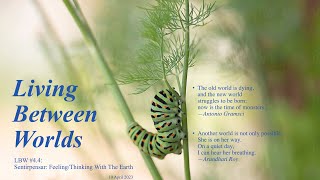
Transcript of a Living Between Worlds community Zoom (April 19). Participants check in, then discuss the Latin American concept sentirpensar (sentir + pensar: feeling-thinking with the Earth), drawing on Escobar and liberation-theology/decolonial frameworks. Conversation weaves personal practices (earth-listening, geotherapy), linguistic notes (ser/estar), pluriverse/decolonization critiques of neoliberal extractivism, breakout-room reflections, and close with invitations to practice listening with the Earth.
Chapters
Gil is here, but Gil has Covid and he's staying off mic and off camera. So he'll be probably just listening in and DMing me whenever he thinks I've made a mistake or said something he's going to disagree with. So please be patient with me today. I have a lot to do. I have to handle the breakout rooms, the slides, the questions, the facilitation, everything. So I could use a little extra, a little extra tender care today. And please do send some good thoughts to Gil. He's doing okay, he's not in terrible shape, but he's just not feeling up for, for being on the call here today. So welcome. This is the living between Worlds call for April 19th and just real quick, let's just do a very brief check in, like a three or four word check in just so we can get people's voices in the room. Say something about how your mood is and just go ahead and popcorn, start wherever you like. I'm in a very, I'm in an intriguing mood. I'm very intrigued by the topic of today. I'm excited to be talking about it and I'll start calling on people. Brad, you've raised your hand. Thank you, Brad, go ahead.
Yeah, I just got notification that a legal issue I was dealing with got resolved in my favor to the tune of almost $1,000. So I'm very, very happy. My mood, my mood is very upbeat right now.
Great, thanks, Brad. Benjamin, I'll call on you because you're next on my screen.
Hello, I'm Benjamin. I'm new to the group, feeling energized today and curious about the event. Thanks for having me.
Welcome. It's a pleasure to have you here. Welcome. Felix, how are you doing today?
Oh, I kind of feel like I've got some good anticipations of things going on in my life right now. So I'm feeling energized and I spent a couple days in Boston and got to see the Boston Marathon for the first time. So that was fun.
Terrific. Thank you. Welcome. Ron.
Yeah, hi, I'm in Evanston and I've just realized talking with some guy from, from Japan and someone from China that were always between the times and have been for eons. So I'm feeling better about and feeling more positive. Thank you.
Thanks, Ron. Welcome, Michael.
Well, I'm first time in here and I'm curious. So be listen and opening.
Listen to and open. Glad to have you here. Thanks for joining us. Bob Horn, how are you doing? Oh, you got your mouth full. So see I used to be a waiter. I'm good at that.
Feeling fine. I will only be here an hour. I've got physical therapy after that.
Okay. Very glad you could join us. Bob. Good to see you. Peter. Peter Mieson.
I'm blooming today. I just got off my bike through trails of the super bloom, which was fabulous. And I want to send some love to Gil and above. Haven't seen you from year to year.
All right. Nice. Thank you. Doug Breitbart.
Yeah. Just good to join your party.
It's good to see you, Doug.
And I'm in southwest Michigan.
John Ballard. How are you doing today? You're muted.
So is that better?
That's better.
Oh, yeah, yeah. I'm feeling grateful. A nine month project to get my pitch down to 283 words. The video was delivered yesterday, so I'm pretty excited about having. Having something in plain English about what I do. It's been elusive. Glad to be here.
Congratulations, Kirk.
I'm.
Reflective.
I'm living between worlds. Just got a new rescue dog that is afraid of people. And my job will be that I have. Will be ending in a couple of months and I'm in this transition space. That's me.
Thanks for joining us. Alistair, how are you doing today? Yeah, I'm fine. I was on a webinar earlier today about consciousness, which is interesting. And you have got some thoughts about that.
Good to be here.
Thanks for joining us. If you're just joining us, I'm just asking people to weigh in with just a few words on your mood, how you're doing today. George, how about you?
I just started two books today. One was by my mentor and friend, Mel King, who died a couple of weeks ago, a big force in Boston and around the world. And the other is a new novel which starts out by imagining United States of America, where a certain governor from Florida has won the election and consolidated his power. But it's going to trip back in the second chapter to 1978. So I'll find out what. What some things are about.
All right, thank you. Klaus, how are you today?
I'm good. I'm optimistic. It's Environmental Week. I'm going to the environmental center this afternoon, see what they're all doing.
Good to see you, Klaus. Elena. Am I saying your name correctly?
Yeah, it's Elena. I'm doing fine. Happy that spring is finally coming to Toronto. Although it's still kind of not very warm, you know, barely above freezing. But the flowers are beginning to come out. So spring is on its way. If it's not already here.
Thank you for joining us. We've heard from Brad. David Schoenbroom. How are you doing today?
Kind of neither here nor there. And I just sent Gil a message that I have Covid therapeutics, things like Ivermectin.
All right, thank you, Nama. Am I saying your name correctly?
Yeah. I'm glad to be here. It's a second time for me and I'm looking forward to hearing the conversation of today.
Great. Thanks for joining us. Janine.
Hi.
There you go.
I'm Janine. I'm feeling very optimistic because I've been networking with climate tech people here in Seattle, and there's a lot of engagement and optimism and excitement, and I haven't seen this level in maybe 15 years, so makes me feel good.
Fantastic. Good news. Thank you, Rick.
Generative.
And succinct. I like that. Thank you. Dawn, how are you today?
I feel. I. I was just doing a spoken word through Deep Adaptation Forum and it.
Was such a rich conversation, and so I feel very grateful.
And then to move into this, very grateful.
Wonderful. Thank you. David Grossoff. How are you? I'm good.
Everyone here is so serious.
I gotta say how I feel about spring is the spring is sprung. The grasses. Riz.
I wonder where them boities is.
The little boy's little wings is on. Oh, the little Boyd's is on the wing. Ain't that absolute.
The little wings is on the boys.
Thank you, David.
That's my dog.
Rolled du jour. Wonderful. Thank you. Karen. With your canine friend. You're driving and you're muted. Please be careful. We'll. We'll just. We're assume that since you're smiling, you're in a good. You're in a good place. All right. Fernando Eloy, are you available on audio here? Doesn't look like it. Mitch, are you here or you just an AI? Mitch is the one I got the message from saying he's an AI. Okay. Richard, are you available?
I believe so. I appreciate this opportunity. I'm new to the group and very interested in both consciousness and climate. I'm based in the Bay Area. Hi to Gil. Hope you feel better soon. Gil, thank you.
Good to see you. Mitch, did you come on there for a second? Are you really here? I saw your avatar change. All right. Joe, are you here? Joe Redstone.
Evening. Yes, I'm here. Feeling good. Apologies for sitting here with the camera off.
I am present, but I've been spending.
Far too long staring at zoom screens.
Today, so please don't take it personally.
But I'm going to sit here probably with my camera off for the most.
Part, but I am very definitely with you all. Good to see you, if only for a moment. And Dixon just DM me. He's recovering from open heart surgery, so he's going to stay in the background. So if you're inclined to send Dixon some. Some good energy as well. All right, let's kick this thing off. Boy, my mind. In the last couple of weeks, I've just been exposed to Manfred Max Neef's work, which I had not encountered until last month. And he does a lot about human needs and barefoot economics. And then Gil sent. I don't know if Gil sent this to me or not, but we discovered this word called. This Spanish word word called sentepensar, which is literally to think, feel with the earth. I see gills just popped up here. So. So we want to talk about that particularly this comes out of Latin America, and it's all caught up in liberation theology. And it really is about decolonizing the mind. It is legitimizing many ways of knowing that. A lot of people have an idea, especially if you've grown up in industrialized, the global north, industrialized west, that the Earth is in. And there's still many, many peoples around the world that live in a world where the Earth is alive and they think, feel with the Earth. They don't make a separation of there's us and the Earth. There's just us. And the us includes plants and trees and rocks and animals and rivers and forests. So really curious to hear from people what your experience is. Does anybody here have a sense of that? They engage in sentepensar. Is this something brand new or is this like. Oh, yeah, I've been doing that for a long time. It's a little provocation here. I'll talk more about it a bit. Just curious. Anybody familiar with this concept? Yes, I will put that name in here. Jan, go ahead.
Yeah, that's a beautiful word. I hadn't heard of that word, but it's been probably the most grounding thing in my life to be in direct conversation with the earth herself since the 70s on pretty much a daily basis. And I find she's very responsive.
Terrific. Thank you. Alistair. Yes. I'm not familiar with that particular word, but I do know that when I was younger it was much more in my head, you know, only paying attention to logic and so on. And I have studied mathematics at university. I'm quite happy about that. And also habitat, I discovered something called experiential focusing, which was developed by a psychotherapist and philosopher, Eugene Gendlin, and that talks about developing a relationship with our sensations and feelings, not just our thoughts. And he values logic and science. You know, it's not a rejection of logic and science, but it's saying we need logic and science and also a connection with our feelings and our relationship with the feelings, not just giving them the keys to the choir. You know, I mean, I could say a lot more about that, but yeah, I'm. Yeah, so that's just about humans and our feelings. I From what I understand, sentiments are also talking about connection with the earth, which goes beyond that. So I can't talk about that myself. Okay, thank you. The risk of boring I'm going to read a couple of things that I've pulled out of some of my reading this week because I think they're really interesting. So this comes from a I put a link in the chat to this particular paper. Escobar tells us that Sentepensar points to the forms in which territorialized communities have learned the art of living. As he explains, it is a call for people to send to Passar with local cultures and knowledges and the peoples of their own geographic and territorial spaces, instead of using external decontextualized knowledge that undergird notions of development, growth, and even economy. He discusses how these multiple communities weave life or tehen la vida as they interact with their immediate environment, always keeping in mind a sense of relationship with the land, the rivers, and the rest of nature. Their ways are radically different from the globalizing, neoliberal capitalist calculi, which turn everything into products of consumption and promote rapacious forms of development and economic growth. These calculi operate without factoring into the in the cost of environmental despoliation through extractivism, the destruction of entire ecosystems and the erosion of millenarian cultures, and the sense of community that the habitants in have his formula for ways of being Formas de ser can be enriched by understanding of being in Spanish, that of having two translations which do not exist in English, ser and estar. The expressions in Spanish. Ser and estar are translated as being in English, but they convey very different postures and intellectual orientations, which I would argue point us to different aspects of Centipassar. Grammatically, ser refers to something that is permanent and unchangeable. It assumes a finishes product, a finished product. Meanwhile, a star refers to a state of being or feeling, or occupying a space, location, or time, but which is not fixed. It's bound to change. It is therefore more fluid and relational with a deeper sense of becoming. The crucial contribution of a star is the celebration of interaction with the world and deeper levels of interdependence with nature through active inaction. That is by waiting and learning to live with the landscape, the land and the rivers without wanting to aggressively change it, dominate it, or exploit it for profit. That feels like it's smack dab in the middle of the living between worlds conversation. Here we are looking at a world that has been organized by neoliberal economic paradigm that sees everything as something to be exploited, extracted, turned into a product. And it's bumping up against a lot of different ways of being in the world from other cultures that do not share that same thing. So it feels like we are right, right where we need to be in this living between worlds conversation of Centipensar offers a way to think, feel with the Earth that might inform us our intellectual endeavors in ways that could actually lead to a more sustainable, humane culture. Anybody want to talk about that before we go into breakout Room? I know it's a lot of dense stuff. Yes, Ron, please.
Yeah, the thing on translation, I couldn't agree with you more, but that you can take any language and I've always been interested in the German with the way they do it, or the Mandarin or any of those. So thank you for calling it out. But it just reminds me, or I'm in Chicago and we talk about the indigenous languages around here and we don't have words for a lot of what we're doing. So thank you for pointing it out. Big topic.
My pleasure. My pleasure. Janine, please.
Well, when you were talking about that, it reminded me of something that I've been thinking about recently, which is the commodification of ecological metrics. And I'm thinking about carbon sequestration, as in forest carbon, agricultural carbon, things like that. When things like biodiversity, indigenous culture, and other metrics aren't included in it, it can lead to unintended consequences when you're maximizing carbon and not thinking about these other values. And so I think what you were talking about really fits into some of the climate solutions that are being discussed.
Thank you, Dawn.
For the last two years, there's actually a zoom call on a weekly basis called Earth Listening. And it is being related to nature and listening what our favorite tree or our favorite garden area is saying to us. It's a direct way of participating, like being integral to nature rather than plopping ourselves into nature. I. I don't know if I'm making myself clear, but that we listen with an open ear as to, you know, what a damaged tree wants to say to us or what, what we want.
You know, that it's coming from a whole different listening place inside ourselves. And so there's a practice. It's a practice. Indeed it is. Thank you, George.
A friend of mine edited a big book called Geotherapy, which is all about natural ways of carbon sequestration. And he had it ready for the COP in Paris and distributed some of it there. And the idea of working with natural systems, existing ecosystems, is very, very powerful, but very, very difficult. And I keep on contrasting it with geoengineering. So I say geotherapy, not geoengineering, please. You know, it's. It's. Geotherapy is listening and acting within the constraints of natural systems, whereas geoengineering is heroic engineering, going straight ahead and not paying attention to any of these less considered aspects. And so I think the, the idea of geotherapy fits in very well with feeling everything.
Gil just dropped into the chat. Another aspect of Senta Pansar is thinking with feeling and feeling with thinking. Michael Mead, who's been a teacher of mine for a long time, says, the heart has deep thoughts and the mind has deep feelings. So just keep that in mind as we go along as well. Bob Horn, please.
I just saw part of the movie that won the Academy Award this year. Everything. I don't know the title.
Everything Everywhere, all at Once Movie.
And what was. What struck me and coordinates with this, with the theme of this group is that they were talking about verses. That is, people were popping between universes in different ways. And seems to me that living between worlds is part of that theme. And for me, I've been asking people here where I live, have they been moving between different kinds of verses? You know, it's a metaphor. It's not like. It's not like the movie Crash and Bing and movie and colors and all that sort of thing. But. And is there some kind of. You know, for me, the theme is that I came out with it is, is there a skill to moving between these verses, including, including the. The one named Centipazar? How do we move to it? Was it easy? Is it hard? How do we move back out of it when. What kind of skill is it? Have we forgotten the skill?
Thank you, Bob. Sorry. I'm trying to text and talk and track all at the same time. And my brain just doesn't do very well at multitasking. So this also refers to something those of you who know Fernando Flores talks about pluralistic world. He might Call it the plural verse, that there are many different cultures, and each culture has its own way of relating to itself and the world. There's a young man by the name of Bayo Akomalafe whose work I really admire. He's from Africa and he says, you know, colonization might involve the stealing of a people's wealth, but that's not the central idea. It's about reinventing the frames of reference about people so that they can make sense of the things that they change. Colonization will say, the relationship you have with that mountain no longer makes sense. That mountain is no longer alive to you now. So it's a thing now you can blow it up and build a highway there. Colonization is about loss of meaning, loss of story, and loss of agency. And that feels a lot like what we've been engaged in over the last, particularly the last 50 years. Probably a lot of, you know, in the last 50 years, 70% of all mammals have gone extinct, 30% of insects. We've seen this huge gap between rich and poor. And as the natural world dissolves before our eyes, people are in denial, saying, oh, no, it's not to worry, you know, technology is going to solve it all. So that's one verse in the pluriverse that seems to be doing the most destruction. At the other end of that, we have colonized peoples who are resisting, and they're attempting to say, no. You know, the world is alive with meaning and it is you. If we destroy our meaning of the world, you destroy life itself. So those seem to be the two poles. And then there's all the different verses in between of anyone who knows. Sharif Abdullah at Commonwealth Institute says there's three kinds of people in the world. There's the keepers, which are the indigenous first nations people who've lived in, in pretty much the same way for thousands and thousands of years. There's the breakers, which are people who are inculcated into the industrial paradigm, and there's the menders, who are trying to bridge those worlds and reconcile them and help us to have a future where we can design human presence to last in sustainable, humane ways for as long as we can imagine. So I don't have an answer to how to shift between those worlds. I know it's possible. I know it's hard. It requires a lot of work, requires a lot of listening. And I'm hopeful that today on this call, we'll hopefully understand a few more about that when we move into breakouts and hear from people. Bob, did you have your hand up for more or Were you done there? Okay, Gil, just put a quote. It sent me a quote. At some point the Zapatista said, we do not want inclusion into your world. We do not even want to change your world. We want a world where many different worlds are possible. So that's the main definition of the pluriverse. It's a world of many worlds, not a world made of a single world, the Western model, modern capitalist world, but really where all peoples can thrive and flourish in many possible worlds. Now, I've been hearing people talk about the world for a long time because I've been in the ontological coaching community, and it's only recently that I understood the difference between the world and the planet. The planet is the source of all worlds. It is actually an objective thing that you can find out there that is real. It can be measured and scientifically, you know, examined. But worlds are constructed. And the world that you construct, if you're born in China in the 1800s versus in Russia in the 2000s versus, you know, Turtle island in the 1400s, each one of those cultures is going to construct a way of seeing the world that's very different. So we do live in a world or on a planet with multiple worlds. And that leads to this idea of the pluriverse. And we seem now to be at a point where we're in danger of having the capitalist world take over everything and possibly take most of us out of the picture in the process. So what worlds offer the best hope, what worlds offer the best paths forward for humans to live and thrive and flourish on a planet that is finite? There's a biologist by the Thames and Willie Barker who asked this question of how do you compound infinite wealth on a finite planet? Life has done that in four, the last four billion years. We've gone from, you know, this ball of molten lava surrounded by a toxic cloud into everything we see around us. In fact, I have a quote from Brian Swim that I was going to spring on you in a few minutes, but I'll say it now. Here's the whole story in one line. This is the entirety of the scientific enterprise. You take hydrogen gas and leave it to its own devices, and it turns into giraffes and trees and people. So there appears to be some kind of compounding intelligence that exists out there independent of humans, called Planet Earth. And yet we feel that only we are the ones who are endowed with intelligence. Only we can decide how things are going to be. If you're from the culture, I think most of us have grown up in but there are other cultures out there who say, no, no, no, the world is totally alive. You know, you just need to listen. You need to actually go out there and be with it. Thoughts on that? How do we engage the poorer verse? How do we. How do we shift between verses to make sense out of the one that we find ourselves living in most of the time? Klaus, I somehow thought that you were going to be the point. Please go ahead.
Well, I mean, we are all confined within the mindset, you know, that took a lifetime to comb. And so they are. There are understandings that we. That we are limited to. So I found the Gaia hypothesis, for example, the most compelling because the Gaia hypothesis, when it came out in the 1990s, 80s, 90s or so, is now a fairly accepted concept where all of the life is so interconnected. I mean, the atmosphere, oxygen, everything is organic and has organic origins. So this interconnectedness is understandable on an intellectual level here. And the challenge for our Western cultures is to translate the intellectual understanding of disconnectedness into the emotional sphere. And so the indigenous understanding is intuitively connected to this wholeness. May not be able to explain it in terms of chemistry and science, but there is an intuitive understanding and an emotional connection. So what we're really looking to do is to connect science and emotion so that we can really deal with the understanding that this is a living entity which we are a part of, when you really think about it, absolutely blows your mind. And so the, the. And so we should feel the pain and anguish of life, you know, as it is around us, as we are, as we are damaging this living entity in so many ways. And I think we're moving towards it, you know, particularly with the younger generation. They are more and more connected to that. But it is that, that disconnect now between the intellect and the emotion that keeps us from really acting.
Thank you, Kaas. Jan.
Yeah, wonderful framing and conversation starting, Ken. And thank you so much for your leadership on this with Gil over the time. I really appreciate, appreciate you. A couple thoughts. One, I'm wondering, sort of a quick poll, people could raise their hands how many people have visited. This place behind me is called La Sagrada Familiar. It's in Barcelona, perhaps the eighth wonder of the world. I think it's a wonderful example of how a local place has created a transcendent picture from a traditional religious frame. But what I want to share is that about. I think it was just a few months ago, last September or August, I learned about a man named Walter Russell. And I don't know if any of you have ever seen this little book, but Walter Russell was perhaps one of the greatest artists and activists that ever lived. He fused art, science and spirit through direct connection with the universe as a whole. And I think that that movie is sort of a symbol of what each of us can do if we tap in. And I. I have just been so inspired. How many of you have actually heard the name Walter Russell? I find it fascinating that one of the most famous and amazing humans that ever lived is. Most people have never heard his name. The only people that have heard his name that I've talked to don't know anything about him. I'll just share one thing because I think along with what Klaus was saying, we have to organize in an effective way. And I just wondered if any of you have ever heard of the Twilight Club that started meeting with Sir Herbert Spencer in 1870 and literally built our entire modern world with all the most famous and thoughtful people of the time. Emerson, Whitman, Thoreau, all of them. Mark Twain. They all created a poet's code together from 1870 to 1895 and then implemented it in our society over the last hundred years. So I've been very inspired by Walter and Lal Russell's view of how we can each sit for an hour a day and tap directly into the universe as a whole and find whatever needs to come to us. So I've just finding out about Walter and being inspired by him has really lit up my life and my heart in the last seven or eight months. I got to go to the Walter Russell Museum in Waynesboro, Virginia. He was Teddy Roosevelt's best friend and FDR's personal sculptor in the White House. I didn't know that a spiritual adept had been guiding this country for almost a century. And I found it very, very inspiring and instructive for today. Thank you.
Thank you. Looking at the time, I think we'll move into breakout rooms so we can go into a little deeper conversation. And I'm putting the question in the chat here. It is said that the heart has deep thoughts and the mind has deep feelings. How did these show up for you and how does that inform your mood? Said that the heart has deep thoughts and the mind has deep feelings. How do these show up for you and how does that inform your mood? I'm going to open the breakout rooms. We'll have about 20 minutes. We'll come back, we'll swap, and we'll do another round and then come back for a plenary. Everybody ready? Any questions? Okay, here we go. Hope you all had a good time in your breakout sessions. Looks like we've lost a few folks. Want to clarify they heard? Yeah, please, Ron, go ahead.
How can we get the chat from those sessions available or they go on?
The best way to get the chat is if you click on the chat and look down at the bottom. There should be three little dots that say more. And when you click on that, you can save the chat and it'll save right to your computer.
The ones from our smaller groups too?
No, the ones from this. I'm sorry, I should have told people. The ones in the small group will not be recorded. That's the way Zoom works.
Thanks. Well, my understanding. Correct me, Ken. If you save the chat from the big room before you go to the breakout room, it'll save that. Then when you're in the breakout room, if you save that before you leave, it'll save that. So it will say so. Like if we have one breakout room, that would be three chat saves, the big group, the breakout room, and then the big group again. I think that's how it works, but.
Shouldn'T believe you're correct. I'm not an expert. Go ahead.
Shouldn't the main chat record everything for the whole thing anyway?
The main chat does not record breakout rooms.
No, Zoom changed it.
Furthermore, you have to record your own. You have to save your own breakout chats, right?
Oh, okay.
Furthermore, after you save the chat before, the breakout room should go to the folder where it's stored and copy that out. Otherwise you will overwrite it with your.
Saves of the second half of the chat.
So I figured this out in like.
April of 2020, and it's hard for people to understand, but now there's a.
Little link if you fiddle with your.
With your mouse and at least the.
Desktop version of Zoom, and you can. You can find the folder that has the saved chat. Thank you, David. I would not have known that. The stuff you learn along the way. This is why collective intelligence beats individual intelligence every time. There's always people in the group who know things that we don't know. So before we go to the next breakout, anybody want to have comment on what they heard in their last breakout session? No? Okay. Yes, John, please.
I was talking with Richard Schoenbroom. I believe it is from the Zero Earth zero. NET Energy alliance in Davis. And he was kind of cut off at the end, but he mentioned something called Earth for All, which sounds like a sort of Pan European initiative that links the Norwegian way. And I just wondered if anybody else had. I Don't see him. He doesn't seem to have come back. Oh, sorry, Shorsky. Richard, would you. Would you. Would you finish what you were saying because you were cut off in mid word. I think everybody'd be interested. Yeah. So this is a book and an initiative. There's a number of familiar names like Johan Rockstrom from the head of the Potsdam Institute and other luminaries. But it's co sponsor. Sponsored by the Potsdam Institute, the Stockholm Resilience Institute group called the Norwegian Business School and the Transformational Economics Commission which includes Kate Raworth Donut economics fame. And it's a quite brilliant and fairly original description of. It's the Club of Rome. I'm sorry also. So it's basically revisiting The Club of Rome 72 report and saying two scenarios this time. One they called a Great Leap Forward or something close to that. Another one's called Too Little Too Late and, and it's basically a blueprint for sustainability and climate management, if you will. I meant harm reduction, I guess you could say. And, and it includes an extremely strong emphasis on what might be called socialization or resocialization of. Of public. Of the commons or re. You know, re acquisition of the commons on behalf of the people and specifically natural resources, including fossil fuels and minerals and all that kind of thing. So to create a public dividend, they call it a universal basic dividend to help deal with some of the transition costs and the inequity and the inequality issues. But a lot of the rest of it is familiar stuff about greening in our civilization. But that one, the emphasis on. On a fairly radical new approach to social control of resources is fairly new, certainly new to the mainstream and, and it's quite bracing and, and very bold and I haven't seen that particular idea really strongly forefronted in a lot of climate planning and techno analysis. So it's really a good read and I read a lot of these things, so I, I highly recommend it. It's also extremely. If you go on their website, the website's brilliantly done and it kind of merges activism and information in a way that I thought was exceptionally well done. So can you put that in the.
Chat for us, please? Can you put a link to the book in the website in the chat?
Yeah, I'm just going to write Earth for All and if you Google it.
Okay. I think George beat you to it. Thank you, George. Ron.
Yeah, I just wanted to say we had Marianne and Rick and it was a wonderful conversation on language and Rick, you ought to put in your book, your article where you talk about language. Thank you. And Richard, I think you put the door books in our internal chat, so maybe you could put them back in this for people. Yeah, that's the VC John Doerr. Speed and scale. I'll put it in there. Also worth a look. And measuring what matters, I think is a good reference, too. The only thing I'd like to say is that I really just feel like there's a. An opening where people are listening outside their comfort zones more just in general. And I think that that's. I don't know, I think maybe we've got some kind of a teachable, teachable moment here in some way. And I'm happy to be part of this conversation. Appreciate your taking the helm today, Ken.
Thanks, John. Real quick, because we only got one more breakout to go. Marianne.
I just wanted to add that I was really inspired by Rick's comment that there's. In terms of language, there are a bunch of taboo concepts that we don't talk about. Not. And he mentioned a couple of them. And one of them was what's equity? You know, looking at the, you know, the ideology of the word and then values and virtue. You know, there are some other ones and like, another way of exploring what's. How we can, in language, inspire the future that we're looking to is maybe another angle that everybody's doing is like digging into these taboo words.
Thank you, Marianne. Rick, please keep brief.
Yeah, I had a coffee conversation with the guy who I met at the festival Ideas, and he want. He sought me out and he introduced.
Me to this term, which I didn't.
Know what it meant, which is tltr, and I'd never heard of it before.
And what it stands for.
Does anybody know that? What it means? It means too long to read. And so I'm going to share something. It's too long to read and it requires some slow thinking and reading to address the comments that we discussed in ICE Mail group.
Thank you. All right, so another breakout room. Somebody just wrote, did we lose the first breakout? No, I'm seeing. I don't know about you. I'm seeing the entire chat in my history here. I don't know if that's the case for you. If not, I'll save the chat here and. And get it to you later on. So, second breakout room. What have been your experiences of feeling, thinking with the earth? How many of you have had an experience of actually feeling and thinking with the earth? And if you'd please share that, people would love to hear about it. And if you haven't had one, imagine what it would be like and tell us that. Okay, Here we go. All right. Welcome back. So, reflections on this last hour and 20 minutes. What's transpired for you? What insights have you had? What amazing things did you hear from other people? George, please.
The last session, the three of us shared our experiences, thinking and feeling with the earth. And that was so energizing. You know, I think for all three of us, you know, really good feeling. And for me, once you experience something like that, you can. You can go back to it. It never goes away. You can always access it and to share it with other people so that you hear what Ken had to do or what Marianne had to do in order to feel that that adds to your experience as they share it.
Thank you, George. Brad?
Yeah, I always come to these conversations, always wanting to go away from them and do something different. Otherwise, to me, it was like, yeah, it was a great conversation. It was very nice, very stimulating for that hour and 20 minutes. But so what and what I got from today, I. My wife and I go out for a walk almost every day, rain or shine, mile and a half, same walk every day. It's the same terrain. And I decided today, and going forward, I'm going to walk differently, I'm going to look differently, I'm going to feel differently on that walk. I mean, I'm even going to tell my wife about it and see if we both have a different walk if it turns out to be a different experience, because part of it's on cement. You know, we go a mile of. It's around, but. But at the halfway point, we go off for a quarter mile in and back on a trail that's in woods. So it'll have both. It'll have an urban and a rural component to it. And I'm just going to see what happens.
Thank you all. Thank you. Marianne, please.
Yeah, I was like, like George, completely inspired by the stories that you and George told, and I just want to share one of them. It's an experiment. Well, that I'll. If that's okay. Ken, is that okay?
Sure, sure. Absolutely.
Yeah. To go and read poetry to trees and see if they answer back. The other thing that I'm taking away is that it. All of us have found that it takes a practice or a time to get in connection with nature, to get the mind clear. And 10 day meditation retreats and six day backpacking trips are one way to do it. But there are other practices. Qigong is a way to do it as well. And if we get into those states, then there's a way that we can listen people into agreement. And so I think as we come to these things, it's a good thing to find some practices of getting fully embodied in presence and getting that connection with the earth. Anyway, thank you.
Thank you. Listening into agreement comes from those of you who know Heather Cox Richardson today. She wrote about George Mitchell and the Good Friday Accords. The troubles In Ireland lasted 30 years and George was the special envoy appointed by Clinton and he listened for two years. He basically just listened to all sides. When they came to the agreement, one of the participants said, george listened us into agreement. There's very, very powerful lesson there about listening. The same thing. I think we can slightly tweak Santa Pansar not just to think, feel with the earth, but think, feel, listen with the earth.
Brad, not to take us off topic, but while we were in the middle of this conversation, a friend of mine sent me a notice about a new bill that's been introduced. It's called the we the People Amendment, HJR 54, which seeks to end corporate rule by firmly establishing that constitutional rights belong to human beings only, not to corporations. It's not quite. It seems a little bit related to today's topic, but I just thought the coincidental nature of getting that email from him. So if people don't mind, I'll. The easiest thing is just email me and I'll forward you that email. I can't put the email in the chat, but it's asking people to contact their Congress people and support this, which I think would be an amazing step to, you know, to not have corporations have the same legal standing as human beings in our courts. So I'll just leave it at that. It's. My email is right there in my box is my name bradbread warren.com just email me and just put, just put, just put. Send me the stuff and I'll know what it's for. Send me the thing.
Thanks. Thanks, Brad. Rick, please.
Yeah, I'd just like to add to the George Mitchell reference, and that is last night on Amapore there was an interview with Tony Blair, President Clinton, I'm forgetting the Irish Prime Minister's name. But it was a brilliant interview because it spoke about the complexity of three world leaders coming together and being totally committed. So they created the platform for George to do his work. But there was so much more behind it. It's an absolutely. And to me, I was thinking, how can we extrapolate lessons from that alignment of leaders to be able to deal with the issues that we're currently facing. And that was some of the questions they were posing to them. So it's a must watch interview about three world leaders who came together in alignment and they said we're going to. We're just going to stick with it, we're going to persist it until we get this done. And it was incredible. And all three leaders were incredibly courageous and took significant political cost but they said it was important to do.
Thanks, Rick. Can you provide a link in the chat for that or at least the name of the show? I'll see if I can get a link.
Yeah, no, it's Amapores on cnn. Do you know Amapores? Yeah, Let me see if I can find it. Let me see if I can. Just give me a moment.
My computer's a bit slow so take your time. No worries. Anyone else want to weigh in on what they've discovered today as a result of this call? Karen, I'm glad you're still with us even though you couldn't be in. I don't know if you can make it to the breakout room or not, but how about just say hello so we know who you are.
Hi, I'm Karen. I live just outside Austin, Texas on the regenerative land management endeavor called Ardor Wood Farm. And I met Gill at an eco conference over a decade ago. So I'm happy to be here. And the conversation is so perfect for my master's thesis writing. Thank you all.
Pleasure to have you join us. Come back. We're here every month, third Wednesday of the month, noon to 1:30.
Thank you for the wonderful conversation.
I appreciate it. It's been a pleasure. Christine, we're just about to wrap up, but welcome.
Thank you. I'm sorry I came late.
It must be important for you to be here for just a couple of minutes because you're here. So we want to honor that last minute thoughts before we wrap up. Gil, you've been quiet the whole time. Do you want to just say hello to people or just stay off camera? Let me know what you want to do. All right, well, we're at time. Oh, Jan, I'm sorry.
You raised your hand. Yeah, I just. I just want to say that. That I think it's wonderful that all humans have the connection and I think Walter Russell directly model that we can not just talk to the earth but we can literally be in direct personal connection with the entire universe at any given moment. We all have that capacity. If we'll still and open to being, you know, embedded in the whole. And I've really appreciated our discussion. Got me clear on that because somebody asked, you know, is, you know, can anybody do it or is this a supernatural thing? I just. It's not. It's just intention to be connected to the larger whole. And we all can do that in whatever way works for us. So thanks for encouraging that with this call.
Thank you. My pleasure. Our pleasure. I'll leave you with one thought. I wonder if people who are living. I wonder if people who are living in cities have easy access to the kind of think, feel with the earth that we're talking about. It seems like most of the people I've talked to today in the breakout rooms have experience of actually being in nature, but there's a lot of people who aren't in nature. I know somebody who's my best friend's daughter, who's 22 years old, said to him recently, I've never seen the Milky Way, which to me is incredibly sad, you know, that somebody. The Milky Way is just one of the most amazing things to see when you're out there in the wilderness, when there's no lights and that. She's never seen it. And a lot of people live inside these concrete boxes and never, you know, they don't see trees, they don't see nature. So this seems to be something that we need to resolve in some way. More nature and cities. The greening of cities seems to be really important if we're going to return to being able to think and feel with the earth. I really appreciate every participation today. It's been a pleasure, as always, to see you. I'm going to sign out. Here we go. David, just put some Blake in there. All right. I'll tell you what. I'll give you a little poem. Here's something for you to go out on. My favorite poet, his name is William Stafford. It's called Ultimate Problems. In the Aztec Design, God is in the little pea that is rolling out of the bottom of the picture. And the rest extends all the bleaker because God has gone away. In the white man's design, there is no pea. God is everywhere but hard to see. The Aztec frowns at this. How do you know that he's everywhere? And how did he get out of the pea? Ultimate Problems. William Stafford. We'll go out with little Brandy Carlisle here if I can cue her up. We will be back next month. I wish you all a great month. Happy, healthy, safe. Enjoy your. Your life. Hang out with the earth, Do a little thinking and feeling. And here we go.
You can dance in a hurricane.
But.
Only if you're standing in the eye. You can dance in a hurricane.
But.
Only if you're standing in I.










