Living Between Worlds 4.6—What if we had to?
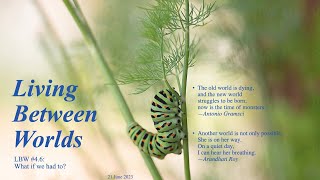
Gil Friend and Ken Homer explore how people and organizations might respond if rapid transformation became necessary to address climate change alongside biodiversity loss, toxicity, and inequality. The group examines historical mobilization, psychological barriers like denial and fear, and practical pathways forward, including efficiency and focusing on the services energy provides.
Questions this video answers
June 21, 2023 (Summer Solstice).
July 19, 2023 (third Wednesday).
'Barely a fifth of the Fortune 500' have set science-based targets; of companies that set goals, 'maybe 5% are on target to reach their goals.'
Chapters
This is Living between worlds for 21 June 2023, Summer Solstice. Three and a half years into this extended conversation about what might it be like? What is it like? What can it be like to live between worlds, between the old worlds that are dying in the new worlds that are waiting to be born. And to do this with grace and dignity and power. I'm Gil Friend. I'm CEO of Natural Logic and Managing Director of Critical Path Capital. My co host here is Ken Homer. Ken, say a word so the camera pops to you.
Word.
Okay, good and very glad to have you all here. Just a bit of logistics before we start. Please keep your mics on mute unless you're called on. Please keep your cameras on if possible. We love to see you use the chat actively. As for ongoing conversation and to exchange with each others, we don't send out the chat, but you can save the chat using the three dots at the lower right hand corner of the screen. So that's on you. We will be doing breakouts today. If you want to save the chat, you will have to save it before, during and after the breakouts because they're just chopped up by zoom into separate objects. Ken, anything else I've left out on logistics?
Just one quick thing. The three dots are actually kind of in the slightly left of center as some people on this call may be.
Okay, good deal. Let's use that again next time. How many of you had saw the newsletter that I dropped in the last couple of days? Okay, about half. So let me pick up on some themes from there and take us into the conversation. And for those of you who haven't, you can find it on my blog and my substack and LinkedIn called courageous contagious. So look, we've talked about climate crisis before and in the spirit of Chauncey Bell and Russ Lakoff, I prefer to call this the climate mess. And it's messier. We have on the one hand more countries and cities and companies setting bold climate goals, more and more setting science based targets, which means in line with the requirements of meeting the temperature targets that the UN agreements have set. But you know, barely a fifth of the Fortune 500 companies have done this. Of the companies that have set goals, maybe 5% are on target to reach their goals. And so the goals are kind of a. So what if the actions don't happen in place to meet them? And I wonder, is this because there are no consequences to not meeting goals for the people who are now in charge of doing them on quarterly reports and so forth. We know the consequences are coming at us. They're on somebody else's watch. And is that one of the complications? You've all seen the stories about insurers starting to leave California and now Florida in face of climate risk, which means, again, we'll have socialization of costs as we, the taxpayers, pick up the impact of actions generated by others. We see temperatures and sea levels continuing to rise. You probably saw the latest, latest wiggle from Antarctica this week. And so the question I raised in the article and I'm raising with everybody I talk to is, look, we know that this is difficult. We know this is maybe impossible. You know, how do you transform a global civilization? How do you turn a global civilization on a dime? But what if we had to, you know, what if we had to, what if, you know. And people respond to that kind of question in different ways. Some buckle down, some retreat to doom. Some say we must do everything we can to prevent this and turn this. Some say there's nothing to be done, we need to prepare for a collapse of civilization and centuries of recovery. But I'll tell you, these questions have me thinking in a larger view. First of all, you know, we talk a lot about climate crisis, but it's not climate crisis, it's humans living on Earth crisis. It's climate and it's biodiversity and its toxicity and its income inequality and it's, you know, the impending massive refugee migrations that we're going to be seeing in the coming decades. And, you know, the list is long. You've all got the list. You've seen systems diagrams of the list of how all these things interconnect like a plate of spaghetti. And it's a, you know, for those who are not oriented to systems thinking, it's very hard to enter into that diagram or into that thought of, you know, doing something more than addressing one problem at once. But that's where we are. I had a strange respite from this mood this weekend reading Baruch Spinoza, 17th century philosopher treated religious political treatise, which is a brilliant piece of work and stunningly fresh. I felt like it could have been written today, last week. This. It felt exactly on target. He was looking at not just the 17th century, but the previous couple of thousand years of history. The story's the same. You know, the masses are the same, the defects in our thinking are the same. For me, that didn't take me into an like, oh, shit, we're completely screwed. It took me into, oh, this is the human condition. We struggle with these questions and we have since time immemorial, and we probably will forever. It's not a question of what can we do to just, you know, clean the slate and make everything perfect, because that maybe will never be. But it's a question of what do we do in the midst of this? How do we do the best we can in the midst of this? And, you know, and you've heard me talk about moods before, this is not about a woo, feel better and make everything better, but it's kind of an inquiry into how do we engage the world? What do we perceive? How do we interpret what we perceive? How do we speak and commit with each other and act with each other in the face of these orientations that we construct out of our experience, out of our histories, out of what we encounter, the conversations we have with each other and the conversations that we have with ourselves. So I want to start there. Ken, do you want to add anything to that before we open the room?
Yeah, as long as we're talking about philosophers. Schopenhauer has a great quote that everyone takes the limits of their own field of vision to be the limits of the world. And I think about anybody who remembers James Glick's book on chaos from about 30 years ago. He talks about how chaos theory got started at mit. There was a professor who had a weather simulator in his office. The thing only had 12 variables. And these guys are betting men, so they would. Would come by. And it was all men at the time, sorry, women. And thank you for the women who are on the call. I want to acknowledge you for being here. They would come by and they would take bets on who could predict the weather five days hence. And they discovered that because of the interaction of just 12 variables, there was so much instability in the system, what they called critical dependence upon initial conditions, that is the butterfly effect. No one could accurately predict the weather more than about three days in advance. So when I hear people saying with certainty, the world, we are doomed, this is going to happen, I think, how many millions of variables in the system are we dealing with? And how can anyone be so sure? So it makes me think of the inner climate at which I approach the outer climate. When I look at the climate mess and all that's entangled with it and all the other what Bob Horn calls interlocking mega messes. How can we be sure about anything we need to really be careful about? Are we taking the limits of our vision to be the limits of the world so that we can enter into conversations where you actually have a chance of potentially resolving some of the messiness of these things.
Thank you, Ken. So what we'd like to do for starters is to hear from you all about your inner climate, either in response to what Ken and I have just said in the last few minutes or your inner climate these days and perhaps how that relates to how you engage the outer climate. As always, please use the reaction button at the bottom of your screen to raise your hand. That will stack you in queue so we can call you in order. And Stuart Levine, your first up. Welcome. Thank you.
Thank you. Thank you, Gil and Ken, you know, I was, I was struck by my own thoughts in reaction to the frame that you posted, Gilbert. And, and as I look out at the demographic of the group today, you know, I will, I will go out on a limb and say we're all of a certain age. We're, we're all Caucasian, we're all middle class, upper middle class. Here we are.
All right.
And somehow, and I really greatly appreciate the historical references, Gil, and how you frame that. I was actually thinking to myself as you were spe. She's somewhere in the last couple of days I read about the fact that the world has always been messy and then I realized it was you who were the one who put that into the conversation. But the whole notion that we grew up in a time, 80s 90s where we were living under the delusion that we could fix the world, that we could turn the whole world into a liberal democratic place of being. I remember when, you know, when, when the Soviet Union fell apart and being like, oh yeah, this is really great, we're going to be able to do this all. And in some sense that was perhaps a high level of self delusion to think that we could fix everything and create this nirvana on a place that is and always has been messy. So thank you for that because it creates a perspective, I think, for how we might think differently about where we are.
Thank you. Stuart. Alexandra.
Hello. All right, this is very interesting. I've been doing a lot of research. Currently I'm involved very heavily in X risk through climate impact research and I've been tapping my global colleagues lately on things like water security. And in my research I'm looking back into history, looking at which civilizations declined because of climate impact catastroping effect and which ones succeeded. And apropos of what you're all, we have always been very reactive and very few civilizations have been future extrapolating enough to be proactive. How do we change the human mind? How do we change our psychological Mindset from this reactive point of view which I think is, falls into that, that category of, you know. Well, you know, my father said it recently and he would, he's 91 years old. He was one of the vanguards in the ecology movement. Knew everybody that was in it in 60s and 70s, I grew up in it. And he basically said, been there, done that, not going to live long enough, it's in your yard. We don't think anymore generationally either. And as a result a lot of people don't really think about what are our grandkids inheriting. I think that's part of our challenge is how do we change that mindset and how do we in essence. So I was raised as a Taoist, which is always kind of fun looking at, you know, how do you embrace the positive and the negative? How do you walk between those worlds? How do you see the whole. I, like many of you, grew up in the Star Trek era, you know, where we thought it's all going to be amazing and we can change all this. I began at one point to look at things as being like a jungle. In the jungle, things eat things and the jungle is both beautiful and dangerous. I think we sit at that crossroads right now. I think the big question will be how do we band together enough to make that tipping point of ensuring that human beings survive. Anyway, thank you, a lot of thoughts.
Thank you for that and thank you again for being here. And maybe you could post in the chat some examples of civilizations that you call forward focused. Shel Horowitz, over to you and then George, you're up next. Yeah, folks, please excuse me a second. Shell, when you're done speaking, please lower your hands. Helps us manage the queue. Shell, go ahead.
Yeah, that I'm going to respond to Stuart and his idea that our idea that we could make this world something really different and special was a delusion with just the perspective that in the 66 years that I have walked on this planet I have seen enormous positive change. There's also been plenty of crazy batshit stuff that is making things worse. But when I was born, blacks even in New York City where I was raised, were decidedly second class citizens. As recently as the late 60s, when my mom became lovers with a Japanese guy, there was open prejudice in a way that now interracial couples seem very, very normal. Nobody even thought about ecology outside of a few science scientists and policy wonks. Nobody thought about things like biomimicry. People thought that fossil fuels were going to last forever and nobody really cared much about how Much crap they were putting into the air and water. South Africa and Rhodesia were still in apartheid. So much as it would be nice to be able to push forward on all fronts at once and achieve radically amazing progress on every issue at the same time. That doesn't work that way. It's more like an amoeba where it comes up over here and goes down over there and it changes its shape. But overall, I think the direction still remains positive and that we now, I think, pretty much have agreement that we actually know how to solve a lot of these problems. We need to find the political will as a society. And that's not about us making other people do things, but about figuring out the trigger points that will make people want to do it on their own. Or when I say on their own, I mean want on their own to move as a. As a society. And it's just so many different. Different things and different pieces. No, no, it's not one. Here it is. It fits this box exactly. Go do it. It's not like that. It's every situation, every environment requires thinking about it differently. I had one other point and I lost it.
Come back to us when you have it again. Thanks, Shel.
George, the last couple of weeks I've been looking at things like World Resources Institute is doing, evidently an annual update on progress for the UN for the Paris Goals. And so online I attended a press conference and then looked at some of their materials on. On how they're looking at this stuff. And it was interesting, but it was polite. And from the conversation here a couple of months ago, the book Earth for All, which is an offshoot club of Rome and Jurgen Randers and that whole, you know, living within limits, you know, limits to growth. So it's another offshoot of that. And there put Earth for All to put together a program which is okay, you know, we can do a Great.
Leap.
And we'll be able to deal with the problems, among which are inequality, which I was very glad to see them include. But if you look at their data, what happens is that their scenario for the Great Leap, as opposed to their scenario for too little too late are the same trajectory basically until till 2080. And at 2080, what happens is we hit 2 degrees Fahrenheit warming and then begin to level out where the too little too late keeps on going up. So even in their most optimistic and reasonable a scenario, in many ways were still screwed. And again, they were very polite. There's no recognition of the fact that people are making money off of this kind of stuff. And how do you deal with that? That there are reasons why they, they mention misinformation and disinformation as part of the problem, but there's no recognition that there are people who are benefiting from that misinformation and disinformation. So for me, my mood is here are the best people in the world, very, very serious, but they're very polite, they're very politic, and I can understand.
George, name the mood for us. Name your mood right now.
My mood right now is sort of bemused.
Okay.
I hear more edge than that, but.
Okay, I have, I have an edge for that as well, but I don't want to.
Greta, who was not in the room with those people, has not been used.
Yeah, yeah, yeah. I, I don't want to sharpen the edge because I don't think that goes.
Fair enough. Fair enough. This is, this is why I asked the question in the post the way that I did. Look, it's very. Any of you, some of you work in companies, Some of you who work with companies? I've done that for most of my adult life. It's very challenging to move a large organization. I mean, you know how hard it is to change your own habit, much less the habit of your spouse or your children, much less 100,000 people in your company. That's hard to do. And yet it happens at the personal and the larger level. These folks are grappling with the difficulty of a gradual transition that doesn't disrupt the basic game as it stands now. And they know that doing a 1% improvement year on year on year is very challenging and takes exceptional organization and skill and, you know, and management, so forth. But we need not 1% per year. We need, you know, 5 to 7% per year reduction in emissions. It's unprecedented. Except when you consider that in 1942, the United States flipped its entire economy from military to civilian production in a matter of months, which was unrealistic. Detroit came to Roosevelt with plans to do it in nine to 12 months. He said no now because we had to. And I think in the rooms that you're talking about, no one is quite addressing it. Like, you know, what if it wasn't beating 2 degrees by 2080, but what if it was beating it by 2030 or 2040 sounds impossible, but what if we had to? What, what could we pull out of our guts and our brains and our networks to do something that has never been done before? Because we have to, you know, if your kid or your wife or the person you love most in the world was on the verge of death. Unless you did something that you've never done before, would you do it? Hell yeah, you do it. You know, you go to the ends of the earth to do it. We're not in that mood yet about this mess we will be at someday. And it might be too late to do the kind of things that we can do now to avert the level of damage we're going to see Shell and then Stuart and I think we should go to breakouts.
Yeah. My other point that I couldn't remember.
See you next time.
Was about resource issues and wars. Because pretty much all wars, when you look at them historically, have something to do with wanting resources that somebody else has or protecting resources you have from somebody else. Even the wars that are disguised as religious wars. And interestingly enough, this goes back at least as far as the book of Genesis. There are. There's a section there where Abraham is negotiating water rights with his neighbors. And so when we keep that in perspective, I think it, it makes some of the messes a little more solvable because we have to figure out who needs what resources. And then the other question is, what do they need those resources for? Like, historically, the United States has felt that it needs oil resources, even if it means invading countries in the Middle east to get them. But actually what it needs is the energy that oil can produce. And we have probably, if you look at the American Southwest, it's one of the best situated locations for solar in the world. If you look at wind, we have the, the coasts, huge wind possibilities, and also some of the Midwest. So the resource, if we think of it not as oil, but as energy, the conversation changes very quickly, changes even.
More than that, because it's not just that we don't need oil. We don't even need energy. We need what energy does for us. The work that if we can get that done better with less energy, then we're ahead of that game. Emory Lovins just sent me something yesterday, which I haven't read yet, but basically laying out a strategy for 5x improvement in energy efficiency in the United States.
I would love to see that.
What that means is that the demand for energy, whether from oil or solar, which needs land and wind, which needs machinery, all that goes down if we focus on what is we're trying to get. Amory famously said decades ago, he says, you know, I don't want. I don't want electricity and natural gas. I want cold beer and hot showers.
Yeah, yeah, you know, it's like that old question of do you spend $10 billion to develop a pen that can write in space, or do you just sharpen a pencil?
Yeah. Thank you, Shell. Thanks very much, Stuart. And then we'll roll into breakouts.
Yeah. So, so quickly, two things come to mind. One, you know, the phrase that Al Gore used, you know, denial is not just a river in Egypt in terms of motivating political will. And two, one of the things that I think I understand and there used to be a mantra in the, in the conflict resolution community is, oh, they're not really ready to engage yet because they haven't felt enough pain. And in some ways, we haven't felt the pain of the kind of situation you posit, Gil, of your family being threatened. We are, you know, somewhat insulated in so many different ways. You know, the concept of climate change justice comes in about how disproportional havoc is wreaked upon people who are in disadvantaged areas. But that notion of feeling a great deal of pain as a motivator for action, pain or fear, I mean, what was it that motivated the amazing action in World War II? It was. It was fear of a catastrophic outcome and the pain of, of Pearl Harbor. So I just wanted to throw that into the mix.
Thank you for the mix. I. I appreciate the, the you throwing that in. And I also, I also wonder whether we really know what motivates people. You know, we're not. We're not billiard balls, we're not machines. And for all the pronouncements about this has to happen or that works that way, we are much more mysterious than that. Ken, before I hand it over to you, let me just say one. One thing that's been rising in me as I've been listening to all of you. Somebody observed that this is a homogeneous group in some ways, in terms of age and origin and political inclination strikes me one way is that we've all come of age in decades of possibility. I mean, you know, Post World War II, 60 50s, 60s, 70s into the 80s, it seemed like anything was possible. The technical, the tech boom continues that story as the other ones get messier. But that's the kind of move that we have grown up in, all of us. I speculate that folks in their teens and their twenties do not share. They're grown up in a very different world than we have. And one of the things that we love to do. Ken and I talked about this some yesterday, is having more intergenerational conversation in these calls. My friend Barrett Brown, who, some of you know, does A remarkable group process, meditation process in three phases, where he invites people to dive deep into the interpretation that we live in the best of all possible worlds. You know, the litany shell that you were laying out before of the incredible progress that we've seen in our lives, and dive deep into that, about how good things are and, and experience it richly in your body, in every dimension. And the second phase of the meditation is the same exercise, but it's. This is the worst of all possible worlds. And enter fully in ways that you might often resist into the fear and all the other messes that you see there. Second phase of the meditation, the third phase is an exploration of this world is perfect as it is. Alexander tiered Daoist upbringing, you know, and what is that interpretation engendered? What moves in people with that one? And it's a very interesting preparation for action. And with that, I'll stop and can hand the baton over to you.
Thanks. You just reminded me that we can paraphrase Schopenhauer and say everyone takes the possibilities of their vision to be the possibilities of the world. So we talked recently about that. We don't see the world, we say a world. Everybody brings forth a world within their culture. And we have to deal with both the world, the physical world that's being destroyed by human, by human behavior as well as the worlds that are trying to preserve it and those that are trying to destroy it. So it's a real big messy thing. So we want to ask you in your breakout room to tell stories, because people love stories. And the story you want to tell is. We'd like you to share a time, put it in the chat now, when you did something you didn't think you could do, but you had to do it, so you did. You know, when were you up against something? It's like, oh my God, there's no way I can do this. And yet somehow you found the imagination, the courage, the commitment, the inspiration, and the stick to itiveness, which is a word from our generation that really should be in better use these days. How did you do that?
Not just something that was hard, something that just felt absolutely impossible. No way can I do this. And yet.
So any questions on the sharing? All right, I'm going to open the breakout rooms. I'll give you, oh, let's see, it's 12:35. Let's do about 17 minutes and I'll, I'll let you know. I'll give you a three minute warning.
And a one minute warning right now. If you want to Save the chat so far. Do it right now because it's going to go away.
Yeah, David, just put that in. Thanks, David. So if you please self organize so that everybody gets a chance to speak because there's no facilitation here. Okay, Here you go.
How many minutes, please?
About 17.
17. Thanks.
Just a. Before we go to Brick at room two, just a quick thoughts on that. How was that for people? Anybody hear something that astounded them? Go ahead, Alexandra.
I think we had an interesting discussion, but one of the things that came up is our discussion led and actually Rick might be better at outlining it more of a where do we go from here? Instead of what was a challenge in the past, but what's a challenge now in the work that we're doing in terms of that seems impossible and how do we move forward through it? So I think we had an interesting discussion, more framed around that I am.
Still looking to try.
Thank you. All right, we have another question for you, which I'll drop into the chat, make sure I've got it queued up here. So now, sticking with that same, same thread from the last conversation. Where did you find the commitment, the courage, the imagination, the wherewithal to get through that thing you didn't think you could do? And that's interesting to break out? Okay, I'm going to open the rooms. Any questions before we move forward? Okay, here you go. We'll have about 17 minutes in this one, too. Thank you for. I want to thank Mike. We had a fantastic discussion. Even though one person didn't have any audio, we still managed to have a good time. Love to hear from folks. So please use the reaction button, raise your hand, tell us what you heard, what you learned, what surprised you, what delighted you, how this applies to your life? Michelle, please.
Well, Stuart Levine and I had not one, but two conversations. We were in the same breakout twice and there was nobody else there. We had an avatar for Rick, but not we didn't have Rick. And it's just really interesting. You know, we started this whole group with him making a very pessimistic comment and I'm making an optimistic response to it. But in the small group, I think we found a lot of commonality in not only our approaches to things, but our backgrounds, which for both of us includes stints in both New York City and Philadelphia, among other things, and poetry. And it was a wide ranging conversation. And that we will continue outside of this group.
Yeah, and thanks, Shel. And if I could just add to that, thank you for the facilitation of opening up possibility as kind of the bottom line of what we were talking about today. At least. At least for me, you know, taking all of the wicked stuff that we're facing and. And framing it in terms of possibility on an individual, which often translates into a larger societal level.
Oh, and one other thing that we discovered we have in common is that neither of us are particularly afraid of dying.
I must hit the wrong button when I sent people out to the rooms. I thought when I recreate that, it was actually going to create different rooms rather than the same one. So I apologize for that. But I don't know about you folks in my group. It actually worked really well because we had all shared some very deep personal things, and I felt like it was a little bit safer to talk about that. So I apologize and I hope it was actually okay. So, Shel, was there anything else you wanted to say? You're muted. Okay, Alexandra, please.
I'll just kind of, like, briefly say that our group had a. And we, too, ended up in the same group twice. So we actually just continued the conversation. But I think we were all initially in alignment with being less interested in the question that was posed to us than in how it reflected in moving what we're doing forward. And we really discussed a lot about being more action oriented, how to take media and storytelling into what we're doing in ways that had goals and messaging to move or inspire people more. But I think we were kind of, you know, we shared some stories, but it was less really about us personally than getting to that point where we're no longer just talking about things, where we're actually looking at the solutions that we have identified out there and creating action plans, which is certainly a conversation. I and my work colleagues are more focused on how do we get out of the. Me, myself and I belly button staring. How do we get out of the. We're constantly talking for the last 40 years, and how do we create better action plans with the technologies and the solutions that we already know are here? So I guess that was kind of the crux of our conversation.
Thank you.
Thank you.
Mitch, you had your hand up for a second, then you lowered it. Did you decide against it or you want to still share?
I felt that I might digress too much.
Oh, go ahead. It's a pretty forgiving group.
We were on the same group again, and Chauncey Bell was on the phone from SeaTac. That was the sound you could hear in the background earlier.
We were talking on the first call.
About the making Decisions to lead a new direction. And the fact, I think all of us generally agreed that we're not particularly challenged by that, that it's relatively easy. In the second conversation, Chauncey said something that George and I heard differently that then led us off into the digression which he said, we're exiting the error of cause and effect. That's what George heard. I heard the era of cause and effect. And this had. In. This was in relation to what do you choose to work on and why do you stay motivated to work on it? And it was, it was an interesting moment where we realized, I think I'm not speaking for you, George, but I'm trying to, that context is everything. And that context can be transformed through collaboration, that taking those first steps brings us into a new relationship, not only with one another, but with the context in which we are operating. And then we got into speculative realism and object oriented ontology, and I won't go there.
You're so kind. Thank you very much. Who else would like to share what they heard? Felix, please.
So Doc and David and I compared.
Notes and I think what emerged from.
All of us is that we were.
All kind of inventors in some way or other. We were all motivated in the past and now by thinking of possibilities and.
By having some confidence in having created.
Something, invented, built something that, that, that made a difference.
And so, you know, thinking of ourselves that way, I suppose more broadly thinking.
Of ourselves as agents was what we.
All had in common. Thank you.
Anybody else? While I have the mic, I'll just share. I had a rather profound realization in my group that I quoted Camus, which I'll quote again because it's always worth hearing. He said, in the midst of hate, I found there was within me an invincible love. In the midst of tears, I found there was within me an invincible smile. In the midst of chaos, I found there was within me an invincible calm. I realized through it all that in the midst of winter I found there was within me an invincible summer. And that makes me happy. For it says that no matter how hard the world pushes against me, within me there's something stronger, something better pushing right back. And I quoted that. And then I was thinking, you know, when I have been up against it, when I've been in places where I don't think I can handle this, if I think only of myself, I collapse. I lack resources. But if I recognize that I'm part of something larger than myself that I'm part of, and in my qigong practice, I often find myself Doing emotion and realizing there's been thousands of people doing this over thousands of years. I'm part of a wave moving through time. If I connect with that, possibilities open, strength flows through me, resources become available and a sense of, yeah, this is hard, but too many people before me went through too much crap for me to surrender. I have to keep going. And it really is very. I hadn't thought of it until this particular conversation. I hadn't thought it in that way. So I'm just really grateful that we had the chance to explore this because for me, it was quite profound. And I don't want to sound selfish, but, man, it just fueled me. It's like, wow, this is really quite an amazing realization that if I collapse into my ego, I'm doomed. And I think this is part of what we're facing as we look at the climate mess. If we get caught up in what we think, as opposed to we're part of humanity attempting to cope with a larger problem, we're gonna. We're gonna really narrow our possibilities down. And if we can remember that there's 8 billion of us who are all interested in surviving, then who knows what becomes possible? Mitch, please.
So, no, it was Chauncey who said something in the call that echoed Camus. And Camus changed my life. Absolutely. He's the philosopher that transformed my existence. He said that his gift was that he could stay calm as others lose their wits. And one of the interesting things about the conversation was we also agree that looking forward while recognizing that there is a long history is the essential gift that you need to change. And, you know, it's. So in terms of your qigong practice. Yeah. There are thousands of years of people doing it behind us, but you are the first of the next thousand, and the next 2000 is the thing I think you have to orient yourself to in order to make the commitment to take the risks to change.
Any other comments before we shift the focus to the closing? How was this overall? Was this a worthwhile exercise for people? Thumbs up, thumbs down? You know, what do you think?
Good. Okay.
Gil, do you want to step in here? You're muted.
Not just yet. Ken, Steven, if you'll permit me. You're new to this group. How. How is. How's this conversation been for you? And you're free to decline if you don't want me to put you on the spot, but I'd love to hear what's arising for you.
I don't know if you can hear me. Yes, hello.
Yes, we hear you.
We hear You.
We do hear you.
Can you hear me?
Yeah.
Yes. Yeah.
Been a very good experience, except, except for the audio trouble I've been experiencing. So it was breaking up on my site and I don't think when I spoke everybody could hear me. So apologies for that. But yes, I was very much attracted to the subject matter of today. Can you still hear me?
Yeah, you're fine. Keep going. Yes.
Okay.
And.
Because so much of this is about taking care of a world that is sort of withering away and we really have to, you know, think about all of the possibilities that are out there in the future, I think it's also so important to do that very consciously with all of the stuff happening in the AI space and the acceleration and the risks associated with it. And early on in the discussion today, there, you know, there was the philosophers mentioned and so forth. But even if you go back to Babylonian times, there was this code of Hammurabi and this was about risk management and in a way where, you know, trying to build a new world, right, or rebirth a world. And indeed this code was, you know, relatively simple. We are over regulated and have, you know, lots of hoops and loops to jump through. But he basically had one of the first building codes in the world and it was rather strict. You had to build something that lasted and that you could guarantee that would survive a long time and if not, there were big consequences. So that law of Hammurabi was very good at simplifying things through incentives and reciprocity and taking responsibility. And so much of our world is all about escaping the responsibility of things. And I think that really needs to change. And so if we are going to make a lot of money in artificial intelligence and it's going to change the whole world, let us make profits for life and invest it in the future.
Thank you, sir Stuart.
Yeah. Quickly, in some sense, motivated by what Stephen just pointed to and what Mitch shared and the story of inspirational activity of what a concerned group can do from Shell, the notion of Joanna Macy's great slogan, active hope. You know, sitting around hoping things will be different is not a very good way of being. It's about being active and, and not thinking that you don't make a difference. You know, the starfish story of paradigm shifting pops to mind around that.
Great.
Quote from the Talmud. Do not be daunted by the enormity of the world's grief. Do justly now, love mercy now. Walk humbly now. You are not obligated to complete the work, but neither are you free to abandon it. So to everyone here, I would say do what you can where you are, with what you have.
Thank you, Stuart.
Lovely. I'm looking. I'm looking for the ribbons and the bows to tie this up with. Stuart, you've. You've shared for me what is one of the. My favorite and. And more grounding and motivating quotes. And it's a wonderful counterpoint to Spinoza, where the sense was, you know, it's a mess. It's always been a mess. That always will be a mess. And the Rabbi Tarfon quote from the Talmud that says, do what you can anyway. Do what you can now, where you are with what you have, regardless of what the odds are. Love to share a little video with you folks by way of closing, but let me just say one thing that struck me in the. In I was. I wound up in two different breakout groups, and in one of them, there was some discussion about talk versus action. And I'm intrigued by that construction. It's a very common one in this culture. But in a way, all we have is talk. All the action comes from talk. It comes with talk. It's people talking together, deciding to do something together, coordinating what they're doing. You can't do the action without the talk. The talk is part of the seed for the action. So I'm intrigued by the different perspectives we have on that. Mitch, you said something about context is everything, and it's transformed in conversation. I think it's a very important. For me, that's a very powerful takeaway. And the. Well, you saying that Camus changed your life is an example of the power of story. Because I know folks, I know Mitch. Mitch is not a guy who talks. Mitch is a guy in action, has been in action for decades, does stuff, builds companies, gets things done. And I think maybe it's that we don't know each other all well enough. But everybody on this call is a person, person of action and commitment in the world. The fact that we're here talking about a different perspective on what we do is not an escape from action for anybody here. I don't think anybody's coming here for escape. I'm very glad you're all here, new folks. Thank you. I hope you come back and continue the conversation. And can you queue up, Gianni?
Yeah, I have them all set to go. Just say one more thing, which is we sent out a survey to people and we got 18 responses back. We know there's a lot more people in the community than that, so we're going to resend it. Along with Gil's recap of this newsletter. If you haven't completed it, if you did complete it, thank you so much. If you haven't, please take you five, seven minutes. It will just help us in terms of figuring out how we can steward these calls going forward. So with that, I will turn it over to this man.
And Gianni is star player on one of the great basketball teams that did not win the NBA championship. I'm curious for you. Do you view this season as a failure?
Oh my God.
Okay.
Because I'm not that up. You asked me the same question last year, Eric. Okay. Do you get, do you get a promotion every year on your job? No. Right. So every year you work is a failure? Yes or no? No. Every, every year you work, you work towards something, towards a goal, right? Which is to get a promotion to be able to take care of your family, to be able, I don't know, provide the house for them or take care of your parents. You work towards. It's not a failure. It's steps to success, you know, and if you've never. I don't want to, I don't want to make it personal. So there's always steps to it, you know. Michael Jordan played 15 years, won six championship. The other nine years was a failure. That's what you're telling me? I'm asking you a question. Yes or no. Okay, exactly. So why are you asking that question? It's a wrong question. There's no failure in sports. You know, there's good days, bad days. Some days you are able to be successful, some days you're not. Some days it's your turn, some days not your turn. And that's what sports about. You don't always win. Some other. Other people's gonna win and this year somebody else is gonna win. Simple as that. We're gonna come back next year, try to be better, try to build good habits, try to play better. Not have a 10 day stretch with playing bad basketball, you know, and hopefully we can win a championship. So 50 years from 1971 to 2021, that we didn't win a champion. It was 50 years of failures. No, it was not. It was steps to it, you know, and we were able to win one. Hopefully we can win another one. You know, I sorry that I didn't want to make it personal because you asked me the same question last year and last year I was in the, in the right mind space to answer the question back. But I remember it.
There you go. Philosophy on the basketball court. We felt that that was just so relevant to the conversation that we're having now and the taking on the impossible challenges that we're facing. You know, in the subtitle of this call, Living Between Worlds, it talks about grace and dignity and power. And I think you just saw an example of grace and dignity and power from this man in a different game than we're in, but something very relevant for us. So, Ken, if you can queue up the next video for me, this is also kind of a summing up of what we're doing of, you know, how do we. How do we dance in the middle of. In the hurricane that we're living in? So thank you all for being here. We'll be back next month on, I think it's the 19th of July, third Wednesday of every month. Many of you have asked about more diversity in these calls. We would love that. Please help us get there. Invite people, bring people with you who might be interested in this conversation. Bring people with you who are different faces than we have on the screen now. Let's. Let's do that. We really welcome that. Yeah, Ken has lost audio contact. And so with that, thank you, everyone. We'll see you next time.
You can dance in a hurricane.
But only if you're standing in the eye.
You can dance in a hurricane.
But only if you're standing in the ice.
The law of Hammurabi was very good at simplifying things through incentives and reciprocity and taking responsibility. And so much of our world is all about escaping the responsibility of things. And I think that really needs to change. And so if we are going to make a lot of money in artificial intelligence and it's going to change the whole world, let us make profits for life and invested in the future.
Thank you, sir Stuart. Yeah.
Quickly, in some sense, motivated by.
What.
Stephen just pointed to and what Mitch shared and the story of inspirational activity of what are a concerned group can do From Shell, the notion of Joanna Macy's great slogan, active hope. You know, sitting around hoping things will be different is not a very good way of being. It's about being active and not thinking that you don't make a difference. You know, the starfish story of paradigm shifting pops to mind around that.
Great.
Quote from the Talmud. Do not be daunted by the enormity of the world's grief. Do justly now, love mercy now. Walk humbly now. You are not obligated to complete the work, but neither are you free to abandon it. So to everyone here, I would say do what you can where you are with what you have.
Thank you, Stuart.
Lovely. I'm looking I'm looking for the ribbons and the bows to tie this up with. Stuart, you've you've shared for me what is one of the my favorite and more grounding and motivating quotes. And it's a wonderful counterpoint to Spinoza, where the sense was, you know, it's a mess. It's always been a mess. That always will be a mess. And the Rabbi Tarfon quote from the Talmud that says, do what you can anyway. Do what you can now, where you are with what you have, regardless of what the odds are. Love to share a little video with you folks by way of closing, but let me just say one thing that struck me in the in I was I wound up in two different breakout groups. And in one of them, there was.










