OK, Now What? — Living Between Worlds 5.11
Recorded conversation from the Living Between Worlds series (Nov 20, 2024) hosted by Gil Friend with Ken and multiple participants. The group reacts to the recent U.S. election outcome, focusing less on postmortems and predictions and more on how to respond — emotionally, politically and practically — through listening, curiosity, organizing resistance, protecting vulnerable groups, and building cross-sectoral coalitions. The discussion also touches on global perspectives, economic drivers (growth vs. care), technology and media dynamics, and climate/sustainability concerns, closing with a poem and musical send-off.
Chapters
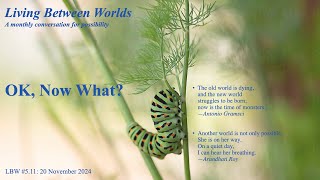
Foreign. Welcome everybody. Welcome to Living between Worlds for November 20, 2024. This is near the end of the fifth year of this monthly series of conversations for possibility. I'm Gil Friend, your host with Ken and you know, when I named this series five years ago, Living Between Worlds, this is not what I had in mind. But here we are. You know I, I often reference the quote from Antonio Gramsci, the Italian revolutionary who said, I think 100 years ago this year that the old world is dying. Any question, the old world is dying and the new world is struggling to be born. In between is the time of monsters. And I've sometimes, sometimes interpreted that to say monsters is not like the fire breathing giant dragon that will eat you alive, but the primal forces under the surface that are burbling and bubbling and shifting things in ways that we don't know these days. It feels like that first kind of monster. So here we are. The, the subtitle of the calls was Living Between Worlds with grace and dignity and power and very intentionally chosen words and those may appear in our conversation today. This is what it feels like to be living through history, folks. This is those kind of times that people will look back on as momentous in the human experience, perhaps, or perhaps another bump in the road. Aristotle said that democracies have a lifespan of about 250 years, at which point people vote themselves into autocracy. So maybe we're right on Aristotle's plan. What we want to suggest today is to not do a postmortem of the election, not try to figure out what happened, who did what, who didn't do what, why things are. There are many theories I often reach at times like this to the teaching from Sri Nasragadatta who said that the cause of all things is all things. And so I'm not interested in trying to untangle that. Also not particularly interested in trying to predict what's going to happen next. One of the characteristics of now is that we can certainly see the shape of things, but the specifics are hidden from us. We don't know what there are. There are no facts about the future. I, I often think of times like this, of the old Daoist story about the farmer and his horse. You know, events happen, are they good? Maybe. Are they bad? Maybe. Are they good? Maybe. Are they bad? Maybe you don't know where it's going to go. And so we want to have a different focus in this call. Not so much about what they should do, but about we will. About what we will do and the way we thought we would frame this is to start with the conversation between Ken and me for, you know, it'll probably be about five or 10 minutes. We have a starting point in mind, but we'll see where that goes. Then we'll open the room up to conversation with all of you, and then we'll suggest a breakout. Will there be a chance for everybody to speak? Because that doesn't always happen in the big room. Then we'll come back again to harvest those conversations from the breakout and see where we want to go with that. Ken, that about right?
I would just say in the breakout rooms, you may hear things that you agree with or not agree with and really be in listening mode, not, not trying to defend or correct or just. Just be with whatever arises. Be helpful to. To not get into any arguments or, you know, someone might say something that startles you and it's like, well, sit with being startled.
We're. We're going to suggest that listening is going to be a pretty important skill these days in these times. Different kind of listening than we're used to. So, Ken.
So listening. Yeah, I find myself doing a lot of listening to my body these days. I've not slept very well the last couple weeks. I wake up in the middle of the night, not in my stomach, thinking about Stephen Bannon and Stephen Miller and the people that are coming into this administration and their plans that are being released drip by drip. And I'm filled with such uncertainty and anxiety about what might happen. And so I'm having to really be quiet and. And calm myself down a lot. Taking a lot of walks. I'm not reading the news, talking to people about things that. That are nourishing as opposed to the challenges of what's going on right now. Because I'm just. I'm really a little bit like, I don't want to dive into it too much. I think I know more than enough. And I try not to be in denial, but also not to be overwhelmed. And so my body's telling me to just take it slow here, not to. Not to project too much of, you know, the horrible things that happen or hope too much about the good things that might happen, but just to be present and really appreciate, you know, the amazing things I have in my life. I've got a community of friends. I've got a loving wife. I have good. I have the opportunity to work with Gil on the people on this call. You know, I live in a beautiful spot. I'm in relatively good shape and good health for a man of My age, which is a line I really hate hearing, but, you know, it comes up a lot, you know, for a guy of your age, you're doing all right. And so I'm trying to focus on that. And it still creeps in at the edges. And it's a real practice to not let that edge creep come into the center and disrupt me too much. So that's kind of where I am right now. How about you, Gil?
Some similar and some difference, Ken? We. I think we have some. Some common instincts and some different balance and ways of playing it. I've been surprised by many things, obviously by the election itself. And I woke up, you know, I went to. I was not planning to stay up till the final results, actually still didn't have final results, but, you know, till it was clear and stayed up too late. Woke up in the morning just stunned, physically shocked. Felt like I'd been hit by a truck. And what was notable for me is that I didn't hit the keyboard and start posting, which is what I normally would have done in a time like this. I just went quiet. I don't know if it was a day or two. Didn't watch a lot of news, talk with people in real time, in real world, and sat with it. And then gradually pieces started to fit together into some kind of shape. Been through many moods, grief and anger, anxiety, uncertainty, a lot of uncertainty, a lot of perplexity. Trying really hard to not enter the space of professional people with professional opinions, just filling, filling words with their opinions because nobody knows at this point. I've talked, you know, for those of you who've been on the calls before, I've talked a lot about cultivating equanimity, trying to find a still point in the face of the, you know, the chaos that sweeps back and forth across us and be less reactive in the moment and more steady in that. And that's really given way a lot in these last few days to the moods of the moment and gradually returning, but with a heavy dose of confusion and perplexity. Fernando Flores talks about there's good perplexity and there's bad perplexity. You know, there's. There's not knowing what to do in dangerous situations that. Where, you know, where life and may be at stake. And there's the perplexity of unknowing in the face of complexity where you cannot predict what's going to happen. And, you know, and we're not billiard balls. This is not a machine where if you move the style that happens over there so, you know, sitting in the not knowing of that, but that's also impossible because we are mental creatures as well as historical creatures and emotional creatures and biological creatures. And so I find myself asking what's changed and what hasn't changed and what's to be done. And some of what's changed is that we are facing the very real threat of the dismantling, systematic dismantling of 50 years of social and environmental progress by people with a plan, with a very long and detailed plan, not just the Project 2025, but the Agenda 47 from the America first people. And you know, I'm not going to recount the appointments. And you know, what you're seeing happening this week, we see the rise of executive action that has happened over many administrations, Republican and Democrat, that's going to be exercised powerfully by this one. We see the, the protection of the courts is fragile at this point. You know, the Supreme Court, you can see where that's going to go. On the other hand, in this election, lots of victories for Democrats in state courts. In fact, interestingly, lots of victories for Democrats in the face of Trump victories. States that Trump won where the senators were, the Republican senators didn't win. Very mixed bag in the election. Below the surface, there's a story that's being told and there's what's actually happened on the ground. But clearly things that many of us have worked for our entire lives are going to be taken apart or are going to be tempted to take it apart. And more on that in a bit. What hasn't changed is the fundamentals. The physics are still the physics. Biology still works the way biology does. The ecology of the planet still unfolds the way that it does. Those, those processes and consequences don't change. Europe hasn't drunk this Kool Aid yet, or at least not mostly. And the European market and the Chinese market around sustainability are still moving in directions that we might hope technological innovation proceeds. Renewables are out competing fossils everywhere on the planet. The coal industry is over. Oil industry, not yet. Natural gas industry, not yet. But there are long term trends that are economic that are going to be hard to deny. CEO of Exxon asked Trump last week to not leave the Paris Accords. Really surprising, not necessarily for the reasons that we might say, but still notable. There's not necessarily a unified brick wall out there and you know what's to be done. I think we've got to pay attention and listen really carefully and. You know, everybody's got an opinion. Somebody once said opinions are like you Know everybody's got one. And there's a real difference between, between opinions that are not verifiable, like Trump has a mandate and assertions that can be tested and verified. Trump has, at the moment, 49.94% of the vote, less than 50% of the vote. There have been 59 presidential elections in U.S. history. He's got the lowest margin, the sixth lowest margin of a presidential election in U.S. history. It's a victory. It's a mess. It's not a mandate. So listening carefully to the messages that we are being offered, the stories that are being spun for us by both sides, I listen to MSNBC more than I listen to Fox. MSNBC is doing a job on us also. And you can see that you can watch the same clips of different extracts of the same event or same clips being interpreted differently. So we need to learn to listen past the stories that were being offered. We're already seeing resistance to the nominations, even from Republicans. We're starting to see the vote count starting to happen, to see that not all of this agenda is going to be so easy for them to pull off. And so the task of organizing resistance, as people are happily calling it at various levels, becomes really key in the face of an attempt to flood the zone with official Bannon line. And so we need to watch what we eat, just like what we put in our mouths. You know, why? You know, this is a crowd of people that doesn't eat a lot of junk food. There's a lot of junk media and messaging out there.
Let me ask you a question, since you bring up eating and next week is Thanksgiving.
Yes.
I know a lot of people whose families are fracturing over this right now, and they're like, how are we going to sit at the same table and be civil with each other? And I'm curious. I have some thoughts on that. But I'm curious. What do you think would be useful in terms of, you know, if you're going to sit down and, and somebody in your family is on the opposite side of, of your politics.
Yeah. It's.
How to approach that.
It's a really live question for most people. I, I'm not. Excuse me. I'm not immersed in that, as some people are. I live in a bubble. In a bubble. In a bubble. So I'm immune from a lot of it. My family, my, My, My family in this area who will be having Thanksgiving with next week. It's interesting. Everybody's progressive, but the family does not like to talk politics at dinner. Jane and I do Other folks don't. So it kind of doesn't happen very much. It's a little odd. But to your question, what. What I have found most enriching for me and the people I talk with is to try to move the conversations as quickly as possible from the positions and interpretations of events and the what we should do to what people really care about. What's the why behind the why behind the why? And I find the conversations are much more interesting, much more alive, and there's the emergence of the possibility of common ground. It's like, oh, we care about the same things, we interpret it different ways, we see different actions to take, but we actually have something in common here. Critically, when it feels like. It certainly felt like on November 6th, we have nothing in common that, you know, we're on the verge of civil war, et cetera, et cetera. But AOC last week, Alexandria Ocasio Cortez, congressman from New York, discovered to her astonishment, that a lot of people in her district who voted for her, she's been reelected by bunch of times. A lot of people in her district who voted for her voted for Trump also. And what she did with her shock was, I thought, really beautiful. She went out and talked to people in her district. She didn't go out and talk to people. She went out and listened to people in her district. She asked why. She was curious. It wasn't like, why justify yourself, but why? I'm really curious. It's an interesting anomaly. What was that? And she found from people very thoughtful, heartfelt, compassionate, understandable concerns that they interpreted in. I'm going to vote for him for that and you for that. Surprising but opening of something. And it's a clue for us that this is a time to keep our eyes open for anomalies, look for things that don't fit, that don't fit the story that you already have, that don't fit common interpretations, that don't fit historical data that don't match your expectations and. And be curious about them. If there's a way to invite and invoke and engender curiosity in these discussions rather than debates, I think that would be the key. A key.
Thank you.
What about you? What do you think?
Similar. You know, the question I go back to, there was a Bay Area Society for Organizational Learning meeting that took place on September 14, 2001, and we decided not to cancel it. And we came in, we just asked one question, what's important now? And it was a really interesting conversation because everybody was highly emotional and, you know, shocked and stunned. And by just unpacking that question, listening, going around listening to what's important now for you led to some really deep and thoughtful and thought provoking conversation. And I think rather than trying to say, you know, you're right and I'm wrong or I'm right and you're wrong, but what's important, you know what, what's important to you about this? And really listen, listen beyond your own filter of I'm rejecting that because it's not my position into. I want to understand what your position is and what you care about because I do know that as you point out, there's huge agreement about a lot of stuff in this country, like big money in politics is bad and people don't feel government's working for them and they have different approaches to making, making a diff, making a difference. But under is, we both agree that this system is not working for us. And rather than, you know, look at the messes now, it's like, what might we do to make our displeasure more constructive instead of divisive, which we have.
To do because that's the only way that there's a future.
Yeah.
Is that, you know, is that votes move or people who are not active become active. I mean they're, you know, people talk a lot about the votes that the Democrats lost this time, but there's a larger number. There's like 130 million registered voters, eligible voters who didn't vote. And we know from the polling that there are super majorities in this country around things like reproductive rights and sensible gun control and a whole host of other issues. But it's not how our politics play out. So there's something to come there, there's something to happen there. Thought just flew through there, gone. We'll come back.
I also think it's, it's really, it's a personal practice to, as I say, listen past the edge of my thinking and my belief system and legitimize somebody else and say, okay, I don't agree with you. I, I don't see it your way, but I understand why you are seeing it that way. And that legitimacy which Ambirt Matrana talks about as love, legitimizing the other can lead to very different conversations that are much more constructive. And, but it is not an easy thing. It's not like, okay, I've got the secret key here. It's like, because you're going to find, you know, that, that there's some heat in these conversations and it's, it's hard to Sit through that. But if you can, keep breathing, and what I do is I direct people breathe through your feet, direct your energy down into your feet, grip your toes, grip the floor and keep breathing deeply no matter what's going on. And you'll find that you're able to be open to a lot more than you thought you were.
Breathing is a good practice. I try to do it every day. I had a conversation after the first Trump victory with a, a friend of a friend who was a Trump voter, supply side economics professional and we were going to talk about climate and I was going to change his mind about his climate denial. And I realized a few minutes into the conversation that unless I was willing to let him change my mind also, it wasn't a real conversation. The result was that we both, we both changed each other actually, and we became good friends. Really unexpected. The thing I wanted to say before that I forgot, Ken, is that, you know, we've talked a lot over the years about this openness to the other, this deep listening, curiosity, being willing to be changed rather than just pushing our own agenda. And there are times when it's time for battle. You know, there are times for compassion and connection. There are times where the lines are drawn and you have to stand your ground and fight. We're going to see both of those. The wisdom of knowing which one when I think is critically important and very challenging. The, you know, the knee jerk tendency to strap on the guns and battle it out too soon and miss the opportunity for connection and mutual agreement and shifting the political landscape is dangerous. The, you know, the passive, accepting overall different realm of opinions and it will all unfold as it unfolds is pretty dangerous too in these times when there are real consequences for real people. I mean, I'm feel, I'm feeling, you know what, what the common term these days is white privilege. You know, I'm, I'm, I'm a white guy living in California. You know, I'm not personally at very great risk, although if they yank Social Security, then I am the yank Medicare in deep trouble. But I have, you know, I have members of my family who are women of reproductive age. I've got close friends who are of color. I know people personally and I know of people not personally who can be seriously, seriously damaged in the coming years. And I'm committed to protecting them. And sometimes that means finding agreement and sometimes, sometimes that means digging in. So we will see.
I think we should open it up here. I'm seeing, getting some hands raised. So Jesse, please unmute yourself and speak and I'll take us out of the spotlight.
Thank you very much. I guess the thing I've been struggling with, I have a bit of a cold too, last couple days, but I've been struggling with people clearly not seeing what's happening in, in so many different dimensions. You know, each group having, having a blindness of its own. And one of the ones I've been investigating and, and alerting others to is the, the tendency of desperate populations misbehaving and, and our world becoming more and more full of desperate populations because the solutions aren't solving anything. They're causing more, more trouble than, than solving anything. And so we, we, we seem to have an intellectual world malfunction of the greatest degree. And, and I, I have, I've tried to find places to talk about it, but it's hard to get people to talk about it. It's, it's sort of been my life's work. It's, you know, I. Picking out things like, you know, if physics describes nature as equations that's leading up.
If.
And equations have no material properties, that's leaving out, you know, people in nature. You know, if we make our decisions on numbers, as the economy does, it's blind to what it's destroying. So we have all these things that are spinning away. And there's this one extremely obvious alternative that nobody seems willing to study. And that's the natural end to growth, which involves growing up, switching from multiplying things to caring for them and finding ways to connect. And so that transition that's the. Also corresponds to birth. But I, you know, I don't think a, a civilization like ours, you'd call it birth to have it wake up and, and, and understand that can't survive as a, as, as an endless explosion of, of consumption and, and conflict. The only chance is to, to start caring for each other. Although how to do that is, you know, really difficult. The place I've, I've focused on is, of course, with money. You can use money to take advantage of people or you can use money to care for them. You can do all sorts of things with money. And when you, in our civilization, we mostly use money to shop and trade work for work, which is pretty much okay, except that somebody behind the scenes is always taking profit from it to increase their investments and making profit. They, the, the, the growth imperative driven by finance compounding, compound investment. And, and, and I can't get anybody. I've been doing this for 40 years and I can't get anybody to talk about it as if it could be something we would deal with in the, like, in the UN Circles. You, you just cannot get anybody to talk about the nature of the living in.
That's, you open up a lot of big stuff. Is there a point you can make that'll kind of close us down and give us something to, you know, focus on here?
I guess I, You know, it's, it's still one day at a time, and we can be grateful for that. But I, I think we, We, we need to. Better understand the nature of things. You know, like the, the Trump people, they got to where they are.
As.
A.
You know, my frustration and, and, and, and complete. I, I've traced them, their language evolving since 75.
I know there's a long history of what's going on. I'm just, I'm asking if there's one thing you'd like to end on here, because we have a lot of people on the call and.
Yes, indeed. I've just, I've said my, my bet is that there's all these loose ends and, and, and, and Jesse, let me.
Focus, Let me ask you this. Could you summarize your mood these days in one word?
That's true.
Thank you. Okay. Thank you. Thanks for all that. Let's go to you.
Did you call on me?
Yes.
Shell, please go ahead. Okay.
Okay. I've got a lot of different disparate things to say that are actually, I think from the 30,000foot level related, but they may not look related. The first is that the opposition is already in place and often running. I was, I've been on quite a few what do we do now? Calls since the election, and one of the earliest ones was organized by Working Families Party and about 200 other progressive groups, including some huge ones like MoveOn and Public Citizen, and they got 140,000 registrants. That is, first of all, it would have been technologically impossible four years ago or eight years ago, but even beyond that, that is just phenomenal. Unfortunately, the other side is also a hell of a lot better organized than they were. I, I really agree with what Gil was talking about earlier, about deep listening and, and what I am hearing on the ground about why people voted for Trump is a whole lot of different reasons, most of which are at odds with what I consider to be reality, such as he's going to be better for working people and the economy and simply not true. And there's a lot about this election that I really don't understand. I, I, the biggest piece I don't understand is why so many people with the stakes so high didn't come out and vote?
I.
The, the, the ground game was so good on the Democratic side, and there was so much energy and so many new registrations and so much door knocking and phoning and texting and all the rest of it. And there were all of these things that should have drawn turnout out, like the. All the states voting on reproductive rights. And there was that. SP AOC is by far not the only progressive or liberal to get elected in an area that went Republican. I don't, I don't think her district went Republican. But you know, the. What she was talking about. In places like Missouri, you saw reproductive rights getting in and Trump getting in it. I just don't get it. And the other thing is that Trump was enormously successful in getting people to believe his propaganda. I had the misfortune to watch one of his commercials. That was a horrible piece of filth filled with lies. It happened that FOX is the carrier of the baseball playoffs, and I watched one of them in a restaurant and I saw that commercial and I thought, that should not even be allowed to air. It is just, you know, I have to question my former free speech absolutism. It seems like we have to have a factor, like the Brits do, of involving truth in what we're allowed to say, and that is just gone. So there's a lot going on. I'm hoping that the Republicans don't roll over and play dead with this thing of recess appointments, because that will be. If some of these people get in. Basically, it's a hand grenade in the government, and it's very disturbing. And I have. My younger child is genderqueer and an activist in that world and also an activist in Palestinian solidarity. And I'm pretty scared for them, and I'm scared for a lot of other people. I know there was a good piece on a show called 1A on NPR that I listened to in the car this morning, and it was a lot about the impact of the incoming administration on the LGBT world. It is not pretty. I'm in the immigration justice world, and the stuff there is equally not pretty. We've got a lot of work to do to just keep it from getting worse. But I, I do have faith that there are things we have in common with our, the voters who voted the other way. And I really think that we need to understand why people didn't show up. All the signs leading up to the election was that there was going to be massive, massive turnout. And that turnout would have worked in our favor and it didn't happen. And we are closer than I thought. But there's still like 10 million people who voted for Biden and didn't vote for Harris. It's down from the 20 million of the early results, but it's still not acceptable. What the hell happened there? I think I'll leave it there. I can keep going for a long time.
Thanks, Shell. Anyone else want to chime in before we move to a breakout room? All right, give me just a second to set up a room here. Go ahead, Gil.
Give it another minute. This is a lot for people to take in.
Yeah, Mark, please.
Yeah.
Thank you. What stood out for me, Gil, and you're sharing, is how you felt the next day. And I guess I'm curious as to what your reflection has surfaced in response to that, that feeling in subsequent days. Like what. What insight is in that feeling? So I'm curious about.
Not sure how to give a compact response. Mark, Couple of things. What we've seen was not a random event. This is a playing out of a 50 or so year strategy from the right in the United States going back to the Powell memorandum in the early 1970s. I'll put a link in the chat about a film that tells that story of the business and Republican strategy to change the terms of the conversation, dismantle the regulatory state, take control of the courts, all of which we've seen happen. So that's one layer of the reaction. I see a, I see a much more consistent strategy on the right than on what we call the left in this country. To, you know, partly to Shell's question. Bernie Sanders has spoken really articulately in the last few weeks about his perception on what's happened, which to him seems the same as what happened in 2016 when he was saying the same thing. And we just came across an interview with him from 2003, 2003, saying more or less the same thing, which the Democrats are not listening to the working people of this country and are not listening to the pain that's being expressed. I mean, this is, I think, true with the Brexit situation as well and in, in other countries as well, that there's real pain that wasn't being heard and wasn't being spoken to. And that may be where some of the loss happens to, to Shell's comment about people saying things that are simply not true. I want to caution us ass assessments, opinions, interpretations aren't true or false. They're opinions. So people have them and you can disagree with them, but it's not like they're true or false a lot I've heard from a lot of Trump voters, man, not personally, but on, you know, on the TV interviews of people saying, yeah, I know, I know he's lying. I know he's making stuff up. I know he's saying extreme stuff. Either they say, well, he's not really going to do that, which is a dangerous interpretation, or they say, I don't care about that. I care about this other thing. But it's not necessarily that they're swallowing lie. Some people are saying very, very strategically, you know, and again, bizarrely, it's like the price of eggs, as if tariffs are going to drop the price of eggs. The economic illiteracy in this country is profound. But I think it's important that we listen behind the things that people say. Jesse said something I've heard a lot from different people over the last couple weeks saying nobody is doing X. Nobody thinks this. Everybody thinks that. I want to invite us all to drop those words from our vocabulary. Let's not overgeneralize about people in general. Let's not overgeneralize about what we think is behind what somebody says. Let's listen and be curious. And I'm not saying that to be soft and nice and condescending, but to be strategic and powerful and stand with dignity and maybe consider the dignity of other people as crazy as they may seem to us, and listen to what's behind that. Jesse said something about moving from multiplying to caring. And I think the heart of the game and the heart of the strategy is, is, is entering into care at every possible level that we can. So that's probably too long response, Mark, to what you asked, but there you go. Randy, what you got?
Yes, just a couple of remarks. I got quiet like a couple of you said for a few days. But I have a very strong faith in humanity and I do have a lot of hope that we will see people waking up to the risks that are involved here and also the opportunities. There is a real need to clean up agency capture and corporate power and there's a real place for literally making America healthy again. And there, there are some, some wake up that can come out of this. So I'm hopeful. I do believe in the American people. The people didn't vote, were confused and, and thought it might. Either they thought it was hopeless or they thought, hey, history will take care of it. I don't know what they thought, but I do think that, that there's, there is reason to be hope when we go to one extreme. Hopefully we will tend to wake up and swing back a little bit to the middle with, with maybe a few wake up calls and some new solutions. So I just wanted to add a little hope and faith.
Thank, thanks.
Thanks, Randy. Al?
Yeah, I quite concur with that last comment that even as the confusion as to what really happened in this election penetrates us, that space of not knowing quite where we are between the worlds, as you put it, Gil, is an open space of a lot of intense human energy out of which some new senses of what is possible and what is needed are potential. And I think that is what we should aim at to. And in particular when the question was so what is our situation now? Our situation quite apart from this election is that we are on the eve of perhaps the last war of the world and the increased tensions that were from the summer now have little pictures of the globe with mushroom clouds all over it. That's what's invading the screen now, that sense that we are on the edge of catastrophe. And I think that part of our capacity now is to put more forward as we ever have to the war makers, just stop, pause the war and listen to the peacemakers for a change. Because this, this policy and the history of a full spectrum domination has come to the point where it is not viable in the longer run than perhaps the next week. That it really needs a shift from domination to cooperation. That is the imperative of the climate situation, end of the poverty and human needs situation and of shifting the economy, moving the money out of the war to human needs.
Let me ask you something, Ellen, and.
Getting our peacemakers who actually put forward, what is the change that we need to get us out of this? All the wars and all the wars, that's what we need now to put forward.
Ellen, you've talked about passionately for many years about saying to the war makers need to shift in this direction in this moment. What's different for you about how you are going about that? Anything changed for you?
I would, I'm trying to draft what would be a petition of all of us, civil society, recreate civil society. Putting that question to the war makers of all the different wars. It's a war system that we are dealing with. It's integrated with the economy. But there are commanders in chiefs who could take an initiative and be in a sense heroes for a future, if we're to have one, to say, well let's listen to an alternative for peace and what is practical to shift from domination to cooperation. The cooperative economy is much More profitable and beneficial. It will be better for everyone. If we as peacemakers in this whole community of consciousness would, you know, the power concedes nothing without a demand. Well, what is the peace demand? Much more specific. And what are the ideas that are actually out there in terms of Ukraine, in terms of Sudan, in terms of Gaza and so on? There are positive ways of cooperation that can move to, from the battlefield to the conference table. That's what we need to put out for the world to know there is an option, because I think the world is looking for something different than this increased tension and insanity at the highest levels of power. And because this system has come to that point, it is not sustainable. When the, when there is this, nobody's backing down. So civil society is a third force that we, everybody on this little, you know, map here could, if we took the initiative through our own networks and begin to put out a common call. This is a time for peace and to back off the war. War makers just pause and listen to the peacemakers for a change. I think that's what we need with a little bit of move the money practicality in it as well. I think people would respond to that. And, and why they went for Trump is because those that, you know, is because they want somebody who will stand up to this system that is not working. And he may be, whatever he is a personality type, but he's somebody that just stands up and puts it to him in a, in a gruff way. And people have been pacified so long and they like somebody who will just stand up and be gruff whatever he says. So anyhow, we as civil society need to stand up and be direct. There is a peaceful alternative option. We need to express it better and call on the war makers just to stop and pause and listen to an alternative.
Thank you. Alan, I have a question. I know we have some, some people who are not us based on the call, and I'd be really curious to hear reactions, what's going on as you look at what's happening in the US not asking to speak for your entire country, but just, you know, to give us a sense, an outside perspective. Is anybody who'd be willing to do that, please step up, raise your hand.
Hi, Ken, Jenny from Melbourne.
Hello, Jenny.
Hello, Ken. Look, apologies I'm hiding, but I had no sleep.
But I couldn't miss out on this conversation.
Although I come from Australia, I know Ken quite well. America is not my country, but it is our world would be my response to that.
Thank you. Thank you.
Hi. Well, I am a Dual citizen living in Toronto. And everybody I talk to here basically asks me, has your country lost its mind? They cannot fathom how someone like Trump could be reelected and how Americans.
Got.
Led down the path of, you know, thinking that kids were going to get trans operations in high school and, you know, all kinds of other absolutely ridiculous things. They just shake their heads. But they're also worried because the tariffs that Trump is talking about imposing would pretty much destroy the NAFTA and the auto pact. We have a similar situation on Canada's southern border, the US Northern border with the auto industry, to the situation in Ireland, between Ireland and Northern Ireland, where stop in the same stream is back and forth across the border on a frequent basis. You know, some parts go one way and then they come back the other way when they're partially assembled, and then they go back that way. You know, there's all kinds of stuff like that. And people are thinking, well, what on earth is he going to do? Is he going to all of those arrangements? And nobody knows. So I think anxiety is probably what people are feeling up here, is that the United States has lost its mind and. And can't be counted on anymore to behave normally.
Thank you. I guess we have to resurrect the old joke that from his first administration of what borders on insanity. Yeah, Canada and Mexico.
Yeah.
Anyone else want to. Jane, Is that a raised hand? You're muted. I think Jane's talking to somebody.
No, she's trying to unmute. She's not able. I'm gonna go next door and do some tech support. I'll be right back.
Okay, keep going. Let me see if I can unmute. Oops. I wrote that was not for you. Sorry, thing jumped around on me here. Jeff, please, go ahead.
Hi there.
You can hear me okay?
Yes, you're fine.
Well, as you know, some of you may know that I've just recently, say six months ago, repatriated to the UK after 12 years in the United States. I was living in San Francisco, California, and you all know where that is. And, you know, prior to moving to California in 2011, I had spent more than a decade in Hong Kong and China. And I'm an unabashed Sinophile. I've often believed that that truly is a of power. And I really do believe, and I believe for a great period of time that the 21st century will belong to China.
And.
And I think to some degree, we've in the west been sold a number on. On China. And so I think that one of the. The areas that I've in the last week or so been exploring a little bit more. Not that I ever left it was that domain that, that Asia and specifically China will to a very large degree be quite benevolent and beneficiary I think to a beneficiary to the United States in, in the coming decade or more. I just wanted to share that and put that out there that I don't think that all is lost. I do think that the US is in a very fragile position right now. But I don't think that whilst it's clearly still a superpower, I don't think that it's the only superpower and I do think that there is a balance that will be afforded us meaning humanity on a go forward basis. Probably not said as, as tightly or as eloquently as I'd like to have said but I just felt that, I felt like I really needed to say something and because a lot of the conversation. I really do appreciate you inviting non US folks to just say something, Ken, because I do think that there has been and there will continue to be a tremendous amount of naval gazing going on but I would encourage you to sort of take off blinkers and look beyond the borders and see where allyship may lie. You may be pleasantly surprised.
Thank you Jeff. Good to hear.
I got audio now.
Shane, let me just say one thing before you, before you go on that just a quick response to Jeff. I appreciate what you're saying, Jeff, and I don't know how benevolent China will be, although I don't think that economic competition is someone else rising in economic power in the world is not to my detriment necessarily. The notable thing about China that I think hardly any Americans know is that China, for I don't know how many five year, not five year plans now has had ecological civilization as a national commitment from the Central Committee. I think it's the only country in the world that has done that. Exactly.
That's my, that's my point. I think the benevolence, I'm not talking about the economic piece because I know where China has been and where it is coming from, but it has been a significant leader around ecological shift and environmental shift for a significant period of.
Time at a very deep and serious level. And it would be something for those who are not familiar with that be worth paying some attention to. Yeah, Jane, thanks. Thanks for your patience, Jane.
Yeah. It's not easy to question appearances when one is in a state of shock and that's true of individuals and it's true of masses of individuals. In a society and I want to read a couple paragraphs I wrote shortly after taking in the election results. Many are in a state of shock and may be for some time and so common sense fails them. Self doubt grows ever more attractive under the numbness of nearly a decade of Putin fueled propaganda targeting our society, culture and the electorate lie repeated states of shock and disconnection from reality. An epidemic of mass psychosis has set in on top of chronic ptsd, and there have there have been national meetings of mental health professionals who have studied dictatorships and normal societies and violent ones for a long time. Call this a mass pandemic of psychosis. What is hiding from us in plain sight, though many of its details remain obscured for now, is the reality that our country is and has been under attacks of the highest order and we are literally in a state of undeclared multifocal wars with Russia and others and its political and financial allies. Of course a population in possession of as much military grade weaponry as ours has must be kept calm at all costs. The wars remain undeclared, of course, while Trump, Musk and others are not perhaps technically traitors, their treachery continues to play out in likely breaches of Starlink facilitated haps of electronic vote tabulation. While pundits and legacy media anchors are too terrified to question a menopausal mood shift in the American voter, instead they peddle all manner of reasonable explanations to justify the whiplash of these results. There may be a comforting distance between the words influence, interference and attacks, but that distance has just collapsed to a razor's edge. And I find in my recent email yesterday a note from a well placed old friend in government that former national security technical people are writing to Kamala Harris and underlining the importance of investigating the data for voter manipulation at a very high level. So there's a question about whether the agreements internationally among nations who favor democracy and held world order with the United States Since World War II, whether international intel will be able to bring forward solid evidence that will keep the United States upset but calm and nonviolent as our President may have to move to stay in office and secure different elections and have a thorough investigation of the attacks against us that have been ongoing for some time. Some call it a rolling couple.
Thank you Jane. I think we should all take a.
Deep breath or two.
Maybe another one after that and even a third.
I can just put in a little compliment to that. I did a calculation. We've had 400 years of doubling the world economy every 25 years so that means we now have an economy that's 65, 500 times as big as s, you know, in 1624 and changing 65, 500 times as fast as exponentials do. And it's ripping the world apart. And we're seen as the leaders of that because we are. And, and, and so, you know, being nice people and doing horrid things is, is sort of where we're stuck, you know, in a, in a, in a cultural environment. The first world is the we I'm talking about primarily. But of course, China's stumbling a little bit. But your growth is still the.
We've lost your audio, Jesse.
There you go. You're back.
Did I, did I click.
We lost you after. Growth is still.
Well, growth is. This is still the, the first priority of all nations. And it's what's tearing us apart. It's what's destroying the environment, it's what's confusing our words, it's scrambling our languages that all the contradictory situations it fosters change so fast. It's, it's blinding. And of course, the middle America, basically conservative, productive culture, was pumped up economically and then had the rug pulled off from underneath it and had social wars forced on it. You know, you know, I was part of the 60s movement and really enjoyed it. But to other people who found their world changing in horrifying ways ever faster. And, and that, you know, applies to the, the Christian nation, which was. Movement which I, I traced from its word use to beginning in 75. You know, the Google has this great tool where you can follow the frequency of groups of words over time, and there's a very clearly synchronized set of, well, the words, right, love at the highest level of frequency, and then a whole bunch of words of anguish and anger and fear.
I think we all, we all agree that there's a long history of things getting.
Yeah, but how do you said better.
And better, worse and worse, faster and faster. My question is.
Yeah, but what, what do you, what, what, what do you do if you notice? That's the problem. What I did was look at how growth turns out in nature and there are solutions, but so far I've been unable to engage in conversation about them.
So I'm going to pose a question to you into the whole group. We've been meeting online now for several years, and we're all in a pretty raw place. So you don't have to answer this right now. You can think about it. Anybody else can think about it. But what can we offer each other? What do we need from each Other, as we go through this time right now, maybe just take a minute in silence and think about that because I think that that's, that's something useful right now we can do in the moment is turn to each other. You know, I've met many of you both on this call and several of you off this call. I have great care and affection for you. And I know we're all suffering and struggling. And so how can we support each other? What can we do? What is needed here and what can we offer each other? And just sit with that for a minute and then I'll please, if you are moved to speak, do so.
You have said what you do do and that's good.
Thank you. Brad, whenever you're ready. Thanks for the silence. Appreciate it.
So, Ken, just, just a quick comment. You said we're all suffering. We're all struggling. And at the risk of whatever. I'm not, I'm not struggling. I'm not suffering. I'm doing very well. My, whether it's Trump or not or whatever, my stocks are doing great. My health is getting better. My wife and I have been married 35 plus years and have the best relationship that we've ever had. We've got six or seven trips planned to go on cruises to New Zealand and Australia and two weeks in Cancun. And I'm semi, I call myself semi retired because I still, I don't call it work, but I still try to earn some income on the side besides Social Security. And from anybody's standard of living or viewpoint, I am probably in the top 1% of the world, maybe somewhere, maybe 5%. So just again, be careful, would be my admonition. When we use words like everybody is we're all this, because we're not all this and not everybody is that. And, and that's all I have to say about that. As far as the anxiety part and what to do and how to live your life, I try to take action on things that are within my control. Anything that's outside my control. I, maybe it's, I got my head up my rear end or head stuck in the sand, I basically ignore because if I can't influence it, then why worry about it? It's either going to happen or it's not going to happen. It's either going to impact me or it's not. But if I can't directly influence that thing, whatever that thing happens to be, I don't pay attention to it. I pay attention to my world. I go deliver meals from Meals on Wheels. I Volunteer with the American Red Cross. I help my neighbors whenever I can. Just whatever I personally can do to make the world better. And again, in my definition of better, that's what I do. And I find that I live a much happier life, a more satisfied life, coming at it that way. And if somebody says, Brad, you got your head up your ass, okay, well.
That'S where it is.
But it seems to be pretty comfortable there. And that's. I'm gonna keep it there if, if that's what you think. And thank you for sharing. So I just find, you know, lighten up, laugh more, love more, hug more where you can. What was. There's that quote. I forget how it actually really goes, but do what you can where you are with what you've got, because there's nothing else you can do. Okay, I'm done.
Thank you, Brad. You're welcome, Tony. Please, whenever you're ready.
Yes. Hello, everyone. This is my first time talking and my second time attending this session. And I can understand the shock and the emotions and, and I believe it's very important for us to have our true and authentic experience through that, whatever it is for each of us and to remember that emotions are meant to be in motion and to not be stuck there and just allow them to move through and then show up for. For the next thing. And for some reason this time around, I'm not, I'm also not experiencing that sense of overwhelm at this point in time. And I am seeing this. I feel like this can be an amazing opportunity for something great to happen. And, And I don't believe even the people who voted for Trump will tolerate a complet. Complete dismantling of our nation, for one. But another is that what I noticed from the election is that climate action and the work that we're doing and sustainability and all of this was barely mentioned during the campaigns. And it seems that it's still a hot button. And it was, you know, maybe with targeted audiences. Kamala Harris had those, those talks and conversations, but I see this opportunity that we need to make sustainability and climate action dinner time conversation with every regular person living in all of our communities. And how do we do that? How do we make this a priority in people's lives? At least make it top three and make it exciting and make it something people have pride in participating in and helping them understand what their roles can be. And this is regular communities full of people where we all live across the USA who are not tuned in at all, who don't even think about their Purchase purchasing decisions. Don't even think about composting, recycling, you know, refusing, reusing all the things that we're thinking about. You know, they're not thinking about them. So I was part of a team in the very beginning of my career, and fresh out of college, I was hired by Merck Pharmaceuticals. It was then Merck, Sharp, and Dome to be part of a sales team. They hired 700 people at once. And they put us out there to talk about the first statin drug, mevicore. And we went out there, doctor's office, at doctor's office, month after month after month, and guess what? Cholesterol became a dinnertime conversation. No one was even barely paying attention to cholesterol. No one was hardly measuring it. We talked to the doctors. We handed out all the patient education information on diet and whatever else. And people were seriously, socially at parties saying, hey, what's your cholesterol level? Like, what's your number? I mean, that's. Looking back on that. That's incredible. That's a really boring topic. And we got out there and made it a conversation. And I look at that, and I think that's what we need to be doing. So how can we help one another? I'd like to have conversations with people. I have some ideas about how we can get people into communities and really build this network of conversations and action and get people involved. And I'd like to hear from other people who've been in this feel longer and, you know, been through a few rounds, like Gil, for example, you know, people who've been in it since the 70s or people who are in it newer and. And think about ways we can get this to be dinner time conversation. Hey, what did you, you know, tell me about your solar panels. You know, I mean, things like this. I just want to put that out there. I had a conversation earlier today with someone from India on this, and I looking to have more. So thank you.
Thank you, Joni Howard, Whenever you're ready, but you need to unmute.
Thank you, Ken. So I personally was deeply engaged in Kamala's campaign. I was a delegate to a state Democratic convention. I wrote a whole bunch of generative AI to really try to move the needle and get a lot of amplification. And I was engaged in bringing a lot of joy and exuberance during the Kamala campaign. And since the election, I've been feeling the pain that a lot of folks. I've been noticing people have a lot of pain, discomfort, and I want to be very sensitive to that. So what I'm about to say I'm going to make some very big jumps and you'll see that I'll be making some big assumptions, all of which could be questioned. But we don't have time and I want to contribute something fairly large. So this will be one of those please don't bite my finger and look where I'm pointing kind of moments. The quote, Gil, you have on in these conversations is that new worlds don't just happen, we speak them into being. And this is a very fundamental epistemological agreement. I think we all share on these calls. So I'd raise the question of why did the right wing, the paludocratic right wing, get to do a so much better job speaking their preferred world into being? And at the moment it seems like they're going to be getting the preferred world that they've been speaking into being so much more effectively now than they have in my entire lifetime since Eisenhower. And I would point out that if we don't have. So this is about speaking. And speaking these days is really a matter of, of not just digital communication, but digitally mediated amplification and sufficiently competitive digitally mediated amplification. And the arms race goes up by a quantum leap every four years in terms of the elections, and we did not match up. We failed to keep up in the arms race. The digital tooling, in other words, the software is the most potent game in town. Those of you who know me know that I've been involved in software for writing code for 53 years. And today if you multiply that by the power of AI software integration and crypto software integration, and you look at what the, the other side has been doing that they kept pretty much under the radar until it was too late for us to respond. And at this point, the bar changes not just every four years, but pretty much every month, week, day, moment. So consider how many emails you got in your mailbox from the campaigns asking for money. I counted the other day, and just to one address, over a thousand. And a lot of our natural allies just had to tune out from the barrage of friendly spam. And on the other side, instead of taking money and begging for money, what they've been doing is somewhere between extremely kitschy merchandising, which we've made lots of fun of, all the way to. If you pay attention to what's happening on YouTube and I don't look at Tic Tac, but, but I look at, I'm. I watch YouTube as the only TV I watch, and they have built a network of grassroots influencers teaching people how to make money in the digital age that we are so far behind in. And they so compare the effectiveness of asking people for money for the cause versus versus giving people money. And worse for us than them giving money. They're not just bribing people with money, they're teaching them how to make money. And even more than that, they're having contests, some of which the payoffs are at the Elon Musk level, at the level of major IPOs, in other words, become a billionaire kind of levels. But even below that, people are becoming millionaires. Whether it's through the crypto, whether it's through the digital marketing. There's a whole range of these things that folks on the left in general have either ignored, made fun of or criticized. But this is a reality now and we have failed. So this is a key, key focus of why what happened happened and also what do we do about it. We have failed to build a sufficiently cohesive alliance and effective synergy between climate movement, environmental and progressive movements on the one hand, and the allies that have the economic power that would be friendly to us, and particularly the technology powerhouses, the relatively clean tech economic powerhouses. I think we all know that Apple, Microsoft, Google, Netflix, Nvidia, et cetera, et cetera, are much larger by market capitalization today than the entire oil industry worldwide. If we had teamed up with them properly and with a good enough synergy, we would have won this election and we would be in a much better situation because we have a much great with them, we have much greater economic power. But instead what happened is the oil industry and the larger dinosaur fossil industries, the pollutocracy or the oiligarchy writ large from the chemical companies, gun manufacturers and all their allies, which is a shrinking part of the economy, has captured the political situation for reasons I can go into detail on. But I think, but I'm making the claim that the oil industry has harnessed the tear down the establishment movement, whereas our side has harnessed the penetrate the establishment and get the establishment to do the right thing. So our people, our allies from 50, 40 years ago, are now in high positions at the IMF and the World bank and all kinds of other highly influential positions. But at the same time, our friends who were about tearing down the establishment somehow bizarrely, but mainly because the oil powers and Putin and Saudi Arabia and all of those have figured out, and with RFK Jr as an example here.
You'Re kind of going into a big explanation of what's happened. Can you wrap this up? To a point or talk about what you'd like us to. What you need from this group, which was the question I posed.
Yeah. Well, basically what I think that we need to think about, first of all, we need to actually be sober and see what's happening. And we need to realize where we've missed this boat and realize that if we want to protect our habitat being habitable, we all know we have very little time. We have to realize that the dynamics have shifted dramatically and we've missed the boat. Whether it's transforming the venture capital world, whether it's building a sufficiently effective, sufficiently progressive venture ecosystem. There's a full range of things we have not yet done. But what I'd like everybody to begin to look at is how do we practically, economically, beneficially, mutually, empowerfully synergize with each other as leaders and synergize with our natural allies from an economic point of view to build the economic powerhouse that can compete with the other side before it's too late. And we will no longer have that option. So that's my big ask right there. Needs to happen.
Thank you. Thank you. We're down to about five minutes in the call. Gil, you want to take us into a wrap up? And I have a poem to close with before we do our final song.
Yeah, yeah, I'm not quite sure how to do that, Ken. Okay.
Does anybody else wants to speak for dual?
We've ranged very widely here and it's not tidy. We, Ken and I knew this was going to be a challenging call to, to, to hold the shape for and it's, it's, it's tough to facilitate. I don't know that we did our best job on the, this one either in how we framed it or how the conversation has gone. But we've, but, but there's lots of. Feeling. The feels, I'm feeling the feels of all of you. There's lots going on here in everybody, even those of you who haven't spoken. And it's not the kind of, we opened up a kind of subject that doesn't have a pat and tidy answer. And that's there in, you know, in, in, in the intensity and length of what people have shared. Really much longer comments than we usually get on these calls. So I'm feeling that. I'm not sure, you know, I'm. The, the, the, the, the phrase that's been coming up in my mind again and again is I've been listening to people was something that I learned in my very first week as CSO for The city, Palo Alto Assistant City manager Pam Antonio, I discovered, had this move that she would make in meetings that were stuck, where people either weren't getting anywhere or at each other's throats or, you know, just things were not moving. And she would say in the gentlest possible way, what might be possible here. She wasn't pushing an agenda, and she didn't have an answer. But the. The. The. The. The words and the framing of it softened the room and invited a kind of creativity in a place where I didn't expect to see any. So for me, that's. That's an important question, a kind of solvent for us to carry with us in these times when we feel stuck, we feel perplexed, not sure what to do is to ask that question, well, what might be possible? You're not. What is possible, not what I'm certain about. What might be worth a little bit of attention. And let me stop there, because I see that John and Dawn have their hands up. So I'd like to hear from you both. John Friedman.
Thanks, everyone. This has been a very interesting conversation. Here's. Here's my takeaway. Concisely as I can it, answer to the question, what matters most now? Intentionality with compassion. Good. That's it.
Thank you, sir.
That's the.
That's the tweet.
That's awesome. Thank you. Thank you, Dawn.
Yeah. I thought I have on my desk here a message from the Hopi elders. It's a short paragraph, and it seems.
To incorporate a lot of what was discussed today.
There's a river flowing now very fast.
It is so great and sweet. With that, there are those who will be afraid.
They will try to hold on to the shore. They will feel they are being torn apart and will suffer greatly. Know that the river has its destination. The elders say we must let go of the shore, push off into the middle of the river, keep our eyes open and our heads above the water. And I say, see who is there with you and celebrate. At this time in history, we are to take nothing personally, least of all ourselves. For the moment that we do, our.
Spiritual growth and journey come to a halt.
The time of the lone wolf is over. Gather yourselves. Banish the word struggle from your attitude and vocabulary. All that we do now must be done in a sacred manner and in celebration. We are the ones we have been waiting for.
Thank you, Dawn.
Thank you for that, Ken. I'll add one more phrase before the poem, because Ilya Prigozhin said some time ago something that resonates Don for Me with what you're saying. When a system is far from equilibrium, small islands of coherence have the capacity to shift the entire system.
Ken, what you got so over the last name? Like Homer, I sort of naturally gravitated towards poetry in my life. And one of my favorite poets is a woman who actually won the Nobel Prize for literature. Her name is V. Zamborska, Polish poet who is no longer with us. But this is called the contribution to statistics. Out of a hundred people, those who always know better. 52. Doubting every step, nearly all the rest glad to lend a hand if it doesn't take too long. As high as 49. Always good because they can't be otherwise. 4. Well, maybe 5. Able to admire without envy.
18.
Suffering illusions induced by fleeting youth.
60.
Give or take a few not to be taken lightly. 40. And 4. Living in constant fear of someone or something. 77. Capable of happiness. 20 something tops. Harmless, singly savage in crowds. Half at least. Cruel when forced by circumstances. Better not to know even ballpark figures. Wise after the fact. Just a couple more than wise before it. Taking only things from life.
30.
I wish I were wrong. Hunched in pain, no flashlight in the dark. 83. Sooner or later, righteous. 35. Which is a lot. Righteous and understanding. 3. Worthy of compassion. 99. Mortal. A hundred out of a hundred. Thus far, this figure still remains unchanged.
So thank you, Ken. Thank you, everybody. Thank you, Brandy Carlisle, for playing us out with a little reminder that seems.
Apt for every call.
You can dance in a hurricane.
But only if you're standing in the eye. You can dance in a hurricane, but only if you're standing in the eye.










