The Only Way Out Is Through: Coronavirus, climate crisis, and living in a VUCA world | Call #1
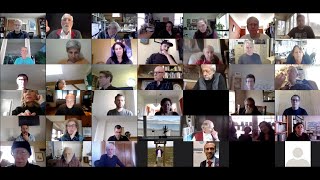
Gil Friend convenes 60 people on Zoom in March 2020 to talk about the pandemic and climate crisis at once. Participants share how the immediate crisis might reshape policy, organizing, and economics for the long term. The mood is hopeful and focused on systems change.
Chapters
Okay. Welcome everybody. Really glad for the turnout and the range of who's here. Thank you, Europe, for staying up so late. Thank you, Asia, for waking up early. By way of introduction, like many of you, I've been spending more time on Zoom in the last couple of days than I have probably in the last year. And I also think, like many of you, I've been finding great comfort in the connection. Even though we're not tactile here, it feels really valuable to be able to share time and heart and thoughts with each other. So thank you for joining us all in that. Us all is, I think, about 60 people right now. I've lost count, but we'll see later what that is. What I'm hoping to do today is provide a place for us to explore together a different kind of conversation than we usually have about the messes that we find ourselves in. I'm inviting you all to an exploration, not to a debate, not to decision making, but to explore ways of orienting to and shaping what comes next as we maybe emerge from, or maybe change phases in the crises that we're in. Since the world will never be the same after this, since, as Fernando Flores suggested, that what may emerge from this crisis is a world reconfigured in maybe every way, I want to ask the question, what might happen? What possibilities might emerge from that? Particularly if some of us choose to hard focus on that question, on the reconfiguration of everything. Well, most people and institutions around us are absorbed in the immediate urgencies that are before us all, on the pressing needs of the immediate. Now, what if we focus a little further out from that? I come to this call with a premise. Most of us have strong feelings and speak in strong words, and all those feelings and words are speculations. Nobody knows either what's going on now exactly, or what's going to come. These are interpretation. They're assessments that we make of what we're observing in the world. And these interpretations are shaped by the moods that we're living in. And in turn, they shape the moods that we're in. So some premises. This is the first of a series of calls that I'll be hosting. I have a roadmap in mind, but we'll learn from this in this experiment together and shape that program over the coming days and weeks. A couple of ground rules. I know most of you are probably experienced with zoom. In case you're not, please keep your audio muted. If you're not speaking, raise your hand to speak. I think I can see all of You. I can't monitor the chat live while I'm looking at you. So if somebody would like to volunteer and keep an eye on the chat, if you see anything there that should be surfaced to the whole group, flag me and let me know. I'd like to suggest this call be less about the specific first aid. How are you getting your food? Are you washing your hands? The physical defenses that we're all learning here and more about how we might orient in the times that we're in. How can we consider and hopefully shape what comes next? When you speak, raise your hand. I'll turn on your mic or turn it on yourself. Please be succinct and please be respectful. Again, we're here to listen and to engage. Not so much to debate, not to settle anything, not to close any discussions, but to open them up more broadly. Okay, make sense? Any questions about that? Okay, so, brief introduction. I think most of you know me, but perhaps not everyone. My name is Gil Friend. I'm chief Executive officer of Natural Logic. We're a strategy boutique that works mostly with companies that are already well along on the sustainability path that are folks who are considered leaders in the world. They typically come to us when they recognize that level they've achieved is nowhere near good enough compared to what's needed and what's possible up level their game. I'm founder of Critical Path Capital, an emerging family of investment funds. Recently served as the first Chief Sustainability Officer for the city of Palo Alto. Helping the rubber meet the road. And I'm a lifelong social entrepreneur inspired long ago kid, fresh out of college by Buckminster Fuller and others to see and think differently, to see the world in systems and you know, some people look at the world and see things. Some of us, I think a lot of people on this call look at the world and see patterns and relationships and interconnectivity. It's a different orientation the world. Like most of you, I'm deeply, I think like all of you, I'm deeply concerned and personally top topsy turvy in the midst of what we're living through. But I'm also observing these messes. And I say these because I'm Talking about the COVID 19 crisis and the climate crisis and what looking at them together discloses for us. I'm observing these not just as physical phenomena but as symptoms of the modern capitalist, I hyphenate that word mechanistic and reductionist civilization that we live in disconnected from the living world of the tissue thin film of living beings and systems that coat the surface of this 8,000 mile diameter ball of rock at 18,000 miles an hour. We're in this little tissue with all the rest of the living creatures of this planet, mostly acting in ignorance of that reality. But I pay attention to that. And lastly, for the last few years I've been living an experiment. Observing how we shape our worlds with the words that we speak, how we looking, observing how we cultivate our moods, how we observe moods and cultivate moods in ourselves and in others, and how these phenomena impact how we live and how we act. So I'm not going to read the post that I've shared with you. Hopefully you've all read that. I'm not going to summarize it, except to say that I basically asked three questions there. How do we live through this time? With grace and power. Open heartedness, number one. Number two, what can observing the COVID crisis and the climate crisis together reveal to us? And third, how might we begin to shape in our personal choices and our collective choices what might come next? So let me start with this with some questions to you. What did this reading put provoke in you? There's some reason that you're taking time today to be on this call. What did this reading provoke to you? I'd like to ask a few of you to raise your hands and speak. We won't have time to hear from everybody, but I'd invite you if you'd like to put your answers in the chat as well. What's your mood in this moment and what did the reading provoke in you? Who'd like to go first? Jean Gene Dunbar. What it provoked in me was an immediate response to want to join together with other people in connecting and speculating on what's occurring and what we should do to take care of ourselves and of each other. And this provoked me to start zoom calls that I'm having on a regular basis. I had my first one last Friday and intend to also engage in helping others learn how to use this technology. Great, thank you. Doug, Unmute yourself if you're not speaking. Okay. What it provokes in me is a whole range of things in which I can only go into a few. But how we dovetail between the climate crisis and the virus crisis by considering also the need that government has to be seen as in a crisis also. So I think it's a three pronged problem. And on the good side, it's possible that the climate crisis is creating things that we would need. Excuse me, for the virus crisis is creating conditions that we need to deal with. A climate crisis that we couldn't see a way to. So for example, shutting down the economy a lot might be something that we need to do to deal with climate because of the problem of CO2. So there are some good sides here. On the bad side. It's like what's being revealed is our lack of capacity to deal systemically, politically or intellectually. And I'm just hoping that we can come out of this in a more. I love your use of the word grace. And as you probably know, I've been working on the idea of coming out of this into the climate issues with a world that is a combination of producing food, producing habitat, and doing it in a craftsman like way and avoiding big corporation problem. Somebody else. Louis, just before I call on you, just comment on one thing that Doug said. The blindnesses that we are living in include a blindness to exponential change. Most people just don't understand what that kind of curve looks like and they look at a little piece of now and think it's going to continue like this forever. And in fact, if you look at the virus growth and mitigation curves and the climate growth and mitigation curves is a very common pattern here that emphasizes decisive early action, which has been missing in both. Louis, go ahead. Hi. The main thing that came to me, and I'm probably not unique in it, in that I started to think about more of the future. And I'll just make a point that in Politico and it's a little bit different, they have a list of some deep thinkers of what they think about the future, but that's what really hit me and how we have to obviously with climate together, but how we can think better and what we need for the future across the board, from increased capacity to another way to have more people from frankly understand climate science and understand how the two are linked. That seems to me it's going to be fundamental as we go forward. Good. And Louis, what's your mood today? I'm overall, I think I'm overall hopeful. I'm working on a couple of just separate individuals ideas. I'm not as distinguished as all of you, but I've worked on and off environment since the time I was in Washington D.C. and it seems like a lot of the lessons I've learned about economics, environment, my early background in journalism are sort of coming together and I hope to figure out a way to make better use of them as somebody who's 63 and who's been a caregiver for the past 10 years. Okay, thank you Sandra Bear. Yeah, I think my camera just went out. But I was most intrigued. Can you hear me? Can hear you and see you. You're fine. Can you hear me? Yes. Oh, good. Well, I was most intrigued by your question about what comes next. And I. For the past year and a half, I've been working on a piece called Rethinking Reimagining Global Urbanization. And really, it is about asking the hard questions that I think we fail to ask regarding climate and population growth and infrastructure and all these things that are urgent challenges in our world. And I think now is the opportunity for us to think about what could we do with this time that we didn't have before, to really imagine new approaches, new ways of doing things. I'll just recommend one other idea, which is a book by Tom Goodwin called Digital Darwinism. And it's really about letting go of our muscle memory. You know, this is the way we always do it. This is the way we've done it before. How could we do things differently? So I think it's right in line, Gil, with your ideas. And even though we're in the middle of the fire, I think, and my daughter actually lives in Italy, there's. There's much more to come from my perspective, talking to her. But even though we're in the middle of things, I think there are many of us that have the luxury to think. To think future tense, as the previous gentleman just said. And I think that's a real. I'm just totally excited by that opportunity. So thank you for this call, and I look forward to more. You're welcome. And what's your mood today, Sandra? You know, I'm feeling pretty positive. I'm in Washington, D.C. it's beautiful here. The spring is springing, and I think there's opportunity. I've been on many calls, as probably all of you have been on, and, you know, there are new connections, new. I mean, I hadn't talked to you, Gil, in 20 years, probably, but now I'm on a call with you. So I think there's. It's just. It's out there. It's out there for us to take action about. Thank you, someone else. For those of you who joined late. First of all, mute your audio if you're not speaking. Second, the question here is, what is your mood today and what did the reading provoke? Let me go to Eric Hanson and then Herman here. Hi. I am definitely provoked. Been dreaming the last couple of days of finding just this gathering of people that want to carpe diem with this current situation and opportunity. So, Gil, thanks so much for putting it out there. So I'm. My mood, I'm excited, and I'm sitting right here in the. In the waning sunlight of downtown New York City. So it's kind of of an amazing sight and scene to be in this fairy tale like, or movie, movie setting of a city. It's really bizarre. And what I'm really interested in is that in the book why Nations Fail, Mowgli and Robinson point out that it was the plague that really brought about some of the most important shifts in the whole movement towards more inclusive institutions and societies and governments. And so, you know, and the rationale for how things shift on a big, bigger level here, there's no. There's no model to drive this process. So it's like when there are big global events taking place, like the plague and like the Twin Towers and like other kinds of things, we've got. We've got an opportunity to move the. Move the way the game is played somehow. And I don't know how we're going to do this. And that's why I'm on the call here. None of us knows how to engage with that dialogue. Thank you. All of us are here. Thank you, Herman. And then Jen. So, I mean, it's very similar to what we just heard. For me, I'm just thankful that I'm here for this moment. You know, it looks like this is a group of, not the youngest folks we're all about in that chapter in our lives. And I think this is the potentially the most magnificent moment of my life in terms of something that many of us have been pursuing, have been working on, have been hoping for. But there's this massive machine that is really fundamentally unmovable and is now asleep or not asleep, what you call it. It's like we've been put on a timeout, sent to our rooms. We've been sent to our rooms on a timeout. And imagine the entire world, every human being on this planet is touched by this. Everything is stopped. That's just absolutely extraordinary and is a signal to what we need to get through in order to have any chance in terms of these 10 years that we have to turn the corner. There was not a signal, hardly a signal, that gave us a sense that even though we know that, even though the urgency is that we would actually be able to do what needs to be done, turn the corner. Just Last year, the CO2 levels have been twice as high, you know, in the neighborhood of 4 parts per million instead of 2 from what had been predicted. So in a way, we're even at a shorter, you know, in a shorter timeframe now. Of course, all that has changed. Right, because everything has stopped. And so I am actually hugely, you know, thankful, although I do also find myself in a position of guilt and privilege because I think for very many people, this is going to be an extraordinarily rough ride all the way to dying, and that's really heartbreaking. So it's this very strange mix of thankfulness that I'm here for this moment, this radical, transformative moment. Great hope that this is finally the thing that will pivot in the direction that most of us here on this call, probably all of us have been working on, hoping for. And also it's a profound sadness about all that's going to be, you know, for how many people are going to suffer through this. Herman, thank you. I just want to say hi because I'm on the screen with Herman and I'm Lisa Friedman, just to introduce myself to people, but I know other people are waiting in line, so I'll just go back and get in line if I need to say something. But I wanted to say hi so you knew who I was. Thanks for doing that, Lisa. Jeb? Eddy? Jeb, are you still there? Unmute yourself. There. Those of you in my phone cannot see what I have on my picture, but for about eight months now, I have been walking around in public. I'm Jab in Palo Alto. And Jeff, before you tell us what you're wearing, what's your mood today? Appreciative of this step on your part, and I want to support it by volunteering to help support more small group conversations like this. Great. Thank you. And what are you wearing? Well, around my neck is a little laminated placard that the others from Palo Alto have seen. It says, I speak up about the climate crisis every day. And I have had about 100. I've been in this for about eight months. About 150 people have gone out of their way to come up to me and say thank you. Thank you for the go ahead, Gil. And has that been different in the last week or two? Well, Edie and I are at home in the last week or two, so I don't have any absolutely, really, really recent experience under the shadow of the virus. But my point is, it's very similar to the fact that you've organized this nice conversation. There are lots of us. You know, I imagine everybody on this call is pretty darn deep blue, but we're not visible to each other. Unless we're a part of an organization that meets in some form, I don't have the faintest idea who the other people on this call are. With a few exceptions, we need to be more visible to each other. So this little sign around my neck has been a wonderful way that other people who feel the same way make themselves visible to me. And I think you and your mailing list offer some potential foundations for doing some more much smaller group conversations where we can all have more airtime, which is something we all want over. Thank you. David Grossoff. Good to see you. Hi there. So I guess I'm both very dark in expecting an incredible onslaught of just death and bad numbers because the social expectation around what exponential doubling times of, you know, twice a week really mean. And there is sort of a propagandistic spin on a lot of the media that I'm over consuming. But on the other hand I'm optimistic that the, the more powerful people in the society will see and newly value the kind of civic society strength that has gone into the international cooperation on the various solutions. I come from standpoint of deeply rooted in healthcare sciences and healthcare technology and I'm really, really impressed with what's going on. Just amazing, high quality, no nonsense information, except from a few over the hill scientists for whom I guess the air is too thin on Mount Olympus, so they've made rather ignorant pronouncements. But the ground level is incredibly powerful and interest. So on the one hand I'm expecting an incredible number of people dying and on the other hand I'm impressed that we have a drill showing what resourceful cooperation really looks like. And of course one of the questions is what could resourceful cooperation look like around the climate crisis? Exactly. What if there were rapid, decisive, focused, collaborative action around the world? What we've just done now is we've proven that that's possible. Correct? You know, if people, if people had, you know, for all the predictions we have, nobody predicted that. Well, hardly anybody predicted this crisis. You know, months ago, or at least most of us living our lives didn't live with the expectation of everything being turned upside down in a matter of weeks. And it happened. And we've responded, you know, varying degrees of effectiveness, but across the globe we've responded quickly and decisively. And then we have this other thing that is the very slow moving crisis of climate. With COVID we saw just like Bam took over the news space immediately. Climate is a quiet story that doesn't get talked about, doesn't get asked in the Presidential debates, But there it is, moving inexorably on its exponential curves. What if we could respond this way to that? So we have a proof case of something here for people who say impossible for the globe to coordinate that quickly, that's now been disproven. Behind that is the usual comment where people say, how in the world are you going to pay for this? Which, of course is never asked about the defense budget, but notice that it's not being asked about the bailout package. Nobody's asking, how are you going to pay for this? They're saying we have to move the resources to make this happen. I say, you know, the we is variable, but there you go. Shelly Gordon. Shelley, Mute yourself. I've got too many people on screen to find you all quickly. Yesterday I was reading an article called Lessons looking back from 2050, and it's written by a futurist. I don't know if anyone read it. I'd be happy to share it with Gil if you wanted to pass it out, but. Yes, please. Of all the things that it said, you know, talking about the future, what. What actually is possible out of this, you know, out of this catastrophe. But one of the things that really struck me was talking about ecosystems and the fact that by, you know, decimating ecosystems, it's no wonder that this virus escaped. So, you know, in a healthy ecosystem, a virus is basically absorbed within that ecosystem, you know, if it is emitted. But because we have leveled so much land and destroyed habitats, it's kind of like no wonder it escaped. So somehow having that information gave me some comfort. I know that's odd, but it was like, oh, no wonder. And so I guess what it tells me is, first of all, it validates that, yes, indeed, if we continue to destroy the ecosystems and the climate, this kind of catastrophe is going to happen. But then there's some recourse. There's something we can actually do. So I guess if you ask what my mood is. Knowledge is power. It's hopeful. I feel hopeful. I feel. And then there's all this serendipity. Like, I read the article, then I got your email, and things are starting to sort of coalesce. I think that's. There's a lot of coalescing going on. And so it makes me feel like I'm not alone in my house, you know, hibernating to protect myself. My husband's here, but, you know, I'm not so isolated. So I see that there's a movement happening on our screens and that that encourages me. Thank you. Marco, Ann, Dixon and Wendy. And again, if you want to speak, there's a, there's a hand raising toggle in the chat link at the bottom of your screen. Thank you for organizing this. It's great. I've been doing a lot of zooms too, to remain connected. I like, by the way, I don't like the social distancing language. I say physical distancing and social proximity or connectivity. I mean, I work on the large systems, including capitalism. One, if you would, before you go there, just tell us what your mood is. My mood is in equal parts excitement and terrified. I'm terrified because of the gravity of the situation and how many. You know, I am in contact with people in Italy and I see what's happening now there, which is basically where we're going to be in about seven days to ten days from now. And it's really very, very hard to take in. But I'm also excited about the possibility of change. Some of you already mentioned we are in together. So this is similar to the experience of seeing the earth from space that change our consciousness. I think this is even more embodied because there is a common experience we all have now. The other thing is capitalism requires growth and I'm not even sure whether capitalism can survive the next four or five months. And we're already seeing the shift from. You're going to fight like hell to do that. Yeah, like we're provisioning now more and more of the things through a known market mechanism. So that's gonna be quite interesting, exciting to see and also which ideas get picked up in this moment of crisis is gonna be a big question. So thank you for organizing. Thank you. Excuse me. Thanks. Marco. Ann. Hi. A couple thoughts. One of the things that has been a refrain in my thought process for a long time is that one of our biggest challenges in dealing with the climate issue is that as humans we're much better evolved to deal with acute than with chronic problems. And we've gone from chronic to acute instantaneously. And I think the big opportunity that I see is that people are starting to say, hey, wait, these are connected. And so I think that one of the things that this can community can do is to put forward that message that climate and the pandemic and other pandemics to come are connected, they're not separate. And if we do that, I think we have the best chance that we have ever had to get the human response to climate elevated to the acute level rather than the chronic. The frog in the slowly heating pan situation that we've had for so long. So that's my thing. And the two most powerful pieces that have come across my desk in the last few days that put that together are. I think it may be the same one that Shelley mentioned that talks about the pandemic comes from our environmental depredations, but also this really beautiful and moving short video that came out of Italy called A Letter from the Virus. And I encourage all of you to seek that out and share these things widely and paired. Watch these, read this, and think about them together. My mood is very watchful. I like the last comment. Both excited and terrified. I don't terrify easily, so I guess I'm not really there yet. Or maybe I'm suppressing the impending sense of terror, but very, very vigilant and feeling like, what's next? It's very, very interesting time. And I think that to me, the what's next is hopefully watching the whole world make this connection that I'm talking about. That's it for me. Thank you. Video was sadly blocked. It's no longer available. Oh, no way. Copyright infringement. Okay, well, we'll find a way around that. If somebody finds a link somehow. Stick it down in there, Dixon. Next. We've got a lot of hands stacked up, so let me ask people, to be very brief, if you can, first, what's your mood in the moment or these days? What's been provoked in you by the reading in this conversation? I missed the reading, Gil, and I was a little late, so I'm just gonna say my mood. I'm emboldened and I'm depressed and a little gleeful. And I'll tell you what I'm gleeful about is we've already said it's about the. You know, we finally have something that moves a little faster than the glacial pace of climate change. And it's really gotten people to really sit back in their. In their seats, so to speak. I noticed that I sit a little deeper in my meditation cushion, which shows me that I'm arriving in a different way. I'm not. And it has among clients and associates. I'm seeing people get settled in and here and now. And it really. I think the opportunity here is that it's going to have a settling effect. I think, in a sense that we, because of technology and a lot of other things, I think we regard ourselves a little higher in consciousness in terms of capacity, but I think in capability, we are far back where we think we really are. And I think that's what a lesson that we're seeing in terms of how our smartest government officials and some of our leaders and particularly our system is not well educated or mature enough, I'll say has not consciously matured enough to handle situations like this. And for me, it's a direct correlation with how we and how we regard climate change. So for me, I think the opportunity here is education both in terms of how, you know, we're, you know, eagle stages, as anybody understands that is they're in variant stages. We have to go through all of them and we cannot do spiritual bypassing or jump a stage ahead whenever we feel like it. Regardless of how technologically smart we are, we really have to grind through those stages. And I think as this is an evolutionary opportunity for humans to be educated and what that means and what we have to do in order to grow each other. That's true. If that's true, we've got to grind fast. Yeah, we're going to grind fast. I need to move on. I've got other hands. I apologize for not having my camera working right right this sec, but say hello from the Lower east side of Manhattan. Hi. And just want to say that I'm the director of Green Map. Oh my mood picking up on what Ann said. I'm one of those frogs in the pot that's getting warmer and warmer, but I remember that frogs are indicator species and they let us know where the environment is helpful. So I'm hoping we're all going to jump out at the right moment to make that connection. I feel a really good connection to all of you right now and so many people who I've never met before except through this medium. Green Map, which is the 25 year old nonprofit I've been running that helps local people map sustainability in their community, is now working on a co recovery iconography that hopefully will be ready to share later this week. We started on it yesterday and it's a mix of our existing and new and we're cobbling it together. We're planning a zoom meeting on Thursday at 10 ET and if you're interested, I'm going to stick my email in here if you want to look or discuss it another time. I'd love to have some of the insights from this group. It's very general use but it could really help people and it's open source so it's just going to be out there and free for people to use. So I want to say thank you to Gail also for convening this and I'll say goodbye everybody. Feel free to put resources in the chat to share with others. Stuart? Yeah. Thank you for convening, Gil. Feels like I've been preparing all my life. My mood is one of vigilance, both internal in terms of self management and external in terms of what's going on around unique opportunity for a planetary reorganization of some kind. My biggest concern is that a lot of people aren't staying home and gun sales went way up in the US My fear is that we don't have the leadership that is going to be essential not to manage systems, but to manage people through this time. And that's kind of going to be a key piece. Can people change? Systems don't get led. Systems get managed or nurtured or stewarded. Very good. Marianne Gallagher hi Gil. My mood is a little low level anxiety that I'm trying to ignore with some peace and kind of excitement about what's possible. And I like what I've heard that this might be the great opportunity to marry climate change and the virus in such a way that climate change gets a big boost. And I think probably conceptually how to do that and how to strategize that might be something that this group would be well positioned to do. And I think the gleeful part of me is going well. There's a moment when CO2 slowed down. It just like kind of feel the earth breathing out for a moment and that, that feels good somehow, that there's just a pause in this incessant demand that I have and we all have to keep moving no matter what. So thank you. Just a word on mood before I go on to the next hand raised. It's striking that the mood on this call is generally good. Listen to what people are saying. There's a lot of comfort, settledness, ambition to do something. Some people have talked about anxiety and fear, but that's not the dominant mood in this conversation, which it is with other people that I talk with. My family, for example, relatives who are. And for me, part of the difference is that the people on this call tend to be engaged in action in some kind. That's one thing. The other thing I want to say about mood, and we'll talk more about it in other calls, because there's not time today is that, is that a mood is always a reflection of an underlying assessment, some assessment or judgment that you've made about what's good or bad, what you like or don't like, what you think is possible or not possible. So it can be helpful when you observe a mood in yourself, is to look at what is the underlying assessment and then you have some options. You can ask yourself, is that assessment accurate? Do I want to change it? Is that assessment accurate? What actions do I want to take to deal with what's revealed by the assessment? You try that out, you may notice that having that kind of conversation with yourself may affect your mood in very interesting ways. Mark Roast. Roast. Roost. I don't know how to pronounce your name. I apologize. Let me unmute you. Thank you. Thank you. All right, so my mood is on the upside and share what Herman said earlier. And I've basically been making a lot of plans. I took Bucky Fuller's Comprehensive Design science course in 66 at San Jose State. So I've been on this trip for a while. And yeah, I am just itching to spill the beans on a whole bunch of technology and economic and political process things that can be done. Thank you. We're probably not going to have time for everybody today. Let me go next to Deb Berlin. Hi, Gail. Thanks for this. Hi, everybody. My current mood is hopeful. And the reason I say that is because I'm in Venice beach, where we're not known for following the rules. And I do see people following the rules. So if we can do it here, we can do it everywhere. To me, this is a big exercise in self discipline. We need to stay away from each other. So we'll see. We'll see if we can do that. I want to add to what a couple of other people said about using this opportunity to make a case for climate change. We all know that people care most about their health, their wallet and their family. And the virus is directly impacting all of those things or is perceived to impact all those things. And for climate change, there's a perception that none of those things will be impacted for people. And that's been one of our problems for so long. So for my money today, banking off what a few other people said, is that rather than try to pull everyone over to climate change to understand more about that, but, you know, which has been hard for the last few decades, instead we focus on the virus and likening climate change to the problems of the virus. Like for instance, Look, there's been several analogies to that, but to look at climate change as an extension of the virus and get the communications right this time. Lastly, you know, our culture works on VIPs, that's what we care about. So there's so many high level people now that can back us up. Bernie Sanders, Jay Inslee, Al Gore, you know, getting, you know, banding everyone together to make a difference on this. Thank you. Thank you, Deb. Mark Barish so Mood determined, I would say and wondering really the sudden evaporation of trillions of dollars of essentially fictive wealth in a largely fictive economic financial system really calls to mind a what that money could have accomplished and transformatively and now is vanished into vapor. But also how do we actually move resources into what we would call the regenerative economy, which is part of the regenerative society. And I can say that I'm involved in some pretty high level conversations on this now, including with the government of Kenya to have Kenya is considering becoming the first country to declare itself a regenerative country as a national policy decision. And this grows out of eight years of work that I've done there with the Green World campaign and could spread through Africa. So and of course what they're worried about as well, will the world community, will there be any money? Because everybody is pulling in their horns and trying to figure out, scrambling how to dampen the perturbations of the system in the way Ilya Prigogen would talk about that we're trying to escape into a higher order in a way and the system is going to fight back and try to reconstitute itself. So do you have any ideas how to actually begin? You know, the resources are going to be the key, otherwise none of this is going to happen. It's all going to be philosophy. Well, you know, it reminds me of an old Alan Watts story about running out of inches. So you can't build any more buildings because we ran out of inches. Running out of money isn't the issue here because we've got people, we've got resources and we've got human will and we need to figure out how to make the fictive line up with that. Thank you, Mark. And I'd also just say that the idea of a regenerative economy would be the the ultimate store of value is healthy ecosystems and thriving communities. And how to actually valuate that is our real question. Tag it in the chat as a topic for a future call. Anna. Hi, I'm Anna. I'm here in Round Rock, Texas, globally might be known as Austin, Texas. I find myself fortunate here to have received a last minute invitation to enter this room. I know no one here and I'm super grateful to be here and super grateful to all of you for the big thinking and big work that you do. Mood is aware of the deep fears moving through. I stand grounded as a reminder that it's okay to feel all that fear. And on the other side of that fear is what we dreamers have been dreaming about, the new economy. My business here is technology, and I'm interested in reforming the world around technology and education so that we. That solves the climate problem, y'. All. A new economy. This way. Thank you, Don Goldmacher. Don, I'm on you. Yes, thank you. So I'm here in Berkeley, California. We've been shut down for a week. Gil, of course, lives here as well. My mood is somber because this pandemic is not the worst. The warning came in 2006 from Dr. Larry Brilliant, an old friend of mine who some of you may be familiar with. He was the guy who wiped out measles, smallpox, across the planet over the last several decades. And he warned in a ted talk in 2006 of such a pandemic. And I have listened to other experts in this arena during the past few days. They expect the worst one down the road. And I should preface this by saying I am a physician, retired, so I have a particular perspective that comes from public health and community psychiatry, as well as being an environmental activist for many decades. So the connection between this particular virus and climate catastrophe is, of course, the task that we all have to do the messaging very correctly, because it is the same system that views nature as something to be exploited and used up that is responsible for both climate chaos and this particular manifestation of it. This particular virus emerging from a particular habitat, along with all the other recent viruses that have come either Ebola or come from mass growth, you know, agribusiness, where you have millions of chickens together or millions of hogs together, creating the groundwork for other bugs to emerge. So my other concern here, which is why I am somber, is the behavior of our megalomaniac, narcissistic president is not atypical at this point. He is a manifestation of a larger phenomenon going around this planet, which in turn, for me, emerged from the 2008 crash, the worldwide economic crash that got started in this country. And so the questions how not just people around the world, governments are going to respond with either more ultra nationalism or to make this idea of globalization one where we say, yeah, we are one planet together, and that's the only way we will overcome. And I, of course, am very somber about climate chaos. I think this is Mother Earth sending a very big warning. This is a red alert. Hey, you kids, go to your room. Don't come out so you can behave yourself. Right? So, you know, I'm struck by this. Done. No One caught me on something I said about a half hour ago. I thought I'd get jumped on, you know, I said nobody could have anticipated this. But in fact, people have anticipated this. They've anticipated, you know, pandemics like this and others. The worst one that John speaks about. People have said no one could have anticipated this level of climate crisis, but in fact, no mobile anticipated in the 1950s and scientists 50 years before that. So it's whenever for me, whenever I hear someone say, no one ever could have imagined my. My yellow flags go up because that tells me that there's a blindness and perhaps a willful blindness and not wanting to see things that are right in front of our eyes. And that's part of the challenge that we have some of its political and economic power, some of it, as Deb has said, is how we communicate these things. So there's all that to look at. We're at five to four. There are a lot more hands up that I think we really don't have time to do, because I'd like to move to closing this call by first of all asking, do you want to do this again? Do you want to get together? I'm saying, give me, give me thumbs up or thumbs down. And, you know, we can talk about what to do, how to do it. This, this one intentionally yes button. Someone fire up a yes button for me if you can. Right by where you raised your hand. Yes. Okay, more. Good. This call is intentionally unstructured. I just wanted people a chance to speak and listen and start to get to know each other. We can do future calls that have more structure to them. So my request to you is, if you'd like to do more calls, please put your email in the chat. Some of you are on my mailing list. If you're not, you can join at NatLogic, Nat Logic. But to make sure you get announcements of future calls, put an email in the chat, first of all, and also put in the chat, what's your mood now? How does it compare with your mood at the start of the call? What moves will you make in response to this conversation that we've had together? What moods will you cultivate in yourselves? Because moods, you know, they. They happen to us, they swallow us up there. Robert Dunham says, your mood is the thing that you feel before your feet even hit the floor in the morning, but also like a garden or like, like musicianship or like athleticism. These are cultivated by our practices. So what will you cultivate going forward here? And last, I'd like you to put very specifically in the chat, we've asked more group calls is one of my questions. Yes. If you're interested in individual calls or coaching around this or other aspects of our work together, let me know if there are ways that you see that I could be helpful in coaching or advising your organizations. Let me know if you see opportunities to team together. I know many of you are doing that kind of work in your own worlds, with your own communities and your own clients raise that, too. We can get into that more in future conversations and see how we can grow something graceful and powerful out of our shared interests and shared commitments here. Let me just scan through. Briefly. David Sherman, if you're still there, can I put you on the spot for a moment and ask for your reflections May not be there anymore. Okay. Matisse, are you with us? I'm here. And well, Briefly, what are your reflections on what we've just been doing for the last hour here? My camera clearly first, thank you very much. I think it's wonderful to bring the community together. There are clearly big, dark shadows that will be hanging over this event. And at the same time, it's just so fascinating, amazing what can come out of it. And kind of the positive spirit that you have kindled here among all of us and kind of the curiosity of what may become possible. It's just incredible. What I see as the biggest opportunity overall is a new intergenerational conflict. Who is now at stake are the old people, the young people, protecting themselves to protect everybody else. You know, so it's kind of also, you protect ourselves and we protect everybody else. And now it's for the old people. And climate change is the reverse that the older generation doesn't seem to care as much about the longer term. And the young people will have to carry the burden. And I think this is a beautiful opportunity to bring our hands together again between the generations and say, we'll help you. He'll help us. Good. Good. Thank you, Gabriel. Grant, can I call on you for one last reflection from the room? And you can say, no, I'm putting on the spot. I'm here. So I see some hope that we can call into being some extraordinary selves, some extraordinary role models for the rest of the world to navigate this crisis along with us. Great. Thank you. Thank you, everybody, for your taking the time and for your openness in sharing here today and for your commitment in the work that, that we all share together. Please, if you haven't done it already, put your email in the chat so I can get respond to you. You can also join my mailing list@natlogic.com I'll come back to you, those of you I can reach in the next couple of days with some thoughts about where we might go next. And we'll go from there. Thank you so much for being with us. Blessings to you all. Thank you. Very late in Greece. Okay. Great to be. Namaste. Namaste. Thank you so much. Apologies for those of you I couldn't get to. We'll get you next time.










