What does leadership look like NOW? —Living Between Worlds 6.5
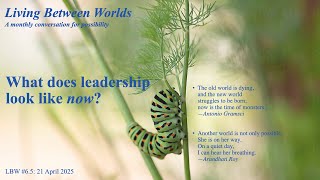
Gil Friend and Ken Homer explore what leadership means now by examining leadership, followership, and fellowship together. They discuss why people follow, how first followers shape movements, and why language matters: ESG and DEI framing often fails because it doesn't speak to belonging or regeneration.
Chapters
Welcome, everybody. Welcome to Living between Worlds for May 21, 2025. I'm Gil Friend, business strategist, executive coach and CEO of Natural Logic. You just met my co host, Ken Homer, founder of Collaborative Conversations and creator of Intelligent Tech. And our theme for this month is what does leadership look like Now? Now, underscored, this was a question that was at the heart of a Climate Week dinner that I hosted last month. And it's a question that's very alive now in this time between worlds, in this time when the world has turned on its head, in this time of norms being ignored and dissolved, battles for budgets and land and power and geopolitical advantage, as well as battles for hearts and minds. So let's talk about leadership, but not your father's leadership. We'll add the dimensions of followership and fellowship, which are twin aspects of leadership that are often left out of the conversation. So we want to explore these three dimensions with you. Leadership. It's a funny thing. People talk a lot about how leaders speak. I'm particularly interested in how leaders listen, how and all of you gather on this call. I consider leaders in the many ways that you do. How do we listen so that we can speak in ways that people listen? How do you lead followership? Well, you know, leaders can only lead if people follow. Authoritarians only have power if people cede power to them, as the hundreds of thousands of people who have been in the streets of Belgrade daily have been unwilling to do so. In this time of not following, whom are you willing to follow? And the following is as important as the not following, because the third dimension that we're calling fellowship. How do we join together? How do we join together around common cares, even across differences? What does solidarity look like, which is not the same as unity? Bernice Reagan, one of the founders of the magnificent a cappella group Sweet Honey in the Rock, used to say that if you're in a coalition and if you're not deeply uncomfortable all the time, your coalition is not broad enough. That's a challenging one to absorb. So with whom do you join and ally and support? So, you know, it's easy to hear these as political questions, certainly these days. That's. Maybe that's my mood today, since I scanned the headlines before I came online with you all. But these questions are relevant at all dimensions in your business, in your community, in your family, in your relationships. So let's explore these together in some depth. Let's perform a kind of diagnostic of a sort on our times and on ourselves. How are these themes showing up for you. Can you bring up that slide that has the three how, you know, how are these showing up for you? Leadership, followership and fellowship. And how are you showing up for them? Are you paralyzed? Like, you know, I'm blanking on the guy's name, the, you know, the Greek myth character who turned at the stone staring at Medusa. I guess everybody did. One guy didn't. When are you not paralyzed? What are the circumstances in which you're not, you know, the story of the two wolves? Which wolf is stronger? Well, which wolf are you feeding? So, Ken, take us into the breakout conversation, if you would.
Sure. So when Gil and I started talking about this, you know, we actually spent significant amounts of time planning these calls, and we actually had a little Venn diagram of leadership. Fellowship. Fellowship. And, you know, the title of this series is Living Between Worlds with Dignity, Grace and Power. And, you know, we are in this time between worlds. The old world is dissolving. It is passing away. And what is being called? How are we being called to hospice?
It.
You know, I have a friend who did a lot of work with the General Hospice Project, and she told the story of this homeless person who was just as mean as could be. And in his last few days of his life, he was still railing at people and swearing at them. People who are trying to, you know, clean up his filth and feed him and nourish him and keep him, you know, as comfortable as possible. And I. I was aghast. I said, what'd you do? She said, we loved him because can you imagine how horrible his life must have been that at the very end, he couldn't even be kind to those who are being kind to him? He really needed love. And so when we look around the world at what upsets us and what. What is causing us to re. Become revulsed, how can we love that into death? How can we be present for what is dying in a way that allows us to really be present and. And learn from what's gone on and do so in a loving, kind, compassionate way rather than. This is just too much shadow for me to deal with. And so I think that's one of the important things. And then on the other side, we're also being called to. To be midwives to what is coming into the world that is going to replace this? And so that brought up the question of who do we do this work with? And we thought, what better community to explore these than the folks who've been showing up here on Living Between Worlds for the last couple Years. We're just going to dive into two breakout rooms and then come back for plenary so that you can choose any one of these questions, or if there's a question you have that doesn't show up here, feel free to talk about that. These are just to get you, get you to creative juices flowing for how to have this conversation before you take.
The screw slides off, go to the next slide. Because there's some boundary conditions that we want to.
Oh, yes, thank you.
So take. Go ahead with that.
Yeah. So we want to set a little bit of container here of. This is not a time to complain about, you know, who's doing what to whom. It's not a time to debate somebody. I disagree with what you're saying. You know, that's. That's not going to be productive in here and not, oh, that reminds me of me. And here's what I did. So don't try and therapize or fix or, or, you know, handle someone else's stuff. Just stick with, well, what might be possible given what's going on. How can we. How can we actually do this in a way that's going to be effective and productive? You want to say anything else, Gil?
I'll just, I'll just emphasize the number one. We put that in there because I found in a lot of conversations I've been in lately, it's been very easy for people to fall into all the things that we're upset about. What's wrong with this? What's wrong with that? What happened last? What led to this? And that's an important conversation. But we'd like to not have that conversation today. I'd like to invite you into the kind of conversation that we're framing. So in your breakouts, there's no facilitator other than the group of you in the breakout. So see if you can hold yourselves to that framework. Our guess is it's going to support a much more productive conversation so can take it away.
Okay, we're going to open up the breakout rooms. My apologies. I don't know if you managed to get the questions or not. I didn't put them in the chat. So let me do that now before do anything else. They.
They flashed on the screen for a.
Moment, but there didn't seem to be any way to get back to them. Yeah. Okay. Well, now they're in the chat. Should be able to see them. They should be persistent. Give me a second to redo the break room. So you'll meet with different people. Gil would you do some stage pattern while I'm doing it.
He's doing it like a mime. Your microphone, that's that clap you come back out of breakouts in the mic is up. So the stage pattern, how was that for you? Like one or two words, A few of you. What was that experience like so far? Inclusive. Okay, thanks, Gene. See ya. Helpful, inspiring. You don't have to go on mic necessarily. Throw some words in the chat about how that was and if anything surprised you in those conversations.
Warm, open, thought provoking, wisdom, sympathetic.
Helpful.
Yeah.
Hard to be an old friend.
That's nice. Increasing the love quotient. Oh, I love that. Thanks.
Thank you. Okay.
All right, well, let's do it again. Gonna open the rooms right now. Well, welcome back. I hope that was a good time. As good a time for you all as it was for me. I certainly had a really great two sessions and very grateful the people that I was with and able to listen to them and speak. So let's just open it up. How was this for you? What, what, what struck you, what you learn, what emerged, you know, what's, who'd like to share? Thanks, Kevin. Anybody surprised me? Delighted. Anybody learn something powerful? Yeah, Brad, please.
Yeah, so it's interesting. Thoughts lead to feelings which lead to actions which lead to results. And my belief and I, again, I'm not trying to convince anybody of anything here. You can change your thoughts. And in our group we had a one person who will remain unnamed said they felt powerless. And I was thinking, that's just a thought. And if you change that thought to I am a powerful being. I am somebody who can make a difference. I am. Fill in the blank and just start saying that. Look in the mirror. Every day when I get up in the morning, the first thing I do, I look in the mirror and I say 10 times, I love you, I love you, I love you, I love you, I love you. And I. I break out laughing because I can't do it without smiling and laughing. I'm looking at myself, telling myself, I, I mean, that's crazy, but it's just one little habit that kind of sets the tone for the day. So I guess what I'm saying and I'll end because I know I talk a lot. Be mindful of your thoughts. Just notice that you can change any one of them at any time to any other thought. And I just invite you to change it to an empowering thought rather than a disempowering thought. Who was it? Dr. Phil. What did he say? How's that Working for you. You know, if, if what you say is, I, I'm powerless, I'm paralyzed, I can't. How's that working for you? You know, if it's not working for you, then choose a different way to talk to yourself. Okay, I'm done.
Thank you. That was just some leadership. That was just some leadership about self leadership. Yeah.
Great.
Yeah.
Cool. Thank you. You're welcome.
And followership and fellowship all wrapped in one.
Yeah, yeah.
Anybody talk about followership? I mean, to me it automatically goes along with leadership, but I almost never hear anybody talk about it. I'm just curious if that came up in your conversation at all. Or fellowship.
I'll talk about followership, please. Well, I share this and I make it very brief in our chat that I've been exploring followership and especially the question of who voted for Trump and why. Looking at it using the iceberg model of systems thinking, that kind of metaphor, different layers. And I came across a book called Stolen Pride by a Berkeley sociologist. We interview a lot of people who lost their jobs in America. And this is just one section of followership. But it's interesting to see why people feel their pride in America. Their work identity was stolen from them, it was gone, it was shipped out. And why they need to recover that in America, if you don't self sufficient and make money and pay the rent.
And.
You'Re worthless, so to speak. So I think it's important to have understanding of the people that vote and why and what could we do to make this life better for everyone, the world work, Everyone. That's it.
Manuel, you know who else shares that assessment, that diagnosis?
Do I also know who, who else.
Shares that diagnosis of the landscape in the United States of America, that disaffection of a large chunk of the population. Bernie Sanders and Steve Bannon. Almost a analysis of a great swath of people who feel disaffected and abandoned and ignored. And they took a similar diagnosis and went in two very different directions with it.
Uh huh. Okay. Thank you, Jill. Appreciate it. I was familiar with Bernie, but I wasn't sure what the other thought was.
Bannon, who was Trump's whisperer.
Yeah, I know who he is now.
I did a long interview with him in the Times about a month or two ago by Ross Dukhas, one of their columnists. And it was really striking to see how, how similar the language was, but really different interpretation about what do you mean, what do you do with that? And what, what do you build with that? And just as a testament to the power that Bernie Sanders, who was pretty much blacked out during most of the primary season in 2016 by the media, 44% of the primary vote, something resonated. He listened to something and spoke something and was a leader of a sort.
Yeah. Yeah. So, by the way, I'll throw in another book that may be relevant to what Bernie's saying in this conversation by Ezra Klein. Abundance.
Haven't read it yet.
Yeah. And in Abundance, they paint the picture, you know, an abundant civilization, society, given what we already have and now and how both the Democratic and both the Republican Party missed the boat. So to speaking in this agenda. So I think this agenda that is proposed in this book, abundance makes a lot of sense. It's all achievable.
Yeah, they've got some really good interviews, long form, like hourish interviews online that you can find.
Yeah, that's.
That's good stuff.
Who else. What you hear? What did you listen?
I think in. In both of my groups, there was just a strong connection between the sense of feeling. I guess the word that we kicked around was paralyzed. A lack of agency, but very much connected with a lack of fellowship. The sense that it's not that what we. That we can't do what we want to do, but that we can't do it alone. And. And we are alone.
Are we.
And, well, we feel isolated or disconnected from. Were not actively. At least the folks in the group, the groups I was in, none of us felt like we were actively in the moment or I didn't get the sense anyway, that we were actively in the moment, connected with the people that we were doing the work with that was capturing our attention and funneling our agency in the. In the way that we want to be done. And in some sense, I. I would imagine that if we were caught up in that, we might not have had time to come here today. And that there's. There's a seeking that's intrinsic to what is bringing us together here in this type of group that we're. We're hoping to find that fellowship to create that collaborative agency to overcome our. Our sense of being paralyzed.
Yeah. So, Philip, when you're. When you're in that conversation or have that sense, does that call you to resignation? Does it call you to action? Does it call you to something else? Where do you go. Where do you go with that kind of moment?
I.
For me, it. It is not so much resignation unless there's a positive spin on that word. The sense that this moment, in which I'm going to use the weather metaphor, in which the storm is raging in such a way that there's so much prevailing chaos that it's not clear what to do, that that moment will not last, that there will become a time when it is clear that there's a course of action that isn't just setting off into the chaos with. With rage and ambition, but no real clear sense of what we can accomplish. And that it's a time for patience, a time for building bridges, not allowing for me anyway, the.
The.
I'm pissed off, man, and I'm. And I want to rage, right? But I. But I don't think that any of you or anyone in general is the appropriate target of my rage. And I suspect that all people, whether in this group or elsewhere, have more potential as allies than. Than any real role to play as antagonists. And I don't want the feelings of urgency that I'm feeling and the rage that I feel to cause me to lash out in such a way that I will, in fact, alienate people who could be good allies. And I have that sense that we're all kind of collectively being battered, and at some point, we won't all be being collectively battered. And at that point, we'll all see similar parting in the clouds or calming in the seas. And, you know, organic cooperation will be. Will happen so long as we haven't alienated each other in the meantime, to the point that. That we're so caught up on how much we despise each other or avoiding each other that we don't notice the opportunities that.
That.
That open up.
So I'd like to speak to that a little bit, Philip, if that's okay, because we were in the group, and I did notice you were saying that, you know, you. You felt the storm was raging and that it wasn't the appropriate moment for action. So you were called to stillness. And I think that's actually wisdom, you know, you also talked about the sense of urgency causing people to act before they'd been still long enough to figure out what it is they wanted to do. And. And the third thing that you just mentioned is about the rage. And Gil and I have talked about this often of difference between rage and righteous indignation. You know, anybody remember Ann Richards, Governor of Texas? You know, she said, any damn fool can kick a barn down, but it takes a community to raise one, you know, so if you're going to kick the barn down because it's rotted and needs to be replaced, don't till it do it until you've gathered the community around you, who knows how to build the next one. And I read a lot of Cory Doctorow. I've just started reading him recently. I don't know how he produces such high quality on such a regular basis. He's really quite amazing. And he said, people ask me all the time, what should I be doing to do something good in the world? And my answer is always join a movement. Because there's not a lot you as an individual can do about climate change or about plastics pollution or about whatever your thing is. It is a matter of collective action. And to me, that's kind of the next stage of social development is it reaches back to how do we organize social movements to be effective around things that are important? And it's also reaching forward of how do we do that in a world where everything seems to be falling apart? If we can't coordinate our actions collectively and do so in service to life, in service to making the world a better place, when so many people are making it about them and they're pulling all the wealth out to hoard it, then we're going to be continue to be in real trouble. So that brings us to leverage and a place to stand. You know, people talk about leverage all the time, but Archimedes didn't say, give me leverage. He said, give me leverage and a place to stand. So where do we stand? If we stand for life, if we stand for evolution, we stand for preserving the world, preserving life, preserving the earth, then we have a tremendous place to stand. And then the leverage is how do we collectively work together in ways that are going to preserve and conserve that what works, what's. What's already there that we can build on, what could be tweaked a little bit that, that could then serve us and what needs to be invented, whole cloth. And that's a really different way of thinking about things than problem solving, because we're not in the middle of problems. We're in the middle of gigantic, interlocking mega messes that don't have easy answers, that require us to think differently. And now I'm kind of preaching, so I'll.
I'll be quiet.
Great.
Well preached, though. Well preached. And movements are a kind of fellowship and they can be big and they can be small.
Exactly.
And. But yeah, takes the community. I'm going to put in the chat a book that's been very valuable for me about this called Disclosing New Worlds. Remarkable subtitle Entrepreneurship, Democratic Action and the Cultivation of Solidarity. And it looks at three different movements in each of Those frames. Blanking Martin Luther King and the civil rights movement, Democratic action. Somebody helped me remember what that one was. And the cultivation of solidarity was around mothers for drunk driving. And yeah, the second one was, was entrepreneurship, was, was Fernando and Terry Winograph in the development of a, of a software business out of nowhere with a radical new interpretation of the world. And in each case, a person or person spoke, made a provocation, made an offer and something formed around them and observes the playing out of those conversations and relationships and impacting the world. It's a very interesting handbook for the kind of things we're talking about, as is Gene Sharp's book From Dictatorship to Democracy, which has been translated into dozens of languages, has been a handbook for the color revolutions in Europe and other countries were actually dictatorships fell and democracy was restored. And may at some point turn out to be good reading in this country.
And I'm going to put something in here which might surprise some of you. This is a website called Burnout from Humans Dot net. It's authored by an AI called Aidan Cinnamon Tea. And he's in conversation with Vanessa Andreotti, who is the author of Hospicing Modernity. And I recommend it because one is a short book, it's free to download, but if you go in there and there is a really remarkable synthesis of all the seven generations and what each. We've talked in this call before about moods and how, you know, a lot of us are baby boomers and some of you are a little younger than that. But when we came into the world, the mood of the world was one of ambition and wonder and we can do anything. And yet younger people have come into the world in very different ways where they don't have that. That hopeful mood, they don't have that level of ambition. And so in one of these chapters in this book, he kind of details every single one from the silent generation through to Gen X and Gen Y, of what their mood is. And it. If you don't do anything else but just read that chapter, I think I find it very, very illuminating because it's about how do we again, collectively work together with people who have really different backgrounds, really different views on the world, very different perspectives. How about getting back to the breakout rooms? Who, who else heard something or maybe they spoke something that they were surprised sometimes? You know, I have a friend, he's been on these calls named Bob Horn. You ask him a question, I'll say, I've never thought about this before. I've never talked about this before. So I'm gonna. I'm surprised to see what I'll say. And so maybe you said something on in your breakout room that kind of caught you by surprise. I didn't realize, I thought that.
I live for hearing people say I never thought of that before. That's always been. That's always been one of my main metrics in my consulting work. Love it. So what haven't you heard before or haven't you heard yourself say before?
So David, do you want to talk about what you just put into the chat and.
And Jim, on the same theme. There you go. One of you step in.
Sure.
I mean the first early followers are really important in movements. First of all they can have a big influence on something that excites them and they can also derail it or demoralize it quite a bit. I have had an affinity, you know, so the way some people pick strange and inappropriate romantic partners. I have a talent for identifying people who are later recognized as extremely smart and innovative. But they may not be so easy to work with. I'll just put it that way. And sometimes self defeatingly so. Or have fundamental flaws that they know they should complement but don't get around to. And it's a challenge for the not only for a leader to understand their own weaknesses and try to complement them with other people on the team and other skills or processes to mitigate their flaws. But a follower, especially early on, can have a responsibility and an opportunity as well. But they're not the one in the limelight or they're not the one actually driving the bus. But they're right there talking to the bus driver's ear.
If you've learned a lot about leadership.
And somebody just clicked that.
Making a movement, then let's watch a movement happen. Starting.
I think that's me.
Please mute that. Thank you. So Jim, did you want to say something about just train healthy on a healthy, unhealthy fellowship. As soon as you figure out how to turn the thing off and then unmute yourself. Huh.
Oh my gosh. I'm so sorry. But. But his. The last comment led me to a. A video that, that a good friend Peter Singhi sent me about first followers and I was trying to get it in the, in the, in the chat group. I don't know if everyone's seen Dancing Guy. The guy dancing crazy on the side of the. Yeah, that's. That's fabulous. So that's what was. You probably recognize it. Sorry. But anyway, back to my original comment. I. It's just got me to thinking about fellowship in a different way.
And.
And one of my deep dives was following a lot of Jonathan Heights work and, you know, the power of fellowship and the positives of people coming together that have similar ideas or even the Simon Sinek, you know, we want to be with people that believe like we believe. But. But at what. At some point that turns from the things that bind us together positively. It starts becoming things that bind us, that blind us to outside ideas. So it just made me think again about a light in the dark of, of, of some of these, these things we, we talk about and just the recognition of. Of both being potentially there at the same time. I know that's. That's what was that. That's what was going in my head until I took the, the detour over to.
One of the things that came up for me in the group, but I didn't have a chance to talk about. It is something that's been on my mind for, I don't know, years now. I named my company Noble Bioresources. I've been contemplating bioresources as an alternative name to organic waste. And I'm noticing how few people in any of the discussions that I'm involved in talk about living things. Humans. Yeah, but all the other living things, which only makes sense in terms of the term regeneration because we've gone through that transition from environmental protection to sustainability to now regenerative development. It's all about living things. Rocks regenerate themselves, but not on a human time scale. Plants regenerate themselves, you know, every year, and humans, you know, every time we have progeny.
So.
I do not hear in the political discourse talking about maintaining life other than the old school, protecting it rather than enhancing it and growing it. That's kind of what's coming up for me in these conversations.
And this has been at the heart of the story for me after, you know, several decades of advising companies through the doorway of here's how you can be more financially successful by paying attention to environmental responsibility, blah, blah, blah, and sheep's clothing. The question I'm now asking is what might it be like if we did business and did everything else as though we actually belong to the living world, not be left bad, not treat it nice or not take care of it, but actually belong to it?
Yeah, and that's really part of the bioregional movement, isn't it? I mean, it's core. We live in a place, it's important that we have living things around us, even though that's hard to find in some cities. But it's easy to find up here and I live in Santa Rosa so.
It'S like wow, you know, it's hard to, it's hard to find in most cities. But even so everything, everything that we value depends on the living world, on the, you know, the, the, the, the tissue thin film layer of life wrapped around this 8,000mile diameter ball of rock powered by 93 million miles away solar energy that has been doing, you know, sustainable, regenerative, productive adaptive systems for 3.8 billion years. Open source R D available to us all the time. And so you know, so I keep coming back to the question of how, what would we do if we actually thought that we belonged to, that they were part of that. Bernard Latour talks about us being terrestrials on the planet Terra with all the other terrestrial beings in that family. How would we do? What would we be. And yeah, for me that's animating and I'm finding it's actually surprisingly provocative to the business people that I talked about. Some of them. Tim Scott.
Yeah, it just made me, you know, even Dan, your earlier thought. I'm in a space in transition where I'm trying to, you know, go through different phases of my background and a lot of that with Interface and Ray Anderson and one of them, another one I'll mention to hear right now is following Janine Benyus's work around biomimicry. We got into that as a bunch of scientists and engineers. I'm an ex oil company chemical engineer. How do we make fix things? But one of the interesting exercises I had forgotten about is we tried to force ourselves to use the language of life in describing things. So rather than levers and gears and driving things, how can we use the language of metabolism of you know, using the language of living systems and how they operate rather than the language and mechanistic systems. And it really did have a fascinating impact on conversation between accountants and manufacturing guys and R and D guys and sales guys and girls by the way. But just another reminder of something that, that had value once upon a time.
That I'm going to, I'm going to.
Think about how do I bring back.
To where we are now? Really great Jim, can you give us just one example of that switch of language?
Yeah, well, what I was just talking about a factory and how it works in metabolism and how waste is assimilated and transformed into food. The idea that we all tried to eliminate the idea of calling anything a waste. It was just the food.
Yeah.
Question is okay, what's it, what's it waiting there to be food for. And another.
Another great example of the kind of linguistic substitution is how often have you heard people or perhaps yourself be in conversation and talk about processing the information that you've gotten in conversation with another person or processing your feelings? Well, this is a mechanistic metaphor. In fact, it's a computer processing mechanistic metaphor. You know, we live in this world of we think our minds are like computers because we've built computers out of what we think minds are.
Yeah.
But maybe this is not what's happening at all. Craig, what do you got?
Yeah, thank you. I was, I was thinking about future generations and how we have so significantly undermined opportunities from exporting jobs to pollution, to an economic focus that gives no value really to their. Their world. And how is it in our culture that we've gone from. I was born in 49 and there was that expansive positive, democratic country that, that evolved in our growing up. How has it gotten from that to where we see a profit rather than longevity relative to our ways?
An important question. And as Ken laid out in the ground rules, not the one we wanted to go to today, the question that we're focusing on more is, given that that's what's happened, where do we go now? Robert, you're going to get the last word.
Yes, I guess I was just going to point out because people referenced it I both my breakout groups, I think it's really important for us all to recognize the language we're using has not worked in our favor. For those of you who weren't in my break of calls, and I'll share it again, I attended a conference earlier and they did a. Someone did a poll to the general public asking what ESG means. Everybody here knows what ESG means. The general public thought it was egg, sausage and grits was the number one response.
Let's fight.
So the language, what I'm cautioning you as we move forward, because I like that. How do we move forward? We have to recognize we've got our own problem. We've created all this language and then for people who are scared of what we're doing, don't understand what we're doing, or openly opposed to what we're doing. We give them all this cannon fire to shoot at us and they lap up this ESG and this DEI and all this nonsense and it's so woke and oh my God. And, and you know, I think that I have said that what we need is that there used to be a TV show or you're Smarter than a fifth grader. We need a fifth grade panel to review. And if they could understand it, their parents could understand it. And maybe that's part of the problem with us communicating our message. We're just speaking language no one understands.
That's a great point, Robert. Thank you for that. You know, the. Communicating our message. We tend to think that communication is about me saying what I really mean, what really matters to me, what I care about, but it's also about what effect it has on you. For you, where I have to listen to how you're listening. I have to be paying attention to how what I say lands for you. It's this multi dimensional process because we live in language. And one of the things we've talked about many times before is about how we create worlds in our language, in our speaking with each other, in the requests and promises that we make to each other and the assessments that we listen to each other with. And that's a thread that's woven through all our conversations because we found, Ken and I in our work and some of the others here found enormous power and opening in that kind of perspective of how we listen to our own listening and how we listen to our conversations with each other and to the theme of today, how that affects leadership and followership and fellowship. So thank you all. This has been, for me, an unusually rich conversation. I've loved the breakouts that I was in. I hope they were as rich for, for the, for all of you as the ones I was in were for me. And we'll see you next time. We're back every third Wednesday of every month at this time slot. Please invite your friends. Please invite people who are not your friends. Let's get bring some more diversity into this conversation as we've been discussing today. And Ken, I think you have your finger on the last word. You can dance in a hurricane but only if you're standing in the eye. You can dance in a hurricane.
But.
Only if you're standing in the eye.










