A Relationtionship Breakup Led Whitney Elkins-Hutten to Financial Freedom & Much More!
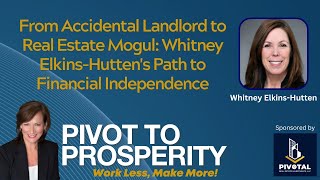
Whitney Elkins-Hutten went from accidental landlord in 2002 to partnering in $800M of real estate across 6,500+ units, car washes, and storage facilities. A relationship breakup sparked her shift to financial independence, achieved in two years. She now keeps just 3-5% in cash, allocating most assets to real estate and private equity businesses generating monthly cash flow.
Questions this video answers
August 27, 2024
Approximately $800 million
About 6,500 residential units
15 express car washes and over 2,200 self-storage units
11 states
Chapters
Are you one of the many busy professionals working in offices day in and day out? Do you wonder how some people grow their wealth fast, retire early and play on work days? Well, you're in luck because Ginny Bolling hosts this show Pivots of Prosperity where she interviews people that can do just that play on work days. Many guests have become financially free. She also interviews people that are on their journey and people that are in support roles like attorneys, contractors, brain brokers and others. Commercial real estate is the common element. She is on a mission to be sure. Busy professionals know they can own substantial commercial properties too, like apartments, self storage facilities and others, and not have to do the work managing them. Passive investing is the key. Syndications are the typical method. Tax write offs are some of the biggest rewards. Ginny and partners find the deals, build a strong team and business plan, then offer the investment opportunities to passive investors. New episodes are released every Tuesday at 12, so watch for new releases. If you want to get involved, let us know. You need to get pre qualified to hear about most deals. See the show notes for contact information.
Hello, Jenny Bolling here with Pivot to Prosperity brought to you by Pivotal Real Estate Investments. And so anything that we talk about here is strictly to be taken as discussion. There's no advice here. We are not your attorneys or accountants and giving any kind of financial advice whatsoever. And so today we have Whitney Elkins Hutton as our guest. Thank you for coming on, Whitney.
Thank you so much for having me on the show.
Yes, she is the director of Investment education@ passiveinvesting.com A phenomenal position I would say. She's also founder of ashwealth.com, author of Money for Tomorrow, how to Build and Protect Generational wealth, published by Biggerpockets, co authored the international number one bestseller Resilient Women in Life and Business, host of the Passive Investing made simple YouTube show and podcasts, and a partner as well in $800 million of real estate, including over 6500 residential units, 15 express car washes and more than 2200 self storage units. And that's across 11 states and experienced in flipping over 5 million in residential real estate. So Whitney, that's, that's a lot of stuff you've done there. So what, what do you, what was that missing or what would you like to add to that?
I that gives a pretty high level of new over 22 years in real estate. So I didn't do that all overn. That's, that's been a, that's been the.
Journey yeah, well, you got in early enough too to really see some things happen. And we were talking before coming on the air. You've, you've had some, some great connections. Why don't you talk about your journey into real estate?
Yeah, definitely. So I actually started off in real Estate in 2002, really completely by accident, an accidental landlord. I bought a house with a significant other and about a month later the relationship fell apart and I had the house all, I was the one with the full time job. So the loan was under my name, all the utilities were under my name. I was the one that could secure everything. But then I had the house, I had all the bills that came with it and I panicked a little bit thinking the house was going to sink me. So I stuffed it full of roommates. But this house was a 1960s version and had green shag carpet, psychedelic daisies painted all over the walls. It was in dire need of a rehab. So I taught myself how to do a lot of the rehab out of a book. YouTube didn't exist. It's called the Home Depot 1, 2, 3 book. Did a lot of things I should have, you know, should have done a lot of things that I shouldn't have touched, like the electrical and the plumbing. But hey, it all worked out. And long story short, I sold the property about 11 months later and made a $52,000 profit. And, and I made more money in that one transaction than I did in my day job that had me traveling, you know, sometimes upwards of 80 hours a week. And I was like, it was my first understanding that I can actually unhook the value I create in the world from the time that I spent doing it. And so I felt like I'd stumbled across like the best things since sliced bread. And I decided to do a lot more of these living flips and house hack type projects and got really good at building up buckets of equity. But then I was like, how do people retire off of this? Like, how did they leave their day job? I couldn't figure it out. I'm like, it's. The income is so incredibly unstable. And that's whenever a friend of mine said, hey, why don't you keep one of those flips that you're doing and put a renter in them. I was like, oh, genius idea. So then I started adding into the portfolio doing, you know, buy and hold real estate. But the backyard, my backyard in Colorado, it just didn't make sense. Things weren't cash flowing. I would, you know, with an eighty thousand dollar investment, I Might make four hundred dollars if the toilet didn't break for the month or something else didn't happen. So then I quickly had to learn how to underwrite property out of state, build a team out of state, and that's where the build in our portfolio really took off. And so inside, once I learned how to invest outside of my backyard, my husband and I, within two years were financially independent. We were able to create enough cash flow to where both of us could, if we wanted to leave our jobs. We had, we could cover all the expenses and our current lifestyle, but we weren't done yet. We had a bigger, you know, bigger life in mind. And so we wanted to figure out how to get to financial freedom. And that's where I decided, I'm like, hey, single family properties probably isn't the way to get there because I have 36 of them and it's not fun managing the manager on all of this. So transition into multifamily real estate both actively and passively, and I will say the paychecks potentially in active multifamily investing definitely could be very worthwhile if that is a passion of yours. But learning how to invest in it passively, it was really what unlocked our time freedom, our choice freedom, and our freedom to make the impact in the world that we wanted to make because it allowed us to do what we love to do best and not have to focus on being the active operator. And so that brings us to where I'm at today as the director of Investor education@ passiveinvesting.com and that's.
Yeah, that's really very interesting. And so does your husband still work too?
Yep, we both do. He works for the government. He's a, he works for the usda. He's a forester. He loves doing that. I mean, but here's the thing. He actually has turned down promotion after promotion after promotion because he loves doing field work. And so he's in one of the highest level positions in the government that still allows field work as a forester. And even today he's like, out in the mountains of Colorado. I'm so jealous.
Well, that's great. And, and that's. Yeah, I can't say it enough. Just like what you said, that to be able to keep doing what you want to do and have your money working for you so that you can be financially free and you just do what you choose to do, that's really, that's what's financial freedom really. So. Terrific. Terrific. And so, um, you have all those different assets that we've talked about. Well, what do you hold right now? What is what is currently in your holdings?
Yeah, so I'm holding you know, right now especially in, you know, the last 12 to 24 months with the run up of the Fed interest rates. We hold, you know, probably 3%, 5% of our portfolio in cash and then another 15 to 20% in debt instruments that produce monthly cash flow for us and then the rest of it is in equities, both controlled real estate as well as private equity cash flowing businesses. And I would say a majority of those cash flowing businesses is in real estate, but not all of it. Some of it is in other types of cash flowing businesses like express car washes which still has a real estate component to it, Self storage still has a real estate component to it and then also do have a little bit in the stock market. But it's not mine, it's my husband's. He loves it. He loves that whole stuff. I know a lot to get myself in trouble.
Yeah. And we should share with the audience what we were just talking about the difference. Why don't you say your view on how they compare.
Oh between the stock market and real estate. Well, part of my role as the director of investor education, I talk to investors, you know, who are their, their whole view of investing has been, you know, investing in the stock market, using the retirement funds to invest. And so when they're thinking about private equities or even thinking about going into just buying their own rental, they're, they have, they can't connect the dots very easily and they're like oh, that's so risky. Why would I do that? And I'm like, well actually once you fully understand the stock market you'll, you let me, let me spend some time with you. You'll actually now when you walk away you'll think the stock market is like a Wall street casino because it kind of is. Yeah. So real estate, you know, the, the land is always going to have value you and just like anything, you have to do your due diligence. You have to understand what your goals are, what the risk you're willing to take, what your timeline is to for investing. You have to understand the asset class, you know, on at least a 30000 foot view level. You know, but real estate, the land will always hold value. You know, very rarely does the land ever go to zero. So that's like you're already hedge right there over the stock market because your stocks can go to zero. But everything that gets built up on top of the land, you know, and this is where we had an interesting conversation before, before the show is really a bucket of commodities. It's a bucket of like metal and wood and you know, various other things that are commodity driven. And so based on certain cycles in the market, the pricing will go up, certain cycle market pricing will go down. You also have the, it combines with the value of the land, you know, how much, you know, supply and demand is happening in that market. And so it's, it's really an entirely different valuation than the stock market. And so even just those buckets of commodity that you built and put on the land very rarely go to zero. Right. And yes, it can burn to the ground. We were talking about wildfires before, before the show today. Sure, it can burn the ground, but you're going to have insurance, you know, if you're doing things right, you're going to have insurance, you're going to be able to replace that. Your stock burns to the ground. Some CEO puts out a tweet and just drives away everybody in the business, which it's happened before, guys, they can essentially burn the business to the ground doing that. And you know, there'll be some assets to sell off, but the, the actual intrinsic value was gone. And so, um, really, you know, once you start taking these things into account that in that, you know, especially in residential real estate, everybody has to have a roof over their head. We're grossly under built in the United States for residential real estate, depending on what numbers you look at where either 3.3 or 10 million homes, residential units under built. I mean, there's still a lot of potential in real estate. So I'm a fan for sure. And I'm not thinking, I don't say that it has to be all of somebody's portfolio, but you know, definitely you should consider adding, you know, a portion of real estate and you know, those type of private equity assets to your portfolio.
I totally agree. And so there's two other things I want to get to talk to you about before we run out of time. One is car washes. I have never started truly looking at those. But the other is how do things work inside passiveinvesting.com because I'm wondering if you get to look at, if you're weighing in on some of the deals you guys are looking at. So those are the two places we're going. You pick what we talk about next.
Yeah. So you know, @ passiveinvesting.com you know, we are set up as a private equity firm and so we have managing partners over each of our verticals. And we do multifamily self storage, express car washes, we do hotels as well. And then we also have a private real estate debt fund that funds fix and flip property. Very conservative, very plain vanilla. It's like an amazing investment for this time in the market. But we have managing partners over each one of those verticals. And then it rolls up into our two managing partners that oversee the entire business. And then we have that team that supports the managing partners, the umbrella part of the business. That's where I fit in, is helping investors identify, if they haven't done the work already, understand what their goals and the risk and their timeline is, and helping them figure out, you know, which of these asset classes would be a good fit for them to take a look at, to include in their portfolio. And the cool thing about how we're structured is somebody can actually do the due diligence on our, our entire company and get diversified within one overarching umbrella. So that's, you know, can be really cool for an investor. Now one of our verticals, like you said, is express car washes. It was something that we've been looking at, you know, since 2019 and especially when we started seeing the rise, you know, take slow take up of interest rates before they finally exploded. But what we were for sure seen in the multifamily sector was the compression of cap rates and the compression of cash flow that was happening long before this run up in interest rates. And our investors were still chasing yield. They wanted something that was still going to, you know, produce consistent cash flow, but give them a nice equity bump in the end. And so we we spent a lot of time researching various industries. You know, what, you know, who did we have on our staff, what strengths did we have, you know, what industry would, you know, could we bring in and that our investors might be, you know, attracted to. And one of the cash flowing businesses we took a look at was express car washes. Now the car wash business is a $38 billion and growing industry. It's growing annually like about, about 4% as a whole. But the express car wash sector is growing almost double that clip. So we're in a unique time in history to where investors can get into an asset class before it kind of takes that hockey stick growth. And you know, this is kind of harkens back to where self storage was before, you know, back in the early 2000s. I mean, self storage has been around for a very long time, but you know, it was really like in the early 2000s, where it started hitting that hockey stick growth, our mom and pop, you know, operators started consolidating, you know, into larger private equity partners. And that's what we're seeing here, is that there's a, a lot of opportunity to scale there. Now if you don't know an express car washes, it's, you know, take a full service car wash, where you got an army of people that's labor is very expensive, and combine it with a car wash that's attached to a, you know, service station, a gas service station, and slap them together. So you get the, you get to leverage technology in the tunnel to be able to, you know, know what kind of membership somebody has, what kind of wash. They get wax, they get shine, they get all of that. And then at the end, you know, it dries the car. And if the member has a, you know, vacuum package attached to their membership, you know, there would be somebody on staff there to help them clean the interior of the car as well. Then most of us are just looking for that kind of fast food. Like our car is really mucked up and dirty. Let's just run it through the car wash really fast, maybe do a quick vacuum ourselves, and away we go. We're done in five minutes. And that's what an express car wash allows you to do. But really what we're trying to do here is, is take advantage that it's a heavy, cash intensive business with very low, you know, if you operate it correctly, with low operational overhead. And so our members might be paying 25, $35 a month, but the actual car wash itself is 83 cents. And when on average the member is washing their car about 1.82 times a month, that's a really big margin for us to cap there. Now, of course, we still have to maintain the property, maintain the equipment out of those funds, but it leaves a hefty margin for us to be able to distribute to investors.
Yeah, it definitely does. So the ones I've seen are more freestanding. I haven't seen very many attached to a gas station here in Orlando.
Yeah, the ones we're doing, we even do our own ground up development. They're all freestanding, the express car washes. But I think you need to help people understand what one is like if they, you know, Florida, you probably know what one is. But somebody like in, like Kansas, they may not know quite yet what I'm talking about. And so, but most of us have seen that automatic car wash that's attached to a gas station. And so if we can, you know, take that tunnel and expand it by, you know, you know, 10x so you can fit multiple cars through at the same time, I think people start now to understand. Oh, that's what we're talking about.
Yeah. So that also ties into a question I constantly hear where people are saying, well, so when we're in a recession or close to one, doesn't the car wash suffer? What's your experience been over the last year?
Yeah, well, so the car wash business, it is different than actual real estate. So remember here we're not, you know, going to have, you know, a set lease, like a multi family lease, that that tenant is contracted to pay month over month. We have a seasonal business. So one we have to, you know, an investor has to understand their seasonality. Now car washes in Florida, maybe not that much seasonality, but like, you know, we, we even had, you know, our car to two of our locations in Birmingham, Alabama were offline for 20 days because of weather. I mean, the pipes would freeze if we ran the car wash. Right. So you have to understand that there's some seasonality to your business. Now, I know you asked about recessions. Here's the thing. In a recession, people actually have to take. The data shows that people actually have to take better care of their cars. They can't trade up, they can't go buy a new car. It's more costly for them to do repairs. So they actually are going to wash their car more often and you know, get, keep it clean, keep it in good repair than they would if it were like in good times where we see people trading up into new wheels. How many right after, you know, Covid, what was it the next summer or two where you could get 96 month financing at 0%? How many people got a new car that could qualify? I mean, I feel like there was new cars all over the place.
Yeah.
In my town. But, you know, when times get tough, you know, you know what we saw at the beginning of COVID we actually saw that you, you know, our car washes were doing better because people were like, I don't know when I'm going to be able to get a new loan. Like this car. I thought it only had to last me 12 months. Now it's got to last me 36 months. Months. So I need to take care of it.
Interesting. Very interesting. All right, so we're at that point in the podcast. I need to ask you the pivotal question. Is there a pivotal person or event that happened to you or that's compelling you forward to put you where you are today.
Oh, my gosh. I. You know, I've had so many, like, little inflection points where you're just like, this is, like, serendipitous that this person. Person is talking to me right now. It was my realtor back in 2002 that put the book Rich Dad, Poor dad in my hands before I bought my first property. It was my friend at a. That we went to a real estate conference, and I ran into, like, the first two business partners that I was with. I ran into one of them in the women's bathroom line at this real estate conference, and we got to talking. We were one of 10 women at the conference. The men's bathroom line is running around the building. Her name was Annie Dickerson. I got to meet her. I got to meet Julie Lamb. They connected me, like, you know, with my. You know, where I'm currently. Currently at with Dan Hanover and Danny Randazzo. But, you know, even now, like, another call out. I'll make one more. Julie Gates. I was standing. I had just made a presentation at the Bigger Pockets conference a couple years ago, and they asked me. I couldn't see that they were asking if I wanted to write a book about my money for tomorrow presentation. That I did. And she, like, just gives me this big old elbow. She was like, of course she does. I was like, yes, yes, they do. Oh, they were asking me to do that. So I'm like, how do you write a book?
Oh, that's terrific. That is.
That is.
And you can. You can nominate any of them for local legends or pivotal people like we were talking about.
Oh, my gosh. I mean, pivotal. You know, pivotal people.
Let's pivotal people all three. Okay, very good. Okay, I'll get offline. I'll fill you in on the next steps then. But that's terrific. So I want you to share how people can get in touch with you. Remember, some people are maybe only listening, so you'll want to spell things out. Go ahead.
Absolutely. Yeah. And I. You know, here's the thing. You know, somebody might be scratching their head and go, why did Whitney name, like so many people is because we have those gifts in our life that, you know, it's one of the lines from my favorite song. Like, once in a while, you get shown the light and the strangers the places. If you look at it right. And so you might miss that gift. But then, like, you know, if somebody just kind of like, touches you on the forehead, you go. The light turns on. Right. So that's why I'm so excited to have, you know, shown people that I've had multiple inflection points. Yes. You can reach out to me if you're interested about directly investing in private equity real estate, you can reach out to me at Passive Investing with Whitney.com. i've got some free goodies. You can get access to my calendar there if we want to talk all things passive real estate. And if you're looking for one on one support, you can reach out to me@ashwealth.com a s h wealth dot com.
Terrific. Okay. And we'll put all that in the show notes, of course. And so I want to thank you so much for coming on the show.
Yes. Thank you so much.
More from Ginny

Dr. Calvin Lowe Saves Lives 2 Ways: Pediatric ER & Teaching Overworked Med Pros How to Get $ Balance

Turning Construction Expertise Into a Thriving Real Estate Empire With Eric Schultz

Build-to-Rent, Community & Cash Flow with Pivotal Person Award Recipient Andy McMullen



Investing Beyond Boring Real Estate: Oil, Gas, and Industrial Properties with Keshav Kolur


Unheard of home prices: $225,000+/- in Portland! John Laine - Breaking Barriers- Home Affordability!


