Building Better Places - Kimley Horn's Nathan Milch, AICP Talks About Pre-development
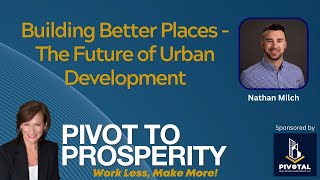
Recorded interview (May 28, 2024 upload) with Nathan Milch, an urban/land-use planner at Kimley Horn. Milch describes Kimley Horn’s multidisciplinary services and his focus on pre-development: analyzing zoning and future land use, advising on rezoning or comprehensive plan amendments, preparing due-diligence and concept plans, and representing clients through municipal entitlement processes. He discusses trends toward form-based codes and place-making (mixed-use, pedestrian-oriented development), challenges in Orlando such as induced demand and the need for transit/density, and practical site issues using I‑Drive as an example (utility relocation, build-to lines, limited access).
Chapters
Foreign bowling here with Pivot to Prosperity brought to you by Pivotal Real Estate Investments, where we help our investors build wealth and income through commercial real estate that also improves communities. And today we have Nathan Milch in our midst here. Thank you for coming, Nathan. Appreciate it.
Hey, Jenny, thanks for having me on. Happy to be here.
Yeah. Well, so Nathan is an urban planner and he's been with Kimley Horn now a couple years and was in a planning position for several years prior to that and worked for the city of St. Cloud as well as the city of Winter Park. And he has a great background, especially in pre development, and is going to talk with us about the trials and tribulations of planning new development, especially here in Florida where it does get challenging. And so thank you for coming. Nathan, why don't you tell me what I didn't already say.
Yeah, yeah, sure. So, yeah, like you said, Nathan Milch, I currently work as a land use planner for Kinley Horn, which is a planning and design firm that offers a whole lot of different services which we can get into a little bit later. But yeah, I just work primarily around, you know, central Florida and in the Orlando market. And I've had an opportunity to, to work on a nice diversity of projects. So you never, never get bored not, not doing the same thing once, that's for sure. Or twice. That's, that's for sure. But, but yeah, I think that's pretty much it.
Well, you know, before we go too far, we probably ought to have you go ahead and talk about all the different things Kimli Horn does. Kimli Horne's got a great reputation and we'll probably forget to get back to it later. So I don't want to lose that opportunity. So why don't you go ahead and talk a little bit about the many things that Kimley Horn does.
Essentially, Kimley Horn is a design and civil engineering firm. So in terms of services, it's just about everything that you can think of. And you know, we've got an aviation group, community planning, civil and development services, or getting an energy group in Orlando that's, that's starting to build environmental services in Orlando. We've got transportation engineering and then landscape architecture, water, wastewater, surface water, sustainable and green design, urban design, transportation planning, I already said. But we've got a group that focuses primarily on transit and rail. So. So just about everything that you can think of. I would say our Orlando group is, I think we're, we're up to like 280 or 90 folks now. So we're everyone's staying busy and we're continuing to grow. As you know, the development start the is flourishing around Orlando and the surrounding area. So we're definitely being a part of that. But yeah, I'd say Kimli Horn is. I've been here for a little over two years now and I would say in terms of a place to work, I just can't believe how efficient things are ran. And it's really great working for a company that takes care of you and then having the opportunity to work on a lot of high profile projects as well.
So yeah, I would, I would definitely say that too. You're an esteemed firm that does get some of those high profile projects. And my years at dot, there were lots of road plans that were either done by Kimley Horn or the pre development, those stages as well. So a lot of the PD&E studies and whatnot. So. Good, good. Well, so tell us more about what specifically you get into because I know you enjoy what you do and I think it'd be fun to have you talk about it from maybe a start to finish kind of approach.
Yeah, yeah, sure. So I guess what I specialize in is the pre development and design side of a project. So essentially a lot of our clients which are either developers or home builders will reach out and they'll give us a parcel ID or an address. And you know, in a lot of cases we have an understanding of what they do already, but with new clients we, we understand what they're looking to do on the site and, and how that would pencil out, I guess. And then if we essentially you go into the code and, and you look up the zoning and the future land use which something that would be good to know is, you know, a lot of folks in, in Florida or folks that work in land development don't. Future land use is, is very important and is a, is a crucial part of, of a property. People, a lot of folks just understand that it's just, you know, the zoning can I do what I want? But there's, there's, there's some more to it than that. But essentially we look at these properties and, and if they can't do what they want, then we figure out a path forward for them. If that, you know, needs to be a rezoning or a comprehensive plan amendment and then essentially help build out a timeline on how to get those approvals. And then if we think there's no way that it's going to happen, we'll, we'll let them know and they can move on kind of Thing because we work with all these municipalities so, so closely that, you know, I can tell you what a lot of the folks at Orange county are going to, are going to answer before I have to ask the question. So a lot of times we can let our clients know up front and save a lot about that. Back and forth.
Yeah. And that dovetails right into what we were talking about before we got on the recording here. And that's what Kimberly Horn is helping a lot of cities and counties rewrite or write maybe the first. Well, I guess it's no first codes anymore, but land use and codes. So that's huge to have that kind of sway when you're representing a client, too.
Yeah, yeah. It's nice that we're working with the public side on rewriting a lot of their, you know, their land development regulations or helping update their comprehensive plan. Because these are the, you know, the two main documents and governing documents in any area around Florida at least. But, you know, when there's always that you're kind of on the fence where at the end of the day, it is always the municipality and their staff that are going to be making these decisions or the elected official. And, you know, we're just a consultant and, you know, we can suggest what will be best or what we think will be best, but kind of get stuck in a spot sometimes where they're like, oh, well, you guys wrote the code. Like, you can just, you know, you, you can just tell the county that this will be good here. And it's like, no, it's not how it works. Sorry. Because at the end of the day, you know, what we want when we're doing, when we're writing these codes and helping update these plans is for positive development that's going to help the community and going to make great people. Places where folks are going to want to go, where folks are going to want to live and work in the future. So there's a, you know, if, if you go ahead and just, you know, we, there's always an option to keep working through, you know, single family subdivisions. We've got a lot of those around Orlando and it, you know, continues to, to sprawl out further. But at the end of the day is, is that the type of. Sometimes I feel like that's not the type of development that's going to make Orlando a better place. So. So, yeah.
Right. And so that's two things that I'm going to want to talk to you about. And I think one of them goes back for a second. We'll do this first. On the code that's being written, are you finding either Kimberley Horn or the cities and counties? The movement is towards place making where it's more pedestrian friendly and less cars and more, more walkable. Is that the movement you're seeing?
Yeah, that's definitely the trend. And what's going on in Orange county, for example, in September of this year they're intending to adopt the new Orange code and the Vision 2050, which I haven't worked too much on, but it's been a lot of my coworkers and colleagues over at Kimlay. Um, but essentially you know, the, the system that we have in place, it was adopted. I think the, the court case was Euclid v. Ambler in 1926 and that created Euclidean zoning which is complete separation of land use. So in a lot of places right now, you know, you've got, you got commercial zones and you've got residential zones so you can't mix them. And that essentially just gives you your, you know, your standard box, like big box retail development and single family neighborhoods. So in Orange county right now there are some mixed use districts. However, you can't, in some cases in a straight commercial site, you're not, you can't even put residential on there and you couldn't create like a mixed use development. So what a lot of places are doing now is they're switching to a form based code which is a code that's based on, you know, creating places and place making like, like you had noted before. But essentially it allows for that mixture of uses, but it does it in a way that, that makes sense and is context sensitive like mailman, who's got to attack. But, but, but, yeah, so, so basically that's the, that's where a lot of jurisdictions are transitioning into, into a form based or transect based code where you have like a, essentially a, a compatible land use next to another compatible land use. You're not going to end up with a 20 story multifamily tower or commercial tower next to a single family home.
So I'm glad you got into it like that. I didn't, I didn't ever really relate to what form based truly means. And you're making it sound like it's like mixed use.
Well, it allows a lot of more flexibility in uses but it basically allows you to have more predictable results and create that public realm using physical form rather than a straight up separation of uses. So like a lot of form based codes will more so address the relationship between a building facade and the public realm and have larger sidewalks and push people for cafe seating and really activate that public realm rather than. And if there is street parking, put the parking behind the building and have the building up against the right of way and frame the edge edges so that you're not driving by and looking at a, you know, a building way on the back of a site and you're looking at a parking lot and you put the Parker behind. Is. Is one of the things that most places are requiring now. So. Yeah.
And is the idea that. That you'll see more form and interesting buildings as you drive a road as opposed to parking lots and. And miscellaneous site improvements?
Yeah, I think that's part of it. But I think the big part of it is like you mentioned before, that place making and creating people places where it's like you can. Like Park Avenue is a pretty good example. It's a place where people want to go. And over the years Winter park has done a really good job of fostering that type of environment. And they're working on it on Fairbanks now. But there's a lot of portions of Fairbanks, for example, that are that older style development where there's parking in the front and buildings in the back. But anything going forward, they're generally going to require you to have the building up front and create more people places.
That scares me just a little bit. I've cut so many buildings because they were too close to the road.
Yeah, well, and then that's the thing in Orlando and you worked in South Florida a whole lot. But we're not at the point where our traffic is so bad that no one wants to drive. And I think that in South Florida there's a lot of. That's kind of the case in a lot of areas. But essentially from an urban planning perspective, you're not going to like you. You need the investment in public transit and you know, bike, pedestrian paths and you know, bus Systems and the SunRail expansion that they're talking about. You, you need that investment and you need public transit to be functional. And that's the only thing that's really going to ease up the congestion on the roadways is if people are off the road and using more efficient methods of. Of transit. So yeah, there's a concept called induced demand that I'm sure some folks are aware of. But essentially they say that when you expand and add another lane to a roadway, then I think it's like a year and a half or something that, that it's, it's going to move more efficiently for the meantime. But within a year and a half there's going to be more people on the road and then the exact same level of congestion out there. So rather than build another lane, build a giant bike path and put, you know, and put transit stops and invest more in public infrastructure rather than doing that. And that's, that's good urban planning essentially.
Yeah, I'm totally for the mass transportation and that kind of thing too. And I, we'd say that what you just said begs to ask you for Orlando. Are they, where they're, they're having the buildings come up closer to the street. Is the street now going to have dedicated bus lanes or something for the mass transit to help that away?
So that's the, that's the challenge, I think, I think that's the idea. And there's better planning going on in the background with like, I've got some, some old, some classmate from, from grad school that work for Lynx that, that are trying to, you know, better plan out these routes and, and figure out efficient systems for this. But the hard part about Orlando is we're, we're pretty pretty big like geographically like area wise. So you need a certain level of density to support, you know, public transit. So in a lot of places where there, you know, is single family neighborhoods where like I had mentioned sprawl earlier, that's just continuing to be like more of a cost burden on the local governments because they have to run infrastructure out there for just single family homes rather than if you have a Baldwin park where there's a mixed use community where people can live, work and play and ride their bikes there, that makes more sense from an overall cost perspective for infrastructure. But also people can walk places. Whereas if you build a single use, single family subdivision, in a lot of cases those people have to drive because they have no other options and that just adds more to the congestion. It's, it's a big feedback loop, essentially.
It is, it is. And we know there's funding for more transportation. It'll be interesting to see how, how it gets actually used in Florida. But, so let's go back to the site specific discussion and if someone has a property and they're trying to figure out what they can do with it, would they ask you to tell them what the, the best thing to do with it is? Or, or do you, do you weigh in on the economics that, do you do a feasibility study at all?
So, so a lot of the times what I, I don't, I don't work personally on the economic side. We we do have, not in our Orlando office, but I believe in a couple of our offices nearby that will do like a market study or a feasibility analysis to understand what the highest and best use is. A lot of times our clients already have that idea or they're developers that have a bread and butter kind of thing that they work on. But I would say a lot of times when, when we get started, they'll, you know, they'll be like, hey, here's a piece of land. We want to do this. Will this, will this fit? And does, you know, would the municipality and the regulations allow for it? So we'll go in and we've got a lot of really talented designers and we'll go and we'll pull the, the shape file from online, which we, we use this software called GIS and we'll, we'll bring a shapefile into AutoCAD and then we'll essentially design the site to scale and say they want townhomes. We'll have the townhomes make sure that there's enough stormwater on site. And our access is always a big thing to, to deal with. But essentially we'll design a site and then, and then a lot of folks will ask for a due diligence report as well. So we'll put together this pretty comprehensive report where we'll outline essentially the, what they can do right now and then the process forward and how long that would take and the cost in terms of like, will do impact the estimates, that kind of, that kind of stuff. So then usually they can take that. And, and a lot of the home builders require their, their lenders require a due diligence report to get approvals on those funds too. So that, that's more so in the case of the home builders, where we'll do the concept plan and due diligence report. But yeah, and then they'll, they'll decide if they, you know, they'll have it under contract a lot of times when they come to us, and then they'll, they'll use some of our research to negotiate if they're, if they need to extend their, you know, due diligence period and so on. But yeah, so then if they need to go through like a rezoning or a land use amendment, then we'll help them along that way so that they're pretty comfortable with what they can do by the time that they actually own the property.
You would actually fill out the applications and attend any hearings that would be either with staff and, or open to the public with and for the owners and potentially be the one to step up to the podium.
Yeah, yeah. So we will go up and it's always good when you know, our client or the developer, the builder is there at a public hearing to show face. But yeah, we guide them through the process and you know, essentially get them to the point where they can, they can do what they want on the property and you know, and, and we act as that liaison when we're negotiating on a site with, with staff. So because sometimes you know, like for example, I, I have a lot of friends at, at the municipalities and people that I've worked pretty closely with over the years. So I've got good relationships with them. So I don't necessarily want to be the bad guy sometimes. So then we need the, you know, the developer has to be the bad guy sometimes because if you think about it like they're the ones that are, you know, making, taking the risk, making the financial investment, taking their millions of dollars and putting it into this. So they, they, you know, in a lot of cases, you know, you have to fight for what you want and, and we help support them with all of the details and you know, the, the, the ability to fight a lot of those battles. But a lot of times I'm kind of like acting as the liaison and communicating between the developer and the, the jurisdiction to, to get those approvals.
Well, and that's key. It really is. I, I know that firsthand, but I'll tell you, you know, and you know, I do syndications. A lot of builders, developers in particular will do the land entitlement separate and then syndicate once they have permits to go vertical. And so that's when they actually get their construction loan and whatnot. And so do you get involved in any of that part of it too?
No, not. So that's kind of the thing. That's why on my, my LinkedIn profile I have you know, pre, pre development and entitlements because a lot of the time on these projects it's actually kind of funny but I work on a high profile project on iDrive, spend six months to a year, get the site approved and designed and then there's another step after that which is preparing the full on construction documents. Unless some of the engineers have questions about the intent of front, then I'm usually just out at that point, so I move on to the next one. And then you know, I, I'm at the point in my career where I'm starting to see a couple of the projects that, and you know, it's a long process so I'm starting to see some of them constructed. There's a lot under construction but you know, you know, I suspect in, you know, five, ten years I'm going to see a lot of these sites built which is going to be. Be pretty cool. So. But I just don't really see that side of the business or operations, which is kind of funny.
Yeah. And it takes so long. But you will see it because if they are indeed proceeding, then yeah, it's very satisfying. I know. So you're doing a lot of work down in the I Drive area then, are you?
Yeah, I think over the last couple years at Kimlay there's been, I've worked on three hotels that we've gotten through that I drive code which is very complex. And then there's a couple more that we have in the pipeline that are exciting ones. A couple entertainment uses. And then besides that, a lot of what I do now is there's a lot of mixed use projects that we're working on which are some other exciting ones coming to Orlando just outside of the Idrive area. But there's a couple, there's. There's two pretty dense and intense mixed use villages that I'm working on that are a couple hundred acre projects that are going to be 20 stories with you know, commercial retail on the bottom and, and residential on top and then the condo hotel split as well. So those are, you know, 5,000 unit plus over a million square feet of commercial population. So those are ones where, you know, you do the master planning side of things. And I'm sure those are the projects that should, should they go through, which I'm hoping they, they will because there are a lot of them are in process still. That would be one where it'd probably be 15, 20 year until they're built out and, and yeah, so those would be, those would be really cool to visit. And in a decade or two.
Are these public knowledge or they. Do you have to. Are some of them under wraps there?
I, I mean they are like public document submittals.
Florida sunshine, right?
Yeah, yeah. So but you know, just at discretion and don't usually, you know, say that, you know, talk about our clients like that and so on. So gotcha.
Okay, well, exciting. What's going on down there? Are they burying all those dang power lines down Idrive?
So that's why that Idrive code has been so complex because essentially you're taking all of these old areas that have been platted that have their existing access points and that code is designed for more of a master plan and there's utilities in the ground. But the new code requires a build to line. So you have to put the building within 0 to 10 or 15ft from the property line along the right of way and that's a requirement. However, you have to ask for a deviation in a lot of cases which staff signs off on to push the building back further because of there's utility easements or something of that sort of already there. So that's where it gets complex and that's where you know, my team, which is a lot of the engineers in the office come in and really, you know, figure out the cost and how they're going to relocate some of these or how they're going to serve utilities to these properties. So like for example, on iDrive it's mostly the codes catered to not allow any more access points on Idrive drive directly. So that can, that can make things complex. When there's an existing curb cut or you know, you, you're surrounded by right of way and you're supposed to, if you are surrounded by right of way you have to have building fronting on all of that. And it just, you know, it. There's a lot of like market based things that just, that don't pan out on the IDRIVE code. So I, I feel like there's a lot of folks that have to pass on on certain sites because it just doesn't make sense financially to do or based on the market to do what the code is kind of pushing you to do. So, so yeah, that's a, that's a fun, complex one. But I think our, our team has probably done the most amount of those IDRIVE projects. So we're, we're very familiar now.
But I remember when Access management came to.in the 90s and we had to do some studies on what's going to cost if we really are going to close all these driveways.
Yeah, yeah.
Amazing. Yeah, so. So I always thought what would end up happening on I drive is that the city and county or whoever might end up agreeing to do this huge pipe as a duck bank to accommodate electric and communications and maybe water and sewer.
Huge.
I mean my hands are big enough. And then you know, you put all these PVC things all through there in separation and of course electric, you have to kind of keep more separate sometimes than others. But yeah, yeah, I just figured that's what it was going to come down to someday. Nobody's talking about that.
I Mean, it makes a lot of sense. Right. But the problem is it's, you know, all separate owners, small parcels everywhere. So are you going to get everybody on board with helping with.
That's why I put it down through the right of way. Yeah. And do, do manholes all along the. Yeah. The edge of, of the right of way.
But still, I guess that just like the cost and getting everybody on board. Yeah, I mean, I mean it sounds like, it sounds like a great idea and sounds very efficient.
That's kind of what Lake Nona did with their communication stuff and a few other, I think, utilities. It was interesting. And then what they did, Nathan, was they, it was very interesting because they had us all. I worked at CenturyLink at the time and, and put everything in. And then they dedicated the streets to the city. So the city had no choice. They knew along the way that that was the plan. But otherwise the city would say, no, you're not going in the right of way or you're going in the right of way by permit, and if you have to move, it's at your cost.
Interesting.
But now in this case, the city has more burdens. But anyway, so I don't want to abuse our time here, so I got to ask you the big question. Well, first, did we cover what you think we should cover?
Yeah, I, I think so. I, I guess the only thing that sticks in my mind from what I didn't, what I mentioned earlier that I didn't address fully was when I said future land use or like the comprehensive plan designation. So just to clarify for folks that are listening, you know, you've got your land development regulations and that's like the code and that's kind of like what's current and you need to follow. And then in, it was, I think in 1985 in the state of Florida adopted the Growth Management act, which required every municipality or jurisdiction to adopt a comprehensive plan. And the comprehensive Plan is a 30 year visioning document that has details on, you know, your, your future land use, your, you know, water, sewer, public facility, infrastruct, conservation, transportation. And it has the big picture ideas and kind of that framework. So your future land use is another map. So there's your zoning map and your future land use. But.
More from Ginny

Dr. Calvin Lowe Saves Lives 2 Ways: Pediatric ER & Teaching Overworked Med Pros How to Get $ Balance

Turning Construction Expertise Into a Thriving Real Estate Empire With Eric Schultz

Build-to-Rent, Community & Cash Flow with Pivotal Person Award Recipient Andy McMullen



Investing Beyond Boring Real Estate: Oil, Gas, and Industrial Properties with Keshav Kolur


Unheard of home prices: $225,000+/- in Portland! John Laine - Breaking Barriers- Home Affordability!


