College Dropout Now Controlling $350M of Real Estate at age 25- Rob Beardsley! || Ginny Bolling
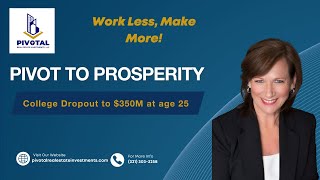
A YouTube interview (Pivot to Prosperity) where Ginny Bolling interviews Rob Beardsley about his background, Lone Star Capital, and practices in multifamily commercial real estate investing. Rob describes his in‑house underwriting model (downloaded >7,000 times), books on underwriting and capital structuring, current underwriting adjustments for high interest rates, preference for Texas markets (Houston, Dallas/Fort Worth), and strategies for raising debt and equity and building investor relationships.
Chapters
Hey, how's it sound to work less and make more? I am talking about money and there are ways to do that through commercial real estate investing and a lot of people don't know just how easy it is to do nowadays. So this channel Pivot to Prosperity will show you how you can do that. It's brought to you by Pivotal Real Estate Investments, where we go find the deals and do the heavy lifting and then bring you the opportunities. So if you want to know when opportunities come available, you need to register at pivotalrealestateinvestments.com every Tuesday at 2 for about 22 minutes. We plan to bring you another video and so like share.
Subscribe. Thank you.
Hi there. Jenny Bowling with Pivotal Real Estate Investments. And I am sitting here with the one and only Rob Beardsley. He is a star in our Mastermind. He has done a lot of work to help support the group and so I am going to let him tell about his background personally. Rob, go ahead.
Sounds great. Well, pleasure to be here. My background is I grew up in Silicon Valley, California in a real estate family. My parents ran a residential brokerage firm from home, buying and selling homes for their clients. And then on the side they did some single family flips and some development. Nothing they did was on the multifamily side. I, I went to school for computer science at Carnegie Mellon and while at school I, you know, quote unquote discovered multifamily as I was just doing research on real estate and investing. I was always passionate about investing, so had kind of somewhat of a real estate foundation through my parents and was able to jump in to multifamily, was reading all the books and articles, podcasts, meetups, conferences. I joined a mastermind group, met my business partner through it, and together we started Lone Star Capital, which is the firm that we run today. For now about five years and to date we've acquired over 350 million in multifamily properties in Texas. And we've also launched our own in house property management and construction management platforms. So yeah, it's been a good ride.
Yes, most definitely. Most definitely. Last five years have been terrific too. I wish I had jumped in a little sooner too. I, and then I got, you know, with COVID I got little cold feet thinking people aren't paying rent, right?
So did I. Yeah.
And man, those are the best years really for, for appreciation and whatnot too. But so you rode that wave better than anybody else I know, you know, as far as start time and, and whatnot. So that's terrific. And so, along with that, I believe that the underwriting work that you've done has become your landmark, your mainstay. Right. Tell us a little about that.
Yeah, so a little over a couple years ago, I published my first book, which is called the Definitive Guide to Underwriting Multifamily Acquisitions. And that was a deal or a book about our underwriting process from start to finish. Very straightforward, very detailed. And it is accompanied by the underwriting model that I built from scratch, spending, you know, probably over 200 hours developing that and retooling it over and over. As we've underwritten, you know, over 2,000 deals through the model, we've been able to really hone not just the process, but also the model itself, which, I mean, it's nothing too complicated. It's just an Excel spreadsheet that we actually give away for free on our website. But that, like you said, has definitely made us well known in the industry as a lot of people have used that model. You know, the model's been downloaded over 7,000 times and is used all around the country. So, yes, the book was a very big success to kind of add onto the model, give the model context for those that really want to go deeper in both their understanding and their application of underwriting, which is just simply the financial analysis of acquisitions.
Correct? Yes, yes. And if you remember that. But, you know, I was an appraiser back in the 80s, which is kind of a similar thing. You know, the. The turmoil or at least the. The unpredictable environment we're in now. So while we're going to come back to your new book in a minute, let's talk about that for a minute, because a lot of people are worried about what's going on. And so tell us how you're underwriting today. What are you. What. What variables are you using that are particular to this environment?
This environment is very challenging, whether you're a buyer or a seller. As a seller, your expectations are very unlikely to be met today as far as Price, because six, nine, 12 months ago, people had certain prices in their heads, and now that's becoming impossible for buyers to pay. So sellers are having trouble there. And then on the buy side, we're being very challenged, really, primarily on the debt side of things. Interest rates have risen a ton over the last nine months, and that has dramatically changed the availability of debt capital, of the type of debt structures. As far as leverage. Debt is the largest source of risk in real estate, in my opinion. And so with lower leverage, we're feeling very comfortable with the New deals that we've acquired in the last few months. And that pivot, I believe, like I said, will serve us well.
So. And are you going for agency debt primarily or other?
We found the last, you know, roughly six months, the sweet spot has been bank, bank debt. Bank debt is a bit more flexible than agency. Agency has really struggled in a few ways. The pricing hasn't been all that competitive as of late, and their underwriting criteria makes it very hard for them to put on any leverage. Some deals only size to 40, 50% leverage, which is very challenging to make the numbers work. And then it's just a very big equity check. We're finding ourselves needing to raise essentially double the amount of equity for the same size deals these days.
And you said that was with agency?
Yes.
Okay. Okay. What kind of reserves are they looking for too, for what you've seen?
Well, they don't have any reserves anymore, so they just lowered the threshold. Just lowered the ltv. Yeah. Because they're debt service constrained. So agency lenders, at the end of the day can only underwrite based on in place income. So with in place income, AKA cap rates being still very low, well, even though they've gone up a bit, they're still tremendously low compared to interest rates. So you have very high negative leverage. And that means that the debt service coverage ratio, which is simply the relationship between how much income you have relative to how much your debt service cost is, that is straining the amount of debt that the agencies can give.
Right, Right. So are you doing any bridge debt at all?
No.
Right. Okay. Are you, did you on anything recently that, that you have any concerns with?
We did do bridge loans earlier in the year before the market radically shifted. So, you know, we're, we're in that boat, as many people are, and having to deal with the effects of floating rate loans in our portfolio. So we are working now towards refinancing out and trying to adjust whatever we can away from high leverage, away from floating rates.
Right.
And really just putting the focus on, let's not, let's not worry about the upside, let's worry about fixing the downside and, and then, you know, let's worry about the upside later.
What are you looking at? And plugging in for vacancy, that's always.
Just based on usually the 1 mile radius. So we'll look at what the occupancy is in a 1 mile radius thereabouts. And you know, all the markets that we invest in are very strong. So that usually looks really attractive. Usually, you know, we just acquired A property a week and a half ago where the 1 mile radius occupancy was 97, 98%. So everything's full. So in that scenario, we're underwriting a.
5% vacancy factor and you've infiltrated kind of the particular market areas where you are in Texas, right?
Well, we do, you know, own some properties near each other. We own predominantly in Houston, where we're expanding in Dallas. So those are our two markets of focus. We really keep ourselves disciplined and focused. You know, when people bring us deals in San Antonio or Kansas City or anything like that, we, we're just a pass. We only look for now, at least at Dallas, Fort Worth and Houston. And that focus gives us a competitive advantage as far as sourcing deals and market knowledge and execution.
Right, right. I can't agree more. That's why it's real important for us to also pick our, our, our markets and try to keep up with them because there's, it's hard to keep up.
Yeah, yeah. One market can keep you busy.
Right, right. So what are you doing for exit caps? What do you, is, I don't mean to do slang. How much are you adding between your initial cap rate and your exit cap rate when you would be completing either a refi or a sale of the property at the end of the term?
So what we do is we use the data that we create through our deal flow pipeline to identify what the market cap rate is for the location and the property type that we're analyzing. And then we go roughly 50 basis points increase to that number.
Is that based on a five year hold?
Three to five.
Three to five. Okay. Yeah. So it's pretty much a tenth of a point per year. Like the old rule of thumb.
Yeah, I mean, I'm not a big fan of that rule of thumb, but you know, we just so happen to, to be around it.
Okay. Okay. Interesting. Well, all right. Well, so. And would you tell us about your book then, please?
Yes, would love to. So the new book that I just released is called Structuring and Raising Debt and Equity for Real Estate. And it's another, you know, straightforward, very detailed, very in depth guide on the ins and outs of structuring the capital stack as far as debt and equity and the relationships between the two and then also raising debt and equity as well. So getting, not just talking about different types and structures, but also how to have lender relationships, how to go out and source a lender and get the loan and qualify for the loan and get the loan and then also on the Equity side, how to raise equity, build relationships with investors big and small, and how to effectively raise capital.
What's been your biggest learning lesson, you think over the five year period that surprised you most?
That surprised me most? Well, I would say that very early on my focus was all about deals and I didn't really want to have to think or worry about investors or raising money. And that was definitely a wake up call and a reality check to understand that you actually have to, you can't just expect investors to invest with you. They have to know about you, they have to learn to trust you and have a relationship with you. So that was a big moment for us to kind of bust that myth. If you find a good deal, the money will come. We learned that lesson somewhat of the hard way. The first couple deals just really struggling to raise capital. And raising capital is still a challenge today and we continue to work hard on that every day. And I would say that is the biggest lesson.
So what is the biggest solution to that? Is it deep diving into the numbers or deep diving into the property characteristics and the market?
Well, it's neither. It's all about building relationships with investors. It's, it's about, it's about digging the well before you're thirsty, you know, making sure that you're growing relationships before you even have a deal. You know, and, and that's not always possible, but, you know, the time to be raising money is when you don't need it and when, you know, you have the luxury of time. Because once you're under contract, you're under the gun and you need to have a process in place to move very quickly, reach out to your network and get your deal funded. So that's, that's our focus. You know, we're, we're focusing on growing our network through thought leadership, through outreach, social media, as well as deepening those relationships. You know, it's one thing to just get a lot of followers on or connections on social media, but you have to actually build something out of it and, you know, kind of get people further down your, your trust funnel until they're ready to invest with you. So that it takes, it requires a proactive approach.
Right? Right. Yeah. And I'm just at the beginning end of that. I thought I knew all these real estate people that understood this stuff and they don't even know what syndications are, most of them. And so I thought I was a little late to get started, but far from it. Like, like Hunter and you guys all say, I, I thought, well, my people know about it, but no. Anyway, I know we have a hard stop at 4. Why don't you tell people how to reach you and, and we'll wrap it up.
Yeah, absolutely. So if people are interested in checking out my new book, Structuring and Raising Debt and Equity for Real Estate, you can check it out at Structuring and Raising Dot com. And if you want to learn more about us at Lone Star Capital, as well as download our free underwriting model that we that we have on available on the website, you can go to our website.
More from Ginny

Dr. Calvin Lowe Saves Lives 2 Ways: Pediatric ER & Teaching Overworked Med Pros How to Get $ Balance

Turning Construction Expertise Into a Thriving Real Estate Empire With Eric Schultz

Build-to-Rent, Community & Cash Flow with Pivotal Person Award Recipient Andy McMullen



Investing Beyond Boring Real Estate: Oil, Gas, and Industrial Properties with Keshav Kolur


Unheard of home prices: $225,000+/- in Portland! John Laine - Breaking Barriers- Home Affordability!


