Diana Lin Found More Independence & Control Leaving her Architecture Job to do Multifamily Investing
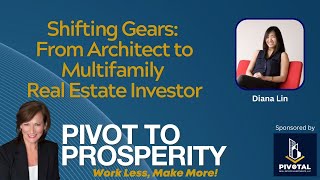
This content was created by Ginny Bolling. This content was uploaded by Ginny Bolling. This is a YouTube video titled "Diana Lin Found More Independence & Control Leaving her Architecture Job to do Multifamily Investing" created on December 17, 2024. It features a conversation between Ginny Bolling and Diana Lin discussing Diana's journey from architecture to full-time real estate investing, focusing on multifamily investments and development projects.
Chapters
Are you one of the many busy professionals working in offices day in and day out? Do you wonder how some people grow their wealth fast, retire early and play on work days? Well, you're in luck because Ginny Bolling hosts this show Pivots of Prosperity where she interviews people that can do just that play on work days. Many guests have become financially free. She also interviews people that are on their journey and people that are in support roles like attorneys, contractors, brokers and others. Commercial real estate is the common element. She is on a mission to be sure. Busy professionals know they can own substantial commercial properties too, like apartments, self storage facilities and others, and not have to do the work managing them. Passive investing is the key. Syndications are the typical method. Tax write offs are some of the biggest rewards. Ginny and partners find the deals, build a strong team and business plan, then offer the investment opportunities to passive investors. New episodes are released every Tuesday at 12, so watch for new releases. If you want to get involved, let us know. You need to get pre qualified to hear about most deals. See the show notes for contact information.
Hello, Hello. Jenny Bowling here with Pivot to Prosperity brought to you by Pivotal Real Estate Investments. And today I have with us Diana Lynn. Hi Diana, thank you for coming on.
Hi Jenny, thank you for having me.
Now we connected because we are both members of Crew, which is commercial women in real estate. I wish I had connected with that a long time ago. I would say that it's one of the best groups of professionals I've ever been a member of and I've known about it for a couple decades I think, and I never did join, so I'm really glad I did. But in any case, so you're located in Dallas, Fort Worth. Tell us, tell us about you and your journey and exactly where you are. And Dallas, Fort Worth is very big.
Yes, of course. So I was actually born in Houston, Texas and so I've made my way to Dallas because my husband's from Dallas and we just ended up agreeing that we'll live in Dallas. So I'm a full time real estate investor focused mostly on multifamily investing. Before I became a full time real estate investor, I was a practicing architect. So I practiced architecture for about 10 years. And getting into architecture, I actually graduated during the last recession in 2009, 2010. So at that time as a freshly minted architectural graduate, there wasn't a job for me. So because there was no job in real estate, especially during recession, my husband and I ended up going to China to find a job and so my, my husband back then, my boyfriend at that time, he. He's a real estate attorney. So he got affected by the recession as well. China had a lot more economic opportunities to. For job opportunities for us in our industry. So I found a job, my first job in Beijing, China. He found his next job in Shanghai, China. So we did long distance for a little bit. I practiced for about two years there and we both end up coming back to Texas and landed ourselves in Dallas. And so I worked in Dallas and about another four or five years until I learned about real estate investing and heard about this concept of multifamily investing through syndication. And so in order to kind of understand how investing worked, we start to first passively invest into these type of asset classes. And that started about 2018 and 2019. So. And that around that time is actually when I left my full time architecture job because I was more interested in investing in real estate. And then afterwards, three years into investing and still kind of doing a little bit of architecture is in 2021 when some of our passive investments in multifamily actually went full cycle and sold. So we saw the proof of concept of multifamily investing. So that's when I decided instead of continuing as a passive investor in multifamily is when I shifted to become a full time sponsor or a general partner into these deals. So I've been a GP since 2021, still am now and back then it's more on multifamily, value add, properties, asset classes and, and shifted a little bit more into multifamily development. So that's kind of where I am right now.
That's, that's great. With the decision to sell in 2021, things were hot. Oh my gosh. With COVID everything, you probably did really well with those, right?
Oh yeah, yeah. It gave us a false impression that all the deals do that.
Yeah, yeah, yeah. We were talking before we came on. I started out in a recession as well because I was an appraiser in the 80s during the savings and loan crisis. And so, so a lot of that. And I can understand that's kind of a bleak way to get started and.
Right. But then when you're in the bottom, you can only go up. Right. Well.
And so we should speak on that because everything was going up, up, up and I launched my company and I was going to. In 2020, I was getting off of a yacht with all these investors. Actually it was a cruise and one person was medevaced. It was May, March 8th and we weren't sure if we'd be able to get off because of COVID but we were able to get off, but I thought, oh, maybe I shouldn't launch the company if people aren't going to pay rent.
Right, right, right.
So I held off. I wish I had proceeded, but so I watched and I observe a lot too, but yes, so, but everybody got fomo, right? And the time to be buying is now that it's down here and people think we've bottomed out now. So. So yeah, this is the time really to be buying, so.
Right, right. I mean, by the time I graduated, I didn't have any capital to invest in real estate in the beginning, but I saw that trajectory of everything going up and up and up and then. So me and, you know, a bunch of other millennials at that time, we're just going to wait for the next crash and then we'll invest. Right? But like even since 2013, 2014, when me and my husband were looking at real estate, my husband always kind of make fun of him. He's like, we're in the top of the market. And I was like, okay, you know, we'll wait till the next crash. And crash just never came. Right. So until much later. Right. So all of it just kind of held on to our capital longer than we should. And if we were to invest back in 2013, 2014, I think that our net worth would have been a lot higher than it was before. But anyways, we live and we learn, right? So when we did invest in 2018, even then we're kind of nervous that we're still investing on top of the market and then. And yet investing to an asset class like multifamily, Whereas typically a 5 year hold ended up being a 3 year hold was like 1.8 to 2.3x equity multiplier. So yes, the market helped, but we, you know, at least got an exposure of understanding how multifamily works as an investment. And so I think that even though we are entering into a down cycle, we're going to learn the most from these type of environment. Right. Especially if we are currently operating one or are we invested in one. Right?
Yeah. And we have something else in common. We both are used to working with people that have been, that have degrees in their discipline. Architects, the land planners, the attorneys, all these people that should have the best grip on the market, right?
Oh, yeah, yeah.
So we think we do and we think we. And but you know what the lesson learned is nobody does. Yeah, you got a dollar cost average Pretty much to get into.
Right, right, right, right. I think, you know, we, I reflect back to kind of my training as an architect. We kind of were trained to learn our profession really well. Right. But we're not trained to be an investor. We're not trained to be a developer. Right. We, we don't understand or we're not honed in on the risk taking aspect. Right. So that's more of a school of hard knocks. You kind of have to do it to get comfortable with it. I think as a professional, we're just used to getting that comfort of the bi weekly check from our W2 job. And so why take the additional risk of putting additional capital into real estate that you may not get end up getting your money back? And that's the worst case scenario. Right. So that's, that's why you don't see a lot of the professionals really pivot or jump into real estate investing. But you know, we still see folks like us who do leave our full time professional job to get into real estate investing. And we don't regret it because, you know, we're, we're learning and we're getting better at it. Right.
Well. And we all get busy with life and we're focused on our job, which demands a lot of hours. So it's almost like we have blinders on. And I mean, lordy, look at me. I was negotiating acquisitions for the state of Florida and for cities and counties and I was dealing with syndications. I was buying from them and I didn't think about me getting in them. It was like busy doing my work.
Right, right, right, right.
And so it was like in 2018, it was like a light bulb moment that I can be doing this. I didn't, part of it is I didn't know the laws had changed. You know, the Jobs act of 2012 and 2017 give a rebirth to syndications.
Right.
Sophisticated investors can get in.
Right, right, right.
Makes a big difference, but.
Right, right.
So.
But I would say that, you know, your experience helped you become. You have a lot more perspective and insight on how it works versus someone who didn't have your line of work. Right, yeah.
Oh, right, yeah, yeah, for sure. Because, yeah, we truly had to transact with them too because, you know, when you're buying right of way, you might be cutting off a parking lot or part of a building or demolishing building. So we had to deal with the syndications. We had to get approvals for, you know, when we did hit a property that was a syndication.
Right, right, right. And to give you kind of a little anecdote about my personal experience as how my architectural experience did help in one of our syndication is that, you know, we bought a 22 unit and one of the space is a laundry room that we can convert to a studio. So we knew we're planning to convert it and then we hired an a local architect in Phoenix area to help us with the permitting process. And I, because I this is my line of work, I reviewed her drawings and saw that it wasn't quite professional. But then at the same time it's still like a tiny unit, it's only like 400 square feet. And so she submitted the drawing set to the city and the city came back saying, okay, if you want to convert one unit into a studio, all 22 of your units need to be up to code and install like a fire sprinkler. And that's a prohibitive expense that you want to do on a C class property. Right. But the thing is that the architect didn't try more than that. So I started digging into the code and saw that we can Adapt to a 2022 IECC International existing building code, something like that instead of the 2018. So put together a seven page code study that we submitted to the city and then I worked with city directly because our architect either didn't really care or didn't have the knowledge to push for what is favorable to the owner. And so I took control of that process. Ended up we got approval to just do fire sprinkler in one unit instead of 22 units. So um, in that sense it helped us in that project. So even during like doing design aspects like designing the signage for the property itself, that's something that I took on myself, that the signage vendor itself provided unsatisfactory design to me that I didn't like. So took that on as well. So there's a lot of aspect that is helpful when you are a professional in certain industry and also get to utilize my husband's expertise in real estate law to help us during the transaction as well.
Yeah, I'm sure you add value in a lot of places like that and people like us aren't afraid of permitting and talking to the government officials at all either. So that.
Right.
Actually I just was doing the podcast with the guy a couple hours ago and he, he off the air he was saying that him and his dad are working on a dot thing and I gave him a couple pieces of advice, but it sounded like because this is a small town, I said you might want to just take some cookies in there too. Amazing what some cookies can do.
Right, right, right, right. Can imagine. Yeah.
But yeah, so no, I'm sure you add value in a lot of things like that because you know what it should look like and you know what's unreasonable. And a lot of people that are working in these places, well, not as much the big cities, but they, they, you know, don't necessarily know or read it or interpret it quite like what the legal world does, you know.
Right, right. And then, you know, one of the things that does give me exposure being an investor is knowing how to raise capital or to put together a deal and to partner with those that complement your skill sets. Right. So that's something that I'm still learning, but finding it's pretty crucial to, to have as part of the investment process.
Tell us about the project you have under development now.
Yeah, yeah. So I'm working on my first development project and that's in a submarket outside of Albuquerque, New Mexico is called Rio Rancho. It's a, a booming suburbs outside of Albuquerque. It's really close to the intel campus. So this, this piece of land is prime for multifamily because there is a shortage of housing in general throughout the city and lots of single family home developments are happening in the area. But there isn't enough multifamily. So we're going to be one of the first to come into the market. 150 unit and we're getting close to pulling permit on this, on this deal. So super excited. Part of a team and one of them is a strong partner who has about 20 years of experience as a developer. So we're excited about it. I'm excited because as an architect I've always kind of wanted to be part of a development so able to utilize some of my experience working on other projects in the past to help this project come to realization.
Let me ask you.
More from Ginny

Dr. Calvin Lowe Saves Lives 2 Ways: Pediatric ER & Teaching Overworked Med Pros How to Get $ Balance

Turning Construction Expertise Into a Thriving Real Estate Empire With Eric Schultz

Build-to-Rent, Community & Cash Flow with Pivotal Person Award Recipient Andy McMullen



Investing Beyond Boring Real Estate: Oil, Gas, and Industrial Properties with Keshav Kolur


Unheard of home prices: $225,000+/- in Portland! John Laine - Breaking Barriers- Home Affordability!


