Dr. Joshua Harris, CRE is Proclaimed a Pivotal Person in Central Florida
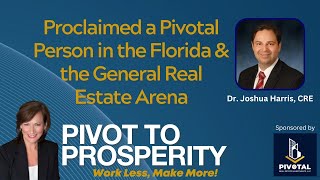
A podcast interview (Pivot to Prosperity) where host Ginny Bolling interviews Dr. Joshua A. Harris, Ph.D., a real estate economist and director at the Fordham Real Estate Institute who resides in Orlando. Discussion covers Harris's career (brokerage, MBA/PhD, Skanska USA strategy role, Fordham leadership, Crossmark Services work), mixed-use redevelopment and density economics (mall-to-mixed-use), Florida's Live Local housing law and its incentives (eligibility thresholds discussed), EV charging/parking tradeoffs, P3 involvement, and his expert-witness work on feasibility and damages models. Episode ends with Harris being named a "pivotal person."
Questions this video answers
Up to 120% of area median income (AMI).
40% or more of units must be delegated to qualify for maximum density.
Chapters
Are you one of the many busy professionals working in offices day in and day out? Do you wonder how some people grow their wealth fast, retire early and play on work days? Well, you're in luck because Ginny Bolling hosts this show Pivots of Prosperity where she interviews people that can do just that play on work days. Many guests have become financially free. She also interviews people that are on their journey and people that are in support roles like attorneys, contractors, brain brokers and others. Commercial real estate is the common element. She is on a mission to be sure. Busy professionals know they can own substantial commercial properties too like apartments, self storage facilities and others and not have to do the work managing them. Passive investing is the key. Syndications are the typical method. Tax write offs are some of the biggest rewards. Ginny and partners find the deals, build a strong team and business plan, then offer the investment opportunities to passive investors. New episodes are released every Tuesday at 12, so watch for new releases. If you want to get involved, let us know. You need to get pre qualified to hear about most deals. See the show notes for contact information.
Hello, Hello. Ginny Bowling here with Pivot to Prosperity brought to you by Pivotal Real Estate Investments. And today we have Joshua Harris as our guest.
Hello, how are you doing?
Thank you so much for coming on. I, I'm, I'm thrilled to say you're back in Orlando and it was funny because I was at a, an Appraisal Institute event and you were the first speaker. I was, I was thrilled. Yes, I was. So that was, that was great. And so I'll do a brief introduction and then you take it from there. So I know you from University of Florida where or University of Central Florida, silly me. And Raymond McGuire, Victoria Butcher and I came and we talked to your graduate class about eminent domain and yeah, that was fun. And then it seemed like it wasn't long after you were, you, you, you moved away. But I am going to let you get into that. You are an expert witness when it comes to eminent domain cases. And I know that you've been a consultant to many and that you are also a consultant in the development side and in with other real estate projects. Is it fair to say around the country or Florida or have we.
A lot of currently doing a lot of things in Florida. I did spend almost four years as head of strategy for Skanska USA's commercial development business in the U.S. we were, I was based in New York and we were active in D.C. boston, Houston, Seattle and Los Angeles. And Skansk is kind of one of the I guess you call a mega developer company. Actually we were headquartered. Kind of a very interesting experience.
Right, that's. You left the area for that job, right?
Actually, Rich, I left for New York University and then I left university. Fill in the blanks.
Gotcha. Okay. Okay. And so you're the executive director of the Florida Real Estate Institute for Fordham as well?
Yeah, for Fordham, yes. I'm director of the Fordham Real Estate Institute, which is based within Fordham University out of New York City. But I do reside in Orlando and just kind of go back and forth as I need to.
Very good. Well, so tell us more about you though. What even got you into real estate briefly?
You know, it was interesting. I originally, when I was, I guess careers, I was sort of proverbial good at math and science type kid. So engineering was something I looked at. I always had a bit of interest in construction and buildings. Just I kind of found that more interesting. Space shuttles, although that always sounds cool too. And I originally was going to major in industrial engineering and kind of get into more, you know, some of the more systems and process. Getting an internship with Hubbard Construction Company. As I said, construction is an interest. And I candidly found the internship to be very boring. Hubbard, great company, was great people. But I realized just from years and people I was working with that I didn't really want to be an engineer. So it was a decision. I'd always kind of interested in real estate and in sort of finance investments. And literally one day I'm just reading the course so printed then. And they, you know, said, well, I looked at any real estate courses they did that led me to a major called finance where they were all sort of, you know, electives within the finance major. And I said, interesting that looking at statics, dynamics and, you know, fluid heat transfer and all these other courses that be part of an engineering curriculum. And I made a decision to switch over and I wanted to get. Try to get started trying to get jobs and interests in real estate, really. The rest is history.
Interesting, interesting. So you got into real estate and then what was your first job then?
So I started working with a small brokerage where I got to do some commercial as well as residential deals. And I was still a college student at the time. I did. I worked for kind of a small, kind of private investor. I. I think, I think. I don't know if you would take. Call a family office or syndicate or some type of, you know, individual out of New York who was from this is pretty. Before the world was getting kind of overheated. And then I decided to go back to get my MBA and then began working in the debt equity or ultimately going back to get my PhD and then sort of becoming call it a real estate economist by trade or development expert or lack for the easiest way.
To describe it after having done all these different consulting types of positions and having kind of your pick probably on where you want to concentrate. Tell us what you're doing now.
So you know, I1 made the decision I'd ratherlando in Florida than as opposed to being up in New York. And especially with now the kind of flexibility to still do things in and out of New York while being here. Obviously that became a lot more normalized in the post pandemic world. That was in one decision. I'm now actually joined up with one of my longtime friends and colleagues, John Crossman, with his firm Crossmark Services. We're actually working acquisitions of retail and some development as well of retail centers and sort of associated property management primarily in central Florida.
So are you an advocate of mixed use with the residential upstairs kind of thing?
Short answer. Yes, obviously mixed use development's always an easier said than done. You know, we were obviously looking, we're working on even consulting what would be mall redevelopments that would ultimately become back as a mixed use context where you would have, you know, kind of a retail town center with a sub with with connected or apartment towers on top. So I. It's difficult and expensive to do mixed use, but I do think in a lot more markets where the density justifies it absolutely has the value.
So what kind of density do you need to make it worthwhile?
Well, it depends a lot on city by city because obviously the minute you are going more vertical construction cost and all the other complexities, you're going to go up substantially. So you need to be able to clear rents that are, you know, going to need to be probably 20 to 50%, you know, your garden or just more horizontal apartments are going to be that works obviously. And you know, like if you're close to any downtown, be it downtown Orlando or in a high density area, that can work. Now if you get the land at a very cheap basis, it can also, it can potentially work. So one advantage that retail has, and this is a big debate about, you know, there's some of these very large shopping plazas are very old that might be sitting on 20, 30, even 40 acres with large parking fields, a lot of just excess space. Some of those might make for great kind of redevelopment parcels that you probably could do that in. Really, you could do that in an affordable or workforce. But, but the key though is you have to have a city or whoever your municipality is for zoning. They have to be able to grant density because if it's, if the, if you're, if you can't go ultra high end, you can always go higher density and then service obviously a much more affordable product which there tend to infinite demand just about everywhere. All right.
So much has to do with your basis and then yeah, density and, and now the incentives. You know, we were talking before recording about the Live Local legislation and have you all looked at using that to max out the density and the jurisdiction?
I haven't worked on a direct live local. That one project I'm working on. There's some discussion of Live local would, would be useful for you know, for getting some of the tax incentives that would be, you know, for some of the units that could qualify. You know, it's still a pretty new law. I'm optimistic about it. I mean I think it was, I mean look, it's funny but outside of Florida and talk about housing and other things out, you know, it's literally up in New York. In fact, this is where for at Fordham we're doing a housing policy panel at the end of January and I think, you know, we're going to, I mean one of the things I'm going to bring up is obviously solutions like Live Local as some part of sort of a nationwide strategy approaching getting moments entitled. But it's still pretty new and I'm kind of excited to see where it goes. But I can't say I've completely figured it out. And you have to be, I think today when you're opening salvos, you have to kind of get, you know, have a lot of willingness to pay attorneys fees to probably if you're trying to fight something on it. But there are tax benefits in there that are pretty, pretty solid. So if you're project qualified, if you're, if you're developing at all in delivering projects that are going to fit up to that. I think it's 120% of area median. Median for apartments. You should definitely look if you can qualify and take advantage of it and get the tax benefits right. I mean that's what it's there for if you know, in addition to all the city local the, you know, the preemptions trying to fight off in these and things like that.
So yeah, there's, there's a lot of talk about that 120% isn't truly affordable housing even attainable it's, it's, it's really market is what some people are saying. What's your thinking? Thinking on that?
It's actually, I think one of the benefits of Live Local is that it doesn't, you know, restrict down to some of these other programs that were as restrictive as 60% of area median income or 80%. You know, it allows you up to 100 fitting something that's sometimes called the missing middle. And if you actually look at where programs or just the action you have like the low income housing credit or light tech type program. Right. And that's, that's really focused more on that 60% below AMI type of threshold. Obviously luxury kind of market. Apartments are what most developers are doing because there's been fairly abundant financing and you know, if you can get the rents to work, it works great. So you know, the, the you know, herbal firefighter, nurse and teacher that are, you know, looking for an apartment who have incomes that are probably close to median income. They can't quite afford or don't want to afford luxury apartment, but they make too much money to afford the affordable apartment. So that's sort of where I think Live Local is trying to serve. And that's, you know, I think, I think that's actually there's a lot of, a lot of market in that category. Right.
And so when you're looking at the malls and the retail and whatnot, are you, are you looking to incorporate residential really at all or not?
For the most, yes. I mean for the most part the only way these projects are probably going to make sense is that you're going to add vertical density of apartments and.
Workforce or luxury or in between.
Depends on the market. I mean I think you're definitely going to probably have some market rate type product. You're, you know, you might have some affordable components just depending on how the site plan goes. Again, I mean what challenges construction costs in just general is that, you know, you know the, as I always joke, a 2x4 doesn't tend to care if it goes into a luxury apartment or goes into universal, it costs the same labor also seems not to care. So the net effect of it is that if you can't sort of build to the, to essentially the top end of the, if you, if you can't build to the top of the rinse, it's very hard to build. So that is just a challenge. That said, with Live Local and some of the other things. Yeah. I do think that affordable components could absolutely come into play especially if you have a large municipality that you. Enough density. So I mean I, I hate to say it's the, the minute the municipality is really much going to be key on the potential of any of that.
Yeah, no, I agree, I agree. And you know, I committed one of my own cardinal sins. I, I threw in a reference to Live Local and we got talking without actually saying what it is. And, and it, it's a law that was passed in Florida over a year ago now is last legislative session before this year. And, and it was intended to help encourage more affordable housing and give tools to cities and counties and local jurisdictions for tax incentives and all kinds of other things just for the audience. And so that's what we're talking about. And so what it provides for though is that you can get the maximum density within a jurisdiction if you delegate 40% or more of your units, your apartment rentals to this affordable housing. That, and we were, that's where we were talking about what's called affordable. And it's up to 120% of AMI, which is adjusted median income for that area. So. Yeah, yeah. So let's go to, for, let's pivot a little bit. I would like to touch on what kinds of things you testify about and help the audience know the kinds of things that you can offer because you're an expert in those, those areas as well.
Right. So I, I typically am called on as sort of a real estate economist or a real estate development expert. Occasionally I've had this goes back some of my unique background. I've had real estate license law standards of practice type cases. They're slightly different, but in sort of the same, you know, some of the same thing coming in. As sort of a professor expert in those areas, I could be building damage models. So if you have one party that, you know, lost their project due to the actions of a different actor, they needed a damage model for how much they should be compensated. That obviously the, in the imminent domain, I'm usually doing an economic analysis or development feasibility analysis that then becomes what's considered predicate material. But the appraiser who has to ultimately decide, you know, the appraisers are battling over ultimately with the, the compensation. I'm supporting them by opining on the market forces or the impact. So which obviously depending on which side either once, you know, hopefully to get high or lowest value. So generally there are always disputes about real estate from either landlord, tenant or investor, lender, owner, lender, developer and purchaser. You know, something that arises where either the value or the market action or function or the standard of practice that gave rise that dispute. I'm sometimes called on as an expert to help guide the parties as well as the courts and if there's even a jury to making the right decision.
Right. And so often that gets into feasibility studies and things like that and cost benefit analyses and so all types of things.
Yeah.
I was just at a presentation by Kimberly Horn on EV stations and where that technology is. Have you done any kind of feasibility studies on evidence EV stations?
When I was with Skanska, we take. We did a lot of analyses on electric vehicle, you know, a lot of autonomous car and parking solutions. You know, Skansk had a. Has a strong mandate towards becoming, you know, a net zero developer and being able to build and not just in the sense like buying offsets, but truly building properties that can kind of generate electricity in or utilize very low rounds of electricity such that they virtually don't draw much. And obviously integration of electrical electric vehicles into the parking systems is kind of a feature thing that is becoming much more common both in new development. It's, you know, it's very, it is pretty interesting. I will say there's some. One of the misunderstandings about EV charging is that it, you know, people, owners of like a retail center typically don't really want EV charging because they don't want people to stay longer than they absolutely have to. Right. Parking is sort of a minimum, you know, a lifeblood of a setter, as I've heard said. Right. So if people stay an extra 15 minutes just so their car can charge, it could distract from another shopper coming in. Apartment complexes, office buildings, things where people are, you know, going. People and people are going to work or going home and they're going to stay there, keep their car parked for a number of hours. That's a place where obviously you need to have probably expansive and ever more capacity for electric vehicles. And you know, certainly over. I think solutions that can help adapt and install these things into existing buildings is going to be a huge opportunity. And I mean, it's easy to do in a new building, but it's, you know, there's lots and lots of buildings that people are going to own electric cars and go to work or go, go, you know, go home to.
Right, right. Well, so. And tell me for Scanza, I always thought of them as commercial construction. More, more like institutional schools. I know more for schools because my husband used to do those. But yeah, so did you do residential communities with them too?
So in. So the way Stanford is, obviously it's a kind of A global conglomerate. So in Florida, they're most known for their construction. They had both the civil construction operations as well as the building development operations, which is probably what you're familiar with. I worked on commercial development, which was the. We were the principal investor, developer side of the business. So we had to. We had to hire Kaskansk as our own contractor. And we did, we did apart. We developed apartments, we developed office buildings, and then sort of retail mix used to come along with that. And they also did infrastructure. So if you're. If you are listening in, sort of in the Florida market, one of the larger infrastructure, not just a construction project, was a thing called the ultimate i4. So they are. I believe they haven't sold it yet. There's still other remaining owners or a 50% owner of the toll lanes along I4.
I didn't know that.
The LaGuardia Terminal B, if you fly into New York and LaGuardia Terminal B, I think they've divested. But they were the lead P3 owner, investor, and then also separately a contractor.
Oh, man, you've said so many things. We're gonna have to do more of these talks too, so. All right, let me go back second and unpack some of this.
Go ahead.
So you mentioned cars being parked too long at a retail place. And I would think that you'd want cars, some cars anyway. Not all. Not too. Not filled a lot lot. But you want to look like people are coming and. And whatnot. Yet when you look at what Vision 2050 is all about in Orange county, how they're revising their land use and zoning codes, my understanding is they're trying to put the parking in the rear so you don't even see the parking lots. Put the buildings up front. And granted that can't happen overnight or even in decades. But what do you think of. Of that?
You know, it depends on the road. I will say that if you impose that restriction, you're going to. On. On certain areas, on certain streets. Listen, I've seen municipalities. Even if I try this, you could fail the project just because people are gonna, you know, if you can't see where the parking is or it's hard to get and out, people drive right by. So you have to be very careful that you still fit market demand. And, you know, God bless government planners. But sometimes, you know, the practicality, you know, there's. You don't want to. Sometimes we call planning light, where you literally put a restriction in and nothing can fall, and then you don't get any of the benefits. So I would, you know, be, I'd be careful about hardcore restrictions. Traditional, you know, putting parking behind kind of goes into that traditional neighborhood or traditional street streetscape concept can be very beautiful. It can work great in certain areas. So I certainly think if it's part of a broader planning it can work wonderfully but it can also be challenging. So it's just kind of making sure that you, you know, obey the market forces as, as they go.
Well said, well said. And then as far as P3s, have you gotten involved in many the P3s out there?
I've done some, I've done some consulting on a few of them also like I've worked on the side when I was with University of Central Florida on the one that's now ultimately obvious on the selection committee ultimately got the project started. That is now the Celeste Hotel, which is the, the on campus hotel at ucf. So I've obviously we did, you know, Skanska did quite a few of those. I didn't work directly in construction development team which is now, now they call it asset management because they're not starting new ones. But so I, I've been involved tangentially at best. It's very interesting. I do think that the P3, it's like all great things. It's big and complex so it's easier said than done. But you know, it, it from, from a need perspective when we think about the amount of infrastructure and sort of development or that's needed. You're pro. We're probably going to need to get better at P3s across the country if we're really going to solve kind of the challenges that we had earlier.
Picks a special kind of team or leaders. The leaders are key. They set the tone so much I think earlier. Yeah, yeah. All right, well, so and I want to ask you the big question I ask all of my guests as we near the end here and is there a pivotal person or event that brought you either to where you are now or that's pushing you forward to a certain goal?
I always, and I purposely held this for the end of this. I For me, the 2008 global financial crisis or downturn I think was one of the most pivotal things in my career in terms both ding, ding, ding.
You get extra points for saying pivotal.
Yeah, there you go. I get the context here. So but because you know, I was born kind of in a debt equity placement shop and kind of saw the handwriting on the wall that we were going to kind of fall apart and it was one of those Things where I don't want to say, like I completely predicted and kind of a much younger age that I would, that, you know, a downturn was going to happen at the, the pace that it did. But I kind of said, well, we're not going to close deals because these were, you know, mostly development type deals. These really weren't working out. The banks were saying no. And I, I figured, well, if we can't close deals, then I'm not going to make any bonuses or anything. And I realized this firm doesn't have a lot of money so they, I don't think they're able to pay my salary even right. And I had the opportunity to enter the, the, the PhD program finance and it was, you know, walking away from not a bad job to make 25 grand a year as a research assistant. And so I'm starting in this in August of 2008, September. It happens a month later like we, let's move Lehman Brothers. Everybody wipes out and suddenly I feel like heck of a lot smarter. And if it wasn't for that kind of impending doom or said that this wasn't going to work out, I probably would have made what was the least of a career, a career decision. Probably the biggest, you know, decision in terms of, in terms of, you know, sort of crafting the direction I went. So that's kind of, I, I always like to tell that story apart because, you know, there always can be crazy calamitous times. You know, there will be another big black swan event and, or recession. Whether that's this year, next year, 10 years, I couldn't tell you. But that's has the sort of why they're unpredictable. But I will promise you it's going to happen most likely in your lifetime if you live for any significant period forward. So don't be afraid, deal with them as they come and maybe you'll at the end of the day as a result.
And it sure provides opportunity too. I mean that is where generational wealth gets created for, for many as well. When you, you know, you get like, like Buffett says, it's when there's blood in the streets, that's the time to buy.
And also it's also when it's hardest to buy. It's also when it's the hardest to buy.
The hardest. Yes, yes. Because people don't want to invest unless they have the vision and they. Yes, yes. So true. But. Well, great. Okay. And so do you have anything in particular I didn't ask about that you'd like to share is something you're working on or anything in particular.
I say the easiest things. If you want to find me, come find me on LinkedIn. You can just look for Joshua A. Harris. It's. If you do the LinkedIn thing, it's J. Harris, Ph.D. is kind of handle a lot of. If you're. We do a lot of events both virtually and in person at Fordham Universities for the Real Estate Institute. So. And if you are interested in, in learning more about real estate, we have all of our in person in New York, but also fully online. So you can live in Florida or Texas or anywhere else. If you want to get a Master's of science in real estate or in development. And now most recently, hospitality, come check us out. Great.
All right. Well, thank you so, so much. That's. That's great. And like, say, I think I'm going to need to have you come on more often and talk about things plugged in here. And I am now designating you one of the area's pivotal people. So what that means, because you influence a lot of lives. What you have since you've been a professor here before and you've been working with some of these big companies and you're still, you know, in, in that professor mode and whatnot. So that means that this will be a specially marketed podcast and I'm going to have a lapel pin that I send you that says you're a pivotal person.
Thank you so much. I'm honored. Thank you. Yeah.
All right, Very good. Well, thank you again. And all that contact information will be in the show notes.
More from Ginny

Dr. Calvin Lowe Saves Lives 2 Ways: Pediatric ER & Teaching Overworked Med Pros How to Get $ Balance

Turning Construction Expertise Into a Thriving Real Estate Empire With Eric Schultz

Build-to-Rent, Community & Cash Flow with Pivotal Person Award Recipient Andy McMullen



Investing Beyond Boring Real Estate: Oil, Gas, and Industrial Properties with Keshav Kolur


Unheard of home prices: $225,000+/- in Portland! John Laine - Breaking Barriers- Home Affordability!


