From Surgeon to Syndicator: Mike McManus' Bold Pivot to Real Estate Success
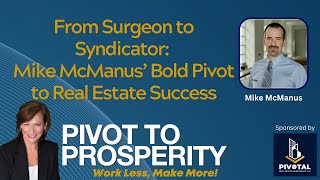
Mike McManus left a top urology practice to build a commercial real estate syndication business. He was burned out by medicine's constraints on team and lifestyle, and wanted passive income from retail and industrial deals instead of trading time for money.
Chapters
Are you one of the many busy professionals working in offices day in and day out? Do you wonder how some people grow their wealth fast, retire early and play on work days? Well, you're in luck because Ginny Bolling hosts this show Pivots of Prosperity where she interviews people that can do just that play on work days. Many guests have become financially free. She also interviews people that are on their journey and people that are in support roles like attorneys, contractors, brain brokers and others. Commercial real estate is the common element. She is on a mission to be sure. Busy professionals know they can own substantial commercial properties too, like apartments, self storage facilities and others, and not have to do the work managing them. Passive investing is the key. Syndications are the typical method. Tax write offs are some of the biggest rewards. Ginny and partners find the deals, build a strong team and business plan, then offer the investment opportunities to passive investors. New episodes are released every Tuesday at 12, so watch for new releases. If you want to get involved, let us know. You need to get pre qualified to hear about most deals. See the show notes for contact information.
Oh, thanks for being here Jenny. This is a great opportunity.
Mike seems to have spent most of his life pivoting. He says I'm in a quote from him. I dropped out of college and transferred multiple times because it didn't inspire me and I would rather be skiing. I ended up with a career in the ski industry and was a ski school director before age 30. It never paid well. I tired of being broke so I applied to medical school and got in. I was a mediocre applicant, but my ski school experience helped me ace the interview. Most recently I burned out on medicine, left at the top 5% private practice and became an entrepreneur. I am now focused on commercial real estate, retail and industrial, have a couple of businesses incubating with partners and moved to Salt Lake City. So I ski most days again.
All right, what does I can't ski most days again. That sounded a lot more exciting when I wrote it. But yeah, I think, you know, it's interesting that a lot of people in the world seek stability and they find their one thing and they do it for many, many years. And at times I've been jealous that I wish I was drawn to that path of stability when, when things are hard. But I've more found that I'll, you know, I, I enjoy new challenges and figuring out something new and finding my way through it. And there's a point where I think where once, once I feel like I've accomplished most of what I can accomplish there that it's time to find something new and, and, and find how to, how to excel in, in that new endeavor.
So have you done the behavioral test before to find out what sign you are or what your, what your, what it would say about you?
I've done a couple of them. I forget what my disc assessment was. There was one I think was the Meyer Briggs that said I was a, a creative problem solver. And, and I remember when I took that in high school and I had this idea back then of the way you like we all get this idea of how we're supposed to be and because I was good at math and science, I was supposed to be a scientist or an engineer and, and I, I think I spent many years trying to fit in a box of who I thought I was supposed to be. And it was years later where I was like, wow, creative problem solver. That's, that's what I enjoy, you know, is a, is finding a difficult problem and trying to find a solution to it that may not be immediately available and isn't a going to be a textbook answer.
That's great. Yeah, that's kind of my, my thing too. But I'm also first and foremost an activator, so I get people motivated. And so I love when I find an issue or a problem, I can get people to buy into it, to either take it on or to support me at least. So usually, I mean, that's like kind of cool, but. Yeah, no, it's, there's something to those tests, I think. I really do.
Yeah, there is. And I think it, I wish, I wish I would have believed in them more when I was younger and tried to at least explore what they said, you know, that. Finding my own path through that. But anyway, that's in science.
So you, you, you got into the medical field and excelled apparently. And so. And you did that 10 years and said that's good enough. Is that basically it?
Well, I mean, I started medical school, I was, I was 28 when I started medical school, but that was 1998. So it's more than the last 10 years was really the years of big success was in a very prosperous private practice in Green Bay, Wisconsin where we, you know, we basically did everything, had great partners who are extraordinarily skilled and we had a nice arrangement that allowed us to fix a lot of problems and be very efficient and very productive. And so that's part of the hard thing though, when you decide that maybe I'm not intrigued by this anymore and I want to go do something different. But when you've really found the financial prosperity, it makes it hard to walk away from. It was a process of redirecting out of there.
You know, we didn't actually say it, did we, that. That you were in urology?
Yes.
Okay.
I think you did. Yeah.
Okay, good. Because we talked a little too much before maybe I started to record what.
Part was for was it and that.
That industry has evolved a lot, I guess too. So you probably had lots of challenges there, I imagine, right?
Oh, yeah. It's, you know, some parts of it, like treatment of kidney stones, you know, you have a little technology, but I'd say In the last 10, 15 years, there's been no, nothing traumatic. We're on the other side where a lot of the cancer care is almost 100% different than when I finished residency. Some of it has changed so fast with new drugs and new protocols and that it's almost like as soon as you wrap your head around it, it's change. So that's probably been some of the biggest changes over the last 10 years that were tough to keep up with and took more of a change where it is more of a team that medicine changes fast enough now that you can't know everything. And so either you do what a lot of the academic institutions do, where everybody is a super specialist and you stay in your. Your one little tiny box, or if you're going to do more, you have to build a team around you, which involved utilizing some very good PAs and nurse practitioners who they kind of became the super specialist in one little area and were responsible for keeping up with the little detail changes and especially a lot of the medical care so the surgeon could keep up with the surgical side and allowed us to have a very high quality practice in a smaller market that we couldn't have 20 doctors all doing different things. You know, we had to cover a little bigger ground, but it was building that team underneath that allowed you to cover a bigger space.
And were you a surgeon actually too?
Yeah. So urologists are surgeons, but unlike a lot of other surgeons, you do take care of a lot more of the medical side or most of the cancers that we treat. As urologists, we handle almost everything all the way through. We're like a lot of the general surgeons treating colon cancer. They do the surgical part and then hand it off to the medical oncologist, where a lot of that with urology, we kept in urology and a lot of. Even the. The chemotherapy and those type of treatments came out of the urology world. And that's probably why it kind of stayed in the urology world in a lot of places.
Interesting, interesting. Well, and so. And given that our medical industry and insurance problems in the country, did that mean that you ended up getting bottled into or boxed into the office many more hours than you cared for or were you able to get out and ski like you wanted all the time? No doubt.
We had a very good organizational flow that allowed us a better. For as productive as we were, we had a better lifestyle than most because we were really from a productivity standpoint in the top 5% of practices nationwide. But we weren't working as many hours as the other top 5%. But it was still a, often a 50, 60 hour work week, depending on your call schedule. And that was really the part that for me, in the end was like, you know, I've worked enough years of being on call every third night, of being at the hospital till 7, 8 o' clock at night on a regular basis. Between that and just the frustrations with the way the whole system is administered now that it was, you know, I'm like, I either need to do this a lot less or do something different. And the way our practice was set up there, we weren't able to come up with an option that worked for me and worked for my partners for me to work a lot less. So we decided it was time for me to exit. And that all came around my younger daughter graduating from high school as the timeline. And so she graduated in May, I exited the practice and we moved to Salt Lake City.
And that was two months ago.
That was two months ago, yeah. All right. A little less than two months ago, we made the move.
So congratulations is still in order then? Yes, yes.
Well, thank you. Yeah, it was a big move.
Yeah. Yeah. Well, and having talked with you a bit before we started recording, you built up your alternative income sources so that you could retire. Right.
So tell.
Talk about that.
Yeah. So, you know, it, it was really a combination of. It's funny when you talk, you know, the big thing in the difference between real estate and medicine is in medicine you build a team, but it's a lot more focused, especially as the doc. You're the, you know, kind of the top of the pyramid and you're expected or a lot of the time you're doing a lot on your own or when you switch to real estate, it's, it really is about the team and your network work and those people. And so it really changed for me. There were a handful of crucial people who really Helped me realize that, okay, now I do have that. That changed how my money was working for me and changed my confidence level to say, you know, I can do these deals and I can do them successfully because I have the team around me to keep me from doing dumb deals that go the wrong way. And that all had a track record of, although not perfect, they had a very good track record of making good decisions, seeing problems on the horizon, and building deals that the worst case scenarios were still acceptable. And that made a difference because that was what really gave me the confidence. And to make a change, I'd say, all right, I'm going to walk away from a very comfortable income, which still isn't comfortable when you see that change. Because my passive income at this point was not at a point to replace my doctor income, but it was on a trajectory to say, okay, it's time to jump ship. Because when you work 60 hours a week at one job, there's, you know, there's an ex, there's a price you pay. It's, you know, the, the opportunity cost that you don't have to work on the, the other thing. And I wanted to make the other thing, the real estate, the main thing. So that was part of deciding it was time to shift.
That's great.
That is.
And so as you mentioned, nothing is perfect. We know that the market has been swinging. There were a lot of that saw the rent skyrocketing for all those multifamily fans. 20% jump in Florida for the rents in one year, in fact. So, and many of the hotspots, so lots of people piled in and were doing that floating rate debt, which I, I explain as the commercial version of what happened in 2008 and 9. You know, that those were arms. This was our version in the commercial world of an army, the floating rate debt. And nobody expected those interest rates to go so high, so far, so fast. So there's some people in trouble. And you know, it's, it's bound to happen at some point. If you're in real estate very long, there's going to be some losses. But yeah, there's ways to try to contain that risk. And, and that's, that's what it's all about. With the due diligence that we were discussing too, I think that you've surrounded yourself with some excellent people with being able help you to properly assess that, that kind of thing for, well, talk about the types of assets that you're, you're into.
All right, well, yeah, I, you know, like a lot of People I kind of started out in the multifamily space or even single family residential. And you know, and, and at this point, at the time it felt unfortunate because when I really decided I wanted to be active was kind of on the back end of COVID As you said, when interest rates went to, were plummeting downward, prices went skyrocketing the opposite direction and right, you know, so right during that time this things, at least in the markets I was looking at stopped penciling out, you know, because people were buying at prices that they just assumed would see some continued asset price growth and that, you know, you could, you could buy a negative cash flowing property but you'd be okay because it was going to be worth more in three years. And that, that was not the way that I was going to play the game from the beginning is, you know, I was looking to build cash flow and so because of that it kind of pushed me to look for other options. And that's really where I went from the small market to looking at syndications. And I, and I invested in some syndications early. And it was funny because the beginning, my criteria were, you know, you don't know what you're doing and you read the books and you take the courses. But for me, until I really get into it and make the mistakes, it doesn't, I don't learn as well. So, so I was, I was looking for deals with very low entry points so I could make my mistakes at a, at a lower dollar value. But through that process and then I was, I was investing mostly in multi family and some industrial stuff. But, but I, I, through that process I, I met the people who, who really changed my opinion on. And that's where the, the transition to, to looking at retail and industrial came. And a lot of that was just moving to a place where there was less competition. Because it's funny to a lot of people it seems like a very mysterious world of, of how that works, but people are more comfortable buying buildings that people rent and live in probably because they've, they've done that. Almost everybody at some point has rented an apartment or rented a house. And so that all that process makes sense to them because they've evaluated it from the renter side. But there's, you know, it's, when you change your tenants to people who are business owners, it changes the whole job and you, you start dealing with a typically much more responsible clientele for sure.
And longer term leases, less turnover. Lots of pluses. Lots of pluses. I, I didn't tell you. But industrial is my favorite and always was from when I was an appraiser in the 80s. You know, I live. I think that's the backbone of America, you know, really. And retail's coming back in. In the hot areas it is too. So I think you're in some good markets and especially Salt Lake City. Talk about Salt Lake City some too.
Well, Salt Lake City is really a hot spot of the country that people haven't talked about as much. There's been a lot of focus on the south, the Southeast and the Sun Belt. We just moved here from the Midwest. And the Midwest has been recovering too. But Salt Lake has in the last 10 years really become a transportation hub. There's movement, I think that maybe that's not the right word. But the state of Utah and Salt Lake City have combined to do what they're calling an inland port. And that's really because it lies along I80, the busiest east west interstate in the country. That also on the busiest east west railroad in the country. And so there's a lot of commerce that goes through here. And what's that smelt is with the support of the government is the amount of building that's gone on as a transportation hub has been sizable. The number of warehouses that have gone in north Salt Lake in the last 10 years is pretty incredible. But because of the.
More from Ginny

Dr. Calvin Lowe Saves Lives 2 Ways: Pediatric ER & Teaching Overworked Med Pros How to Get $ Balance

Turning Construction Expertise Into a Thriving Real Estate Empire With Eric Schultz

Build-to-Rent, Community & Cash Flow with Pivotal Person Award Recipient Andy McMullen



Investing Beyond Boring Real Estate: Oil, Gas, and Industrial Properties with Keshav Kolur


Unheard of home prices: $225,000+/- in Portland! John Laine - Breaking Barriers- Home Affordability!


