Got Big Real Estate Gains? DST’s Can Take the Pain out of Taxes with Ray DeWitt || Ginny Bolling
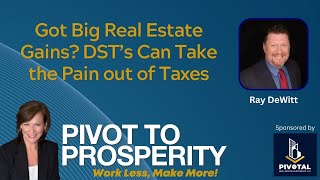
Ray DeWitt explains Delaware Statutory Trusts, a way to defer capital gains taxes after selling real estate. DSTs require accreditation and a $100k minimum, typically hold for 5-7 years, and generate immediate income from institutional properties. The market grew from $1B in 2012 to $10B in 2022.
Questions this video answers
Typically $100,000.
Average 5–7 years (typically no longer than 10).
Technically 2004; market growth accelerated around 2012.
About $1 billion in 2012 and about $10 billion in 2022 (and over $2 billion in Q1 of the cited year).
Approx. $1 million net worth or $200k–$300k household income (single/joint), or industry professional.
Chapters
Foreign.
Hi there. Jenny Bowling with Pivot to Prosperity brought to you by Pivotal Real Estate Investments. And we have with us here today Ray DeWitt and I am going to read his bio. Ray specializes in Delaware Statutory trusts which are a financial services vehicle that have been created to help a lot of people to find ways to dispose of I shouldn't say disposition. It's the disposition of assets to sell their assets in a way where they can draw out those gains in a way that is much more acceptable for tax purposes and they also do other financial types of investments. But he has 20 years experiences experience in the financial services industry and has been able to be quite helpful to people that are in the retirement planning stage of life. So whether you're an individual looking for investment, real estate or investment strategies, retirement income or a business owner looking to find an exit strategy or retire or make change, Ray focuses on helping people to invest in those things and private placements, direct placements, maybe you want to find tax strategies for investing or 1031 exchange program, he can help you. So his specialties are indeed 1031 exchange opportunities, investment management, retirement planning and financial planning as well as real estate investment trusts and the securities offered through Concord Investment Services LLC is a member of finra sipc. Do people say it SIPC or sipic?
I hear it both ways.
Do you really? Okay. Advisory services offered through Concord Asset Management are SEC registered as. Wait a minute. And a SEC registered investment advisor. Insurance products offered through Concord Insurance Agency CIA all of whom are unaffiliated with third party sites. Cannot verify the accuracy of nor assume responsibility of any content or linked third party sites. We probably can edit some of this. I think the last part probably I'll ask them to maybe jump out but. So DeWitt Wealth Management is an independent independent of CIS, CAM and CIA as outlined above. So welcome Ray. Please tell us what's between those lines. Tell us about Ray.
Yeah, thanks for having me. I'm excited to be here. A little bit about me over over 20 years financial services industry. I am based at Salt Lake City area and I grew up in a small southwestern desert town on the border of Utah and Arizona. Moved up here 20 plus years ago for work and I love what I do. I help people every day. I really help people solve a lot of tax problems, headaches. If you're tired of the toilets, tenants and trash. Perfect person to talk to. So I do have to say before we get started with what we're going to talk about, this is not a solicitation. I'm not going to be speaking about particular offerings. It's just purely educational and you must be an accredited investor to participate in these programs. And an accredited investor is a million dollar net worth or 200 or $300,000 single joint household income per year or an industry professional. So that's my disclaimer.
And yes, gotta do that.
Let's fire away.
All right, well, so and I believe you said the majority of your business is dealing with the DSTs, right? So explain those, would you please?
So, so Delaware statutory trust is a way of syndicating or putting together real estate. It looks like a real estate Investment Trust from 10,000ft in error, but it is not as distinctly different, has very different rules and it is specifically designed to be eligible for 1031 exchange investors. So the benefit of this, the Delaware statutory trust is it allows you to sell your investment property via and you can do a 1031 exchange, which is the IRS code that allows you to sell one investment property, exchange the proceeds into another investment property and you can defer your taxes. The reason the dst, why I'm bringing this up is why it's different is because a lot of people, as I said earlier, tired of the tenants, the toilets in the trash, they want to turn them into the travel, the tea time and the tequilas, I love that, don't want to be landlords anymore. They're sick of it. And this allows you to sell your investment property like you normally would do, a 1031 exchange into a Delaware statutory trust, which is at 100% passive program. It's professionally managed, completely hands off. You continue to get income starts immediately, but you defer the taxes and you have gotten rid of your headaches because you're now getting mailbox money, so to speak, instead of worrying about the terrible tease.
So that's you 1031 are usually to defer taxes because your gains are pretty big. Is there a threshold to make it worth getting into a DST?
Well, there's no threshold. The minimum investment is typically $100,000. Okay, so fairly low minimum in real estate terms. And so it also, that also makes it very easy to diversify. So if you had, you know, a million dollar property, you could Hypothetically invest into 10 different DSTs and be very diversified. And these, these programs, like I said, they start paying immediate monthly income. And they are, it's all very high quality class A institutional quality real estate. We're talking about multi billion dollar real estate managers that have reach all over the country, years of experience, very, very conservative class A properties that Are typically new built, you know, very conservative, very boring. Real estate, apartments, storage, medical buildings, industrial, a lot of Amazon distribution facilities oddly are in Delaware statutory trust. Pretty much every asset class you can think of a real estate is available. And these properties are spread out all over the country and they are actually stabilized up and running operating properties. And when you step into the investment, you know what the cash flow is. They do a 10 year projection on what the cash flow will be. You'll know everything about the property, the address, what it looks like and it's just a done deal and you invest and boom, there's no issues. Unlike some 1031s where you're buying a new property and you've got to do inspection report, environmental, all your due diligence, diligence. These are sort of already in place. And literally I repeatedly am told by my clients, wow, that was the easiest real estate transaction I ever did. So if you, if you're tired of complicated, this is the way to go.
So that's for the investor looking to put his money somewhere. His or her money somewhere.
Correct.
That is typically gains. But it could not be. It could just be.
You could do a cash investment into a DST and then you would get the benefits of being able to 1031 exchange it later. Unlike investing in a limited partner GPLP deal or REIT or when they sell, you're going to have capital gains. The DST you would have that ability to 1031 exchange on the sale of the property.
So you can put money in that is not from a 1031 and it becomes a 1031 and you can. What's the holding period usually.
The average is five to seven years, typically no longer than 10. The IRS is at very strict rules on these properties and I really like these rules in a lot of ways because it forces the properties to be safe. Well, I should say safe, but a little less risk than some properties. And you know, you know exactly what you own. And unlike a REIT where they can buy and sell, they have control of the property, they can refinance the debt, they can do all sorts of things in the dst it's set in, this is the address. Every trust is its own separate entity. If that property is sold in the underlying trust, the trust is dissolved and all the unitholders of the trust get their share of the proceeds, including the profits. And they contend 31 exchange again. Also oftentimes in the institutional and professional investing world, we use leverage, we're using financing the bank's money to enhance our yields. The growth whatever reasons. Oftentimes DSTs do the same strategy. When the DST, when you go into it as an investor, you know exactly what the loan terms. That loan cannot be refinanced, barring a special circumstance, prevent bankruptcy or something crazy happening, Right? So you as an investor know exactly what was happening. The benefit of the debt is it's non recourse to you. The trust has it. You do not, you do not have a mortgage payment. You're not doing a credit application, pulling your credit. When you invest into shares or units of the trust, you're getting the debt and the equity and the real estate. And another real power of this is oftentimes when somebody sells their property and they're doing a 1031, they've got a mortgage. And IRS rules are you have to replace the amount of real estate that you sold. They do not care if you had the bank owned part of it. So for example, you sold a $2 million property, you had a million dollar mortgage, mortgage is paid off, you've got $1 million in your escrow, your 1031 exchange account. Well, the IRS expects you to take that million dollars and buy 2 million of real estate. Two ways to do that, come up with another million bucks or get a mortgage. Benefit of the DST is you don't have to get a mortgage you can invest into. Let's say the DST is 50% loan to value. Your million dollars goes in, you buy $2 million of real estate. The IRS says, okay, you've satisfied the $2 million requirements, but you no longer have the headache of having a mortgage. But you get all the tax deductions from it. Any additional depreciation, the interest expense, everything passes through to you, except for you actually don't have the debt in your name. So it's really powerful tool.
How do you put 1 million in and get credit for 2 million from the IRS?
Okay, well in this case, my example was the property has a mortgage on it. It's 50% loan to value. So your million dollars buys technically 2 million of real estate. Because when you buy into the units, every unit includes the financed property and the equity in the property. So when you're buying in, in that 50% scenario, a million dollars is getting you 2 million of real estate. One million financed, $1 million of equity.
Okay, interesting. Okay, so yeah, that's powerful. It's, it's definitely powerful. And I know not many people know about this either. You and I have talked. I have a couple clients that have some major capital gains and so if they are looking to dispose of an asset, likewise, you know, they. I think you've said you can set up a DST based on their asset, right?
Is that what it was?
I understand.
You will sell your property like you normally would. This works like any other real estate transaction. From the sales side, you will sell your property. You will go through your title company. They will send the proceeds to whichever 1031 exchange accommodator you choose to use. But instead of going and buying other real estate, you would invest the money into a dst. We work with your accommodator to set up the transfers to fund them. It works like any other DST. Excuse me, not the estate, any other 1030 worth. There is no difference. No difference at all.
Okay. Huh. All right. Yeah, I guess I was confused on that, thinking that you could set up a DST around their asset.
So, okay, the idea is to get out of the asset, no longer be responsible for it. So you sell it and take the cash and invest it into the DSTs.
Got it? Okay. Yeah. Yeah. So, and, and they are trend going upward big time, I believe. Right.
Sales of DSTs over the last 10 years have gone up 1000%. 2022 was just about a 10 billion dollar market, where in 2012 it was a 1 billion dollar market. Things have slowed down a lot this year, but we are already at over $2 billion during the first quarter.
Yeah. And this is a tough year in some ways.
Yeah. And this is becoming a more and more popular investment option. And it's not only retirees using this. I do have a lot of younger clients who, you know, maybe they don't want the headaches of managing certain properties so they get out. But other reasons people do it is sometimes, you know, in a 1031 exchange, you have a limited time frame and it can be hard to find things or close on a good deal. And so people will use this as a backup plan. You know, if you, if you're confident that your property is going to work out, the DSD can be your backup. Also, the technical term, weirdly is called boot, and that taxable boot. And that is when you don't complete the full exchange. Let's say you sold a $10 million property and you found this wonderful warehouse you want, but the warehouse was $9.5 million. What do you do with the $500,000 that is taxable? So people will take that $500,000 boot and they will take that excess money and put it in the DSTs to defer the Taxes and keep the money working Nice.
Yeah, that's really a golden nugget there, for sure.
Well, and the average person doesn't realize the tax hit of the DST or of a 1031 exchange. Not only is it your capital gains tax at 20%, it's also your state tax. You also have the Obamacare tax, which is another 3.8%. And then you have to recapture 25% of your appreciation. So if you've owned your building for 25, 30 years, which is often the case, you have zero cost basis in this building. Well, you have to recapture 25% of the depreciation and pay it those first three taxes I mentioned. So if you live in California, you're paying, you know, 38, 39% in taxes on the sale. So it can be pretty big, you know, it could really hurt your potential returns.
Yeah. So yeah, you want to reinvest for sure. Especially if you can defer those taxes. Right. So do you have any, any other interesting data wise that where Most of the DSTs are, are based or what asset class or all over the country?
Yeah, you know, when it comes to stuff like multifamily and things like that, you know, we're looking for area, they're looking for areas where people are moving to or there's a reason they want to live there. They do a lot of research on the market, the neighborhood. Obviously an industrial medical building could be a little different. It's really more about the tenant, you know, and you know, real estate's location, location, location. Right. And so, yeah, these are all over the country. And as an investor, I literally am a fiduciary. I literally will show you a menu and say, look, here's 50 available options. This is in Florida, Texas, Michigan. Where are these properties? What kind of properties are they? Let's discuss what you would like to accomplish. What helps you sleep at night? If you say, I don't want to invest in Florida for whatever reason, I will never talk to you about Florida again. I will show you other offerings. And we also, I also make sure that if you are replacing debt in your exchange, that we get a DST that does replace your debt. But by the way, if you don't have that and you don't want that, we also have all cash offerings. You do not have to take on debt. And then we also have very highly leveraged options as well for those people who have higher debt needs. Or we can do some really creative stuff where we can replace someone's mortgage with a little bit of cash. And then they can take their cash and go buy their own properties. But maybe they don't want to have a mortgage anymore. So some really crazy, amazing things I could do for people and with this DST product.
Hmm. I think I want to talk to you about some of that a little more later.
Yeah.
Okay. Okay. Well, interesting. And is it difficult to set to buy into these or what? What's the process?
As I said earlier, most of my clients would literally tell me that was the easiest transaction I ever did. We take a few minutes, gather your information from you. Obviously we've got to know your customer. You know, driver's license avoided check. So we know where to send the deposits. Get your information. My assistant or staff will put together the paperwork. We send it out via DocuSign, click, click, click, click, click of the signatures. A couple days later, the investment sponsors are reaching out to your 1031 accommodator to handle the wire transfer. You literally could tell me today that you wanted to invest. We'd do the paperwork and you would be funded by Wednesday of next week. It's that easy.
Wow. And do you have to have a prior relationship?
No. Certain products? Yes. More and more products? No. We can do that.
Oh, okay. Interesting. Okay, well. And we all know, you know, that hurry up and learn about this stuff because all too often there is a need for that.
Well, I run into people all the time. And it's really unfortunate how uneducated real estate agents are oftentimes, especially residential agents, they don't even know what a 1031 is. They don't even care. They just want their commission. They move on. And then I run into somebody and they're like, oh, where were you a month ago? I just paid 400 grand in taxes. Nobody told me, let alone the 1031 exchange, but the DST. And unfortunately, once you take receipt of the money, even if it's for one minute, your 1031 exchange is dead. You have to use a qualified intermediary.
So what about a business that has a high cash flow and they are looking at a lot of taxes? Can they invest their income in these?
Sure. And you know, we do a lot of other. A lot. I do a lot of other non 1031 related real estate as well. REITs, partnerships, we do self directed IRAs. I do opportunity Zone funds. So if you have capital gains in a business sale or a stock sale, the Opportunity Zone is a great way to get some tax benefits, let alone the tax free sale on the back end, which is very powerful. We deal with oil and gas drilling, solar panel funds where you can get immediate tax deductions and then start getting cash flow from the products. So I really can help people if they want to be invested in real estate, which I personally believe in very strongly as the premier thing to invest in and help you with a lot of tax problems.
Yeah, yeah, I know, it's powerful. So going back for a moment to that example where there's a business that's just growing by leaps and bounds and have a lot of cash income, they could potentially invest in one of say the oil and gas or maybe an opportunity zone and reduce their tax.
The opportunity is only for capital gains money.
Oh, that's right. I should know that. All right, okay.
But we do provide high end or I provide high end tax services. Tax planning. We can't help you set up very interesting defined benefit cash benefit plans can do a lot of things for you. Family office services. There's a lot I can do to really help you reduce your tax liability. And in fact, if you're going to be in the Salt Lake area June 29, I am doing an event and we're going to be Title. It's not what you make, it's what you keep.
Yeah, that's a good title.
So, you know, we, we. A big focus is, you know, let's pay the IRS less money. So. Right. And make some money on our money, by the way, at the same time, you know, so.
Right, right. Okay. Okay. It's. It's really a very cool vehicle. And when did these start? Are they new?
DSD really technically first came out in 2004. There was a lot of issues with the tin and the common structures back in the day. A lot of just horrible issues. A lot of people lost money and there were some big flaws. And so this product was created to sort of fix all those problems that the tics inherently had. But it really didn't start taking off until about 2012.
Just like syndications, right? Yeah. When. Now you said ticks tenants in common. So you breezed over that so that the audience understands, explain a little more about what it was that was the problem in case they hear about it.
The problem with the tenant in Commons is you've got a bunch of owners that all have to vote to do anything and nobody can agree, you know, on anything. But also it's harder to do financing issues. It's harder to. There was just a lot, a lot of issues. Poor management. Anybody can put together a tick. They're not. There's no regulation really. The Real estate world compared to the security world is like the wild west. I kind of laugh, you know, my, my real assignment real estate license as well in tech. My office, I am actually literally the office housed with a commercial real estate brokerage. And I laugh at, you know, the how wax regulation in the real estate industry is. And so with the DST being in the jurisdiction of the securities and Exchange Commission and the irs, you've got a lot of oversight, way less fraud, it's much more transparent. I just feel much safer option. And also the DSTs tend to be bigger asset managers. So we're beginning higher quality assets. I look at a lot of the ticks that are out today. They. And there's some great ones that are not trying to bash anybody. I'm just saying that oftentimes the quality of real estate isn't that great.
And.
Oftentimes neither is the person managing the asset. So just a different, different animal.
And so to understand it a little better than so the trust, it's a trust. Did they end up doing similar to a syndication then and having limited partners and general partners?
It is a syndication, a Delaware statutory trust that was created under the tax laws of the state of Delaware. I don't actually think there's ever actually been a DST with a property in Delaware, ironically, maybe one. And so the trust owns the real estate. Every trust has its own tax ID. So the trust owns 123 Main street and when you buy into units of the trust, you are owning the underlying assets of the trust, which is the real estate. And that's why the IRS allows this. There is no gplp. There is what they call a master tenant of the trust. And that master tenant is typically the sponsor company. And they will, you know, they are either managing a property themselves or hiring a third party like a, you know, property like a landlord, you know, property management company or something. The manage the managed trust. And then you as a unit holder are completely passive. And the entire trust is built around, in my example, 1, 2, 3 Main Street, Anytown USA. Right? That is the trust, that property is the trust. And if the property is sold, the trust is dissolved.
Okay. And so each of the people that have bought into it, are they considered beneficiaries of the trust?
Unit holders? Yeah, beneficiaries, basically unit holders. It's sort of the reverse for people who are familiar with syndication. It's like it's sort of the reverse of syndicating where oftentimes people syndicate to acquire a property or go start buying properties in the dst. The property is acquired and in place and it's sort of reverses. Instead of raising capital to buy the property, we bought the property. And then through syndication, I'm paying myself back as a syndicator for buying that property. And for those who syndicate, the DST is a very magical way to syndicate and is the best way to raise capital over the long term. If you're committed to this business. The DST is a very wonderful thing for people who are real estate syndicators. And I would love to talk to you about helping you do that.
Yeah, I see that it could be in. Yeah, there's. Every time I talk about DSTs, there's some other light bulb moment. And yeah, they're powerful for sure.
My broker, dealer, Concord Investment Service, we are the number one DST firm in the nation. We do the most volume. We literally did over 10% of all the volume this year. We're at 12% of the volume. I am a top five producer with that firm. And I'm not bragging, I'm just saying I know what I'm doing. And we research all these DST companies, we do background checks, we make them go third party, independent, due diligence reports. We do a lot to try to protect our customers. There's a lot of DST companies out there and we do not work with quite a few of them because we don't like what they do or who they are. Think they're bad people or bad managers or sometimes it's just they're too new. Now we don't want to practice on our clients. Go, go do a couple deals, take them full cycle and give us a call and we'll look at, then we'll, we'll talk to you about, you know, selling your product to the public.
So, so I'm not great at this, but what I read with your bio and whatnot, I. So if I understand correctly, you.
Are.
Helping people buy into these, but do you also set them up?
Oh, I kind of wear two hats, the retail customer hat every day. And then I work behind the scenes to try to connect the syndicator with a syndicate to help them raise the capital.
Okay. Okay, Interesting. All right, so. And you said you guys were the top in volume last year. Was it?
Almost every year we have.
Almost. Oh, wow. And that's under which name?
Onboard Investment Services. That's the broker dealer.
Gotcha. Okay. Okay, Wonderful. Well, so how can people get in touch with you? We need to wrap this up. I know you have a hard stop.
Yeah, go ahead and put my contact info on the screen but my cell phone's 801-815-6619. Great way to just call me directly.
All right. Well, very, very good. Anything that you want to depart telling people.
You know. Thank you again for your time and if you are hired of the toilet stimming trash want to learn more about passive real estate investing, I'm your guy.
And I should ask you if there's a book they can read. If they are so inclined to do that, contact me.
My business partner has written a book entitled are you tired of the tenants toilets and trash. I'm happy to mail it to you. The website has a plethora of information and educational videos as well.
It does. I've seen. Yes, yes. Okay. So wonderful. All right.
The website is www.bangerfinancial.com I repeat that, repeat that. B A N G E R t e r financial.com okay, very good.
Well, thank you so much. Appreciate it.
Thank you.
More from Ginny

Dr. Calvin Lowe Saves Lives 2 Ways: Pediatric ER & Teaching Overworked Med Pros How to Get $ Balance

Turning Construction Expertise Into a Thriving Real Estate Empire With Eric Schultz

Build-to-Rent, Community & Cash Flow with Pivotal Person Award Recipient Andy McMullen



Investing Beyond Boring Real Estate: Oil, Gas, and Industrial Properties with Keshav Kolur


Unheard of home prices: $225,000+/- in Portland! John Laine - Breaking Barriers- Home Affordability!


