Gregg Gruehl Brings Institutional Level Skills in Industrial Asset Investing to the Missing Middle
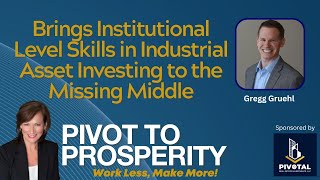
This is a recorded interview (Pivot to Prosperity / YouTube) in which host Ginny Bolling talks with Gregg Gruehl, an industrial real estate professional based in Columbus, Ohio. Gregg traces his family real estate roots and career from DDR/Site Centers to multifamily asset management, then to Link Logistics (Blackstone portfolio company) where he handled leasing and asset management, and to Stag Industrial where he led Midwest acquisitions. He describes industrial leasing mechanics (term, escalations, triple-net structures), market incentives in Columbus (tax abatements, OSIP grants) and mentions an opportunity-zone 12-acre site he is evaluating. Gregg recounts pivotal events (COVID, relocation, being laid off from Stag, and founding his own firm with his brother) and provides contact information (active on LinkedIn and an email/website).
Questions this video answers
January 28, 2025
Columbus, Ohio
He negotiated over a couple hundred transactions and well over $100 million in total consideration while at Link Logistics.
He executed over $300 million in transaction volume during his time at Stag Industrial.
Link grew from ~80 million sq ft (valued ~$8–9B) to over 500 million sq ft (valuation cited in the high $30s–$40B).
Chapters
Are you one of the many busy professionals working in offices day in and day out? Do you wonder how some people grow their wealth fast, retire early and play on work days? Well, you're in luck because Ginny Bolling hosts this show Pivots of Prosperity where she interviews people that can do just that play on work days. Many guests have become financially free. She also interviews people that are on their journey and people that are in support roles like attorneys, contractors, brain brokers and others. Commercial real estate is the common element. She is on a mission to be sure. Busy professionals know they can own substantial commercial properties too, like apartments, self storage facilities and others, and not have to do the work managing them. Passive investing is the key. Syndications are the typical method. Tax write offs are some of the biggest rewards. Ginny and partners find the deals, build a strong team and business plan, then offer the investment opportunities to passive investors. New episodes are released every Tuesday at 12, so watch for new releases. If you want to get involved, let us know. You need to get pre qualified to hear about most deals. See the show notes for contact information.
Hello, Hello. Jenny Bowling here with Pivot to Prosperity, the show brought to you by Pivotal Real Estate Investments, where we help investors build wealth and income through commercial real estate that also improves communities. And today we have Greg Gruel with us. Gruel, you even told me drives with you.
No worries. That trips up a lot of people. Half the people in my life still call me Greg Gruel and a lot of times I don't crack them anymore.
I bet, I bet. Yeah. Well, welcome. Thank you for coming on the show. I'm so excited to have you because you specialize in industrial real estate, which is one of my, if not my favorite things. So we've been talking, gosh, almost an hour. An hour. And so now we're going to record.
Perfect. I appreciate being on the show, Jenny.
Yes, yes. Well, so you are in Columbus, Ohio and have a fantastic background. You have phenomenal experience that you've decided to take into your own firm. And so please tell us about your background, your journey and then what you're doing now.
Yeah, so background on my, me, myself, my family, because it's all kind of intertwined. My family's been in real estate for, gosh, the last eight decades, starting with my great grandma being a real estate broker in the 40s, working the way through my dad who really kind of pushed me and my brother down that path as he's been a commercial real estate broker for 40 plus years. I decided when I was in college to not go down the path of being a broker. Didn't like the ups and downs. Saw what it did in 2008 to my dad with his paychecks in the house and everything. So decided I wanted to go on the principal side because that was a more secure quote unquote paycheck. So started out with a public REIT on the shopping center side in a management trainee program where, you know, retail was kind of in a pivotal, if you will, time where ding, ding, ding.
You get points for that.
It was rotational. Right. It wasn't a great time for large power centers. So. And I was kind of seeing the shift towards E commerce as well as my belief in that area being growing. Decided that that firm went through some layoffs, decided not to take the full time role out of the rotational program and landed at a multi, multifamily firm or did asset management for a short period there before my wife moved us out to California for her role. And that is where I fell into the mother load of roles. I landed a job at Link Logistics. Before it was Link Logistics, which is Blackstone's largest portfolio company. I did asset management and leasing during my time there. Did over a couple hundred transactions and well over $100 million in total consideration and leasing negotiations while I was there, but really wanted to move back to the Midwest and landed with Stag Industrial as an acquisitions lead for the Midwest and parts of the mid Atlantic, where in the three years I was there, did over 300 million in transaction volume and then ultimately decided to start my own thing with my brother. So that's where the family ties back in after all that, that long journey.
All right, so since I don't want to let all that experience that you just brushed over go to waste, so I'm going to ask you to tell us maybe your most interesting story in each place, working with each of those biggies because I want to cement what you took away from there.
Yeah. So we'll start with DDR, which is now called Site Centers. At one point they were one of the largest shopping center REITs in the country. My experience there, I would say the biggest experience there was going through layoffs. As my first job, I was not laid off, but everybody I had met, the people that had hired me were all laid off. And then I was offered a full time job because I was cheaper. So what I will tell you is as a fresh college graduate, that messes a little lot with your mentality. So when they offered me a full time role to move to Chicago for low pay, I Said no thank you and found a role as an asset manager with a smaller multifamily firm at that time who now has 4 billion in assets under management. So they've grown quite a bit, but they were much smaller at that time. Maybe 40 or 50 large student housing assets. That location, biggest takeaway, attention to detail. So in the asset management role I was in, I was doing investor reporting and bank reporting on financials and my boss at that time was very into detail as most institutional style firms are or those that are going to be institutional. Every sentence was analyzed with a ruler and a red pen. If he didn't say something the way he liked it, even if it was just saying something as, as the result of or due to, he had a very specific way he would want that not. And he chose due to just so.
You know, I know that world, I know that world well.
Yeah, your grammar was very important and that was over writing 40 of those each month. So that was quite a bit of work on every expense line item explaining why the snow removal was higher in this property or why was trash higher at that property or was there what was why is the water bill higher? And we'd have to go find out and then I'd write the sentence about it for the investors. So really attention to detail on the expense side was very important there as well as learning, you know, what drives revenue at student housing as well as standard multifamily, you know, what levers to kind of pull. Are you going to give a gift card? Are you going to give a half month free, a full month free, whatever it is. In the case of student housing, sometimes it was concert tickets and you would see, you would track leasing throughout the year and say, okay, well last year we're at this point leased. So understanding what that all meant. But the biggest takeaway from those first two experiences was I really wanted to be in the business to business world. So when I went out to California and landed at Link Logistics, I had applied to several multifamily firms because of the background, didn't want to go back into retail because I didn't believe in big box retail at the time and most people didn't. This was middle teens, 2000s, so 2015, 2016, when it was kind of going through its heartaches. Now it's on the upswing. So retail investing is probably back in the limelight a little bit. Landed at Link Logistics, learned a lot about leasing. That was my main focus on a day to day basis on the asset management side. So what was beautiful There was. The firm was growing. We went from 80 million square feet between 8 and $9 billion in valuation to over 500 million square feet to be the second largest owner in North America behind Prologis. In just those three years, that valuation is somewhere in the high 30s to 40 billion, depending on who's valuing the portfolio. That experience allowed me to. Being employee number 18 allowed me to experience much more than your typical analyst would, in that I was given the keys to doing leasing because my boss was off underwriting whole company valuations for other companies that Blackstone was going to acquire and put under our portfolio. So that was what really gas pedaled my career. And in that role, it allowed me to see how the economy worked, from nail manufacturing to fake crab meat, all the way to rockets being created. So I saw it, ran the gambit of what was going on in the economy and really loved to see that from there. When I went to. I wanted to move back to Ohio, found a role in acquisitions for Stag Industrial, a large public REIT. Not as large as Link, but about an $8 billion REIT that owns about 120 million square feet, where I ran acquisitions for Midwest and part of the Mid Atlantic. So I acquired properties in Ohio, Kentucky, Virginia during my time there. And really, my career has been an amalgamation of different roles that have led me to be rounded in being able to form my own company.
Yeah, that's what it sounds like. It really does. And I gotta ask you, that one boss that gave you so much, so much autonomy, do you stay in touch with that boss?
He's actually probably the closest boss that I've stayed in touch with.
It sounds like you should. Yeah.
The beauty of. I don't think he did it on purpose. Right. Because he was in a position where the reason for a lot of that was they were underwriting a company named GLP that was 180 million square feet, and a lot of that was on the West Coast. So he was out visiting those suites to do those underwritings and meeting with the brokers in all those markets on the West Coast, 20 plus markets. So like Reno, Salt Lake, Louisiana, then you're going up to Seattle, Portland. So he was traveling every week, so he didn't have time to lease the existing portfolio, which was amazing. So when I was directly working with Blackstone and their team on leasing calls on negotiating the leases, I was talking directly with the brokers in the market. And I had just come from multifamily, so my head was spinning. But I learned a lot and the beautiful of industrial leasing is it's typically only a few variables. It's rent tis free rent. And that's really what you care about from a dollars and cents standpoint. When you're negotiating and the term, you don't have to do it every year, you don't have to do it every year. So we're leasing at that time. Most of those leases were five year leases, but you can see anywhere between three and ten year leases with some option periods. Honestly with the way leasing was in that period, 2019 to call it mid 22, it was a landlord favorable market. It was, we were actually at Link, one of the first groups to push for 4% rent increases per year out in the west, which then grew to the whole country. And then Reno was actually able to get 5% rent increases, which was uncommon at the time. When I first started, even in 2018 at Link it was still sometimes you'd have 2 or 3% in markets in the Midwest. Even till this day, you'll still see people come up with from renewal with 2%. But out west where I was covering, we were pushing three, then four, then almost, then five in a lot of cases. And so if a tenant wants x starting rent, you might push the escalation up to 4 or you might give them free rent to push the rent higher. Or you give on the term or you give a little ti and and you really just kind of do the net present value of what that rental stream is over the years. And that's kind of what I was looking at when I was analyzing those deals was like, okay, they want to be at the starting rent. But for us to exit with an exit cap at the highest rent possible, let's give them a half month free rent. It equals out on a net present value, not even considering a sale, much better. But then when you consider the cap rate, it is incredibly better because it's a multiplier effect.
So and in these days, negotiating leases in most areas, are you talking triple net, modified gross gross, what?
At the Link stages out in California they were almost all triple net. Now there are certain types of product that lend itself better to modified gross or gross like flex business parks where you have 2,000 square foot suites. And those are really more like apartment leasing in that hey, here's our lease, here's the rate for the space, take it or leave it. We have businesses coming through every day. Kind of like multifamily is right where the big industrial product is almost always these days on new class A, it's Always triple net. You're not doing a ton of gross. There's some existing gross leases that have renewal fixed renewals that have that language still in there, but very uncommon.
And when you say triple net, what's your typical pass through? Is it still called pass through? I'm, I'm talking 80s, you know, I was in a pretty back then.
Are you talking about the actual operating expense totals like per square foot?
Yeah. What the landlord's going to pass through not so usually on a percentage basis or dollars. Pardon me?
Yeah, yeah. Are you talking on a percentage basis or a dollar per square foot basis?
Where. If you can.
Yeah. So there's, I mean there's the rain that runs the gamut on the range.
Percent is a better percent.
No, per square foot is probably better, but you're running the range of. Like in Columbus, for example, there's tax abatements involved. So I mean you could have as low as a dollar for per square foot and operating expenses because of. No, no property taxes to 2, 250, you know, $3 in some cases. If you're high. If they're high, the smaller the product, the smaller the sweet size, the higher. Typically, but not always they're modified gross.
Most of the time. The ones I've been looking at because we were talking about that I've started getting back into industrial here locally and we, it seems like down in Palm beach county and you know, Martin St. Lucie, when I was doing that work, it was, it was triple net. But that was a long time ago.
Yeah. So anything that I'm looking at today is all triple net. And a lot of Columbus, and a lot of Columbus's submarkets have tax abatements. That's not the case everywhere. They're common throughout the Midwest but not every market. So like Louisville doesn't have tax abatements in Louisville, but the second you go over the river to Indiana, they have tax abatements. So then you're competing. But Kentucky, the Kentucky side has lower tax rates anyway. So it doesn't. It's kind of a wash and the rates are close to equal. Not quite. Whereas in Columbus what happens is you have a tax abated building versus a non tax abated building. A. The tax abated building usually class A, so they're getting higher rents anyways. So then you have a non tax abated building which is usually class B because the tax abatement usually ran out. If that's the case, if it's unabated. Now there are certain municipalities within Columbus, certain suburbs if you will, that don't have these abatements in place. Some wealthier suburbs that don't want industrial per se in their markets that don't have them. So those are at a disadvantage because you might have a class A building in the submarket. I actually live in in Dublin, Ohio, where the market rent for this building might be $10 here, but in the abated market it's 11 or 12. So you can have that large of a delta because of the abatements. So when you're valuing abatements, when stag would come in and look to acquire something in Columbus, what you would do is if we were figuring a 10 year hold, you would figure that your abatement ran out. And what you'd have to do is you would have to basically figure out what your gross rent is, or let's just call it your net rent plus your tax liability and basically take the market rent with the abatement and subtract the tax liability to get to your new market rent. And that's what you would put your exit cap against for your noi. And so your valuation is lower. Right. So your returns are lower in year 10. So if you have a 15 year abatement, sell it at year 10. So you still have five years of that left. But sophisticated investors know these things. Some people might get slipped up that don't understand these things and you really just are in a world of trouble if market rents didn't grow past your expectations during that time.
So. Yeah, yeah, yeah. Do you get into opportunity zones too?
So ironically, we were talking before the show, the 12 acre site that I'm talking about that I told you about is actually in an opportunity zone. So we are looking at that one on a specific joint venture scenario where this specific investor needs to utilize the entire credit and wants to do a 10 year hold. So.
Before the end of next year, right?
Yeah, correct. And this would be this year, we could start this project pretty fast. Yeah, it'll probably be extended on top of that in Columbus. On top of the abatements in Ohio, we also have OSIP grants, which I don't remember exactly, Ohio, Ohio State incentive plan or something to that effect. But what's nice about those, you don't always get them. So they're through the economic development agencies. You apply for them and they'll basically give you like in one of the examples I have with a local developer here, not a project I worked on, he was like, yeah, I mean they gave us a cash flow, an NOI note Like cash flow of a million dollars in the first year of a project. Well, think about it. In development, you're typically an industrial 12 to 16 months. Right. Till you stabilize after starting a project.
And you stabilize or just have what you're talking new construction.
Yeah, so.
So I would say co in Florida. It takes.
Depends. Yeah, yeah, yeah, right. It depends. Right. And now you have income in year one that you didn't used to have. So that makes the IRR on a project incredibly better because you're realizing from like a, a discounted cash flow standpoint when you're doing your IRR calculation, realizing cash flow in year one, which is almost never the case. So these abatements, these grants, these are incredible incentives for developers to go and do these projects, which is why I'm looking at expanding outside of Columbus, because some of those OSIP grants haven't been utilized in other markets. And that allows me to have to achieve a lower rate to achieve the returns I need to, so I don't have to push rents all that hard if I can get an OSIP grant.
So I didn't think of this before when we were talking, but maybe as we continue talking, if you want to. Do you have any pictures of something you might want to show or do you want to send something that we can link in the show notes?
I can sense I don't have anything to share at this point. Let me. Okay, yeah, we can, we can cross that bridge maybe in a couple of months. Depends on when you're releasing the podcast.
Okay. All right. Well, so as far as the. Let me go ahead and ask you the big, big question, I guess then now so we can wrap it up because I, I have to grab that call.
No worries.
Is there a pivotal person or event that has happened in your life that has brought you to where you are now or that is pushing you forward to a certain place?
Yeah. So I'll give you two. The first one, as was a pivotal moment in probably most people's lives, which was Covid. We were out in California. My career was going well with Link. My wife's career was going well out there. But the day that everyone shut down their office that same week, my wife, we found out she was pregnant with our first child. So we spent her pregnancy in a one bedroom, 650 square foot apartment, only going out every day for about 30 minutes to go on a walk in Southern California where it's beautiful outside, but everybody was afraid of each other at the time. So fast forward nine months, son's born, we're still in California and now my wife and I are doing our zoom calls as everybody was at the time. I was doing mine from the non walk in closet, talking into shirts. So as you can imagine, not sleeping, working from home, working in 650 square feet, never leaving, can get a little tough mentally on you. So that, that really drove me to desire to come back home to the Midwest. So that was a big change in my life because my career was going great within. Lync took an acquisitions role, which was another kind of notch on my belt versus the leasing and asset management. So that was the kind of the pivotal moment of that was deciding to go into acquisitions. And then the biggest moment as of late was to start this company. And the founding of this company came after being laid off from Stag due to a slower acquisitions volume because the rising interest rates over the last several years. Stag went from doing 70 transactions a year down to 20. So during the time in 70 they built up the team and then didn't need the team they built at the time anymore. So although did several 300 million in transactions and hit my bonus goals already in 24, I was laid off in 24. I had hit them in the first six months. So they paid a nice bonus and paid a nice severance and said have a good one. But honestly, that was on Friday. By Monday morning, I was working at my desk in my brother's office trying to set up this company and what it is today. And honestly, I'm thankful that those things happened. Yeah.
Sounds like it really was pivotal.
Absolutely incredibly pivotal for us. Yeah, yeah, yeah.
Well, so go ahead and say how people can get in touch with you and we'll put it in the show notes. But some people may just be listening. And so go ahead and spell out things, please.
Yeah, so the easiest way is to jump on LinkedIn. I'm very active on LinkedIn, so that's just LinkedIn.com/greg Griel. Pretty simple. And my last name is very unique, so there's not many grills on there. You can reach me by email gregreal cmp.com so gr u h l cmp.com and happy to answer any and all questions. I love talking about this stuff, so feel free to reach out.
Great, great. And again, grio is spelled G R.
U E H L. Right.
Okay. And your website is grill G R.
U H L C M P dot com.
Very good. And like I say, we'll put it in the show notes. Great to have you on. We'll have to revisit this because I want to stay in touch with the industrial things going on. And so I thank you very much, though, for coming on the show and invite people to connect with you or with me that want to know more about industrial for sure. And we can, we can look forward to a really probably, I think a good 20, 25 and 6 because sellers are getting more real, right?
Absolutely. And I look forward to that. And maybe the next time I'm on the show, we can talk about some projects and we can share some on the screen. Right.
Very good. Thank you.
Thank you, Jennifer.
More from Ginny

Dr. Calvin Lowe Saves Lives 2 Ways: Pediatric ER & Teaching Overworked Med Pros How to Get $ Balance

Turning Construction Expertise Into a Thriving Real Estate Empire With Eric Schultz

Build-to-Rent, Community & Cash Flow with Pivotal Person Award Recipient Andy McMullen



Investing Beyond Boring Real Estate: Oil, Gas, and Industrial Properties with Keshav Kolur


Unheard of home prices: $225,000+/- in Portland! John Laine - Breaking Barriers- Home Affordability!


