He Applies the Humility & Discipline from the Military to Multifamily 4 Success: Ismael 'Rey' Reyes
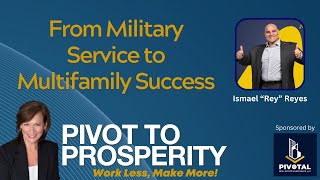
Ismael 'Rey' Reyes, retired lieutenant colonel, moved from 28 years in the military to multifamily real estate. He now runs a fund with $1 million allocation and is closing a 144-unit Class A deal in Dallas-Fort Worth built in 2023, applying military discipline to syndication investing.
Questions this video answers
28 years; retired as a lieutenant colonel in 2019.
$1,000,000
Fund investors: $50,000 minimum (then $10,000 to add into additional deals within the fund); operator direct minimum on this class A deal: $100,000.
144-unit, Class A, built in 2023; located ~12 miles from downtown Fort Worth in the Dallas–Fort Worth metroplex; purchase price cited roughly $160,000 per door; submarket median income ≈ $80,000.
justicecapitalfund.com
Chapters
Are you one of the many busy professionals working in offices day in and day out? Do you wonder how some people grow their wealth fast, retire early and play on work days? Well, you're in luck because Ginny Bolling hosts this show Pivots of Prosperity where she interviews people that can do just that play on work days. Many guests have become financially free. She also interviews people that are on their journey and people that are in support roles like attorneys, contractors, brain brokers and others. Commercial real estate is the common element. She is on a mission to be sure. Busy professionals know they can own substantial commercial properties too like apartments, self storage facilities and others and not have to do the work managing them. Passive investing is the key. Syndications are the typical method. Tax write offs are some of the biggest rewards. Ginny and partners find the deals, build a strong team and business plan, then offer the investment opportunities to passive investors. New episodes are released every Tuesday at 12, so watch for new releases. If you want to get involved, let us know. You need to get pre qualified to hear about most deals. See the show notes for contact information.
Hello. Hello. Jenny Bolling here with Pivot to Prosperity brought to you by Pivotal Real Estate Investments where we help investors build wealth and income through commercial real estate, but also improves communities. Today we have Ismail Ray Rays as our guest and thank you for coming. I'm going to call you.
Appreciate it.
We, we had so much talk about, we never got recording last week. We, we talked for the whole hour and didn't even record. So he is a distinguished guest. And so what I will say is I want you to tell us Ray about your journey into real estate.
You know it's, I don't know if, if you have the same thing Jenny, I bet you do. I mean you've been in real estate a long time but you know, you the itch from, from as, as far back I did, I certainly, you know as a kid I remember playing Monopoly as my being my favorite game. I just, I just the idea of, of being in real estate was, was not just a money making operation, it was just something more. But like all of us, you know we, we go through our, our cycle of growth and education, formal education, some of us and, and so I, I went to college, you know, got a degree in psychology because I just didn't know what I wanted to do. But and I felt it was one of those that I could use in a lot of different ways, kind of like a general studies degree and I also because I didn't have a ton of money for college I also joined the National Guard, the Army National Guard. So I was a military police officer. Took a year off to go do that and get some money for school, which is what a lot of people do in the military. And along the way I realized, in fact I went to Desert Storm. That took another year away from my colleagues timeline, but I went to Desert Storm. But I realized that I really liked the military. There were certain things about the military that really are very unique. It is a brotherhood and you do things and you suffer together and you grow this bond and it becomes kind of bigger than, you know, that, than the sum of its parts, you know, when you as collective. And so I actually, in my third year of college, I actually joined rotc. And then when I graduated from college, I had my bachelor's degree, but I also had a commission in the United States Army. And shortly after that I went on active duty just because I did enjoy that. And I like the, the aspect of serving, but I also, in the back of my mind I'm like, well, if I want to do that, I want to get paid for it, right? As an enlisted soldier, unless you're just, you know, sort of thinking about the, you know, the, you know, going to college and other things, most people don't become enlisted to do 20 years in the military. I think most people, you know, at least people I know that, that want to do that are trying to get a more formal education so they get on the officer ranks, you pay a little bit more. So I became an officer, I got my commission, and then 28 years later, you know, I decided to actually go into multifamily investing full time. Now during my career, I especially once I got to be, you know, once I became a captain, I had a little bit more disposable income. I had a little bit more. My family was settled, my wife and my kids, you know, you gotta, gotta get that right. But you know, once we were in a good enough place, then I started investing in single family because I had that itch, right? And along the way, once I got to the point where I was getting ready to retire, my thought was never a lot of people retired to the military and they go take a six figure income doing what they were doing in the military. In my case, I was an intelligence officer. It would have been very easy to get a civilian job doing something within the realm of intelligence or something within the realm of essentially working at the higher echelons of military. But I knew that what I wanted to do was this. And so, you know, I Started. I started right away, right into this path of being an active, active investor and in multi. In the multifamily state. The only other thing, and we can talk more about it, is how I've sort of some of the little transitions that I made since I retired and with my overall plan. And we talked. We can talk about the fund, we can talk about different things that I'm doing at that point, but that's it in a nutshell. It's just the itch that's kind of gone along my entire, you know, lifeline, if you will, and then other pieces of me that have wanted to do certain things to serve my country and duty. And once I got that out of the way, then it's. Right now it's just about, you know, growing wealth. Not just my wealth, but the wealth of the other people that I know and that. That. That want to come on this journey along with me.
Very good. Very good. And that's why we connect so well, I think, is that doing it with people that we also like being with and that. That connect and. But I didn't realize you were in the service 28 years.
I did. I retired as a lieutenant colonel in 2019, just before the pandemic, which was, you know, that's a whole different story. We talk a lot about that. But, you know, essentially, here I am going out into the private sector, if you will, and next thing you know, I guess it was a little bit of an advantage because I didn't have to go work somewhere I could do. Part of the things that we enjoy. A lot of the people that are in this business is the flexibility that we get to be able to be really work remote. As long as you have some connectivity and you get on a call and you can get on some video, you can do this anywhere. Right now, I'm in Florida, Guinea. Where are you at again? Remind me. You're out of Florida, right? Yeah. You're in Orlando. So. Yeah, so we. Yeah, it would be a lot harder to try to do this if we had to drive and get somewhere.
Yeah. Yeah. And being in Florida, it didn't lock down as bad as a lot of places. So.
Yeah.
But, yeah, me being right by Disney and Universal, it was shocking when they closed then, you know, it's serious. Right. But very good. Well, so. And I gotta ask you this then, too, just for fun, did your. Did your family move much when you were growing up?
My family moved from Puerto Rico. And the story that I got was, it was, you know, we moved from Puerto Rico to Milwaukee, Wisconsin. And they were like, wait a year. Puerto Rican and Milwaukee? What the heck is that all about? Well, it was the. One of the cheapest tickets out of Puerto Rico. You know, there was four of us, four kids, and it was cheaper. And on top of that, we had, you know, like typically happens when you have, you know, family migrations, one person kind of tips their toes somewhere else and they say, yeah, this is a great place. And next thing you know, you've got that sort of little mini hiatus or, you know, the immigration pattern that kind of flows there because you've got a support person that's kind of, you know, leading the way. And so I did.
I had a.
An uncle and some other family had moved here. And then we just kind of came and then it was a lot of jobs. That was part of the reason that the tickets were so cheap, because there were a lot of factory jobs, industrial jobs at that time. This was pre nafta, of course, I'm dating myself, but pre nafta, a lot of that type of work was being done in the Midwest and a lot of other places. And so my mother worked as a. As a seamstress, and she was able to plug in right into a sewing machine operation. And my stepfather was working in a tannery, and right away they were able to get to work and blue collar, and it was. We weren't looking for any free rides. We were just waiting for the. Looking for the opportunity, and it was a good way to jump in.
Wow. Well, are your parents still alive?
My. My actual father died. He died a while back. And my stepfather is still alive. He's back in Puerto Rico. My mother and him separated, so he's, he's got his family there. And my mother actually lives pretty close to you. She's in Lakeland.
Oh, okay. Yeah.
So, you know, I make my trip out that way every once in a while from. From here, where I am, just north of West Palm beach in Port St. Lucie.
I bet they're very proud of where you're at now. That's. Yeah, yeah. So. And then you got into single family and multifamily or multi family first, then single. How did that actually go?
So, like, a lot, a lot of, like, it happens to a lot of professionals. You, you, you don't know what you don't know. And it was very easy. Most of us can, if we have a little capital, we can kind of do a single family, whether we be our accidental landlords, in our case, a lot of military folks, they move somewhere, they get they get, you know, we have a permanent change of station, which is what it's called when they basically move you somewhere to operate out of. And. And so we either buy or we can rent or, you know, or live on base. It never made sense for me to rent, and living on base was sometimes hard to get. And frankly, you know, we like the idea of being out in the economy a little bit more and having that flexibility of not being on the actual installations when we could. So I would buy a house and, you know, and then, you know, two, three years later, we would move and that house would become a rental. It was very deliberate for me in that sense, not for all people. I guess the one thing that, you know, you. You wish you could do differently. But I always tell the story because I think it's funny, like, most people, when they think about, you know, hacking their way into financial freedom through. Through real estate, they think, okay, multifamily. And their mind is like, oh, I can buy a duplex, I can buy a triplex. And to get started, right, because it's still considered single family up to four units, and below is still considered a single family from a financing perspective. But I could never get my wife to. To want to live in a fourplex as much as, you know, it's like, hey, this makes a lot of sense. Like, you know, you're gone way too much. I deployed a lot. We traveled a lot, and a lot of times it was me by myself, and she had the kids back home. And, you know, so it was. I understand that. And I think it would have been a lot different if it were just me to be able to do certain things versus having to consider the security and the safety of the family. So ultimately we had a lot of houses, you know, we bought along the way. Initially, they didn't really cash flow because we were buying nicer houses at, you know, market rate. The market, you know, market rates. It wasn't initially to rent them. And so you have to kind of get through the first couple years where you were red a couple years. But over time, they appreciate just like everything else, you gotta take your lumps in the short term. So it made a lot of sense that way as I was, you know, in the military. One of the kind of things that happened to me when I really started thinking about switching over into multifamily is and really more about passively investing versus, you know, actively being involved. Because when I was stationed in Mexico, out of the US Embassy there in Mexico City, and my wife was working in the Embassy. I had my job working, supporting the, you know, supporting and helping us, assisting the Mexican military. It's very busy work. And we had a property in San Antonio that the tenants decided to do some. Sometimes with tenants too, that makes things difficult. Right. You know, they kind of wanted out and they were trying to figure out how to do it, and they essentially got so bad that our property manager, because of course, you have to have a professional property manager if you're not going to be on site. And we weren't. Our property manager said, you know what, it's great. Would have loved to get that little 10%, you know, rental income, but this is way too much work dealing with this. These tenants buy. See ya. And so now all of a sudden, we had a problem. And so my wife actually took the brunt there because she had a little bit more flexibility in her work. She wasn't happy about it, but she had to end up going back and dealing with that situation. Right. And so that just kind of in my, in the back of my mind, I just like, you know, this needs to be. I need to figure out how to do this because the more rank you get, the busier you get. And so in my case, I started thinking about other ways. Passively investing in multifamily, not necessarily single family. The question was how to do it, how to finance it, how to get the money for it. And that's obviously things that you learn along the way.
All right, so. And that's something that we now teach other people. Right? And so how did you start? Were you using retirement funds? Then how did you. How did you solve your problem?
So initially what I did is I just sold off a couple single families. The ones that I, that I didn't, you know, that I. My, My decision was, you know what, As I kind of wanted to settle down in Florida, I was getting closer to retirement. I didn't need properties in other states, so they still gave you the same type of problems. And there was no scale there, so I'd have a sprinkle of homes all over the place. So the idea was, okay, I need to consolidate. And in order to do that, I just started selling a couple of assets and then I would take that. I didn't do any 1031s. The one thing I should have done, I sold those assets and essentially I took the capital and I just reinvested it in the passive deals, which technically, if you're investing in a syndication, which is what I did, you couldn't really use, not easily anyway, unless you have Some sort of a, you know, more structured agreement, and you have enough capital, it's hard to 1031 into that. So I essentially just invested as a limited partner in several syndications because I wanted to learn about it more than anything else and figure out if that's something I wanted to do myself. And so I, I invested in a couple of deals on, on areas and properties that. Or on areas that I wanted. And then I looked for operators in those, in those areas that, you know, that I felt I could trust and I could connect with. And that was kind of part of my journey going into from single to multifamily.
So 2019, you got into multifamily.
Yeah, and I started learning about it right around 2016, 17. You don't like to just jump into something cold, but, you know, really started learning about multifamily and learning about how we get into these deals without having to fund the whole thing. Because I think that's the limiting belief, the limiting belief that, oh, I can't do that. I can't. How am I going to afford to buy, you know, 2 million, 3 million? Just, just add the number, right. Depending on where you're at, just add a little bit more. And there's your limiting belief. And syndications is a, is a way to get around that because you're basically joining forces with others and combining your monies and your experience and your talents towards that unilateral goal of, you know, acquiring an asset and then obviously managing that asset and growing your wealth really.
Increases the buying power. It really does. And, and the scalability of it. Instead of buying one refrigerator, you're buying fifty hundred. Yeah, yeah, it's, it's crazy that, that, especially for me, that 40 years in real estate and I didn't realize I should be scaling, you know, really. I was doing the individual rentals too, and buying property for other people.
So, yeah, talking to a guy who, who, who was running. He was a CEO of a family office and, and he just, just happened to connect because, you know, you're networking and, and you network with people, and as part of that, you get to hear the stories. And he's like, I just got tired of other, you know, making other people money. And this is a professional. He's not in his 20s, you know, probably late 30s. We didn't really go into his age or maybe early 40s. And he had just, he just had the epiphany like, I know what I'm doing, but what I'm doing is not helping me. Really. It's helping them so he's making his transition. So everyone has their own timeline of when they sort of do things. But yeah, it's, it's, it's crazy that when you work for someone else, you're building somebody else's dream, right?
In my case it was mainly for government. So it wasn't like making them rich or anything. It was a public, it was more of a public service in a way. But then you get busy with, you know, you work a lot of hours and then you're trying to do the private life, being a mom and all this kid stuff and yeah, someday hopefully you wake up. But that's one of our, that's one of our jobs is to try to knock on that door to tell people there's opportunity here.
And to me it's those limiting beliefs, you know, like when they put it in front of you, you said, well here, have you thought about doing that? And so yeah, absolutely.
One of the organizations I belong to is the local apartment association. I don't remember if we got talking about this but so I go to the, I'm on the membership and special events committee. So I get talking to these people and in our committee meetings we get to introduce ourselves. I say that I help people buy large commercial assets like apartments and that means that people like you and I can own these big major assets together. And their eyes like, because they're so used to saying the owner's coming, the owner's coming. Well if they can be an owner now too, they'll understand a lot more. So it's really cool to watch that wide eyed realization. But, and same with the real people, you know how that is. You know all these people that are investing in the single family, they don't realize it's not that hard to put some of that money that they don't want to be investing in their, their single families put it to work in the multifamily and they're scaling twice as fast.
So yeah, one of the things that happened to me is when we would go to some place, we would be stations and it only happened a couple times when I was working in the Pentagon. More than anything else it was just too expensive to buy and frankly I just didn't, I wasn't planning on retiring in that area in the D.C. area. So you get put in a position where you're like, okay, I want to invest but I'm not going to buy a house. I don't want to, I don't want to have another single family house. What do I do to invest. And so that's where the passive piece of investing and you know, as a limited partner and some of these syndications took to, you know, flourished and became something I really started looking at because otherwise you just, in our case, if you're so busy and that's really your only angle, you're. I'm missing three or four years where I'm not investing in real estate because of know, basically being in a place where I didn't want to be. And so, so yeah, you're absolutely right. This gives you some flexibility to even look outside of your own, you know, wherewithal, your own area, your own geographic location. Sometimes some people don't want to invest. Like, I don't know about you, but I get California investors reaching out. We got some stuff going on in Texas and they're like, they like living in California. Nothing wrong with living there, but don't want to invest in real estate in California. And you know, they give you their 20 reasons why and we probably have another five that we can talk about. It's on a show of why. Probably doesn't make a lot of sense to invest in places like California where it's not really pro business. Right. And then we won't go into that. But essentially that's, that's gives you the flexibility to do these things, to scale outside of your own little backyard.
Huge. I think that's just huge. And what I try to also help people understand, which I know you do too, is you can start with as little as $50,000. Most people don't realize that they save a lot more than that to go buy a property. Then they have to manage it and sign on the loan and all the rest of it. Whereas what we do, they don't have to do all that. It's all passive. So, yeah, it's a beautiful thing. I think on my LinkedIn, I call it the best thing since sliced bread. Absolutely. So you are now actively in, you have a property under contract which you are able to talk about because it's a 506C. Right. So tell us about it.
Yeah, so we. So one of the things that I did is I, in my journey, I started working, working as more of an operator or general partner in multifamily. And that was, you know, I did, I did that for several years. But I realized that what I really enjoy doing more is actually raising capital, talking to people and kind of talking to them about what they can do and how they can employ their, their money. Right. Passively or even actively Some people every once in a while get on, on a console call with somebody that really wants to be an operator. They got the itch. And so how do I help them with that? Right. How do I get them, you know, keep them from making huge mistakes along, along their initial journey. But one of the things I did then, because I understood that then, we created a real estate investment fund. And so through that fund then we're able to use capital from investors to then invest in syndications and multifamily. And we can frankly invest in a lot of other things. We're focused on multifamily because I like investing in things that people need. I don't like investing so much in what people want. You can get. No, you can, you don't have to buy that Starbucks cup of coffee, but you do need to live somewhere. And that's kind of one of, one of our models. So that's where we've focused. It doesn't mean that there may not be an opportunity somewhere else. But right now we're looking at multifamily. And so we, this 144 unit class A 2023 built multi family property in the Dallas Fort Worth metroplex. It's about 12 miles away from downtown Fort Worth and in a booming little emerging little, what used to be a bedroom community that's just getting kind of sucked into the whole metroplex, people are willing to live a little bit further away from downtown areas because a lot of them work remote, just like we're doing, right. And so they're able to live where they want and still get the professional, you know, meet their professional requirements to make money for their family. And so this, this little area is fantastic. It's. And one of the things that I, I'm focused on right now, on real estate and multifamily specifically, is we do potentially have some, some indicators of a recession. Some people will argue yes, some people argue no. But at the end of the day, you can also invest in things that are a little bit more risky, that maybe have higher upside opportunistic deals. Which is what. Which is. We can talk about some of these definitions, but it's definitely more opportunistic to, to buy something cheap, you fix it, call it a value add. In single family, they call it fix and flip. But essentially they're doing the same thing. You're making. You're taking something old, you're buying it for cheaper. Ideally you're fixing it, you're selling it for more. But that's opportunistic because you're having to deal with, you know, with financing. That, that's not ideal. It's not long term. You're, you're working in bridge products usually means you have a three year kind of loan and, and if you haven't, if you don't have, if you don't have any black swans or anything going on in, in within that, that time frame, then, then you can turn a tidy profit. Really make a lot of money by doing that. But there's a lot of pitfalls and a lot of people that were doing this strategy, the value add strategy for the last few years found themselves, especially if they got into deals as the Fed was losing its mind with the Fed funds rate and interest rates went up the roof because nobody projected that kind of an interest rate jump, right? And it's not a direct correlation. Some of my more technical investors go, well that's not really what caused, that's not really what causes, you know, mortgage rates to go up. But it's, it's, it's definitely a large indicator, right? You know, you got, you got the 10 year yield which is kind of a more, a much more closely aligned number that, that tracks rates. But nevertheless, overall there is a very huge correlation between what the fed funds rate can do, right? And in this case, people that were buying with an anticipation of selling something for cheaper or not for cheaper, for more and making a profit now find themselves in a situation where they can't refinance the asset because the rates are so high that it doesn't, it doesn't match their, their, their, you know, their, their exit strategy. And so they, they, they can't refinance and then if they have to sell it, they have to sell it for cheaper because those people that are buying, are looking, are looking at it from the other coin are going like there's no way we're going to be able to buy this at your price point and make it work with these higher rates, higher debt. So that's very risky. Right now we're looking at class A assets in great markets that, because the market in and of itself all had the same kind of general level of distress at the national level, right? Every market's different, but at the, at the very top levels you did have this pressure from the Fed funds rate that really drove a lot of the multifamily specifically downwards. And the other thing that the pandemic did, which, which makes it even more interesting is people, people stop building single family during the pandemic. It was just too hard to do and it was very costly to do so. Developers were not doing single family by and large. They started doing a lot of multifamily. And where did they do their multifamily? They were looking at these great places like Dallas, Fort Worth, like you know, markets like Orlando and, and markets in certain areas that they knew they had the population growth and the economic diversity and there was enough going on there that, that it was, it was a good strategy. But they overbuilt because everybody's looking at doing the same thing. So then we had this glut of properties that were out there, that are out there but you still have the, you know, the up, the pressure of the pricing because the Fed has not really dropped the rates significantly enough for it to matter. So now we have distressed assets that are class A. And in our market in this particular deal, the, the property to con to build it, the construction price is more than what we're paying for this thing. We're paying 160,000 a door for a new property in a, in a submarket where the average median income is, is $80,000, which obviously in some places like New York maybe it seems like that's nothing. But in Dallas and a lot of the southern markets that's a good size, you know, that's a good size average median income. And so it is, it is not going to be one of those deals, you know, that we think is going to be, you know, triple your money. But it is, is a cash flowing deal because you're not fixing anything. We're not buying something old, fixing it and trying to sell it for more. We're buying something new. We just raising rents a little bit because you know, there is some flexibility in these newer properties. We're able to raise rents, not a lot, but the market is starting to turn that way. So we're able to raise rents and not have to worry about crazy expenses from it. So base hits, doubles, singles is what we're looking for at. And this property is probably a double with some potential to really do a lot more because of what's, what's happening. Dallas is, if anybody just does some quick research is is a market that's coming up as like the emerging market that's going to make the biggest rebound right away in 2025. They're saying it's going to explode because you never stop people going there and the economy growing. That's a lot a bigger cycle. Those macroeconomic trends don't stop as quickly as real estate cycles do. Right. And certainly real estate cycles are still slower than the, you know, the market, which can go up and down in a day. But there's still, there are still some cycles there. But these macroeconomic trends where people are moving, moving families, that's not something that changes on a dime. So you never lost that economic power in places like Dallas, Fort Worth. You just had to write out that, that, you know, the, the distress trend from the, from the rates. And we think we're in a very, very good spot now where just about bottomed out and we're going to go back right up and ride that roller coaster up to the top in this next cycle. So we're really excited about that. And the easy way to find it is justicecapitalfund.com offering and you can find everything that you want on it. It's, that's a landing page. It has everything about the deal itself. But it is when you can buy something for cheaper than it cost to build, that's a winning strategy.
I agree. I agree. And that on top of everything that you just said, the fact that, you know, Orlando and Dallas and all, you know, they, they were going up, up, up, then all this supply came on and so, and with the interest rates in a high amount for a prolonged time, we started hitting that, that stress. But that's when all these builders cut back too.
That's a great point. The supply and demand is critical and they stopped building. So just like they built too much, then they completely stopped building. So for the next few years we're going to see deliveries going way down. So that's going to, you know, get that curve going again in our favor as a multifamily investor because you don't have the absorption. Very good point, Jeannie. I failed to mention that. But that's part of it. It's all supply and demand and we're on, we're on. I'm going to be on the good side of it soon.
Right, right. So location too. You know, you really got to pay attention to what you got. But so that's exc. How much money are you raising for this one?
So our fund is allocated a million dollars, which isn't a lot. This, this, the particular deal was, was a 506B initially and they raised capital under 506B which meant that you and I couldn't talk about it. Right. At that point in time it was more about personal relationships and people that are non accredited investors through those links that were able to hear about that opportunity. But once we get to the point where we've already Maxed out the number of non accredited investors, which is 35 or less. Then you, A lot of, a lot of this, a lot of the syndicators are now basically using a hybrid where they flip it over and they make it into a 506C. So now it opens up the floodgates to much larger amount. So on a 506c side, we've got a one million dollar allocation. And that's going quickly. It isn't a lot in the deal itself. The other advantage is if you're investing in a deal, you mentioned $50,000. That's typically when you're investing in a lot of deals, especially if they're class C, that's typically what you have to come up with is 50k. But when you start looking at class A deals, that number, that minimum number goes up. So the minimum number through the operator on this case is $100,000. And what they're offering to that, that investor who invests less than a million dollars is not as good as what we're getting through the fund because of those relationships and our ability to kind of, you know, create higher investment amounts into these deals. So we're getting a better split of the, of the upside and we're getting some protection on the downside. And our investors only have to put in $50,000 instead of $100,000. So you have to make the funds more attractive than people going directly to the investor. Because why would they, why would they, why would they go to you if they can get a better deal directly? Right. So we're not, we have to make these deals attractive. The other piece of our fund, which is important is that once you invest in one deal for $50,000, then you can diversify within the fund and only have to contribute another 10,000 to get into a separate deal. And it's a customizable fund. So it's not like you putting money and it's a blind pool. It's, you get to pick where to use your money on what deals. And so it gives some flexibility while still getting the benefit of having to be within that fund structure.
Thank you for elaborating. Right, yeah. Now that, that's, that's a newish product that is very exciting because people can pick and it's usually what, 1k1 right at the end of the year for their tax. So you can diversify within the fund. And so you go and you work with someone like yourself and you've got choices then and so you find the person you know, like, and trust that can offer you, you know, something like that. And you've got more choices without having to because otherwise you end up having to get to know several operators or several fund managers, which you should do anyway. You should have several because when you're ready to deploy money, they might not have a deal. And so, you know, you do need a few, but the more you have that have multiple options, the chances are there's a deal there. So yes, it's, it's a beautiful thing.
The other thing, and I'm glad you mentioned the operators, Jenny, because I think that's the other piece that a lot of, you know, passive investors really need to understand. And we talked about some of the issues in the last few years with folks trying to, you know, execute value add strategies on an older classy properties. Well, those operators, they're going to make or break the deal, you know, raising the capital, especially in good times, because we were in very good times, was not, not hard. People have money and they would, they, they have a goal and they, they, you know, you present them something in a reasonable business plan, they're going to go for it. But a lot of these operators didn't have the experience to work in this environment where things aren't, you know, where the ties aren't high. So you have, you know, tides that were going in the wrong direction and you had a lot of operators that didn't have the experience or the, or the bench really to operate in that space. And so there has been some distress and there's been, you know, money lost, you know, and, and I, and the truth is if you've been in real estate long enough, I don't care what you did, you probably lost a little bit of money along the way. That's part of your journey. You can't, you can't let it affect you overall because the idea is to have more upsides than down. It's the same thing as the market. It's just a lot less ups and downs. But you will take a few lumps. Ideally you talk to people like Ginny or myself that have taken those lumps and we, we allow, we basically give you some knowledge that allows you to avoid it. But there are going to be some lumps on the way. But through the fund and through very, you know, through those kind of structures, the fund can then go in and really do a deeper dive into these operators. And we do have a, in place to make sure that we're really doing all of the homework on these operators that are telling, saying one thing and perhaps not telling you the entire truth. And they've got a lot of skeletons in their closet and they're. And so we, we take your, we take that information from them, we vet it, we do our own background investigations on them, very thorough investigations. A process in place so that, that takes that away from the, from the individual investor. When they get something through the fund, they know that it's already gone through an intensive filtering process to make sure that the operators are better than your average person that you would potentially do a separate deal with. So I think that's critical.
That's a huge thing. It really is. And I think, you know, people are learning quickly because syndications have performed so well. There's been a lot of talk. Everybody jumped in, you had all this FOMO and prices going up, up, up. But then now the pendulum swinging. We're having that cleansing of the industry. There's going to be some people hurt. We know that over the next probably 12, 24 months we've been talking about, there's adjustments going on and those people that were caught with floating rate debt are giving back property. All their investors in some cases are having losses. But you know, that's part of, of the process like you're referring to and these fund management groups that are forming and like you mentioned that we're really putting it through stringent due diligence processes and we're finding out, you know, who really knows how to operate and who doesn't. Because if, if the jockey can't run the horse through the business plan and you know, get it all done, it's not going to work. Right, right. So yeah, it's exciting times this next 12, 24 months. Many people feel like we've already bottomed out or we are now. And so the upside is coming as some of those properties have to be recapitalized, reacquired anew.
The only reason we've got this property in Dallas Fort Worth right now is because the developer who was the initial builder of this deal and they, they wanted to, you know, get it out the market and make their money on, you know, from their initial cycle, from construction to, to sale, they got caught in the market cycle. And construction loans are short term loans as well. So they had a three year window to take this from, from dirt really to a, to a leased up product that they could then sell at a higher profit margin. Well, we're buying it. They never quite got to the full lease up and now they got to get rid of it. And so they're, they're Selling it for cheap until those opportunities are out there. You just have to have the networks in place so that you can come bring that capital and those deals to bring them together. And, and when you buy again. And this is the thing about real estate in general. I mean, if, even if all you can do is buy single family or, you know, or partner with someone to do single family deals, if you buy right. That's, that's the majority of your problem. You got to buy. Right. But now obviously you have competition and you got to do your research and you got all kinds of things that can happen. But reality is, if you buy right, no matter what it is that you buy, you're probably going to make some good money. The question is, you know, if you're actively doing this, how often can you buy? Right. You know, if you're buying single families, that was kind of my decision cycle too. Like, okay, I can do single family. I know how to do the research and do all that stuff. But, you know, after three to four months of that cycle of that acquisition cycle, all I had was, you know, in some cases $300 a month cash flow, sometimes less. And so that's a tough one to repeat. I'd rather repeat that on higher multifamily deals because of the scale.
Yeah. Where one or two vacancies doesn't kill you. And to that point. And then we're going to have to keep going because we're running out of time. But amount of time it takes to vet all these deals. Holy moly. So the busy W2 worker out there, it's hard to go through. You can't go through as many as we do full time. You just can't. And so the passive investing is really a priceless kind of a thing for everyday people, I think. But anyway, so very good. We're going to have you share your contact information in a moment. But like everything, like everybody I interview, I want to ask you, is there a pivotal personal event that brought you to where you are today or that's pushing you forward to where you're trying to be?
Yeah.
No.
And Jenny, you know, you know, we love talking real estate. We can do this all day long. But question. Okay. And so here's my answer to that. I think the biggest thing in my life was really when I enlisted into, in the military because we talked about limiting beliefs and how they impact our ability to do whatever it is that we want to do. The military does a very good job of getting you through limiting beliefs and you're able to see that kind of success. So we had, when you go through basic training as an example, you know, some people, they're afraid. Heights, My God, you know, they just, they're afraid of heights. But guess what? If you want to pass basic training, you're gonna have to get on that ladder and you're gonna have to climb the ladder. You're gonna have to put your foot over the ladder and climb down on the other side, hundreds of feet up in the air. That's just an obstacle course. You must do that. Right? And, and so there is a limiting belief that when you finally are able to do that because you've got more confidence in yourself, because you have a team that's p along the way, and you take that step above the ladder and you start climbing down. Wow. So now you, you've. You've been able to go through a limiting belief destruction process. And so imagine doing that in multiple ways through, through a career in the military where they're just teaching you how to be, you know, teaching you how to be a better leader, teaching you how to, you know, do things in a, In a very methodical way. If the army can do anything, it's basically has to be able to maintain. Our army has been able to maintain its superiority, our military, our armed forces, because of these processes. But initially it all boils down to, can you get that individual soldier to cut across those limiting beliefs. And to me, when I was able to do that, now, with me, it was never about heights. With me, it was more about discipline. I was young, I was 17 years old. I graduated high school, I just turned 17. It was about discipline and it was about, you know, I was never a little guy. I was always a big guy. Played football, you know, and it was about, you know, being humble. In some cases. That was just hard to do. You know, having somebody scream at you and tell you what to do and those kind of things that you would think that you would never be able to operate. In my case, being able to do that, being able to accomplish that, and then loving it enough to want to do it for the next 20 some odd years. Right. So long answer to that question. But I would say joining the military was a game changer for me. And when people, you know, when younger kids don't know where they want to go, one of the first things I, I recommend is maybe you should do the military. You know, pick something that you like. Obviously there's, there's all, many, all different kind of careers you could do within the military. Pick something, serve your country. Do something bigger than yourself and you'll come out much better for it on the other end.
Wow, that's. That's surprising to me. I wouldn't have thought you needed humility because you seem like you have it. So, so.
Well, you know, I try, I try. But we all have our moments, right? And that's where the team can kind of knock me over the head a little bit when I get a little bit too. A little bit too rambunctious and they go, that doesn't make any sense, Ray. And here's why. Perfect. And the. The ability of a leader to listen to others is not always easy.
That's true. That's true. Funny, funny. All right, well, so Sherpa, how people can reach you?
Yeah, the easiest way is just my name, Ismail rayreyes.com and from there they can connect. There's a link in bio there they can link and schedule a call. I do an initial consult for free. For anybody that is thinking about real estate. I'm happy to talk to them and get them organized. I used to spend a lot more time because like you see, Jenny, I love talking real estate. I used to spend a lot more time doing that for free. My time has become more limited, so I'm using platforms, YouTube and other channels, blogs to provide knowledge without it, you know, personally taking away from my. My day to day time to do that. But I'm happy to get on a call with anybody at least once to help them kind of get their thoughts together and understand what it is they're trying to do and see if I can give them some guidance to get them there quickly.
That's excellent. That's. That's so true. Okay, well, very good. Well, thank you for coming on. I do appreciate it. And we'll have to stay in touch. Several things we need to keep talking about. So I'm gonna go ahead and say thank you and we'll put everything in the show notes.
Thank you, Ginny, for having me.
More from Ginny

Dr. Calvin Lowe Saves Lives 2 Ways: Pediatric ER & Teaching Overworked Med Pros How to Get $ Balance

Turning Construction Expertise Into a Thriving Real Estate Empire With Eric Schultz

Build-to-Rent, Community & Cash Flow with Pivotal Person Award Recipient Andy McMullen



Investing Beyond Boring Real Estate: Oil, Gas, and Industrial Properties with Keshav Kolur


Unheard of home prices: $225,000+/- in Portland! John Laine - Breaking Barriers- Home Affordability!


