Local Legends and Pivotal People Series: Dr. Owen Beitsch, PhD, FAICP, CRE || Ginny Bolling
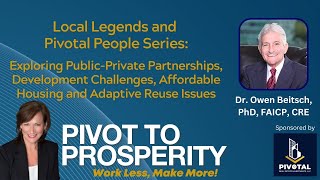
YouTube interview (Local Legends & Pivotal People Series) of Dr. Owen Beitsch (PhD, FAICP, CRE) by Ginny Bolling (published July 4, 2023). Beitsch recounts his career in public finance and real estate (Tennessee Housing Development Agency; Big Eight accounting firm; Real Estate Research Consultants; early Colliers partner), his academic role at UCF teaching planning and public finance, and civic service (founding member, Orlando Neighborhood Improvement Corporation; eight years on Orlando Housing Authority Board). He discusses public–private participation (vs. true partnerships), the Baldwin Park redevelopment (former Navy base needing about $90M demolition), transportation projects (SunRail, Brightline, high-speed rail concepts), affordable housing tools (4% and 9% Low-Income Housing Tax Credits, new markets tax credits, Opportunity Zones), accessory dwelling units (pros/cons, financing challenges), and impacts of tourism taxes and post-COVID office demand. He emphasizes educating planners on public finance and better mutual understanding between public agencies and private developers.
Questions this video answers
About $90 million.
Mortgage rates as high as 9%–10%.
Winter 1982.
Eight years.
Four years.
Chapters
Foreign.
Hello. Ginny Bowling here with Pivot to Prosperity, brought to you by Pivotal Real Estate Investments, where we help investors build wealth and income through commercial real estate that improves communities. And Today we have Dr. Owen Beich as our interviewee and welcome. Owen, thank you so much for coming.
And, Jenny, thank you for inviting me. I think I told you this will be my first podcast. So it's not only interesting, it's actually, it's exciting. It's like, good, good.
And you are number one in our new series of local legends and pivotal people. And I declare you are both.
That's pretty strong. I'll try to live up. Live up to that in today's conversation.
Okay. We won't be able to help it.
You will.
Okay. I do. Like I said, I want to read your whole bio. So here we go. I'm going to call you Owen, though.
Since we've worked together.
And we work together at GAI Consultants, and. And I loved sitting on the same floor. Even I used to come visit you. Probably more than you wish. But you're a senior director there, and Owen is PhD, FAI, CP and CRE. And we'll get into what those mean if you think we should. Basically. This is going to explain a lot of it, too, though. You've been active in the management.
And.
Execution of very complex studies for public and private clients for many years. Years. Your particular interest in special issues confronting urban studies for civic and business activities is pronounced. Owen is a founding member of the Orlando Neighborhood Improvement Corporation, for which he served four years. He recently concluded eight years of service as a member of the Orlando Housing Authority Board of Commissioners. As a resident of Winter Park, Florida, Dr. Beach Beit.
Sorry.
Served as assistant chair of the city's Economic Advisory Board, as well as a member of the Planning and Zoning Board. During this time, he also served on other ad hoc committees exploring policy issues for both Orlando and Winter Park. Owen is currently the elected chair of do you say that Century xef.
Century City.
Yeah, Century City Community Development District, which oversees major tourist area approximate to Disney World. Owen was asked to join the Counselors of real estate in 1990, a group open only by invitation and normally focused on valuation issues. He previously served on the group's editorial board and was assistant editor of Real Estate Issues, the organization's referred journal. In 2010, Owen was named a fellow in the American Institute of Certified Planners, the highest honor bestowed in the urban planning profession, and awarded only 3% of those achieving certification. That's the AICP. He was named as an outstanding alumnus of University of Central Florida's College of Health and Public affairs, which is Cohpa in 2011. Owen remains active in Cohpa, where he has been a member of the urban Planning faculty since 1996. Germane to his consulting and academic responsibilities, Owen speaks and publishes often. Owen attended Vanderbilt University, University of Florida and University, and Florida State University and received PhD from the University of Central Florida. And it doesn't say you're a professor there now.
Well, I am a professor now, and that resume is probably a couple of years old, but it's reasonably correct in most respects.
I didn't look. Were you grimacing?
I'm always grimacing when people read that resume.
Well, tell us about you and what's between the lines. What makes you tick?
What makes me tick? Well, as I get a little bit older, since you ask, am I still a faculty member? I'm spending more time at UCF than I used to at gai. While I certainly not retired, I've been in a position, I think an enviable position to pick and choose a little bit more about the projects that I personally want to be involved in. I've also had the luxury, perhaps the joy, of seeing most of my department and its responsibilities pass to a younger, perhaps more enthusiastic and energetic group of youngsters that I think are performing extraordinarily well in their expanded responsibilities. So I do want to take this time to nod and call out Laura Smith and Natalie Frazier, who I like to think I helped shape into professionals. And they're now doing an extraordinary job of taking over the Economics department, primarily at GAI Consultants. But as I indicated, I love my teaching job at ucf, primarily because one thing we might want to talk about is civics lessons in Florida, which I think we basically abandoned. But as a faculty member in the planning department, you really have to understand government in order to understand what government's role can be. What it should be is not the same as what it might legally be. But. But certainly the public sector has a lot of intervention and a lot of control over private vault. And it's been my role in the planning department specifically to try to bridge that gap between teaching planners how to plan and regulate and how to acknowledge the importance of what private development yields in a community, since private development and private capital are substantially responsible for what we collectively call the built environment. Right. So among teaching the normal types of subjects in a planning program, UCF has taken some initiative to focus on how we review and evaluate private development opportunities that public agencies might eventually participate in as partners, even if they only participate in that role as regulators to understand the cost of decisions through regulation and interpretation of regulation. And UCF has also said, wow, if we're going to talk about how we develop and work with private development entities, perhaps we should also be teaching our planners something about public finance. And it has long been my particular position that we don't do enough to teach our young planners about the economic dimensions of their decisions, Whether it's in terms of the actual financing, the risk associated with pursuing private development, perhaps in the risk and cost associated with allowing a private developer to actually implement development inside a regulated environment. I think it's too easy to disregard the role of community development. Some organizations, like the American Planning Association, Urban Land Institute, the Counselors of Real Estate, which I'm a member, have done a pretty good job of trying to sensitize and in some respect, educate the planning community. But UCF would be among the very limited number of graduate planning programs that actually emphasize that as a dimension of public policy, specifically public policy and planning. And why do I have that interest? Let's back up. Many, many, many years ago, My training in college was primarily in economics and accounting. I am not an accountant. I don't want to confuse people, but I do have background. And my first job, my first real job at a college was working for the Tennessee Housing Development Agency in the public finance area. And the Tennessee Housing Development Agency, which I think we've discussed before, is not anything like the Florida Housing Finance Agency in a very important regard. Tennessee housing was a direct investor in affordable housing. Most state housing finance agencies either make tax credits available or involved in the secondary market, whereas THDA was in fact the generator of its own financial portfolio. So in addition to several thousand multifamily units, which at that time were supported by Section 8 and mortgage rates as high as 9 and 10%, which is shocking when you turn the clock and look backwards, but mortgage rates 9 and 10%. We also had a portfolio of, I want to say, seven or eight thousand single family homes. So we needed to understand how housing was delivered by small contractors, often in rural settings, how materials were delivered and what the risk was in supporting the construction and then sales activity. These small builders, along with major developers doing multifamily housing. So, you know, at a fairly young age, I had a very significant exposure to affordable housing, housing in general, affordable housing in particular, and came to realize that the public side could play a pretty important role in and how that market mobilized. Now, I think what's interesting is that I came to that industry really not Knowing much about affordable housing, I don't want to pretend that I did. I did no finance. So thda obviously influenced my thinking in a lot of ways. And then I guess I worked at Tennessee Housing for about six years and was recruited from Nashville to Orlando and came here in the winter 1982 to work for what was then one of the big eight accounting firms. So in the early 80s, some of the accounting firms were trying to guide their own clients into the affordable housing industry, which at that point in time really was very different than it is today. But nonetheless, accounting firms obviously had an interest in, you know, watching what their clients were doing with their money and played a large role in that type of activity, and then just became more interested in general finance. So I lived in Orlando for many years working at this accounting firm. Eventually worked with another gentleman to form what I think is probably a legacy firm in Orlando called Real Estate research Consultants. And we referred to Real Estate Research Consultants as rerc. And then we were involved in a wide variety of real estate analytical activities, which I think one of the most notable since it predates the computer and certainly predates a lot of electronic databases today. We literally surveyed and verified the occupancy and tendencies of every commercial structure in the larger Orlando Regency. We also validated the occupancies of apartments. I don't recall what year, but as we were doing this, a publication was available in Orlando called Black's Guide. And it was a hardbound publication or was a wire bound publication, but it had hard covers and it reported occupancies and rental rates for all these commercial structures. And we were approached after having very lengthy relationships at that point in time with the savings alums and with the two or three larger banks in Orlando that bought our data on a quarterly basis to inform their underwriting decision. Now, how well they inform their underwriting decision, I can't speak to that. But we were the source of information using their underwriting process. And Black's Guide bought our database to supplement its own efforts. And that database then became absorbed into whatever most of us are using now in other electronic forms of communication. At one point, we were closely associated with Colliers, Arnold Colliers Real Estate. In fact, I was one of the first Orlando partners to Colliers, which isn't actually in the resume, in part because of the analytical services we provided. And Colliers thought its clients would benefit from having access to that kind of information. But back to my teaching, it's because of these varied activities, especially many years dealing with affordable housing, which by Inference makes it a public type of activity. I have been really interested in how the public engages with the private sector and the provision of product, whether it's housing, commercial facilities or some types of institutional facilities. And as I think, you know, which I guess also isn't really reflected in my resume because it. It's much older than I am, really is, the accounting firm that I worked for had a very interesting specialization. In addition to being advisors to many people investing in affordable housing, through some very fortuitous turn of events, we became associated with the New York Yankees. I mean, literally by just one of these lucky things. George Steinbrenner, the owner of the Yankees, was in fact a tax client of the accounting firm that I worked for. And George, ever looking ahead, you know, was trying to figure out what to do in part, not just with his baseball team, but his shipyards and other. Other enterprises that are accounting firms responsible for. For counseling. In any case, at some point, George introduced us to some people in Kansas City, which in turn introduced us to people at New York State. New York State government, specifically that owner, controlled almost every sports facility in the state of New York. So we then became associated with Yankee Stadium, the Meadowlands, several racetracks. I don't even remember all the different facilities that were involved. But as a result of two tax engagements for the accounting firm, suddenly our practice was expanded way beyond the bounds of affordable housing, and we got involved in major sports facilities. I haven't maintained that connection as strongly as I would like over the years, but here in Orlando, I was a participant as the city was trying to acquire land for the Orlando City Soccer Club. And so we helped put together what was initially the public to be. Initially to be, since it went away initially to be the public financing package for Exploria Stadium until it became privately owned, funded in finance. We pursued or were part of similar activities at the Kansas City Stadium for the Kansas City soccer team. So as I've gotten older, you know, soccer appeals to a younger and younger group. And I found myself engaging now in soccer, which I hadn't been exposed to at all as a kid, really only baseball and football. So my horizons have been broadened. But what ties all these things together, since I'm talking on and on and on, is that the public side needs to make some accommodation for the private side. The private side does need to understand that even an informed public will move ponderously slow. But if you choose to get involved with the public side, which is often necessary, it needs to be understood that there are certain disclosures and certain Timing difficulties that you're going to have to manage because of the stewardship involved with those public dollars. But I'm here to say both need to understand each other better. Wow. Is that too much?
No, no, that's great. And so, in that same vein, let's go a tad bit more. We will be able to reach into opportunity zones after we talk a little more about public private partnerships. That was like all the craze 10 years ago, starting out more than that, probably, But I got involved here and there probably about 10 years ago, and then I went to Baltimore to participate in what. But so there's lots of nuances.
What do you think? Right, right. And we tend to package it all as public private partnerships. I think the first mistake is they're really not partnerships for the most part. It's really about the value of money and the value of benefit, either the public side or the private side. On the private side, it's usually about how can we gain access to assets that would otherwise be tied up by a very public process. From the public side, it's how do we engage expertise without exposing our assets irresponsibly. There are still some things that are going to occur that way, but I think it's proven to be a little bit more difficult in most places than people surmise it to be because of. I think we need to distinguish perhaps, Jenny, Florida from other states. I work in many states today on different topics for those that might be listening to this and don't really have exposure to other states for them. These people may not realize how extraordinarily difficult Florida is compared to other states. Our public records laws in Florida are extreme compared to most other states in this interview. Certainly not on something that could be for public consumption. Well, I say that public disclosure is wrong, but it certainly poses a challenge, especially for developers that have a history and a preference to maintain privacy for their financial undertakings. And in Florida, it's very, very difficult to keep financial information of any kind from disclosure. I think one thing we've seen under DeSantis is some effort to tighten what is publicly disclosed, at least as far as how the state operates. But at least so far, that kind of less limited public access, however you choose to describe that, has not been conveyed to local government, who are under still extraordinary pressure when they participate with a private developer in any kind of activity, they're forced to make disclosures. The largest project I've been involved with here in Orlando, with Baldwin Park, I don't know that we've discussed that in the past. But Baldwin park, for those who may not know, since they see it as this wonderful neo traditional subdivision and may reside as we're having this discussion. It was a very badly contaminated navy base that required about $90 million worth of demolition. And the city of Orlando, in a very short version of this, came to control title of the property and had to make this property available to private owners, developers. That was an extraordinarily complex process because we're involving developers not just from Florida, but from other states. We were engaging in very sensitive, certainly quasi, if not entirely confidential conversations. And one had to figure out how to have those and still satisfy public scrutiny. That satisfied the law. That was a challenge. But I think the results are sort of self evident. I'm sure there are some people that would have criticized the original Baldwin park disposition and development process. Some people may not be altogether happy with what's there. Can't speak to that exactly. But I think most people would say it's. It's been a tremendous real estate asset to the city of Orlando because it backs up to Winter Park. I think Winter park would say it may be at our back door. We like what it does to our back door. So by most measures of success, rapid build out, rapid sales, extraordinary quality, high value. And it was probably a public private partnership to the fullest extent. The city received high value consideration for its property, continued to receive remarkable stream of tax receipts. The public participants disclose what they were required to do. On the private side was pretty generous about making its records available, but that was a lengthy set of selection criteria that the private side needed to understand if they were going to become the partner. Right. So I choose to believe that we don't have partnerships again as much as we have participation. And one person's participation perhaps is another person's partnership, but it does require patience and understanding.
Yeah, yeah. And if something starts going wrong, the right mechanisms need to already be in writing to help control things so that they don't go totally haywire.
Because.
You know, we're in a litigious society and it's so sad to see, you know, if, if people have the right intentions when they, they sit and they are true to themselves and true to that intention, then, then that, that can change the complexion. I know once a suit is filed, things can change for anybody, I guess. But I, I totally agree. It's. It's very important that if you're going to do any business with the government that you understand some of those, especially in Florida. Right.
I did contribute a long chapter, but A chapter, nonetheless. Not, not a full book. A chapter to a book on public private partnerships. It focused primarily on their benefits as a means of stimulating economic development. I am embarrassed to tell you, I don't know the name of the book.
Oh, no, you'll have to let me know.
We can research that and I'll send you an email. That's how much my, my publishing career has meant to me. I think my, my residuals on my publishing career have probably added up to, I don't know, 25 or $30 over 30 years. But in this particular book, what we really looked at were transportation partnerships and the complexity and in many cases the failure to realize the original agreements that were laid out in these partnerships. They definitely brought economic development because few roads aren't going to bring economic development development. But there's been quite a debate as to whether they really paid for themselves or not. And, and most of them have yet to pay back, you know, all the, the obligations that were created as a result of the original enterprise. It's going to be interesting to see what happens here in central Florida. Right. Based on the expressway, you know, the ultimate i4 discussion, and the tolls that are collected on that bit of roadway, I don't really have any opinions about that other than I'm doubtful that it's carrying the capacity of traffic that perhaps had been envisioned when the project was first planned several years ago.
Yeah. And let me back up. Are you referring to the transit overlay zones paying back what they were envisioned to do? Is that what you were referring to?
Yeah, well, that is what I'm referring to, but in the case of the book I was referring to, I know all the arrangements of those specific enterprises.
Okay.
So they vary. They vary. I mean, I know the detail. In the case of the ultimate i4 and the tolling arrangement there on the limited access line, I don't know the arrangement. So I don't want to, I don't want to offer a negative interpretation. I'm not doing that. I'm merely saying is that as I've used the toll lanes, which were created with the expectation they could pay for themselves, as far as I know, they appear to have much lower level of usage than I would have expected given that financial arrangement.
Right, right. Let me carry that over, though. Have you gotten involved at all with the SunRail stations and transit areas or circles of influence to the SunRail stations in Orlando?
I'm mostly a deliverer of bad news, really. I don't know if any of your listeners recall, but Florida does Have a high speed or did. I don't know if it still does a high speed rail commission. And in that high speed rail commission, a stretch of high speed rail was envisioned as running from Miami to Orlando to Tampa. And a group of developers and major world class construction companies formed a consortium called Fox. Interestingly enough, since we now associate Fox with broadcasting. But this consortium had nothing to do with, with the broadcasting empire. And Fox had envisioned privatizing the the rail high speed rail through rights to development in certain locations. And one of the key locations was generally at the. What we will loosely call 528 and I4 loosely called but I don't know that they controlled it at the time. And so we helped put together a program that basically said, you know what's really amazing about I speed rail in Florida, if you can really deliver a two hour delivery time between Orlando and Tampa and you know, 20 minutes to Orlando and Miami and deliver 20 minutes to Tampa is probably the real value isn't the railroad that probably has nominal value. What really has value is the underlying real estate at the key locations where you're dropping passengers off, picking up the train and using the system. And we concluded that that was a far more valuable franchise than, than the actual rail activity. I'm not sure, I still don't believe that today. And we were fortunate enough to have some very early role in Brightline, which is now whatever it's called, and figure out what the economic and fiscal impact would have been of what we're seeing now finally connecting Miami and Orlando. And maybe we'll connect Tampa. Years ago, while it was still in the planning stages, we were involved in the station choices for what was light rail and is now Sun Rail. And of course light rail has many, many, many more stops than, you know, heavy rail, which is sunrail and would have been implemented differently. And we worked on that I think for two to three years to see it disappear. And a vote at the county commission and I want to say around 1998, 1999. So that was very, very disappointing. It's very, very difficult to go back and say if something didn't happen, what would have happened? Yeah, so we don't know what would have occurred had rail really been here. But the, the experiences of two or three systems that are very highly developed, which Orlando's would have been under. The proposals that were being offered are Charlotte, Portland and I think Phoenix. I mean the station area development has just been astonishing. Maybe we experienced that development elsewhere in non station locations. You know, until you really do an Analysis, you don't know. I mean, you can't say some of it didn't occur anyway. But it's, it's certainly very obvious when you look at these other very mature systems where these rail lines have been placed, that they have brought, at least at their locations, just some extraordinary value to their cities. And by bringing it to those locations, they did potentially preclude it from occurring in other places. And so it's about where you really want your real estate value or locations to be capitalized, Right?
Yeah. I look at all the growth and development going on now, especially with the apartments and, and I'm not sure and perhaps, you know, but it seems like a lot of those more stringent requirements on development for impact fees, widening roads and all of that have been kind of held in the bands and never really came back after the recession as fully. And the capacity of our roadways, I suspect, are going to get great enough that people will maybe start looking, if they happen to be close enough and like the station and whatnot, to perhaps use that if it's convenient enough, if they're running at the right hours. But I like to think, since I'm a transportation girl from way back, you know, that, that that would be smart. It's really nice if you don't have to drive and if it's cost effective. And so I'm. I'm hopeful there. But do you. Do you see if. Is there as many requirements on new construction now as there were 20 years ago now? I was an appraiser in the 80s. I was following land develop or the Comprehensive Land Use Plan through adoption. So I kind of really had, and that was in West Palm, a pretty strict and stringent perspective on that. Though I was not in development. I would appraise some development properties, of course, but. Yeah. Do you think it's. Is it is sharing the burden equally enough?
At the risk of potentially offending some of your listeners, many of whom I think are probably in private development, I do think that the Florida system of regulation control is very difficult. Okay. And now I'm tying it back to the earlier part of the conversation. So we do need to educate those that regulate development and planning. We need to sensitize them to the costs and the challenges that poses to develop. We need to do that. Now, having said that, because I do believe all that is true and it's valuable, I think what is also true, and this is the part I think people will take issue with, is that I do believe controls have substantively weakened. Now, what I think is More debatable is whether that's a good or a bad thing. Yeah. So, you know, I have many developer friends that are a good deal younger than me, so they only know the regulatory environment in which they have been practicing as developers. And I say to them, it used to be far worse. They go, well, that doesn't matter. It still might be what is true. It is much less regulated and depending on what your focus or interests are, policy, that's a good or a bad thing. So I can easily dodge, you know, being put on the spot. I think what is also true as part of that statement, though, is there is a much higher degree of autonomy locally now than there was in the period that you're speaking of. So what the state and state legislature have done is effectively eliminate the. The power, and I will use that word in all caps, the power of the comprehensive plan. They. These documents still play an important part in policy and general management of the community. But. But the power that they held in the early to mid-80s and into the early 90s has been substantially curtailed by the state legislature in good ways in many situations, perhaps not so good in others. You mentioned impact fees, for example. The requirements for those are much more precise and specific than they were back then. I'm not sure that the way in which they're calculated has ever been, you know, sufficiently addressed. I'm not sure in the way in which their levy has been sufficiently addressed. But nonetheless, I think some impact fees are important and clearly they fall on some type of development or likely to fall on some types of development more than others. But one. One thing that just occurred in the past legislative session is I think we might want to talk about that at some point in time. For example, is certainly the acknowledgement that housing is badly needed in this state. Forget the price points. Price points don't matter. I don't know that most people that I chat with about housing understand how deficient we are in the number of housing units that are being constructed. Price is only a small part of the issue. Is we are literally hundreds of thousands of units deficient in terms of meeting what would be the normal population requirements. Nationally, we were producing, oh God, many, many hundreds of thousands more units in a period when our population growth was less. The percentage may have been higher, but the number of population being added, the number of people being added was less. So we have more people being added, not necessarily at a faster pace. I hope I'm clear on that. But the numbers are still bigger than were being added in the 60s and 70s. And we're building fewer houses. Clearly that is going to have an impact on whatever houses are available for rent or for sale or apartments that are available for rent or sale. But at least in this state, because our population is trajectory is so huge, so enormous, steep I guess is the word, that deficiency in units is especially striking. So the state legislature did say, and I guess a support for more affordable housing. And I am not as familiar on this topic, this piece of legislation as I might be. But fundamentally it does make more land available for affordable housing free of the controls of local government, which often stifle more affordable housing. And it makes areas that would otherwise be difficult to develop, perhaps a little easier to develop by suspending certain kinds of height and density regulations. These are a significant advancement in my mind of policy for affordable housing at the local level. And I'm sure in some cases it's probably gone, as we often do, too far. And making land available, or wanting to make land available for housing that actually may not really be suitable for housing. Forget neighborhood issues, forget trans. Oh, transportation would be an issue. So it might make land available where there is no transportation and would otherwise not really be suitable for any kind of housing, let alone affordable housing. But now some of those lands are opened up and are subject for developers that have an interest in trying to do affordable housing. And then there's a different set of tax abatements or lower taxes that will be granted if affordable housing goals are met. These are tremendous strides. But in general to emphasize it's not just affordable housing we need, we need housing. And the old planning school construct that brought me into affordable housing is we had this process of, it was elaborately called filtering, where eventually older homes kind of work their day way down the economic chain. And as you upgraded to a more expensive home, you know, your less expensive home or apartment, but then became available for younger new time homeowners or those in need of an apartment. Whereas now everything's expensive. So the really filtering doesn't seem to be working, if in fact it ever really did. I mean, there may be a debate about whether it ever really worked, but the theory was, is, you know, if we built enough houses we'd have room for everybody to enjoy a roof over his or her head. I'm doubtful that that's the situation.
So have you been involved with or can you talk about the accessory dwelling unit likelihood to be allowed perhaps in the greater central Florida area? Because it seems to me that's one easy solution to help where people are apt to be able to accommodate Perhaps another car and have a yard big enough to do something. But I know hurricane issues, so building code and all that may make it cost prohibitive, more than I realize. But is that a viable solution in your mind?
Well, I'll talk about the pros and the cons. If you're an urban Planner, we have 300,000 homeowners in Florida or more. I don't even know what the number is anymore. Many hundreds of thousands, if not millions of homeowners who live on a single family lot. In my casual conversations with planners, urban planners see each of those individual lots as a free site for an accessory dwelling unit. So, you know, suddenly, however many single family homes there are, there are that many potentially free sites for an accessory dwelling. Well, as an appraiser, you know, there is nothing free. I mean, that's sort of an absurd proposition. I've tried to correct that. And they go, but, but what's your point? And your point is, is, is that even if it is free to the first user or creator of that accessory dwelling unit, if it was free under any conceptualization, then it produces rent and the next buyer of that house that has the accessory dwelling unit is going to capture the value of that free site. So it might be free for a period in some alternate conceptualization of value, but as soon as it passes ownership to another party, it certainly isn't free at that point it's been capitalized. Right. But the bigger issue that I have grappled with is the accessory dwelling unit can be most expeditiously and easily, I guess that's the same word most appropriately and easily fulfilled in a new construction situation where the site plan, the building plan, the access to the unit had been pre programmed. Why is that important? Because you can make better use of the site rather than trying to squeeze something in that then runs afoul of neighborhoods. But perhaps more importantly, which is what is often overlooked, is it's hard to get mortgage on that accessory dwelling unit. There's no separate fee interest in the accessory dwelling unit. Right. So if you want to provide that accessory dwelling unit for your kids, for your grandparents, help for a renter, you're not going to get a mortgage on that. You're going to get a mortgage on your whole property. So suddenly your house, which may or may not have equity in it, is the target of the mortgage of the lien, not the accessory dwelling unit, which can't be lien. And you may or may not be able to get mortgage underwriting assistance by assuming some rents associated with, with that Unit. So that's a financing and cost consideration that a lot of people don't think about. And I talked to many mortgage lenders about that. They basically say, you know, you need a home equity line, you got to pay for it yourself. Not so much true in new construction, where you got the mortgage anyway. So think about that. That's a huge challenge. So to your bigger question, is it a source of housing? Yeah, absolutely. I think it's one of the least objectionable. I think it's one that we should be doing everything we can to encourage. I totally believe that. I also just don't believe it's as easy to realize as, yeah, every house is a free lot. Not so fast. Right. And we're certainly not going to let our owners subdivide their houses into their prime and their secondary unit. Right. If we allow that, then maybe some of this problem will go away. I don't know.
All right, so we're running out of time. I just wanted to make a statement, too. I think it's quite obvious how your past and all makes you the part of the local legend I'm talking about. And we've been talking about all the pivotal stuff too. And so let's go briefly, if we could, over to opportunity zones too, and just touch on where those are at, if they've been considered successful. Maybe. I don't know in what aspect you're. You're really involved these days. If you are, Are you?
Well, new market tax credits and opportunity zones are similar vehicles in that both have to be used in what the federal government calls underserved counties or underserved census areas, census tracts specifically, which means by definition they are the lowest income areas and typically have high racial concentration. Those are typically not the kinds of areas people want to mobilize any type of activity in. So what, what happens? Frequently, the areas that are best served through either of these vehicles are locations that are immediately adjacent other areas that are emerging as up and coming areas. So you might have an area south of downtown Orlando, for example, or near downtown Tampa that itself hasn't yet lit up, but the neighborhood just to the east or west of it may be undergoing enormous growth potential. So if you as a developer or entrepreneur, New York see the benefit in these near opportunity neighborhoods, which are either classified as true opportunity zones or locations where you can use new market tax credits, they can be very, very rewarding. When we talked about the soccer team coming to Orlando, where I had participated in that discussion initially was the city of Orlando was considering making new market tax Credits available to the developer of the stadium because it was one of those prime neighborhoods that was near an area where things were really occurring, but you could still use tax credits in that area. So because the stadium was ultimately financed privately, fully financed privately, the new market tax credits went out the window. So the shorter version is there are most of the locations. It's like they have so many challenges even with either the tax credits or the additional support provided by the opportunity zone. Oh, for those who don't know the difference, I mean there's a big difference. Tax credits are literally tax credits. So you get money by buying or selling tax credit. The opportunity zones are simply this. You gain a free basis in your taxable value of your property. So if you engage in an investment activity in an opportunity Zone, you can significantly raise your tax basis and experience no tax loss. So, or no additional tax burden is probably the better way to phrase it.
That's if you hold it for the whatever stated period at 10 years minimum.
Then you have a step up in gain and it's like, wow, that's money. The challenge is with both of these vehicles. They are incredibly complicated. They really are not for the faint of heart. They require patience and skill. And they're not available either. Neither is available just for the asking. So individuals in neither case can acquire either the credits or the money from or the tax opportunities through opportunity zones just by assembling their paperwork. They have to work through intermediaries. So there are specific ventures or organizations one has got to approach to either secure the assistance of the Opportunity Zone approvals or to secure the tax credits. And there are not really that many organizations. I don't want to call it, certainly not calling it a cartel, but it's shocking how few of them there are really. And most of them have specific requirements for certain types of development. So there may be new market funds that only invest in health care facilities. There may be opportunity zones that are only are investing in apartments. But in any case, you're having to go through this intermediary in order to access those benefits. And because they are in such demand, certainly in terms of the tax credits, they're fully prescribed or subscribed. Not prescribed, they're fully subscribed the minute there's a release of tax credit. So you have to be looking for a project 18 to 24 months in advance and making prognostications about that in order to really satisfy the requirements of your opportunity zone tron or your tax credit fund. It it's really a challenge. And because of that, there are only a handful of people one should associate themselves with to really understand the financing. And I'm here to tell you all I can do is discuss it.
Right, right. Well, you understand it.
Yeah, that's my mouth.
So is that very similar to the 9% tax credit under the Affordable Care or not Affordable Care? Affordable Care. Affordable housing.
Yeah, the affordable. The 9% tax credits work a lot. I should say they. A tax credit is a tax credit. The programs are very, very different. The 9% tax credit you get for housing very rarely can work with these other tax credit programs. Those tend to be very separate. I will say this. There are probably more people that can put you into a 9% tax credit vehicle knowledgeably than there are people that can get you new market tax credits or Opportunity Zone funding. I'm pretty confident in that. Interesting. But the 9% tax credits, while they're easier to navigate. Okay. They are more limited in their availability. Okay. I mean the state really controls those like dripping faucet.
All right, well, we'll probably be talking about that some more later maybe, but I do want to leave you some time to get ready for your three o' clock too. And we're just coming up on one hour. I knew the time would fly.
I'm having fun. This is. Yes.
I'm hoping you'll do another one. Like I say, because there's so much we could talk about.
And I'm here for you whenever you want and I don't do more. I do. Let me say one, you asked about 9% credit. Did we discuss 4% tax credit?
No. So if you would, I was going to ask you to give us a couple last things that you might want to leave us with.
Well, I think while 9% tax credits are far easier to navigate than these other pots that we discuss, the easier still is 4% tax credits. They are virtually available in an unlimited supply for those that ask for it. So it's always been sort of surprising to me that we don't have more groups, individuals, developers, institutions looking at to acquire those 4% tax credit. Yeah, yeah. I think, I think what has discouraged people a little bit is it's obviously a 4% tax credit is worth less than a 9% tax credit. I think the argument would be is that I have to go through a lot of damage to get the four versus the nine. And I say, yeah, you do. You do have to go through brain damage. It's still not the same brain damage as Opportunity Zone new markets. And unlike the 9%, all you got to do is Put your name on the list. And you put your name on the list. You can have them if you meet the rest of the requirement. So what we're saying is if you're willing to follow the, the procedures to get the 9%, not the 9, the 4% tax credits, then you can count on them as part of your planning process and add those to your funding stack, you know, as an assumption as opposed to a hope and a prayer. And if you follow the procedures, the state of Florida will be very, very pleased to give you those 4%. So I am, I am really, I remain disappointed, I remain surprised that more people don't, don't opt to, to pursue those despite the requirements, honestly.
Maybe there needs to be a facilitator.
Well, there is one string attached. There is one. And I don't know if this string is flexible. It may be a wire. You're supposed to use bond financing. But, and I don't know, and I'm sure there is some literature that explains what the rationale is for using bond financing in conjunction with the 4% tax credits on the 9%. There's no connection. Every 4% deal I've seen has used bond proceeds to support the mortgage.
Bond proceeds. It's not just a performance bond.
No, no, no, no, no, no. Long term financing is with bond. Proceed, proceed.
Okay.
Which obviously, yeah, is its own form of brain damage, but considering the fact funding is guaranteed for the credits, it's a nicely paired arrangement because those that are issuing the bonds are probably going to be local banks, know the local situation and aren't prepared to engage in it. Orange county has a housing finance agency that is very willing to do 4% work with 4% credits on bonds. But there may be other options available. I just haven't personally been exposed to them.
You're saying the housing finance agency can actually sell the bonds for you?
The Orange County Housing Finance Agency? I don't know that the state is particularly interested in that.
But banks also could do it.
Huh.
I have to look into that.
I don't, I don't think they would do it for the project you and I were discussing earlier. That's far too big. The 4% deals tend to be a little. Well, compared to that, a lot smaller. But, you know, the 4% deals may be 75 to 125 units, say where. But that's not a programmatic limitation, just tends to be the scale that I've seen.
Okay. Okay. Anything on the horizon that. Well, you've been involved with? The tourist development tax, I guess Right.
Well, yeah, I mean, I think the first development tax is. Is big news. I think the community is really faced with some big policy decisions. Does the local government of Central Florida. Local government of Central Florida. They want to try to convince both the tourism industry, which I'm sure is excited about it, and state policymakers that we should rethink how we use our tourism taxes? I mean, I personally do believe that more options should be available for the tourist tax. Honestly, I mean, it just makes no sense to me that we continue to support activities and facilities that are further challenges to our local economy, despite the fact that tourism is our primary economy. I mean, I think we need to be dispassionate and balanced in how we do that. I think we all have been kind of shocked at how well Orlando area has done in the wake of COVID Right. I just bought a round trip plane ticket to go to Washington D.C. i just can't believe how much I had to pay for that ticket. So tourists, travel related businesses seem to be doing quite well. And I think how well they have rebounded is at least a cause for discussion about how we use the tourist taxes. What else about tourism? I think from an appraisal and the development standpoint and Covid, I think we're going to be hearing more about what the return to office means and doesn't mean I'm hearing so much contradictory information, so many competing opinions. Back to work and not back to work. As an appraiser, you can certainly appreciate most office leases are probably a minimum of five years. Maybe some are 10 and 15. Certainly if you're an ACRO tenant. Their longer term, those people of course have more space. The longer their term is, the more space they have and perhaps the more they are suffering from lower occupancy in their physical footprint. Now they're still paying their rent, but they're probably going crazy as they're doing it and would love to see less space or lower financial obligations into the future. I don't think we've seen real suffering here in Orlando yet. I don't think the numbers show that. I don't think COSTAR would open you up and you know, oh my God, we're 75% occupancy. Although I don't know what the actual numbers are. But certainly your big urban markets with much more inventory are seen as a fact. New York is being decimate, literally. And with that reduction in occupancy, even if the rents are still there, appraisers and investment funds should be concerned about the future value of their assets. Right. If you're a local government, you're concerned about the taxable value of the property. And if you're in a delicatessen on the first floor, you're wondering where all your customers are. Right, Right.
Right.
Now, I don't know that we know what. We can all see the fears and get that, but I don't think anybody really knows how truly permanent that is, honestly. And if we were to go into a recession and your boss said, come to work and don't keep your job, you're going to get you. You might be more inclined to occupy your seat in the office. Right. Covid came at an opportunity when the bargaining unit, the worker, had an advantage. And for many companies it worked. I think it's worked fine for gai, it's worked fine for plenty of other companies, but for everyone, where it's worked, I hear here, I don't know that they're true, but I hear horror stories. And you're certainly aware of what the major banks and tech companies are doing. So everybody has an opinion, but if the negative opinions are correct, if they are, then you can clearly see some major changes in facilities. You're starting to see a lot of people try to convert facilities. That makes sense. All facilities aren't convertible. And what do you do with those? I mean, I think you could spend hours literally discussing the impacts just of COVID and work from home. In fact, I've been asked to do that. I'm giving you a preview of a talk I've been asked to make sometime in August on that topic.
I would love to think that, you know, landlords and tenants can work together to do some creative kind of adaptive reuse, perhaps for helping in the housing, even environment. Some. Most offices aren't conducive to something like that readily. Certainly, you know, decent, safe and sanitary enters into it and all. But I think it's something that's worth brainstorming more.
Well, I was talking to an architect literally last Monday asking him about this topic. And even when you ask different architects, you get different opinions. Yeah, but he, he made a very specific point that I had. I hadn't thought about. He said that the buildings that are the least adaptable, honestly, are the ones that have been built in the last 20 years, because those have. The nature of the architecture and the infrastructure of the building are far different than what they were in the 20 years before that. So the more we only had curtain walls and steel skeleton and relied on that central elevator core, as his opinion was, the more and the larger the floor play, we made it more difficult to convert because of course nobody ever really thought about that happening. So he says that you know, the suburban office building where you'd want to put a lot of things, they're the ones that are the least adaptable. And he pointed out to me specifically New York, I mean he did mention New York, that, that he's very busy in New York and Philadelphia doing smaller older buildings that might now have deteriorated into class C office buildings, but because of their footprint configuration are in fact adaptable. Isn't that interesting? So yeah, you know, I don't know what that means at a macro level because he's talking individual building example.
It'll be interesting to see what really happens. We still have I don't know how many people arriving in Florida per day these days. It was what, a thousand a day? I think the latest I heard was 800. Is that.
Yeah, that's probably the number. I think what we have in Florida though is if we don't have adaptable buildings, we certainly have adaptable sites. So yesterday's class F shopping center, that probably is a perfect multi family site. Right. So and, and, and your class D office building stuck somewhere in. Pick your location. You know, some suburban area that had all these glass curtains, walls, two or three of those removed might make for a nice apartment complex near those remaining work situation that I get. But we're, we're talking about adapting the land, not the structure.
Right, Right. Okay. So if anybody wants to reach you, what's the easiest way? We got to wrap this up.
Easiest way is to email me at listen carefully. O.B E I T S C H bites Jenny at gai consultants inc.com and they can also email me at owen bikescf.edu.
All right, well I thank you so much for coming on and I do hope to have you on again. Like I say and follow what's transpiring. I know Gai gets into so many good things and they're such a respected company here locally. And everywhere I go I ask, I think I've told you, I ask about what studies have been done in those areas. And Gai's name, Community Solutions also comes up all the time.
It's very good. It's, it's nice to be in that position. It's sometimes hard to stay in that position.
Yeah, yeah, yeah.
I hear we continue to do good work, you know, bring on quality people, younger quality people.
I think Laura was there when I worked there. Right. She was she there and she had just started 1415. Yeah. Okay.
Laura and I will make my final plug for ucf. Laura was one of my students, so I think it's. It's a thrill to have exposure to people that are going to rally to your way of thinking. Right. And that you think, oh, you know, I've got to know this person in this artificial environment, the classroom, and, you know, hopefully they'll be interested in taking that knowledge and bringing it to the real workplace.
I'm so glad you mentioned that, because that was one of the big things I wanted to point out, too, how you are such an influencer by being the professor, and so many of your students have come out and they're in local government, and you naturally have a tremendous network as a result of that. But we've talked about lots of people that were your students.
Well, lots of people do. And I hope that I did make a lasting, not just a semester, impression on some of the issues that we're talking about, about their responsibilities, like students. Some truly did, and some, I'm sure, resisted and perhaps felt like I was indoctrinating. But indoctrinated or not, they were certainly exposed to a different point of view. Right. So.
Yeah. Yeah. Well, very good. Well, again, thank you so much.
Thank you for having me. I. I had a great time. I hope this was really something of use to you.
Good. Well, thanks.
More from Ginny

Dr. Calvin Lowe Saves Lives 2 Ways: Pediatric ER & Teaching Overworked Med Pros How to Get $ Balance

Turning Construction Expertise Into a Thriving Real Estate Empire With Eric Schultz

Build-to-Rent, Community & Cash Flow with Pivotal Person Award Recipient Andy McMullen



Investing Beyond Boring Real Estate: Oil, Gas, and Industrial Properties with Keshav Kolur


Unheard of home prices: $225,000+/- in Portland! John Laine - Breaking Barriers- Home Affordability!


