Military Veteran To Investor: Tim Little's Story Of Financial Growth
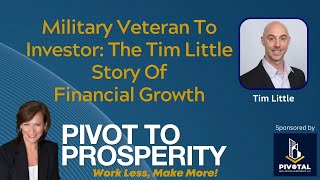
Interview (Pivot to Prosperity podcast, Mar 26, 2024) with Tim Little, founder/CEO of Zana Investments and military veteran. Tim recounts his path from early military service and graduate school to buying a duplex in 2014, learning syndication, and scaling to large multifamily investments. He discusses using self-directed retirement accounts (Solo 401k/IRAs) to invest passively, recent deals including a ~236-unit Class A property in Rapid City, SD, and a portfolio reported at 693 co-owned units valued over $90M. Contact details and resources (zanainvestments.com; Journey to Multifamily Millions podcast) are provided.
Questions this video answers
693 co-owned units valued at over $90 million.
2014 for $85,000.
Korea twice; Iraq three times (Ramadi for ~1 year; Baghdad ~15 months during the 2006–2007 surge; another deployment to Baghdad in 2018).
He rolled retirement funds into a Solo 401(k) / self-directed IRA (checkbook control) to invest in syndications and hard-money loans.
Rapid City, South Dakota — approximately 236 units (reported ~97% occupancy).
Chapters
Foreign.
Bowling here with Pivot to Prosperity, the podcast brought to you by Pivotal Real Estate Investments, where we help our investors build wealth and income through passive, passive income, that is through commercial real estate that improves communities. And today we have Tim Little as our guest. Tim, welcome. Thank you for coming.
Hi Jenny, thanks for, thanks for having me on. It's great to be here.
Yeah, yeah, I appreciate it. I'm going to read your bio because I think that's, that's the best way to make sure that we don't miss something up front here. Tim is the founder and CEO of Zana Zana or Zana Zana Zana Investments, a Tampa based real estate investment firm named after his two daughters, Zara and Lana. I should have read that first. Yeah. Is passionate. He's passionate about helping his fellow military veterans escape the landlord trap and get competitive returns by providing opportunities to invest passively in apartment buildings. Tim started investing in real estate with a duplex in 2014 and has grown to a portfolio of 693 co owned units valued at over $90 million.
Yay. Yay.
Practicing what he preaches, he also passively invests. He has an MBA and has served several years as an active duty army officer, a strategic communications consultant and head of multi family communications for the Department of Housing and Urban Development before transitioning full time into real estate. Tim is also the host of the top rated podcast Journey to Multifamily Millions of where he talks with experts in the field of investing in multifamily properties. Outside of real estate, Tim is commander of an Army Reserve public affairs battalion based in San Antonio, Texas. In his free time, he enjoys taking in all the fun and son of Tampa, Florida with his wife and daughters. There we go. Welcome again. I love your, your logo too. It's very eye catching.
Oh, thank you. Yeah.
So tell us a little bit about where you're from and, and your, your upbringing to start with to get you to where you even went in the service.
Sure. So kind of bounce back and forth. I'm a northeast kid between Connecticut and New Jersey. You know, the whole parents were divorced so hopping between the two, but ended up in New Jersey all the way up until about middle school and then we moved down south. So finished out high school in Deltona, Florida, which is a real place. People always think I'm saying Daytona. I'm not, they are in the same county. But I went to high school in Deltona and within I think a month after graduating high school, I was off to basic training and so went into the military was there for about two and a half years, and after that decided, you know what, maybe the military isn't the right thing for me from a long term perspective. And I was ready to go to school just like all my friends, right? So I got out and I went to Florida State University where I ran into an ROTC recruiter. And he said, you may want to think about the military again. You know, you've had some experience, maybe you'd be a good leader. And he's like, oh, by the way, you'll also have a guaranteed job when you graduate. And I was like, okay, maybe we'll think about this. And so I joined the ROTC program. And when I graduated from there with my degree in international affairs, I got commissioned as an officer in the army and did about five more years active duty after that and again decided it was time to get out. After multiple combat deployments, I was ready to, to take a knee and start learning again. So went back to grad school at the University of Denver, where I met my lovely wife. And once I finished up there with my dual degree in basically international trade and an MBA, wound up moving to Washington, D.C. for my first official job after graduation. And that's where my real estate journey really started. Because, because it was, you know, one of the first times in a little while where I had some, some extra money left over. I did have significant amounts of debt after grad school. We could talk about that. But exactly, because I had so much debt is why I wanted to start saving and investing as well. Right. To kind of offset the other. So that's when I bought my first duplex in 2014, and that was in Richmond, Virginia. And that was a duplex that I found after touring probably five or six different properties in one weekend. We just made a weekend trip of it and wound up putting an offer and got that duplex for 85,000, which seems ridiculously cheap, and it kind of was, but it was in a rougher part of town and the numbers just seemed to work. And so that was my first foray into real estate investing.
Gotcha. So let me back you up a little bit too, because that's all very interesting stuff. So your active duty, where were you deployed to?
So I've been to Korea twice, and then I've been to Iraq three times now during the, my officer time. Back then it was, I was in Ramadi for a year during like real combat, and then I was in Baghdad for 15 months during the, the surge in, in 2006, 2007, and I recently did a deployment to. To Baghdad in 2018 as well.
So was it pretty rough in those times? I'm trying to.
Back then it was, yeah. Yeah. In the 2006. Well, 2004 to 2008 time frame, things were. Were pretty rough. Yeah.
Yeah. Wow.
Wow.
So have you ever thought about. Well, maybe you automatically do, because I know the veterans are good about helping each other get. Get services, but are you in touch with some of those people? Have you done a reunion or is there automatically some kinds of reunions that help you all to see each other again?
No, not necessarily reunions, but, you know, even stuff like Facebook does wonders just with, you know, keeping tabs of people and keeping in touch. So there's folks that I still talk to, you know, even from back in those days, you know, just saying hi, seeing how they're doing, seeing stuff like that.
Yeah, that's good. That's important.
Probably.
And then when you went to D.C. you said you had the MBA in international trade.
Yeah, so I had a master's in International Trade from the. The School of International affairs, and then I had an MBA in International Business essentially from the business school. It was a dual degree program. I.
Are you using that at all in your practice now?
I mean, I guess I would argue the MBA because it is somewhat generalist. Right. It's general business skills that. It's certainly helped me in putting my business together and some of the considerations associated with it. Now, do I fall back on like my accounting classes and stuff like that? Not necessarily, but, you know, I'm talking.
About attracting the international investor.
Oh, no. And, and that's the thing. Like, you know, getting international investors in is a little bit trickier. It certainly can be done, but I haven't had the opportunity to help any international friends out yet with investing in multifamily real estate.
Yeah, I bet you'll figure that one out, though. It's. Yeah. The, the properties you've gotten into. Well, so you got to the duplex. Go ahead and take us to the multi family then.
Sure. So the, the duplex kind of got my feet wet. Right. And just in. In terms of dealing with all the issues that come along with these types of properties, you know, tenants skipping out and things breaking and stuff like that. So kind of learned the ropes there. And then at a certain point I learned about syndication, you know, through like podcasts and reading books and just kind of got introduced to it in a cursory level. So I wanted to learn more. And at that time, this. Now we're talking like 2017, I wound up going to a multifamily conference in Texas and just got a straight fire hose of information for like two days. And so much of it was new to me that it was a bit overwhelming, you know, coming from the single family or small multifamily side of things. But I thought it was really interesting and I thought there was a lot of promise in it. So I was like, okay. And this was right before I was about to go on that deployment in 2018. You know, they're trying to pitch me, you know, their, their program and all this stuff. And I was like, listen, I'm not going to be around to take advantage of it. So there's really no point in me, you know, getting this mentorship or whatever. So I was like, but what I would like to do is passively invest so that I could, you know, earn while I learn. That's how I saw it. I could either spend 25,000 on a coaching program that I won't be able to use, or I can spend that 25,000 in an investment which will hopefully make me money. But I also had to have the added benefit of being able to ask all the questions that I want, you know, within reason, and really learn the process from the investor's perspective. And so that's exactly what I did. I wound up investing right before I went on that deployment in a deal in San Antonio with Reed Gooseens, who, you know, you may know, and others may know, it was one of his first deals. And that deal, you know, went, went great. Within, I think, you know, four months or whatever it was, I got my first distribution check while I was, you know, sitting out there in the Middle east. And I was like, okay, this is, this is a real thing. Like, this actually works. It was kind of that proof of concept that I needed. And obviously it makes you feel a lot better when you actually see a distribution and you're like, okay, well, they didn't just run away with my money. I'm not going to be on the next episode. American greed. You know, it makes it real. And so it was kind of at that point that I decided that I was going to start learning a lot more about it and maybe even start to get on the more active side myself once I, I got back to the, the States.
Good for you. Right, right. And I, I totally understand that, you know, and I was in real estate at the time. I learned about syndications. I, I, it was, I had learned about them before because I bought property for government for years but you know, 35 years in real estate and I, I never thought about buying commercial real estate for myself. It was like have to go through the proof of concept a little bit too. But I did the same thing. I invested first in limited partnership and since I'm so active, I'm looking like you are for sourcing deals firsthand. But that's not for everybody. And the majority of the investors are the limited partners. They get the biggest part of the ownership. So I don't do anything, right?
Exactly. So I'll tell you straight up, my goal is to one day be just a passive investor. Like why, why wouldn't you want to just have that money doing all that work for you rather than having to be on the active side and you know, yeah, you get equity and stuff. But if I could be in a position where I could just deploy capital and make it reproduce itself, then I would certainly much rather do that. So I could do whatever I want with my time.
That's where I'm headed as well. I like to learn things from the ground up. So I want to be on the GP side and do some, some of that. But I'm in my 60s, so I'm not going to be doing that forever. I want to ultimately just be an investor passively and, and that can take you a long, long ways. So. Yeah, that's exciting. So, and then I believe we talked briefly about that you have investors that are using their retirement money with your investments as well. Right. Do you want to speak to that?
Sure. Yeah. So I mean, this is another thing that I discovered again, you know, in research and talking to people and stuff that you can self direct IRAs. Right. Like a lot of people have 401ks for the military and government folks. TSP, same thing basically. And like a lot of people I had a TSP or I can't remember whether it was my tsp or my 401k from a previous company that was just kind of sitting there after I left. Right. It hadn't really changed. It was still invested in whatever it was invested in, you know, fund A, B and C. But I, I didn't have any control over it. I was no longer with that company. And so someone was like, yeah, you know, you could take control of that and you could like invest it in not whatever you want because that's a, there are restrictions, but you, you can invest it in something like multifamily syndication. And I was like, okay. And so that's exactly what I did because I have a, a business right. I have an LLC, so mine just happened to be a Solo. 401k is what I transferred my money into. And then I was able to have literally checkbook control of that money. Now you think about it, most people, again, all they're offered is, you know, choose from fund A, B, C or d within their tsp or 401k, right? Yeah, exactly. And there's not a whole lot else they can do with it. And those providers are not really keen to let that money go. But once you have left that company or that organization, then you can roll it over into one of these self directed IRAs and again you can invest it in something like this, you know, apartment buildings, self storage, whatever the case may be, and you could get much better returns than you would be seeing at, you know, whatever it was in previously, most most likely. And, and that's been my experience anyways, so I invested mine in a syndication during like Covid that you know, was planned to be like a three to five year hold and it was like a little over two years. They, they met their goals and so return of capital. I was like okay, let's, let's do it. And so what did I do? I, I deployed that capital again into another deal and I've also done, you know, basically hard money loans with that money, which a lot of people don't realize you can do. But now most of it is tied up in multifamily syndications and I just don't really pay a whole lot of attention to it. Don't get me wrong, I read the investor updates and stuff like that, but I feel like I can take a little bit more risk and diversify a little bit more because it's retirement money, I'm not going to get to touch it anyways. So I'm going to make it work while it's, while it's doing its thing.
Right. And yeah, you just hit on something that I try to explain to people that they don't understand is that there's so many different asset types. You can take a self directed IRA and invest it not just in multifamily, but self storage. You can diversify it across asset classes and even invest in businesses, gold, lots of things. The big thing is you just can't have it in your own possession. You have to have a custodial relationship with certain things and have, there's, there's some rules. But yeah, it's, it's really very powerful to take control of your own retirement money.
And yeah, and that's the thing I Think it's the empowerment aspect, right? Like, why shouldn't you have control over your own money? And so for like the military folks, the way this plays out a lot of times is if they retire after 20, between 20 and 30 years, they have that TSP sitting there and it might have a nice little chunk of money in it, but they may not roll it over into their next employer. And then they just kind of forget about it. And so I tell them like, hey, yes, you can roll it into a self directed IRA and put it into, you know, all of these wonderful assets. Like you said, there's, there's rules. You can't buy yourself a vacation home and Airbnb it sometimes and then go hang out there yourself. You just can't get direct benefit from it. But generally speaking, as long as you're smart about it, you know, you can, you can get pretty, pretty good returns, right?
For sure. And so one of the, the things that a lot of people have tried to do is define who should have that checkbook control. It's not for everybody because if you don't know how to follow those rules well, you don't want to risk losing the rights to call that retirement money that is potentially, you know, if it's deferred as far as taxes, that's one thing. And then it could be a Roth. I have mine in a self directed IRA and I have a Roth. And you don't want to chance doing something wrong and losing that protected status of retirement money. So sometimes you don't get, you're better not getting the checkbook yourself, but let the custodial company review and approve all your deals and then they issue the money. But that you got to figure it's going to take two, three, maybe four weeks. So if you're going to use retirement money, right, you better get started from the day you do your soft commitment. Get things started.
Right? Yeah. And I've seen some companies do it surprisingly fast. Like with an investor I had, he was like, hey, I want to, I want to use, you know, this money. And, and so he was able to use one of those providers and they were very like White Glove service, right? They did everything for him. They're like, just give us your information. And so they became kind of the intermediary to, between me and him and they did exactly what you're talking about. They're the ones who set up the payment and did everything else that way. All he had to do was just sign his name on, on stuff, right? They reviewed the documents and made sure. Everything was right, had the right information. Cause that's where it gets like squirrely, like how you're signing and you know, a person versus the account itself. So they helped him with all of that and they were able to get it done in like less than two weeks. I was really impressed.
That's, that's good. Yeah, it really is.
Right.
Let me mention something too that was interesting. Are you familiar with the name New View Trust?
I think I've, I've heard of it.
Okay. Yeah, they're, they're right near me, so I like those guys a lot. I really do. That is where I got my self directed IRA though. And I did take it to Merrill lynch because one of the guys that used to work at Newview now worked at Merrill lynch. And, and when he was going through training, they were looking at the list of all the different kinds of accounts they do and right at the bottom is rcma. And they, and he said, what about that one? Because I didn't talk about it. And he, and they said, oh, we're not real, we don't really use that one. And he said, why not? I know all about that one. That's the retirement fund.
Right.
It turns out that Merrill lynch does have a way for you to put your money there in a self directed fund to self directed account. And you can put it in stocks and whatnot while you're waiting for the right investment. It doesn't have to sit idle. So yeah, that's a wonderful thing. You just have to find somebody at Merrill lynch that knows how to, how to do it. Or I can tell you how to find the guys that know how to set those up, but they don't advertise it because they don't make money on it.
Exactly. And that's what people need to understand. Right? Like they make money by being the custodians and all these, the fees associated with it. So if they're not the ones moving your money, they don't get any benefit from it. So why would they be incentivized to tell you how to look elsewhere?
Yeah, yeah. I keep thinking they're going to grow that I don't know if they have or not, but. So I've had mine there three years now. And anyway, so you also have on your list of things that you're, you're familiar with or like to talk to people about is, is the, the, the military vets that are looking for things to do, how do you reach them? Are you, are you finding that challenging?
So I mean, a Lot of to do with money.
I'm sorry. Yeah, yeah.
A lot of my networking is, is through LinkedIn. That's a great resource. And then Facebook as well. Right. Because, you know, a lot of old friends and co workers are on there as, as well. But what I see as the advantage for, you know, former military, you know, retired military folks is that a lot of times, you know, they only stay in one place for usually three years max. Right. And they're, a lot of them are savvy enough to know that they should be renting out, you know, properties, you know, when they leave. So a lot of them will buy, buy a property, even if it's their, you know, their residence. And then when they leave, they'll hold on to it and rent it out and then they'll move to the next place after three years and rent it out. So I know a lot of folks, you know, three to five properties, but these are mostly single family homes and so they're using property managers, geographically dispersed. And so it's definitely better than doing nothing. And I'm not trying to dissuade anyone from, from that path necessarily. But as they go on, they're like, hey, I'm not seeing necessarily the returns that I thought I would because, you know, they weren't buying it as an investment, one, but two, they're having to deal with all the issues associated with being a landlord. And so at a certain point they're just like, you know what, that's why I call it the landlord trap. Because they, they get told that, hey, this is the way to, to build wealth. Just keep buying single family properties over and over again because that's all they ever talk about on bigger pockets and stuff like that. But at a certain point they don't feel like dealing with all the hassle. And, and so an alternative to that is, you know, getting the cash associated with those properties and putting it into something that's much more passive, where they could still get the tax benefits, the obviously financial benefits of real estate, but be very hands off and not have to deal with all those headaches.
Right. So true. So, so true. And same with the people that I was telling you about, my peers. So many have retired. They're, they've been in real estate for decades, but doing it differently. And then, then it's, it's too hard for people to realize you can really benefit by owning and not have to do anything. It's just like you can't believe it. And I get that, I really do, but I, that's Why I've researched it so much and built a whole business around it because I'm trying to educate people, open their eyes. You know, it's like, probably won't last forever, but. And what made a difference for me, truly, Tim, was the job. Because I was trying to say, how come I didn't know about this? This is a scam, right? The jobs Acts of 2012 and 17 really was what gave a rebirth is what I call it, to syndications. And they're. They've been trending because they're so successful. People are telling their friends, oh, my gosh, you know, so it's taken off. Yeah. Yeah. So you said that you had a closing not that long ago, right? Did I hear you right?
Yeah, probably a couple months ago. Now closed on a property, property in, In South Dakota. And, you know, I, I wouldn't have looked at South Dakota in the past. I was a little skeptical at first, but once I, I dug into it, I realized there was a lot of demand there, but not a whole lot of supply necessarily. Right. It's not those hot markets like, you know, Atlanta and Phoenix, where builders are throwing stuff up like crazy and kind of, you know, filling the gap. So, you know, buying a property out there in a place like Rapid City, for example, you can maintain very high occupancy and continue to raise rents because there's just not a whole lot of supply there. And so, you know, this was a class A asset that we wound up getting our hands on. And it's. I think it's like 236 units, and it's, It's a beautiful property, and it stays like, 97% occupied consistently. When we bought it, it was 100%, but, you know, even now it's never dropped below like, 97 because, again, just the, The. The. The demand is there. So now I'm starting to look closer at some of those, like, you know, secondary markets that I hadn't really thought about before. Maybe even stuff in, you know, in the Midwest like that, and get outside of my usual Sunbelt bubble, which is, you know, Georgia, Florida and Texas, which I still love those markets. Each one, you know, has its pros and its cons. And I would obviously love more to invest in my own backyard so that I'm. I'm closer to the assets. But sometimes you just have to go where the deals are. And so that's what we're doing.
Right? And I'm right there with you. I'm in Orlando, your Tampa, so we know it's been really overheated here in the state for the last couple of years. But let's just touch on to put a bow on this as we wind up that, you know, the philosophy that you are using is a little different for different asset types. Usually. Are you going for a value add situation?
Yes, generally it's, you know, like class B value add. You know, maybe It's. It's like a 90s vintage and, you know, a portion of the units have been updated, but not all of them. So we're able to go in there and, you know, do renovations, maybe add an amenity that wasn't there, like a. A playground or a grilling area, something like that. That really adds value to the property and makes tenants more willing to. To pay higher rents. But, you know, we're kind of getting away. We did have some class, I would call them class C properties, maybe B minus, but we're trying to get away from those just because it can be much more management intensive. The lower down that. That scale you go, and we're just not seeing the rewards for it. Sometimes it's a risk reward, you know, trade off, but we're not seeing the rewards associated with that risk. So now we're skewing more towards class B. And in the case of the Rapid City deal, class A properties.
And when you're doing a class A property investment, what was the strategy used for that one?
So that one, it's not as much value add. I mean, we are, you know, obviously improving some aspects to it. Right.
Operational efficiencies, that kind of thing.
Yeah, yeah. There's. There's different things like adding key fobs and, you know, for. For tenants and, you know, updating the. The workout area and stuff like that. But it's not to the same level in terms of, like, remodels were needed on a lot of the units because it's so new. It's just not. There's not a whole lot of interior renovation that's required. So it focused more on like, the. The landscaping. One of the things the tenants really wanted was more lighting because there's like a trail around the property. So stuff like that, that the tenants were asking for, that, that maybe just wasn't thought about before from the previous owner or, or hadn't been done. And so it's. It's just kind of keeping up. Once you get to the class A, it's more about like, okay, what are the new demands that. That tenants have or expectations and putting those things into place and trying to find the unique things that you can put in there to make it even more attractive for people, you know, going into the future.
Right. Because the bottom line is we want to make the bottom line more profitable to increase value, so. Right, exactly. Right.
Right.
Well, very good. Well, so we probably had to wind it up here. I meant to warn you. What I ask everybody at the end is if there's a pivotal person or event that they would say has made a big difference in their life. Is there something for you?
I mean, I guess I would probably have to say, you know, the birth of my daughter, slash, daughters, because as any parallel children have a way of changing your priorities. And it's at that point that I really started to think more long term in terms of like, even investing and providing. Whereas before it was like, oh, I have a job that pays pretty decent. It's enough for me to get by and do this and that. But once you're like, oh, well, now I need to start thinking about, you know, someone else's college bill and, you know, saving for my own retirement. And, you know, it just kind of lengthens out that, that perspective and that, that timeline on how far you need to start planning out and that changes your priorities. And so I would have to say, yeah, the birth of my first daughter and then just double that with the, with the second one.
Right, Yeah, I get it for sure. I have two of my own. Well, very good. Well, so tell people how they can reach you. And remember, this isn't just video. Some of it Spotify and itunes. So say it as well.
Sure. So anyone can email me directly, Tima Investments, or they can go to the Zana Investments website. It's just www.zanainvestments.com. if they want a free gift, they can get my passive investor cheat sheet, which is basically just a short little dictionary with clearly explained language on the top terms that they need to know to be a confident investor in multifamily real estate. And just go to, like I said, zanainvestments.com/cheat sheet to get that. I'm also on LinkedIn, so please connect with me. I try to post a lot of valuable content on there and go ahead and check out my podcast if you like podcasts like this Journey to Multifamily Millions.
Very good. Well, we'll put that in the show notes as well. And so thank you very much for coming. I really appreciate it.
Thank you, Jenny.
More from Ginny

Dr. Calvin Lowe Saves Lives 2 Ways: Pediatric ER & Teaching Overworked Med Pros How to Get $ Balance

Turning Construction Expertise Into a Thriving Real Estate Empire With Eric Schultz

Build-to-Rent, Community & Cash Flow with Pivotal Person Award Recipient Andy McMullen



Investing Beyond Boring Real Estate: Oil, Gas, and Industrial Properties with Keshav Kolur


Unheard of home prices: $225,000+/- in Portland! John Laine - Breaking Barriers- Home Affordability!


