Scoring BIG in Real Estate with Alvin Scioneaux
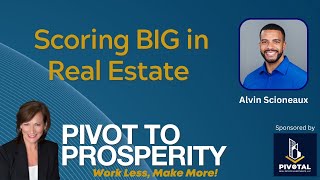
Alvin Scioneaux played for the Chargers before an ACL injury ended his football career. He spent eight years in aerospace engineering at Northrop Grumman and Raytheon, then moved to multifamily real estate investing. He recently closed a 42-unit deal in Omaha and is working a 7-unit Hollywood property, now helping athletes invest passively through Financial Athlete Capital.
Questions this video answers
LA/San Diego Chargers in 2014 and 2015.
Tore his ACL and damaged his meniscus during the 2014 season (season-ending injury).
Scholarship to "Watford College in South Carolina" studying physics (verbatim from transcript).
Northrop Grumman and Raytheon Technologies; he also says he worked on NASA rockets and satellite payloads.
Closed a 42-unit property in Omaha, Nebraska; in escrow on a 7-unit in Hollywood, California.
Chapters
Foreign Hi there. Jenny Bowling with Pivot to Prosperity brought to you by Pivotal Real Estate Investments. And today we have Alvin CNO with us. Alvin, thank you for coming.
Yes, thank you for having me.
Yes. Well, so we are in the same mastermind and we're both looking at multifamily properties a lot, often every day, many, and digging for the, the right ones to syndicate. And so I would love for you to tell the audience about your journey there, Alvin.
Yes, so my journey has been all over the place. Very, very diverse. I kind of first was introduced to real estate back in Louisiana where I grew up. My parents owned several properties out near New Orleans and they focus more on the residential one to four unit. So that's where I was introduced to a lot of the operations, a lot of the asset management, property management. And from there I went on to play football. Athletic scholarship to Watford College in South Carolina while I studied physics so had a lot of success in football. So then my life kind of transitioned to football as a professional. I was playing with the Chargers, the LA Chargers when they were in San Diego in 2014 and 2015. A season ending injury from my ACL messed up my meniscus and you know, life kind of was uncertain for me at that point. I did rehab for the whole year, went on to do one year, 2016 in the CFL. But that never really came to fruition. And right there my life kind of was, I kind of was uncertain of what's the next step, you know, because football was 90 plus percent of my my time. So then because the a lot of my internships was in engineering, I went to get my master's in engineering at San Diego State, so went back to California. I had a great time, was working in aerospace engineering during that time as well. Got a full time job after being dealt with my master's. So I worked about eight years in aerospace engineering. A lot of the big companies, Fortune 100 companies, Northrop Grumman, Raytheon Technologies, working with NASA rockets and satellite space payloads. But at that same time I was just building my passive income real estate, the asset of choice. And just earlier this year I went full time into being a real estate investor. So focusing on multifamily investments. Just closed last last month on a 42 unit with some great partners and operators. So in escrow right now on a 7 unit in Hollywood. So it's full, it's full fledged into the real estate space as an investor and working with financial athletes, hence the the title of the capital company. Working with athletes. Mass and present on professional college and even former high school players that have capital they're looking to invest to create that, that financial literacy up here and then create that asset growth out in the, in the real estate market.
Wow, you just said a lot to unload there. So, yeah, you had the real estate foundation and then you, you got the education, the, the academia, so to speak. And we're able to do the athletic side of it. And that's so cool. And you know that so much of it, as we were talking about before coming on is, you know, you're analyzing things all the time on the football field, then when you get into aerodynamics and all that stuff, you're really analyzing on steroids. Right. And then real estate's probably super easy for you to take because the number of variables really drives some people crazy. I, I've been with it so long, I have a tolerance, of course, but some people are like, holy moly. You know, all the variables.
Yes. Yeah. I mean, there's certainly a lot of due diligence. I mean, from the property to the market to the type of lending to the type of partners, even that a lot of people overlook, but that's probably the most important other things to analyze is who you partnering up with. So definitely always make sure you're partnering and getting great sponsors, general partners, on any syndication or real estate investment. But yeah, in, in comparison to engineering and even going back to football, that's certainly something that I have been doing pretty much all my life. So transitioning to real estate, that there's a lot of transferable skills in that aspect, which, you know, I enjoy doing, I enjoy using, and it serves as an advantage when I'm out there in the field or looking at properties, being able to juggle a lot of different variables and come up with the most optimal approach with that given opportunity.
So I also have to ask you, since you're obviously focused on helping other athletes, it's often said that athletes, especially the pros, you know, make a lot of money, but then end up with very little as they get towards retirement. Is that really true?
They're certainly very easy to go down that path. I know for myself, after I was done playing, a lot of, A lot of people don't know about just the transition period is a lot more daunting than what people might expect. I mean, imagine you're doing something for 90 plus percent of your time, you know, every single day, day in and day out, you live and breathe this one aspect of life. And then, you know, just like that it's over with. And you don't have the support you once had, you don't have the structure you once had, you don't have the opportunity you once had. And then all of a sudden, you know, everybody's all around you and then they kind of, okay, well you got it and you just gotta figure it out, you know. And a lot of guys feel alone, they feel, you know, forgotten about and they, they kind of struggle with that transition process. And you know, even myself, someone that was have. I consider myself to have a lot of things together from academic side, athletic side, have my, my ducks lined up. I even had a, a period of struggling to try to, you know, find myself, identify myself, what I wanna do, do next. And for guys that don't really have that, that backing from a family structure and a friend structure to really support them, it can go downhill really fast. So, you know, that's why I want to. With the financial athlete capital, bringing the financial literacy, bringing the opportunities to invest in, in different hard assets like real estate. That's been the most consistent asset class since the beginning of time. So that's, that's really the opportunity and the value proposition that I want to help my fellow athletes from, at, from a professional, collegiate and even from former high school players just to, to their, their finances in a, in a great way to set them up post their career. Because at the end of the day, nobody's an athlete forever. You know, even if you Tom Brady, you're playing 25, 30 years, seem like it will come to an end forever. It will come to an end eventually. So you want to work on that now.
You just said something that's near and dear to me too. I really hit hard on the fact that you're really investing in the asset of all time. Because mother Earth, everything sits on it. Buildings, everything. Gravity, we all need it. It's not going anywhere unless we're going somewhere. And it's, it's the wealth that since the beginning of man, people fought for land because that's what builds wealth. So I was wondering how easy or hard it is when so many people are brainwashed to think you have to invest in the stock market or whatever, that the employers are saying it. Do people that you're talking to, the athletes that are, you know, so focused that away do they, are they hard to help see the light?
Yeah, I mean athletes are, I would say they're just like any, everyone else in society. A lot of people are, A lot of people are focused on us on the stock market because that's really the thing that's pushed. But from a, from an asset risk factor, from asset profit and growth aspect, real estate is as, as good as there is. You know, there's, there, the population has been increasing since then, but there's only, there's no more land. You know, we're not creating more land population ever increasing. So the demand for that land is, will increase as a result. Whereas with businesses, you know, businesses are popping up left and right. A lot of people try to find the, the next Uber or the next Amazon or the next Apple to just blow up which, that's a dime a dozen real estate everywhere. You, you can use what you have, what you're, what you're walking on. Just need the right partners and right knowledge to, to make the most of the opportunity. So with, with athletes, which I would explain to everybody else, the, the, the only really gap there is just having the know how. So that's, that's another aspect that I kind of just try to explain to them. The only real risk in any investment is just your lack of knowledge. So you know, if you, if you know that an investment is good or bad, then you'll be able to choose the right option. But with that lack of knowledge, that is what leads to the actual risk in any opportunity. So, you know, that's why it's great to partner, great to read books, great to collaborate, invest in your network. Like you alluded to earlier, the mastermind we're in, which is what I have been doing for the past decade and has helped me a lot.
Right, right. Well, very, very true. So you're seeking multifamily and got the two, two things going on right now. Are you looking for larger multifamily at the same time too? Or is that kind of what you want? Is the under 100 or where are you at there?
Yeah, so I mean that's just been the opportunity so far. I'm certainly open and looking at 100 plus units as well. But I don't, one thing about me, I don't force anything. You know, I take opportunities as they come and make the most of the opportunity. So if, if I see a great opportunity that's under 100 units, you know, we'll, we'll analyze it, do the due diligence, visit it, set up the capital, the debt capital and equity capital. Everything is structured correctly and we can make it happen, you know, at the end of the day. So as long as it's a great opportunity, that's the main thing for me. But I am Certainly looking at the multifamily as a whole space one of the most consistent asset classes within real estate. You know, we mentioned about real estate within assets overall, but now even within real estate, you know, you can, you can get very granular and, and detailed within that asset class in and of itself. Which multifamily has been the most consistent within the real estate realm?
Yeah, the housing shortage is far and wide, that's for sure. And there's just not enough development the last 10 years. I, I was shocked to hear the numbers a couple years ago when they really started blaring because it, it's worth really glaring.
Right, right.
But yeah, you always have to watch exactly where, where you go though. Of course. But yeah, now you're, you're 40 some units. Where are those located?
Those are in Nebraska, in Omaha, Nebraska area. Partner with, well, capital, a couple really great operators. They have over a thousand units themselves. So you know, like I alluded to earlier, the, the most important aspect is make sure you partner with, with great investors, great general partners and operators that you know will make the investment worthwhile because you can have a, you can have a great investment, but have a bad sponsor, a bad operator, and then it goes downhill or you can have a okay deal, but because you got a great sponsor, a great operator you're working with, it turns out really good. So that's the first most important due diligence and thing to analyze when it comes to my investments.
Did you have any surprises on the 42 units? Anything that popped up that you were not really expecting?
No, not so far. We just closed last week. Last month we actually are hitting some of our year three rent projections already within a month or so.
That's great.
So, yeah, so we're actually performing well above what we underwrote the deal to. So that's always great. That's always great to see. You know, it goes back to again the, the, the operators and the partnerships that, that you form. Whereas somebody else might have not been as, not been as careful or cautious in their underwriting. Whereas you, you want to, you want to make sure you under, you want to make sure you over deliver on your promises. So if you have a standard promise, you want to always make sure you, you over perform. So under promise, over delivered always.
Right, right. Yeah. Yeah. I, I don't think I told you. I used to be an appraiser in the 1980s and there's.
We don't want the appraiser to under, under promise.
Right, right. You're sure? So true. But yeah, you want to, you want to always be sure that you got that rolling, but so on. On the team there. Well, how many investors do you have on that, that particular property?
So there's five general partners, five of us, and then we raised about a million dollars or between like 100 different investors. Passive limited partners. Passive investors.
Nice. And what's your role on that, that team?
So I'm working with the, the investor relations and also helping with the asset management on the team.
Good for you. Okay. Okay. And do your parents get involved at all? Have they invested at all?
They, they have invested on, they have. Not in the syndication, but within my own real estate deals, they have invested.
Nice. Nice.
I bet we'll definitely get them involved in the syndication investments really soon.
They probably have to get used to it because a lot of, lot of people, I mean, like I told you, most of my peers have been in real estate for decades and I didn't even know about syndications either. It was like, really? How could I not know?
Right? Same. Same here.
Yeah, yeah. So it, words getting out there, it's going fast, especially because the returns are so good. So people are spreading the word. And like I say, it's like a new product, you know, it's still in the adoption curve and it's got a long ways to go. And one of the things that, that I say a lot that I doubt you, I've never said it to you, but you've heard it probably before, is that Harvard Business considers syndications one of the best business structures of the information age. And the SEC had at one point said or re quoted somebody as saying back in 1960 that someday syndications would own all major real estate.
Well, that's a very interesting way. Back in 1960, I mean, as you mentioned, great returns, it's the most optimal because you don't need a whole, you need a whole lot of cash. I mean, you can take $50,000 and be a part of buying a $10 million property. Right. Whereas not many people want the ability to buy a $10 million property on their own. So it certainly is certainly the, the wave of the future.
That's powerful. You know what I'm just, I'm thinking it was 1960 for one of the two quotes I use a lot. The other one was like 1980s ish. But it's a, it's been known a long time by, by them that, yeah, syndications are just, that's, that's the way more common people can own commercial real estate. And it's so good to Diversify, right? Yeah, absolutely. So what do you have on your, your plate right now? Do you have something cooking you just.
Right? Yes, just close on that about a month ago. And then right now we actually have, I have a deal in, in Escrow in Hollywood 7 unit that I'm partnered with on some, some other investors out here in Southern California where I'm based at now Los Angeles and we're, we're in the due diligence period of escrow. So all of the inspections and the loan, the loans, all of the getting, getting everything in order. I mean we already pre wrote everything but now bringing it to fruition, talking to a few different investors to get involved on that which it. We're basically we're at about 400,000 in equity from, from where the ARV the after repair value will be at for, for the purchase of the property. So we're, we're getting it at 400,000 under what it would be worth in the market right now. It was, it was a bank owned, it's REO property. So. Nice. A lot of upside, a lot of opportunity. If anybody is looking to, to get involved in, in this, in this opportunity. On the upside you can definitely. We'll, we'll, I'll put my contact information toward later on.
Yeah, yeah, we'll, we'll put it there. Yeah yeah yeah. And you know certainly we sometimes joint venture on these smaller places as opposed to syndications and all because we're very cautious about SEC and can't talk about some stuff. But, but I'm sure you know for something that size. Yeah there's lots of ways to do it but. Right, well, so exciting. And so do you have a certain number of doors you want to have at some point?
Yes, I mean right now actually at 51 and I'm looking to, we wanna, we wanna reach the, the thousand mark, the four four figure mark. That's the, that's the goal here within the next year or two which you know, we're well on our way, well on track especially going full time with the right partners, the right opportunities. Especially even with interest rates going up, there's a lot of uncertainty which equals opportunity in the market within real estate. So that's something that I'm looking forward to hitting here within the next year or two.
Great. Great. Okay so we're going to wind it up. I'm going to ask you the big question now. Okay. What pivotal person or event has made the biggest difference in your life not so much just for being an investor.
But in your life in my entire life. I mean, biggest person or event, I would say I'm. I'm an and person. So I'm gonna actually answer both of them. The biggest person, most influential person in my life will certainly probably have to be my parents. Like, I can't exclude one without the other.
Good for you.
Good for you. They're. They're a union.
Yeah.
So both my mom and my dad, they. My dad electrical engineer by trade, and they both have investment properties. And then my mom, she's a Zumba instructor and work at the local high school where I'm from. So she's very involved in the community, very active in that sense. So I'm often seen as the culmination of both of them from the engineering and investment side, the analytical side, like my dad is, and then the more outgoing, engaging, you know, very welcoming side that my mom portrayed. So those, those two will have to be the most influential as far as the most influential moment, impactful moment. Just from a transition standpoint, I would say when I was playing with the Chargers back in. Back in 2014, I tore my ACL meniscus. And that was really pivotal for me because it helped me understand that a lot of things in life, or they can change at a very abrupt, very quick time. And a lot of guys in the league, you know, we, we say NFL is not for long. NFL. So during that moment for myself, it really made me reconsider and reevaluate my life. Because even though I went on to play in the CFL for one year, it didn't come to full fruition after that. It made me understand that you gotta have. You gotta have your. Your stuff together. You know, you can't really be so focused or who, you know, hit in the clouds, so to speak, on. On one aspect, because things can change like that and you gotta adapt, you gotta be flexible. You gotta be. Just be ready for the calling. I'll always say, you know, stay ready so you don't have to get ready. Because, you know, as the saying go, the one constant thing in life is change. So being able to adjust on the fly. When that happened, going into aerospace engineering and, you know, now going into real estate investing, that's probably been the one consistent theme throughout my life. It's just transition, change and adaptability of being ready. So you don't have to. You don't have to get ready.
Yeah. And so the passive income, especially if you're busy, an athlete, and in athletic arenas of all different types, it's so easy for them to have a Passive income on the side so that if they get injured, you know, there's a safety net. I'm sure you're teaching everybody that, but yeah, there's a lot to it.
There's definitely a lot to it. And that's probably. Of all the, the things of my professional NFL football career, the, the one thing that I probably wish I would have done was, you know, the injury things happen or the opportunity, coaches, location, everything, all that stuff is fine. The one thing that I wish I would have changed was actually, would actually use my active income while I was playing to invest in different asset classes like real estate. You know, imagine 2014 owning property in Southern California. You know, that's 10 years ago. It probably would be sitting on seven figures income at least. So.
Right.
Yeah. That, that opportunity is, it comes and goes and, and I wish I knew then what I knew now. But you know, that's, that's part of my message to, to teach that to the younger guys. You know, when you're 22, you're not really thinking about investing in, in asset classes and oh, I need to put my money to, I need to put my money somewhere where it will grow and be more than what I'm spending it on now. Some things that I appreciate in value most. 22, 24, you know, 26 year olds are not really thinking about that. So you know, that's part of my message just to spread that enlightenment, spread that knowledge so that everyone can end up in a better position than then do better things than what I did.
Well, good for you because that's really, really important. Especially because the injuries can be debilitating.
Absolutely.
You might not be able to do that other job that you assumed you could do, you know.
Right, right. And, and what? Football injuries is not a matter of know if they happen, but really when you know, football is definitely a grueling sport, so for sure.
Right, right. Well, I'm sure you're good at teaching them, trying to shine the light on that and I wish you luck with all of that and so appreciate. Yeah. So why don't you tell people how they can reach you? Remember, some of it's verbal only on itunes and Spotify. So you know, spell out as well what, what you're saying.
Yes, yes. So for anyone that want to reach out or contact me, I'm on all social media. My handle is A the number one and Seano my last name. So a one CNN number one S C I O N E A U X Or you can just search Alvin Siano Jr. On LinkedIn, Facebook, but on all the others it's the A1CNO. And then you can also reach out on the website financialathletecapital.com the ebook that goes into everything passive real estate investing. And then there's another website, Imperium Fortune I m p e r I-u m fortune.com and then you'll see a lot of the. That's the joint business I have with my wife who's an attorney, a lot of estate planning and asset protection. So we kind of tag team that that side of the business. I work on the asset growth, she work on the asset protection. A lot of pre and post marital agreements as well. So you get the full package.
Right, right. Very good. And now that ebook, that's a big accomplishment.
Yes.
Why don't you say the name of that?
So the ebook is the athlete's guide through passive real estate investing. That is you can find that on the financial athlete capital.com. and then I also have another ebook on live new Optimizing your nutrition, exercise and wealth. New N E W Nutrition, exercise and wealth. And then my wife has a book on asset protections. You can find that on the website Imperium Fortune.
Great, great. Now in the show notes we'll put the links to yours, of course and, and your wife's. That for that matter. That's fine. But fantastic. Well, thank you so much for coming on the show and I wish you all the best.
Thank you so much. Jenny has been a great time.
More from Ginny

Dr. Calvin Lowe Saves Lives 2 Ways: Pediatric ER & Teaching Overworked Med Pros How to Get $ Balance

Turning Construction Expertise Into a Thriving Real Estate Empire With Eric Schultz

Build-to-Rent, Community & Cash Flow with Pivotal Person Award Recipient Andy McMullen



Investing Beyond Boring Real Estate: Oil, Gas, and Industrial Properties with Keshav Kolur


Unheard of home prices: $225,000+/- in Portland! John Laine - Breaking Barriers- Home Affordability!


