The Captain's Guide to Thriving in Multifamily Markets with Scott Kidd
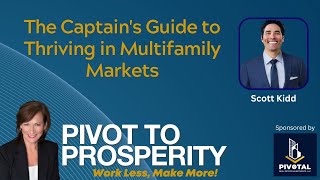
Interview (Pivot to Prosperity) with Scott Kidd, a captain-turned-real-estate investor. He describes 25+ years in maritime operations (licensed USCG Master), why he moved into passive multifamily investing for stable income, and how networking led to his first joint-venture 13-unit in Port Orange. He now invests in multifamily syndications (Ohio, North Carolina, Oklahoma mentioned in bio; currently seeking deals in Ohio, NC, Texas, and Florida but wary of Florida coastal insurance/taxes), runs the Yachty Real Estate Investors meetup in South Florida, and is involved in self-storage developments (prefers climate-controlled, class A). He works six weeks on / six weeks off and focuses on investor relations, capital raises, and asset management. Contact: investwithscottkidd.com.
Questions this video answers
February 2, 2024
USCG Master of 1600 US Tonnage, 3000 International All Oceans
investwithscottkidd.com
Six weeks on, six weeks off
A 13-unit joint-venture in Port Orange (Daytona area)
Chapters
Foreign hi there. This is Jenny Bowling with Pivot to Prosperity, the podcast brought to you by Pivotal Real Estate Investments. And we are doing an interview today with Scott Kidd. Thanks Scott. Thanks for coming.
Hey, thank you very much for having me on. Glad to be here.
You're welcome. I am going to read your bio and then we'll let you fill in between the lines. Okay, perfect. So Scott Kidd has over 25 years maritime experience including new builds, refits, project management and yacht management. He's a licensed USCG Master of 1600 US Tonnage, 3000 International All Oceans with a background in it and a strong mechanical background in maritime transportation machinery and heavy equipment and has a beautiful picture of a nice boat behind him. In his career. His cruising includes the Mediterranean Gulf coast, including Mexico, Great Lakes, Pacific, Alaska to Panama, Canada to Florida, Caribbean, Bahamas, South China Sea. Really cool places. In any case, he has been a multifamily real estate investor for several years. He has invested in multifamily apartment syndications in Ohio, North Carolina, Oklahoma and joint ventures in Florida. He runs a monthly meetup group, Yachty Real Estate Investors in Florida, Fort Lauderdale, West Palm and Stuart. And he is going to fill you in on what wasn't in that bio. Go ahead, Scott.
Do you want the short or the long version?
But do the short so we have time to talk about everything short.
Okay. Well, I've been doing multi family investments for the last several years. I originally started like a lot of people with single family, you know, as my family got bigger, bought another house, rented it, moved to the next house and then went along with there. And then one day I just originally started like a lot of people. I figured I'd buy one house every year or every couple of years and then in 10 years I'd have five or 10 houses and that would be pretty good be another pocket to put my retirement in. But I had a friend of a friend was in town and we were all talking and he told me one time that he was, he had bought and sold a 46 unit in, in Houston and he'd made quite a large sum of money. And I, and I said you can do that? And said yeah, you can do that. Anybody can do it because I can. I did it. Me and my brother did it. And so that kind of the light went off there. So I started learning as much as I could about it and then started networking and, and going from there and just eventually started my own meetup group and networked with a lot of people that were actually doing it. And it got me Here today because I originally started because the industry I work in is very unstable. You can be here today, gone tomorrow, from hero to zero all in the same day. So I wanted to have the passive income to where, you know, if, if I do lose my job I can one have the cushion and also to where I don't have to jump into the next thing which might not be the right fit for me or the other or the, or the boat that I'm jumping on. So that's basically it in a nutshell. And today I'm working on a variety of different things which, you know, if I didn't get started, I wouldn't have. I never thought a lot of these things were possible. So it's been really good to me.
That's awesome. That really is. And I gotta agree. I mean, you know, it, it is a light bulb. And I even worked in the industry for decades buying from other people and didn't realize I could be buying too. So it's, it's really a wake up for most people I think. But so terrific. And so of course I have to ask you about the boat in your background and if, if that's something like what you usually are driving.
Well, the boat in the background isn't the boat that I'm running at the moment, but it is one of my like vision boats that before I hang up and closed out my career I. One of my goals is to build a boat as project manager like the one behind me. It's. This is a 100 meter bedship behind me and it's probably be about a 200 million dollar, 150 plus million dollar project which is something I get really excited about, which I think would be really fun thing to do.
You're kind of keeping your goal in front of you, aren't you?
Yes, yes, definitely.
That's, that's important. That really is helpful. I know. Well, good, good. So tell us about the first deal you got into.
The first deal I got into was like a lot of the, all of the deals I've gotten into was I met through networking. I met my partner at probably one of the first meetups I went to where they weren't trying to sell me anything or weren't, you know, trying to get anything out of me or anybody else that was there was just hanging out, talking about real estate and had a really great time and I kept in touch. She invited me, my partner now she invited me in on this 13 unit as a joint venture which is as you know, a joint venture is pretty much Everyone has to be an active participant. So we each put in a certain part and we all have active roles in the deal. It was in Port Orange, which is the Daytona area and we still have that today. Been a great partnership. Everyone gets along great and we've renovated pretty much all of the units, put a new roof on it. It's taking over like clockwork. It's about three years later now, so it's just moving, moving right ahead. And that led to an eight unit after that and then you know, things progressed and, and got bigger and bigger after that.
Terrific. Yes. And that, that first experience can be, can be critical and it's not always pretty. But the big thing is as we know, you know, because we belong to the same mastermind recognized race masters. The, the going saying is to hurry up and fail, fail forward so you learn from it and do better the next time. And it's, it's so true. Right?
Yes, that's, that's definitely something that I wish that would have done at a younger age is failed faster because then I would have learned quicker and kind of realized what my strengths and weaknesses are.
Yeah, yeah, no, I, I totally get that. Well, super. So, and I think in our, our conversation before we started recording, you mentioned self storage. Are you into self storage now?
Yes, I signed on with a group, Military and Patriots group. They're doing a couple of new, few new development deals and they have larger company that's going to come in and do the management and possibly buy them afterwards. The one that I'm working on specifically right now is a 506B so I can't really talk about it too much. The other one is a 506C which is basically a similar kind of thing, but it's in a different area, different returns, different things like that nature. But the way I look at it is that it's a class A. They're class A properties and self storage, it's always intrigued me because it takes less time to put them online. So it's about nine months rather than about 18 months for multifamily. And you also, you don't have tenants. It's kind of a luxury. It's an extra thing like people put their stuff in it. You don't have any tenants that are paying rent to live there, so they don't pay. Then after X amount of time you put a lock on and you sell their stuff and you re redo the unit. And like I said, it's class A. So it's, you know, in some great areas that are growing which is very important. They're not saturated with storage yet.
Right, yeah. Yeah. I like self storage too. Tenants toilets and termites.
Right, yeah, yeah.
Usually because they're metal, you know. Yeah.
Expense ratio is quite a bit less as well.
Right. Right. Now we just used some terminology though that I want to go back on. So definitely you're saying class A and giving a quote on, on construction duration. So let me get you to go ahead and elaborate a little on that.
Well, class a is generally 2000 build and and newer going to be at the highest point in the highest rates that you're going to be charging. It's all new or brand new. New, brand new or newer product that you know is going to have all the new new regulations and everything, all the new building codes. So it's going to be built very nicely. Usually in a more affluent area that will demand that higher price returns are usually can't be sometimes a little bit less because the price point's a little higher to get in. But they're more stable and less problems, less maintenance. You know, Class B would be more of your and multifamily be more of like workforce housing and class C would be a little bit less than that. Class b would be 1980 build and, and above Class C would be anything underneath that. And you know A, B and C are, you know, it's just a matter of your preference and what your risk tolerance is to what you, you know, what you specifically want. You know it all comes down to the person as the investor, what, what their overall goals are. You know, anyone can be a fit for any, any one of the, any, any specific investor if that fits their plan.
Great, great. I think that might help some people as far as the, whether they're climate controlled or not. Do you, do you look for their, them to be all or partial or not at all?
Yes. I generally like the climate control better because you do charge a higher price point. You do have a, you know, a little higher clientele. You're probably going to have people that have higher business, you know, more revenue generating businesses and they're generally going to pay the rent most of the time because you know they have all their equipment and stuff and that's their livelihood and their stuff needs to be climate controlled and taken care of. So you know you're going to have those people, if they have their equipment in there, they're going to pay because if they don't pay then you know their business is out. You know and the other stuff that they're going to have that needs to be climate controlled. It's going to be a higher price point of someone that can afford, keep their stuff in a climate controlled environment and they want to keep their stuff in, in good shape.
Yeah, yeah, you would think that's a strong indicator for the most part.
You never know though.
Right? Right.
Yeah.
So the projects that you're involved with, what is it that, that you do with the travel, you know, potential interruptions and whatnot. Well, first say how often you're traveling.
Well, I'm, I work right now, I'm six weeks on, six weeks off. But I do real estate 365 days a year because I love it a lot. And I mostly focus on investor relations, capital raise and asset management because it's kind of what I do, asset management, that's what I do. On the boat it's very similar. You know, I can be managing up to 3 million dollar plus budgets. You know, I've managed higher than that. And you know, you're managing, you know, $20 million plus assets, you know, you're doing everything soup to nuts, you know, that goes in with that managing of that boat. So a property is not that much different. You have to get the right people in the right seats to make sure everything's covered and you have a long term strategy as to where, you know, targets and budgets of where you want that property to be.
Right, right. And so tell us where you'd like to invest or.
I like to invest at this point right now. I like Ohio, I like North Carolina and I like Texas. Florida. I have not seen anything, not to say that there isn't anything there. I know people are still buying and finding good deals. The ones I've looked at, the insurance and the tax taxes have kind of pushed me out on that. So I'm still looking because I still love Florida. I just probably am going to move a little bit further away from the coast because the insurance prices can be quite, quite expensive.
Right? Yes. I didn't get a chance to tell you. I'm involved with the apartment association on the state and local level and national level. And the went to Tallahassee and were lobbying for some legislative changes. And one of the things of course was the insurance. Yes, you know, problems we have and while we had some law changes just so you know, between when the, the bills were drafted and those, when they were approved, accepted and formalized, went into, you know, had an effective date, there was over 100,000 lawsuits filed.
Oh wow.
So until all of those are cleared out, we're Told that the rates won't be coming down. So it's going to be another year and a half, probably.
Wow. 100,000 lawsuits. That's quite a lot.
And it is. Yeah.
It's not just Florida insurance is going creeping up a lot of other places. Texas, Gulf coast as well, and East Coast. I know in Houston they've gone up quite a bit as well.
They have. We had the worst fraud.
Yes, we did.
Yeah.
Because I think they're the, the bill you're talking about. This has to do with a lot of the tort reform. So people can't just, it's more of a frivolous lawsuit type thing. Yeah, I think that's going to make a big difference, I think for us.
Yeah. Supposed to, but. So what I would say is that, you know, don't stop penciling. No, no, I've had the same problem.
I, I keep looking. You know, you have to keep, you have to keep looking and keep underwriting or else those skills go away. You know, you know, some, as we were discussing before, before we got on, you know, sometimes the best deals are the ones you don't do. Yeah. Because there's, there's a reason why that that happened. And, and you know, you, you might learn something else that, hey, this might work. Doesn't work with this one, but it might work with something else, you know, with another deal in another place. So.
Yeah, yeah, that's so true. And, and I, you know, hate that it's been a dry spell, but better that than, you know, good money after.
Yeah, better. Better than a, than a year or two long fire drill.
Yeah, yeah. And there's a lot of capital calls right now, as you know, and we don't want to be one of them.
Yeah, it's pretty tough. And, and for, for, you know, a lot of people didn't, you know, we all didn't see the rates going up this high and a lot of things happening this quickly is just, you know, it was unprecedented and, and a lot of them were trying to do the right thing and it just, they just got pushed into a corner. So it's hopefully that a lot of them get a chance to work with the, the banks or the lenders and are able to work through it. And, you know, I wouldn't wish that on anybody. It's pretty tough situation to be in.
Well, I'm hoping to be in a place where people would call me if they, if they wanted to talk about, you know, trying to do some rescue type work.
Yes.
Rescue funding up, right?
Yeah, yeah. I've seen a bit of that and I know there's going to be some opportunities there, and I'm. We're looking at that as well, because there could be some. A good opportunity where as long as it doesn't water down too much of the returns from the, the other investors depends on what their tolerance is, if you know what they need to get done, you know.
Well, how much equity is there, too?
Yeah, that's the biggest thing.
Yeah.
If they have a lot of, if they don't have much equity, chances are they're not going to do too much with it. You know, they have a lot of equity. They'll. They'll try to save it, you know, more than likely.
Yeah. And, you know, we all don't want to see the industry take a black guy, you know.
Yeah.
It's important for us to work with each other as much as we can. So.
Yeah, that's the key, you know, just surround yourself with good people and keep pushing ahead. You know, sometimes you'll take a hit, but, you know, that's. That's life, you know, you can't, you can't let it, let it stop you. You know, you have to just kind of move on, take your hit sometimes.
And a lot of it, I think, is too, that the dry period, the tough part is the cash flow. If you can get through that part and have the final bump at the end with the resell, because of appreciation in most of these growth areas, you'll be fine. But if your investors can't be patient or whatever, then it's a problem.
Yeah. The thing that I see is, is that, that what people need to keep in mind is just, just, you know, maybe take a step back. Step back. Don't, don't panic. Don't think it's the end of the world. Just kind of see what your, your options are. Because a lot of times there's, there's a lot more options than you think are available, you know, and that comes with, hey, lean on your network, find new networks. You know, somebody might have a solution that you might not have ever thought about. It may not be pleasant, but it might work, you know?
Yeah. Yeah. And that's why it's really important, I think, to know your investors and to stay in touch with them so that you're, you're aware. If, if there's something major that, that matters to them, hopefully they're telling us yes, you know, so that we, we know, you know, there's, there's a, another consideration, especially if they're A primary.
Yes.
Yeah, yeah, yeah.
Communication is key. And you find that that's. That's key in just about every facet of your life, you know, and I knew any of your relationships, if, if you communicate too much, that's. That's probably not a bad thing, right? If you, if you talk too much. Yeah. But if, if you communicate. Oh, yeah, that's fine. Yeah.
Funny. Yeah.
Yeah.
Well, good. Well, so I do want to go ahead and respect time here, too. We try to keep these to 20, 30 minutes the most, for the most part. So if someone wants to get in touch with you, why don't you go ahead and say it? And remember, this isn't just video. It's also, like on Spotify and itunes. So go ahead and spell out.
It's investwithscottkidd.com that's I n V E S T W I T H S C O T T K I D D dot com.
Okay, great, great. And we'll put in the show notes, your links and whatnot, too. And I wanted to also ask you, I almost forgot to tell us, a pivotal person or event that happened to bring you to where you are now.
Well, I would refer back to that first deal that I did before. We did a deal together with my partner, Annette. She was talking about a deal she was working on, and it was bigger than she was used to. And she said, well, I said, how did you know to do that? And she said, well, I spoke to this other person and. And they made it happen. And I said, well, if, if, if they can do it, I can do it, too. And I said, you know, that's right. Yeah. You know, I said, yeah, they can do it. You can do it. If you can do it, I can do it. I was like. And it, it kind of just fed, like, well, then I need to just keep doing this, you know, just keep showing up and show up early and show up often and it'll eventually happen.
Trickle down. Yes.
Yeah.
It's contagious. Some things are contagious. And that's one of those sayings. Yeah, they can do it. I can do it.
Yeah. And positivity and happiness. If you're happy, you're going to be 30 to 40% more productive.
Yeah, I think so. Right, Right. Well, great. Well, thank you so much for joining us. I really appreciate you coming on.
Well, thank you so much for having me. It was, it was, it was a great time. I'd. I hope to do this more often, and hopefully we will keep in touch and speak a lot more often.
Right. Appreciate that. You take care.
Thank you.
More from Ginny

Dr. Calvin Lowe Saves Lives 2 Ways: Pediatric ER & Teaching Overworked Med Pros How to Get $ Balance

Turning Construction Expertise Into a Thriving Real Estate Empire With Eric Schultz

Build-to-Rent, Community & Cash Flow with Pivotal Person Award Recipient Andy McMullen



Investing Beyond Boring Real Estate: Oil, Gas, and Industrial Properties with Keshav Kolur


Unheard of home prices: $225,000+/- in Portland! John Laine - Breaking Barriers- Home Affordability!


