Travis Watts, Director of Investor Development with Joe Fairless' Ashcroft Capital
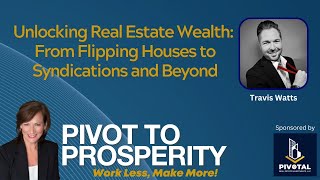
YouTube interview (June 11, 2024) with Travis Watts, Director of Investor Development at Ashcroft Capital. Watts recounts his real-estate path (started single-family flips in 2009; vacation rentals; transitioned to being a full-time limited partner in 2015) and joined Joe Fairless/Ashcroft Capital in 2019. The conversation explains syndication basics (506B vs 506C, accredited/sophisticated investor tests), outlines current capital-market conditions and debt strategy (preference for fixed-rate agency loans today), and describes Ashcroft’s fundraising/marketing process (webinars, ~60-day raises, monthly distributions, quarterly reporting).
Questions this video answers
2009
2015
2019
$200,000 per year (single-person income threshold; with expectation and two-year history)
$300,000 combined per year (with expectation and two-year history)
Chapters
Foreign.
Bowling here with Pivot to Prosperity brought to you by Pivotal Real Estate Investments where we help our investors build wealth and income through commercial real estate that also improves communities. And today we have Travis Watts as our guest and he's with Ashcraft Capital. And I am going to say that he's got a very unique background. I'm very happy to have him on. And I will say that he's in Celebration, Florida. He's local to me. Did not know that. Happy to know it. But he's been working in the forefront of the syndication industry, I would say in many respects. And so I'm going to turn it over to you, Travis, to go ahead and take it away.
Thanks so much, Ginny. Thanks everybody for tuning in. Yeah, happy to start with just kind of a background in a nutshell I suppose. So I got started in residential real estate in 2009 with single family. So started flipping homes for many years and kind of playing the appreciation upside game and the value add game. That led me into vacation rentals out in Denver, Colorado which started to teach me a little more about cash flow and the importance of passive income. And then as I was scaling that portfolio up, I just kind of realized over time after acquiring numerous properties that this was going to be really hard to scale. If I ever wanted to have, let's say 50 or 100 homes that I was having to manage or co manage, it was going to be a full time job. And so I looked into becoming a limited partner investor with other people and their deals and, and made a transition into larger residential commercial real estate, specifically in the multifamily space. So even though I do invest in a lot of different asset types and classes, front is front and center is multifamily residential. And so I've been a full time limited partner since 2015, came on board with Joe Fairless and Ashcroft Capital in 2019 to help grow and expand their team. And the messaging just to get the word out to other folks, which I know is part of your personal mission as well, teach people about value add real estate and the tax advantages that may come with it and the potential equity upside and things like that. And so that's what I do here today. I'm director of investor development at Ashcroft Capital and still a full time limited partner investor.
I think that's fantastic. And that's, that's exactly where I'm at. I, I want to co invest. So while I'm investing as a general partner right now, I'm also investing as a limited because I want to be on, on all sides of the ones that I'm picking to participate in. And like we were talking about before we started recording, isn't it amazing how many people are already in real estate and don't realize they can do commercial real estate? These participate in syndications.
It's funny that you bring that up. I would say our average limited partner has already one, two, even three single family rentals and is finding out about this game in their late 40s, 50s, sometimes even into their 60s. And that's exactly right. And you know, I help even open the eyes to my dad who originally opened my eyes to real estate in general and the single family space. And so he's become a limited partner as well in a lot of these, these same deals. But it's just a great way to help somebody scale if you're looking to be a limited partner. As I mentioned before, and even I'll use my dad's case too. He's retired. He's got probably eight single family rentals out in Colorado. But he just realized that if I really want to be fully retired, I don't want to have 30 single family homes that I'm managing. I pretty much am maxed out at eight. And so he started to scale his passive income and portfolio through syndication. So yeah, to your point, it's a great, great thing and unfortunately it's just not widely marketed. You know, I had read a lot of books and attended a lot of conferences leading up to getting involved in this stuff and had never heard of it, never even heard of someone talking about it. So I made that part of my mission to help, you know, teach and inspire others and just show them that this is a real path and people really do do this on a full time basis. That's not everybody's goal or objective, but you know, I'm a living example of that, as many others are as well.
A lot of people have reached financial freedom this way. Yeah. And you know, I give myself a little grace on this because it was the jobs Acts of 2012 and 2017, as you know, that kind of gave a rebirth to syndications and crowdfunding. And so it was 2017 when I started flipping houses and whatnot. But it was 2019, which I guess is the year that you started working with Joe, that I read his book and he kind of wrote nice, kind of a Bible almost. Right. That was a great first book to read. And so I realized immediately that that was the direction I would be going. But in the meantime I was flipping with an Old college buddy and whatnot. And so anyway, but so a little grace there, you know, that I didn't realize it was now within reach for the average person. Pretty much, you know, if you're sophisticated enough on real estate and investing. Yeah, it's a brave new world.
And you know, it's a great point, great points in general. It keeps evolving. And I think one thing to point out is some people, if you've just barely learned about syndications or private placements or private equity, you may have the impression that this is all for accredited investors. And the reality is that that's not true. There's so many operators doing 506B offerings and regulation A offerings and even on the debt side of things, there's opportunities out there. So my real message to others is to have a focus on passive income producing assets. And whether that be multifamily or self storage or mobile home parks or ATM machines or car washes or you know, land plays. I mean, there's a lot of different things out there to choose from. My bread and butter has always been multifamily because there was a very easy to understand parallel from what I was doing with single family homes. And it was just basically doing the exact same business model on a larger scale. And we can get into that later if you want with the, the scalability and the efficiencies, but just something to think about.
Yeah, it's huge. But so let's keep walking it through a little more. So you're, we're both educating people and they're realizing, you know, that you can see in their eyes that light bulb moment. I can own apartments like that or hotels or. It's kind of an awakening. And I think I told you I'm involved with the local apartment association, so I go to the functions with the leasing agents and the regional managers and things like that. And when, when they hear that they can be owners, that's like a whole new world. They're so used to saying the owner is coming, the owner is coming, get everything ready. Right. And for them to realize I can be an owner. So it's interesting.
Exactly. Yeah. And not even that, but I mean, I mean that's, that's huge in itself. But you know, we back up 20, 30 years and this was largely an institutional run business. You know, these were Wall street and hedge and deep pocketed money which by the way are all still heavily in the game generally speaking. But it became so much more accessible for the average person. And to your point of the tax cuts and jobs act specifically, I think at least that was the most recent thing in my experience with President Trump at the time. Having the bonus depreciation and fueling that demand has really been a huge game changer. It's been interesting since 2015 to watch it evolve where there was, it felt like two or three conferences nationwide and a couple books out there to, you know, who doesn't have a book on syndication now and, you know, which conference do you choose from these days?
So we think that because we're in this world, but there sure are a lot of people that don't know what the word means yet.
True. Yeah. That's just an inside perspective for sure. And there's still, to your point, I mean, the vast majority of. And that's what's so shocking. We're talking about. I like to envision this pyramid, kind of basically an upside down pyramid. So at the top is how many people in America are just interested in investing in general, whether that be stocks or anything else. That's still not a huge percentage. And then you step it down and say, what about real estate specifically? And then it gets a lot smaller. And then you say, okay, what about commercial real estate? And then you say, what about value add multifamily private placements? Right. And then you run the whole accreditation factor for some of the deals. And I mean, really it's, you know, what, under 5% of people, I don't have the stats in front of me, but it's not a lot of folks out there. So there could certainly be more education in the space. And as part of our mission, as you pointed out, to do that, I.
Think that there is data out there that shows that it is evolving, though, because I think in 2021, if I recall, that private placement money outpaced institutional money for the first time. I need to verify that, but I'm pretty sure, yeah, it was a shocker there. And it's just catching on because when you do it right, there's great rewards and then friends tell friends and the words can spread quick, as we know. But so let's talk a little bit more about that educational process. So you have a property, right? You do 506 Bs and Cs, right.
In the last few years, since about 2020, we've been doing 506 Cs, which means we can publicly advertise, generally solicit, but each investor needs to be an accredited investor. At least with Ashcroft Capital before that point, we did 506 B's.
Okay. Right. And just to Explain that a tad bit more. Why don't you go ahead and say what an accredited investor is?
Yeah, so it's, it's a income or net worth threshold to qualify as an accredited investor. There's other ways too. By taking certain exams, holding certain licenses, I won't get in the weeds of all that. But in general, if you're a single person, it's 200,000 per year in income, expectation to do that or more in the current year. And you, you need to have had that in the last two years. If you're a married couple, it'd be 300,000 combined total income for the last two years with the expectation to do the same or greater in the current year. And if you qualify by net worth, just exclude your house altogether. The equity and the debt, just forget about it. If you're a homeowner, it's a million dollar net worth whether you're single or you're married, excluding a primary residence.
Right, right. And so, yeah, those are the main two. There is one other that I'm, I'm curious if I say it more if it might start popping up is if you own a business that's making over 5 million. I think it is, yeah.
There's other ways. Even if you have, it doesn't even have to be like an active business. So like if you had an entity, let's call it an LLC, and you have $5 million worth of assets in it, in general, then that entity could be deemed accredited at the entity level. Which means, let's say you have 1000 non accredited investors investing in that entity. You could still partner with groups like Ashcroft or others doing 506Cs because the entity itself is accredited. So there's, you know, I would go to the IRS.gov and you can check out, or is it SEC.gov I don't know, one of those, but you can check out the detailed stuff on there. And like I said, this stuff's always evolving. We're in the midst of an election year and there's talk about maybe these thresholds are going to change or maybe there's going to be an exam that you might be able to take. And if you pass that exam, it's basically an accredited investor exam. You could be deemed accredited because you have the knowledge and know how to, you know, evaluate the risks of, of private equity investing. So, you know, this stuff can change at any time, but that's basically been the way it's been structured for many years at this point.
And if you would touch on what you would do when you had someone claiming to be a sophisticated investor when you were doing those.
Yeah, so a sophisticated investor is basically self certifying that they know and understand what they're investing in. They can identify what the risks are. Maybe they have some experience that they can articulate in a few sentences. And you know when you do a 506B as in boy, you can work with people that are in your existing network, people that you already know and have had conversations with, you understand where they're at, what their risk tolerance is. The, the downfall to a 506B is you cannot generally advertise or solicit those deals. So they can't be out there on Facebook or YouTube or LinkedIn saying hey, we have a new deal. Here's all the, the things about it. You can only do that with the people in your pre existing network that you have a pre existing relationship with. So it's basically when you're signing your docs on a 506B it just says are you accredited or not? And if you're not, are you sophisticated and tell us any background experience and things like that. So it's a self certification. You can let in x amount of these investors into a deal like that. Similar to a regulation A offering with a 506, you have to have third party verification that somebody is in fact accredited. So there are services out there online that you can pay to use. They'll write you up a letter and they're only going to ask you for either your pay stubs and your past tax returns or the assets that you currently hold. If you're qualifying by net worth, for example, you could do it with a licensed cpa, a registered investment advisor, a broker dealer, an attorney, a CPA that's licensed as well. So it's just basically someone else saying this person is in fact an accredited investor as of this time and date. And those letters are generally good for 90 days. There's exceptions to that. But so, so you do have to go through that process as you're making new investments, you know, year over year.
Okay, so we talked a bit also about the current market and that it's been challenging. Go ahead and touch on that and where you're going today.
Yeah, it's a great point. We are in the midst of a capital market cycle. So this is a lot different than what we experienced in 2008, 9 and 10. That had a lot to do with the loans and the single family space and whatnot. And then an actual full blown economic recession. And so a lot of differences. So what I mean by a capital market cycle is inflation started to get out of control with all the stimulus coming in from 2020 and 21. Basically all asset classes were going crazy in 2021. Well, we had to reset to a normal, right? You can't expect to have 15% rent bumps year over year for the next 30 years. That's just completely unrealistic. So we've been in this return to normalcy. But it kind of looks like a recession of sorts because in commercial real estate, these loans are very interest rate sensitive. So when the Fed came in and started raising rates, by the way, nearly twice as high as what they had projected In December of 21, if you go back and look at the forward looking forecast, it hurt valuations because a lot of these loans are bridge loans, they're short term loans, they're adjustable loans. This is what got a lot of folks in trouble in 2008. 9 and 10 in the single family space, right? You sign up for a mortgage payment with a 3% loan, all of a sudden it's 6%. You know, you're having to pay out nearly double what you were before. You just can't afford to hold on to the home. Plus the values went down because it became a lot more expensive for the next buyer to buy that asset. So that's what we've been seeing in the commercial space is anything that you've owned you in the past as a temporary dip or decline in valuation because rates are as high as they are. Some people are out there getting 5, 6, 7, even 8% loans on $100 million assets. So without a doubt, that's a lot of money out of pocket that has to be factored in. So what you need to compensate for that is a reduction in the purchase price so that you as the new investor can still get a healthy cash flow in return out of the deal. Now, on the flip side of that, I just spoke of a lot of the negative. The positive is if you're starting to invest now or over the last year and a half, debatably, and maybe for the next year and a half, looking forward, this is a great time to buy the dip. We've been buying assets roughly 25% discounted relative to 20, 21 and early 22 peak pricing when rates were very low. So this is a time where even if the Fed kept rates, you know, quote unquote, higher for longer, we would be in a fine position putting fixed rate debt on cash flowing assets that we were buying it roughly 25% off relative to previous pricing. Now, if rates come back down in the next few years, which is what they're forecasted to do, that could just strengthen our hold position. That could give us more opportunities for things like a refinance or to maybe even sell these deals early. Though we had intended to hold them five to seven years. Maybe we sell them in three years or something like that. So it's a great time to buy the dip. It's going to be a very limited window. You've already got Brookfield, Blackstone, you know, big institutions jumping back in the space, the multifamily space with billions of dollars right now, this happening over the last couple months, signaling perhaps the bottoming of this market cycle. And they're trying to get a good entry point to hold these assets moving forward. So some people refer to institutional money as the smart money. It's just, if nothing else, a leading indicator as to, you know, what, what they see happening. You know, keeping in mind that a group like Blackstone is the largest commercial real estate owner in the entire world. So they probably have some data they're looking at, they're probably making some decent decisions, we would hope or think.
Yes, yes. So for the acquisitions that you're doing now, are you doing fixed agency type debt?
We are now. That's, you know, again, it's always a controversial topic, even from 2021 and the folks who were doing adjustable loans and purchasing these interest rate caps for protection. If you had taken a look in 21 for the past 30 years leading up to that point, there was a great case to be made for adjustable loans with rate cap purchases because rates, you know, they weren't fluctuating very much. You have usually a lot more flexibility, sometimes just a better overall terms on those types of loans. But as I mentioned, the Fed went twice as high as what they had projected to go. And it caught a lot of people off guard. And now as that debt's resetting and it's putting a lot of groups in a very tough position. So even though we can't accurately forecast the future, we can only look at what other people say. We just found it prudent at this point to do fixed rate agency loans just so that in the crazy scenario that the Fed decides they're going to raise rates even more, we're locked in for at least a five year period with these types of loans that are also very competitive loans when you go with agency too. So that's what we decided to do. But what I meant by Controversial is if today you went with a floating rate loan and the projection is that rates are coming down in the near future, you might do really well with that type of loan too. There was just a period of time where it worked against a lot of operators and that was 21 and early 22 for the most part.
Right, right. And a lot of people are just figuring it can't stay high forever, so.
Right. I mean, we got a national debt of over 34 trillion. You know, we have a pending possible recession. It's an election year. If you just look at the history of rate cycles, they tend to, you know, go up and then, you know, cut rapidly after. So there's a lot of metrics you could go off of. I don't have the crystal ball, but yeah. Over the next two, three years, the forecast from almost all analysts and the Fed themselves is that rates will be coming down at some point. So we'll just have to wait and see.
And since you have a deal coming up and it would be a 506C, I don't know if you would know of him what kind of interest rate you all got for that. Do you know?
Yeah. So just for some perspective because again, you know, the economy evolves rapidly. I don't know when this podcast is going to air. It could change week by week and month by month. But basically, if you're out there scoping out loans in general on commercial deals right now you might be in the six and a half to 7% range, generalizing. So on our new deal as a five year fixed rate agency loan, we're getting roughly 5.55% loan. So. And this will be a class A property basically, so newly built, construction, things.
Like that, and all that enters into it.
Yeah, it does, yeah. Yeah. Generally speaking, you get better terms on an asset like that, so it's lower risk for the lender is how they look at it.
So let's just talk briefly about the steps from here. You've got it under contract, you're going to do webinars or have you already?
Yeah, that's typically we're changing it up a bit before, you know, the whole time we've been a company. We'll do a live or a pre recorded webinar of Joe Fairless, Frank Rosler, our gps, along with Scott lebonhardt, our chief investment officer, kind of going over the market and the deal and we're why now? And what's interesting about this particular opportunity now we're taking a lot of our team members and doing kind of like a mini video series and each team member is going to cover a specific topic. Like let's say I cover the debt structure. So I'm going to go over the loan and the loan to value and what's happening in the economy with interest rates and what the forecast is and why we like the deal for the reasons, you know, we're putting this type of debt on it. Someone else will cover the market and the sub market and you know, the institutional grade and class of the property, things like that. So long story short, we'll send out either emails and, or webinar in that kind of format and then the raise will be roughly 60 days. Sometimes it's a little less, sometimes it's a little more, and then we close on it. And we're a group that targets to do monthly distributions to investors, monthly reporting and then full detailed quarterly financials to our investors.
All right, and so you don't raise after you close or do you sometimes continue to raise?
Ideally we don't. And I say ideally because we were closing out still simultaneously. We're closing out our third fund, it's called the Ashcroft Capital Value Add Fund 3. And we had an opportunity to buy two deals simultaneously from the same seller who we had bought deals from before. So this is a true off market transaction. And we got really great pricing, really great perks, you know, buying the debt, buying the discount. The problem was we had to raise a lot of capital in a super short time frame. And so our general partners stepped in with their own capital, basically investing in the fund to buy the deals and make sure we got them in the fund. So anyone getting in the fund now is essentially buying those shares and back from them. So but in a perfect world, ideal circumstance, had we had, you know, 100 days to close, we would have just organically raised for that.
Gotcha. Okay. Okay. And you are leaving the fund model temporarily, you think at this point, you.
Know, it's always debatable and subjective. I don't want to put anything definitive out there, but the fact is we've done three funds now for over three years in a row and, and the deal volume has just been so far down with sellers not wanting to either A discount or B, they just want to wait and see when rates come down, what happens to valuations which ideally would, would pop back up. So we're seeing like 60, 70% deal transaction volume down. And so in a fund model, you know, in our Fund 3, for example, we have three properties, but in Fund 2, we had seven properties and in Fund 1, we had eight properties. So we were making the case in a lot of ways from a marketing angle of the added benefit of diversification among all these different deals. You know, your performance isn't dependent on one asset. But if you can only get two or three deals in a fund, it may just be better to do one deal at a time and capital raised for that. So we're doing that on the latest deal. We'll see what happens after all.
Right, so after the webinar, at the conclusion, you have oftentimes people that are roaring to go. Right. You do a great presentation. I know that.
Right.
So let's talk how that those next steps go briefly here and then we'll wrap it up after that.
Yeah. So, you know, historically speaking, we normally do an incentive if you want to go ahead and invest now, even though we're not going to close this deal for let's say 30 or 60 days. So that could be in the form of like some interest, you know, kind of like you'd be earning in the bank or something. So you don't feel like you, you need to wait till the last second to send funds in. You're still going to get an equivalent type of yield. It could be other types of incentives. We've done bonus structured incentives. But you, you've, you've always got a handful of people that are in a position to jump in right now. They're excited about the deal. They want to make sure they get a spot. We do everything on a first come, first serve basis leading up to, you know, before the interest rate debacle, we were funding single asset deals in a lot of cases in like 48 to 72 hours. It was very rapid. It would be, here's the new deal, are you in or are you out? And then a few days later, sorry, it's closed, it's over. I hope we get back to that in the near future. But for those reasons, there's always the people that want to jump in early on and then there's always the folks that want to jump in once they see the momentum. You know, gatherings like, hey, you know, we're 90% subscribed, there's only a little bit of room left. It's now or never. Then you'll get a new tranche of investors then. And then in some cases, if we've already closed the asset, you know, that's a level of certainty and a de risking profile. So then there's people that are interested in coming in at the tail end right before we close. So that's how it goes. You know, first come, first serve is how we do it. And it tends to work well. Works best. I think my opinion on single assets because it's a smaller raise and a shorter timeframe and you know, it's one and done. You don't have to wait to see kind of what develops in the fund over time and what deals end up getting purchased.
Right, right. Okay. All right.
Well.
And you all are considered experts in the field and set that, that bar. Like I was saying before we actually started recording, I think so. Something I didn't get a chance to warn you about was that at the end of the interview here, I always ask everybody, is there a pivotal person or event that either brought you to where you are today or is propelling you from here?
Oh, wow, that's a good one. Yeah, there actually is. I'll share this story. When I first was looking to make some kind of pivot or transition from doing single family and flips and you know, smaller residential into I didn't know what, but something else that was perhaps a little more hands off or scalable, it became real when I got two mentors. I didn't pay for mentorship or classes or coaching. These were two gentlemen that sold their companies in the mid-1990s and ever since they had that liquidity event, they became full time investors, specifically limited partners in private equity deals. And they were the ones I had asked them. I was at an investing meetup in Boulder, Colorado and I had asked them, I said, what's your number one asset class ever since you started investing? And they said, it's value add, multifamily syndications. And I thought, well, that's interesting. I have no idea what you're talking about, but please tell me more. And so they were open in these small tranches of 15 to 30 minutes at a time for about a year where they would just kind of open up to me and kind of share the pros and the cons and the ins and outs and how it works and how you know what to look for and how to vet deals and sponsors. And I got so inspired by that and you know, we took a look at 08, 9 and 10 and how multifamily held up and all these different things. So I thought, okay, that's what I'm going to do too. But I was still a little nervous and skeptical. So I did one deal out of some profits on one of my flips and I said, I'm just going to try this out and See how it goes. So I gave it about six months, made sure the cash flow distributions happened and the reporting happened and I went and visited the property and that made it even more real. I just really fell in love with the model and so I just doubled down on what's working, you know, that was simple as that. And started selling off all my homes, single family and going into these limited partnerships one at a time. So I think it's been a little over 50 at this point that I've done as a limited partner. And just it's a beautiful model, but it does take a little bit of networking. And if you can, and I try to be this for others, find a mentor, find somebody already doing it, you know, successfully and just, you know, pick their brain if you can, if they're willing to give you their time, which I always am for people.
So that's terrific. That really is. And so I don't want to take advantage of the time here. We'll go ahead and tell people, if you would, how they can reach you.
Sure. On social media you can find me Travis Watts. Watts on LinkedIn or BiggerPockets forums like that. Or Passive Investortips on Instagram and Facebook. That's my handle @ PassiveInvestortips. Or you can visit ashcroftcapital.com Travis and that's my calendar link. And I'm always happy to have 15 minute calls with anybody. Whether you're new or experienced, young or old or whatever you want to learn. Accredited, non accredited. I'm always happy to point you in the right direction and give as much value as I can.
That's terrific. And that's a huge part of giving back. And you know, the people in this industry really are great in that regard. I've met so many people that are willing to help each other and I think that hopefully that's helping keep a lot of people out of trouble.
I hope so. And I found that to be true as well. Quick side note. I worked, I won't name their name, but for a very large brokerage firm in the US years ago. And I found kind of the opposite to be true in my experience there. You know, I found there wasn't really an alignment of interest you were having to promote and market products you didn't necessarily invest in yourself or know a lot about. And I just found it to be. It just didn't sit well with me. So I ended up leaving that to go back into real estate. For these reasons. I like to have a conversation with someone and say, hey, look I'm investing with you. I've got family members investing in this deal with you. Our general partners have X amount of money in this deal with you. So it's in all of our best interest to make this successful.
Right. And just to add a bit more there too. When you're looking at a holding period of five or seven years, Three, five, seven years, you're in business together. So you want to be in business with people. You want to be in business with a hundred percent.
Yep.
Yeah, yeah. No like, and trust is very important. So besides knowing the people and the plan and the property, of course. Yeah, yeah, yeah. All that needs to work. But fantastic. Well, thank you so much for coming on and we will have all that information in the show notes and so thank you again.
You're welcome. Thank you, Jenny. Thanks, everybody.
More from Ginny

Dr. Calvin Lowe Saves Lives 2 Ways: Pediatric ER & Teaching Overworked Med Pros How to Get $ Balance

Turning Construction Expertise Into a Thriving Real Estate Empire With Eric Schultz

Build-to-Rent, Community & Cash Flow with Pivotal Person Award Recipient Andy McMullen



Investing Beyond Boring Real Estate: Oil, Gas, and Industrial Properties with Keshav Kolur


Unheard of home prices: $225,000+/- in Portland! John Laine - Breaking Barriers- Home Affordability!


