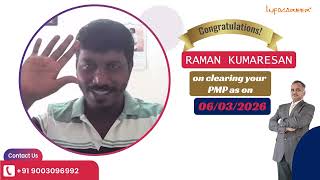
In this interview, Raman Kumaresan shares his experience preparing for and passing the PMP exam. He recounts following an unconventional "answer‑first" strategy taught by an unnamed trainer, which allowed him to complete the exam in two and a half hours by selecting the best answer before reading the full question. Raman explains how obtaining the PMP credential transformed his professional credibility, enabling him to persuade project managers and clients more effectively and reducing proposal rejections from about 50% to near zero. He expresses deep appreciation for the InfoCarrier/InfoCareer team—particularly Swathi, Tamil, and Leela—who supported his preparation, and he offers no critical feedback, stating the program already meets his expectations. The content is a first‑person testimonial highlighting personal tactics, perceived career benefits, and gratitude toward the training provider.
Chapters
Trainers, uh, even I forget the trainer's name who taken the class because the GLS is very, very open. That is the clear session. Other side, Ajay, I attended one offline session due to missing live session. I forget his name. Really, I want to say thank to him because he has, uh, explained the way how he has cleared the exam. Okay. So I followed his instruction. What he says, the options what they are giving, answers, without reading the questions, if you read the answers easily we can find out which is best. So that will become the answer. Yes, that's what he has suggested. Same way I followed, and even the way what he has explained, the same way I followed in PMP exam. I completed my exam in 2 and a half hours because most of the questions around, I can say minimum 20% questions, I have not seen the question directly. I read the answers, I, I was choosing which is best. So this way, no institute will say like this. Any institute will say you first read the question and understand the question, because sometime, no, clearly one paragraph they are giving us a question. So time is very less, we cannot invest time on reading the questions. Maybe other, uh, other person, maybe they want to read the questions first. This is my personal opinion, without reading the question also we can answer. As per— I forget his trainer name. Even I asked Leela or someone, but they are not— they are also unable to find it.
I'll check.
Yeah, check.
So, uh, uh, and one thing I want to ask is, uh, what are the key benefits, uh, you got after, uh, and benefits and changes, uh, after you clearing the PMP?
Benefits, I can say that before completing this, even my organization they don't agree what I am suggesting. They will put it to project manager. The project manager, even project manager will validate something, he will remove something. Again, it will go to the client. The client will say no, we cannot agree. When I complete my PMP, when I am going with my PMP knowledge, the way of attitude and explanation to the customer and approach to the project manager, they are really ready to agree whatever I am saying. And also even ready to agree, straightforward, they will not agree. They will also validate the what PMP says. I, because when you are giving some clarification to the PM or client, we should give this justification why we are introducing this. So the way of justification is majorly helping for me to convey the customer or my project manager. Okay, so this is the major concern. So I can say like if you are the PMP holder, easily you can convince the customer as as well as your internal organization. Yes, but only thing, we, we also should be very clear what we are proposing, and we should be ready for what we are— how we have to justify if they come up with some query. Okay, so blindly we cannot put the points to them. This earlier I used to do that. After PMP, I just, I removed whatever the negative things from my side, what mistakes I'm doing. So these all I removed myself as per the PMP rule. Then almost earlier it used to reject around 50% from customer or manager, whatever I'm proposing. But now even I'm removing that 50%. Before them, I'm removing the 50% remaining. I'm approaching them, removing the sense, whatever the points no need to escape, like a kind of golden rule. So this is helping me to show my progress in faster way and easier way.
Yes, okay, good, good, good to hear. And, uh, thank you. Uh, so one last question. Uh, is, uh, what is the one thing InfoCarrier should continue doing and one thing, uh, we need to improve on? Uh, one thing we need to improve.
One thing improve means already they are doing really great. I don't know, I don't find any negative from them. First of all, last thing, thank you to you and the entire InfoCarrier team who supported me in the exam. And also, Swathi, thank you for you. She is trying to arrange this session last 3-4 weeks, I think. So unfortunately, I'm getting something even now also scheduled for tomorrow. Unfortunately, another meeting was there. I didn't see my calendar, so morning only I noticed. Then immediately I called. Swathi, thank you for this arrangement. Also be in touch with us, okay? I will visit because I am sitting in Malachery. I will visit sometime. Thank you, Tamil. Thank you, Swathi. Yeah, bye. Thank you to entire InfoCareer team. Finally, okay, we will meet again. This is not the last session. This is the one of session, I can say. Thank you. Sure, we will meet again. This— I— that's what I said, this is one, one of the session. This not the last session. We will keep in touch. Yeah, sure. Yeah, thank you, Swati. Thank you.