How AI Is Impacting Engineering Leadership
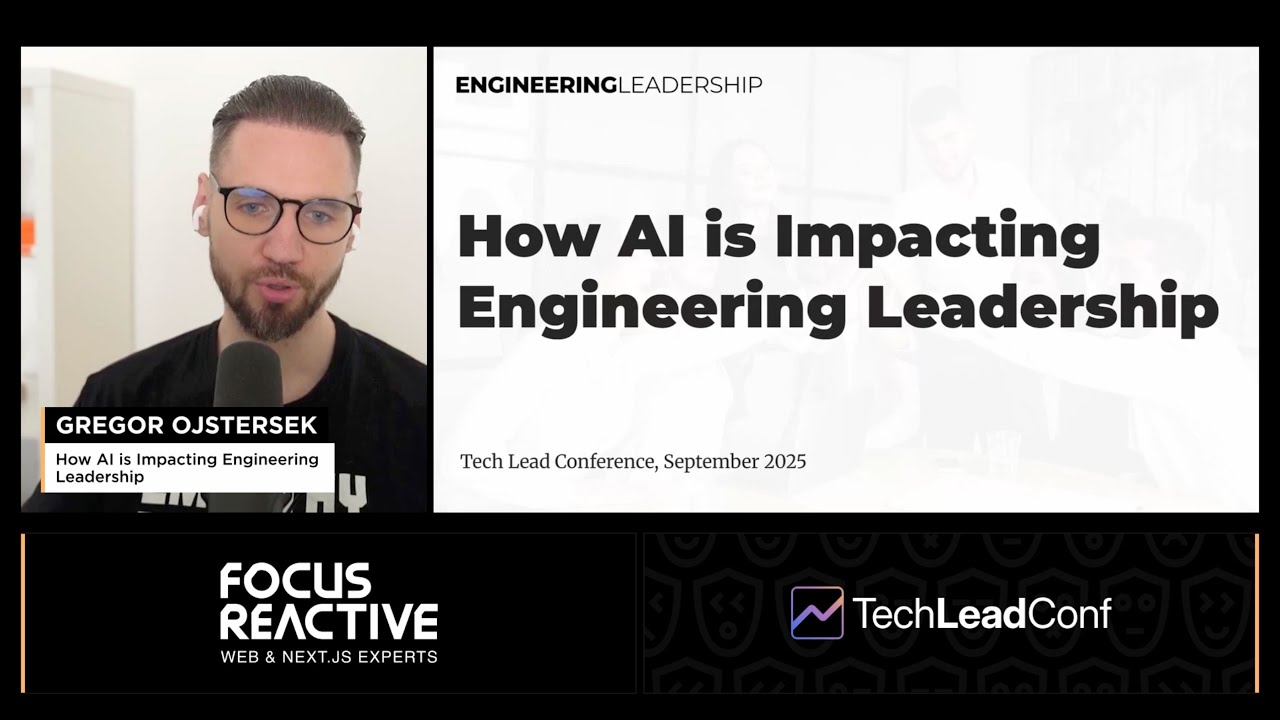
In this Tech Lead Conference talk, Gregor Ojstersek examines how artificial intelligence is reshaping engineering leadership. He begins by citing the Lead Dev Report, which found that 51% of engineering leaders view AI’s impact as negative and that team motivation has declined. He attributes this pessimism to sensationalist AI predictions from high‑profile figures (e.g., Mark Zuckerberg, Dario Amodei, Andy Jassy) that generate fear‑of‑missing‑out (FOMO) among company executives. This FOMO leads to unrealistic expectations—claims of 100x productivity gains, mandatory AI usage KPIs, and rapid AI‑centric transformations—that often backfire, increase costs, and erode team morale. Ojstersek offers concrete advice for company leaders: avoid FOMO, set realistic goals, run small, low‑risk experiments, and prioritize culture over flashy AI initiatives. For engineering leaders, he stresses the need to educate themselves on AI tools, proactively own AI product strategy (citing insights from OpenAI product leader Migda Jaffer), and act as the bridge between technical feasibility and business value. He also highlights a second industry trend: the blurring of traditional engineering roles. Managers are expected to take on staff‑engineer duties, staff engineers may wear manager hats, and product engineers are emerging as hybrid roles that own both product thinking and implementation. This convergence is driven by layoffs, higher individual‑contributor ratios, and improving development tools. To succeed, leaders must cultivate human‑centric skills (leadership, empathy, communication) and deep problem‑solving abilities, while leveraging AI as an augmenting tool rather than a replacement. Ojstersek concludes by offering a QR‑code linked resource bundle—including his Engineering Leadership newsletter and a complimentary subscription—for anyone seeking to become a great engineering leader in 2025 and beyond.
Chapters
Hi everyone. My name is Gregor Ojstersek and I'm happy to be here today on, on Tech Lead Conference with all of you guys. And today I'm going to be talking about how AI is impacting engineering leadership. And this is a topic that, you know, is quite a lot of people are asking about it. And I'll be talking about two impact, the most impactful things I'm hearing across across the industry. And this is based on my discussions from various different engineers and also engineering leaders, and both from big tech and also startups. And also at the end, I'll be also sharing, you know, tips and also my advice on what to do to be a great engineering leader in 2025 and beyond. Before we get started with, with those impactful, impactful things, let me say a little bit about myself. So I have over 12 years of experience both as engineer and also engineering leader. In my career, I grew from engineer to senior software engineer, then to engineering manager— sorry, team lead, engineering manager, head of engineering, VP of engineering, and then CTO. Currently, I'm working as a fractional CTO and advisor and also coach and mentor. Most people know me as a writer of Engineering Leadership newsletter, and I also teach a course. It's called Senior Engineer to Lead, Grow and Thrive in the role where I helped over 200 students to grow, to be able to, to get insights on how to grow towards the next, the next role, which is lead position. Overall, my goal is to help as many people as possible to become great engineering leaders. Okay, so let's, let's talk about the first impactful thing that I'm seeing across, across the industry, and that is that 51% of engineering leaders believe AI is impacting the industry negatively. So this has been quite an alarming data point that, that, that I saw when I come across this, this information. By the way, this, this, this is from the Lead Dev Report where they interviewed more than 600 engineering leaders. And when I saw this data, I saw— I was thinking like, hey, what is, what is going on here? What is happening? Why? Why? Why do we, why do we see that? And yeah, I started to dig through it and I started to ask, you know, our other engineering leaders on what's happening. And I saw also I had, I saw a lot of different important findings when I digged more in details. But also before we go into that, an important thing to mention also from the Lead Dev Report is that Teams these days are feeling less motivated than 12 months ago. And that's also alarming. And that's also connected with, with, you know, engineering leaders believing that AI is impacting industry negatively. And we will go straight into why is that next. So it all starts with, you know, sensationalistic predictions regarding AI from non-public individuals and You have probably seen a lot of these predictions. It's all across social media and different media platforms. You know, for example, Mark Zuckerberg saying that AI will replace mid-level engineers in 2025. But we all know that this is not even close to being a reality. And, you know, for example, also Anthropic CEO Dario Amodei mentioning AI could spike unemployment to 10 to 20% in the next 1 to 5 years. And, you know, believing also that AI could wipe out half of the all entry-level white-collar jobs, you know, such predictions are very, very sensational. And, you know, just believing that unemployment will go up in the next 1 to 5 years by 5 to 10% is, is very, very, very big. Big, big take, and it's hard to believe that's going to be the case. And then also, you know, Amazon CEO Andy Jassy is saying AI will reduce its corporate workforce in the next few years. And the problem with such takes is that they create FOMO, they create fear of missing out. And whenever people feel that they are missing out on something, then they are doing some, some acts that are, that are quite not as strategic and not that actually thought, thought of. They're, they're doing very reactive, reactive things in order to try to improve or try to, you know, try to adopt a certain, certain technologies in order to not feel like that they are missing out and so on. So What this creates then is that company leaders are experiencing FOMO when it comes to AI. And you've probably seen this has been some time ago, Shopify CEO enforcing the use of AI in, in, in, in across all the teams in the company. And especially I went through this, this memo pretty in detail and some claims like AI improving productivity by up to 100%, sorry, 100x. Is quite, quite a bold take and it's quite unrealistic based on my discussions talking with various different people in the engineering industry and also across different industries as well. What, what we've seen the most is around 1 to 2x productivity increase. And also, and also, you know, the bigger, the bigger and the larger, the larger the codebase you're working with and the more complex systems you're working with, the less impactful is going to be AI in order to get to be more productive. So such takes are what, what is then, you know, causing a lot of issues for people inside a team, inside a company, because the expectations are skyrocketing and then people need to, need to manage those expectations. Right. And then also, you know, demonstrating that you can do what is needed with AI before asking for more headcount. Again, this is, this is something that is, that is very sensationalistic. And, you know, it feels like that, okay, AI is going to replace, replace, you know, many different people and we need to justify new hires to be, to be part of the team instead of looking at what are, what are the actual business challenges and what do we need in order to solve those business challenges the right way. And also, you know, we mentioned including AI usage as a KPI in the performance review. What I believe, you know, is if you measure the wrong things, people are going to be inspired to try to game the system. And if you just measure AI usage as a KPI, then people are going to be inspired to, to, to try to, you know, use as much AI as possible and use as much as AI tokens. And that means also, you know, the, the cost is going to go way up. But if, if the cost is not justified with business value, then the cost is, you know, it's, it's not not useful. It's actually being, being used in a wrong way. So actually the company is losing money instead of gaining value. And then also we've seen company leaders like, for example, CEO from Fiverr sending a memo to all of the employees about AI is coming for your jobs. And, you know, there are many more examples similar to this. I've spoken with many different CEOs and also company leaders, and I saw that being the case in many different situations. In some cases, I also saw like, you know, different CEOs trying to white code the homepage of the, of the current website and then saying to engineering leaders and engineers how easy that is, that is to be, to be the case. And then, you know, it, it's all, it all trickles down to engineering leaders and their teams to being able to manage such unrealistic expectations. And yeah, this is what we're going to talk about next is, yeah, I've heard a lot of different unrealistic expectations from many different individuals and, you know, believing AI is a plug-and-play solution that you can just, you know, plug it in into existing, into existing workflows and things are just going to work out very, very well. But, you know, it's rarely the case that, plug and play rarely works across different, you know, improvements, and especially when it comes to processes. And, you know, expecting AI to eliminate all manual work is something that is also, you know, it's very, it's very sensational and it's not, it's just not, it's not, it's just not possible. Right. Understanding the cost and complexity of building internal LLMs. Yeah, it's a big difference if you're building a model yourself or if you're using existing models. Model like GPT, for example, you know, it's the— there can be a difference, can be, you know, between 3 or 300 days when you're building a certain feature with, with calling an existing model. You can just call that API and it will do a lot of that heavy lifting for you. But if you build your own model, then you're going to need a lot bigger team and a lot more time and research to do that. Yeah, assuming AI will just magically understand the whole context and the specific of the specific domain, expecting AI to be replacing entire teams, assuming AI will just work without failures. And then also, you know, thinking that there are no ethical, legal and security risks when it comes to AI. You know, if you're not careful, if you're just, you know, if you're just generating a lot of code and you're not, you're not reviewing correctly, then, you know, The problem is going to be with, with security, with ethical reasons, legal reasons as well, because the human, the accountability should always be on the, on the human side and never on, on AI. So yeah, also, you know, assuming AI will exponentially increase the performance over time and so on. And yeah, this is a good illustration of what's happening. And it all starts with sensationalistic takes by non-public individuals. That then trickles down to company leaders experiencing FOMO with AI and forcing AI usage and AI feature development. What we've seen from a lot of different companies is that they're, they're, they're rebranding their companies to AI companies to, to, and also, you know, forcing development of AI features. What happens a lot of times is that this backfires, backfires back and, and You know, by trying to enforce too much different features, you lose the essence of what is actually, what problem are actually solving for the users and so on. A good case for this happening is Duolingo, where they completely made the AI transformation and a lot of users didn't like that and they stopped using it and such things, you know, feeling FOMO from company leaders then trickles down to engineering leaders and teams operating within unrealistic expectations. So This, this, this becomes a big problem then for engineering leaders and engineers. And that's also the reason why a lot of engineering leaders feel that AI is impacting the industry negatively. So what to do? I will give advice for both company leaders and engineering leaders. So let's first start with company leaders. Of course, the number one advice is you should not be getting— you should not be letting FOMO get to you. And it all starts with setting the right goals and setting the right environment to be successful. And if you let that FOMO get to you, you're going to be doing, you know, you're going to be doing decisions that are not going to be, you know, in the best case scenario for the business, for the company. And especially if you try to do full-scale AI transformation all at once, it will in a lot of cases backfire. It's, it's not the way to go. Small experiments are a lot better. You know, start with something that is less impactful and then you see how it's working. And then if it's, if it's working well, you move on to, to more impactful parts and you utilize that in those parts. And also what I like to say is there is, there is no better productivity increase than a good culture. Good culture is going to to, to be the most impactful for any company. You know, it can be the reason of, you know, being more productive by 10x, 100x and so on. Good culture is what really connects so many people together and, and you can build so much good stuff. And, you know, people feel, feel great working in a good environment and good culture is, is what is going to be the foundation for, is what is the foundation for many, for many companies. And then also let's go to the advice for engineering leaders. You know, obviously the first thing is make sure to educate yourself on how to utilize AI tools and also how others are using AI tools as well. And be confident. You know, whenever you're talking with company leaders, with stakeholders, with investors, with people who have unrealistic expectations, you need to be confident and you need to inspire confidence in you. The last thing what you want to do is go straight into saying yes to silly requests like, you know, we need to start using this AI tool or we'll fall behind. This is, this is the recipe for disaster. And if, if you do that, you know, a lot of, a lot of things are going to go wrong and you will lose respect. People will lose respect for you. And what is going to happen and what can happen is just, just, you know, people, you know, company leaders or any kind of other stakeholders are just going to make decisions without you. So instead of, instead of you being reactive, you need to be proactive and you need to take ownership of the AI strategy and not wait to be looped in. That is, that is very important. And especially for directors, VPs, and CTOs, don't wait to be looped in on AI strategy. You should be owning the AI strategy. You are the strategy. This is, this is from Migda Jaffer, a product leader from OpenAI. We did a recent collaboration on my newsletter and this has been one of the most important parts of that newsletter. Also, he mentioned that AI engineering— sorry, engineering strategy is actually the same as AI product strategy. So you should be the one who is dictating like, hey, this is the way to use AI, this is how we should be using it, and this is how we can also adopt AI across our— across the company. And His recommendation is for engineering leaders to get a lot, a lot more closer to that part because— and the reason for that is that you already understand the whole part. You already understand what it takes in order to build that specific, you know, AI feature, AI product. As I mentioned before, it can be the difference, you know, the way you approach to building that product or that functionality can be the difference between building it in 3 days or 300 days. What you need to focus on as well is, you know, the what, the when, and the why. That is very important. And that takes a bit more business and product understanding. But anyway, you need to, you need to do that. This is very important in, in, in 2025 and beyond that you as an engineer or an engineering leader become more business and product minded. So Yeah, very important to take ownership of it. And also this is a really good visual as well. This is from Migdat from OpenAI and his proposal and his recommendation is that, you know, the whole strategy is getting a lot closer to engineering. You can see like a traditional product strategy is across many different departments like product management, design, finance, UX research, QA, procurement and so on. But in terms of, you know, AI strategy, that, that is a lot more closer to engineering. And the reason, as I mentioned before, engineering understands the how part and there is no one else who can understand better what it takes to build something, what it takes to actually, actually make sure that that specific thing can be adopted across the organization, or we can build that AI feature, we can build that AI product and so on. So again, you should be the one who is owning the AI product strategy. Don't wait to be looped in on the AI strategy. Strategy. Okay, let's talk about the second impactful thing that I see across the industry, and I see engineering roles just getting closer and closer together. And for example, like engineering managers to be expected to take on staff engineer roles as needed. Like, for example, if there's a project that is a lot, a lot more technical and that there may be a lot bigger need for someone that takes on more of a hands-on role, then it's expected that, for example, engineering managers take on a tech lead role if needed. Obviously, it depends on what kind of profile of people you have inside a team. But yeah, I can see this being the case more and more in the, in the upcoming years as well. Similar, like with staff engineers, be able to take on manager hats if needed, and also architects, you know, taking on staff engineer roles or manager roles if needed. I think those three roles are just getting more and more together and are going to get blurred as time goes on. And also similar trend I see for both product managers and engineers. I see the role of a product engineer getting more and more popular over time. And I see that, for example, a lot happening in smaller startups, smaller companies where, you know, they're hiring product engineers and they're owning and they're proposing functionalities, solutions, and they're owning that those particular implementations themselves. And they're owning both what to build, why to build, and also when to build, and then also building it as well. And I think that is going to get more and more common as time goes by. So very important, you know, if you're an engineer or engineering leader, become product and business-minded. You know, this is going to be more and more important. And Here is why I believe, you know, that is, that is happening more and more in many different companies. Obviously, we've seen layoffs happening within multiple companies. And as soon as there are fewer people inside a company, more is expected from existing people. And also, you know, Amazon's initiative to increase the ratio of individual contributors to managers, that, that has inspired a lot of other companies to do a similar amount of similar thing that, that, you know, more people are reporting directly to directors factors of engineering instead of reporting to middle management. And then also, you know, the tools for development are getting just better and better over time. So that's why I believe, you know, engineering roles are going to get more and more blurred as time goes by. So I believe, you know, being good at many things will not be a nice-to-have, but a must-have to do. So to help you, what, what you need to do as an engineering manager, engineer, architect, I kind of like dissected the skills into two different parts. And the first one is human-related skills. You know, the more, the more things are becoming robotic around us, the more important human-related skills are going to become. Leadership, teamwork, good communication, being a great person to work with, empathy, and overall emotional intelligence. All of these skills can't be replaced by AI. And you being good at it is, you know, going to be immensely valuable to the company, to the team, to the organization. And so on. And the second part is, you know, being good at solving problems, being pragmatic, being, being resourceful, having a good network of people who you can talk to and ask questions, you know, also having a list of resources that you can refer to any time. Also, obviously utilizing AI tools, business understanding, as you mentioned before, and also having a deep understanding of relevant topics, especially see it at current times. I see I see people coming to the industry with more shallow understanding of engineering fundamentals than, for example, 10 years ago. So having good understanding of, you know, fundamentals and also particular topics that you work with is going to make you very, very valuable. And yeah, to help you with this, I have prepared a list of resources to becoming a great engineering leader in 2025 and beyond. You can just scan this QR code and it will take you to the list of resources. Some of the resources, some of the articles in this, in this list are paid articles of my Engineering Leadership newsletter. And the only thing that you need to do is you just need to send an email to me and tell me, and tell me that you attended this, this talk and I will give you a 1-month complimentary paid subscription. There's also a template of an email and also my email inside, inside, inside this, this link that you can scan with the QR code. I hope this has been helpful to you. And yeah, definitely, if you have any questions, let me know.
More from Gregor










How I Grew My Newsletter Engineering Leadership to 165k Subscribers in 3 Years
