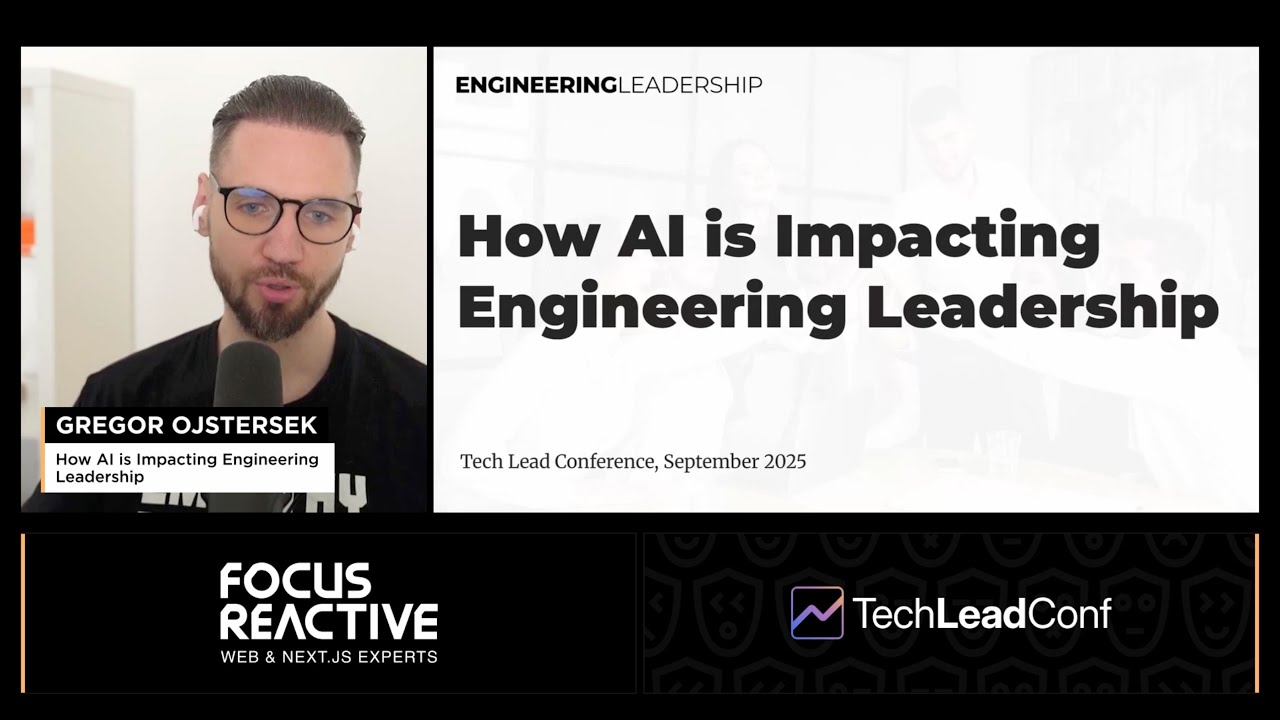
Why Engineers Must Become Multipliers in the AI Era (6 Important Trends)

In this Amsterdam conference talk, Gregor Ojstersek (30+ years of engineering and leadership experience, author of the Engineering Leadership newsletter and upcoming book The Multiplier Mindset) argues that engineers must evolve into "multipliers"—individuals who amplify the impact of their teams, products, and organizations—especially as AI tooling reshapes software development. He outlines six major trends driving this shift: (1) growing end‑to‑end ownership of projects by engineers, (2) the rise of engineering‑leadership roles such as tech leads and staff engineers, (3) hiring preferences for either strong generalists or deep specialists, (4) the emergence of product‑engineer responsibilities where engineers wear the product hat, (5) expanding job requirements that demand rapid learning and AI‑assisted skill acquisition, and (6) a reversal where former managers return to individual contributor (IC) roles, blurring traditional hierarchies. Ojstersek defines the "engineering multiplier" as a force‑multiplier mindset: focusing on human‑centric skills (communication, empathy, mentorship), problem‑solving, business understanding, and leveraging AI tools to amplify collective output. He stresses that improving the performance of a few teammates by 20% yields far greater value than modest personal skill gains. The talk concludes with a QR‑code resource list and a Q&A session covering junior‑to‑tech‑lead pathways, product‑vs‑engineering focus, self‑directed growth without managers, handling AI‑resistant engineers, and showcasing soft‑skill impact to employers.
Questions this video answers
Show passion for learning, ask questions, build and showcase personal projects, and be proactive in applications (e.g., attach a demo). Pair with senior engineers to create a symbiotic learning relationship.
Both perspectives matter; some companies keep dedicated product managers, others expect engineers to own product understanding. The key is knowing what to build for users, regardless of role.
Engineers must take ownership of their own growth, seek mentorship, be proactive in learning, and some firms use external coaches or maintain limited manager‑to‑team ratios.
Encourage a mindset shift: view AI as a delegation partner, not a threat. Emphasize continuous learning and demonstrate productivity gains from AI assistance.
During interviews and reviews, give concrete examples of mentorship, communication, leading projects end‑to‑end, and quantifying business value delivered.
Chapters
Hello! It's really great to be here in Amsterdam. I was here about 2 years ago, where basically one of my first conferences, and it's always, always great to be here, returning back here. So yeah, I'm excited to be giving this talk today. It's a really, really important topic at this time, especially in the AI era, and we're going to be talking all about Why Engineers Must Become Multipliers in the AI Era. Before we go into more details, a little bit more about me. I have over 30 years of experience, both as an engineer and also engineering leader. I grew from engineer all the way to CTO, senior software engineer, senior software engineer, team lead, engineering manager, head of engineering, VP of engineering, and then CTO. I'm also a fractional CTO and advisor. Most people know me from writing the Engineering Leadership newsletter. My goal is to help also as many people as possible to become great engineering leaders. Additionally, a lot of ideas from today's talk is going to be regarding the book that I'm writing. It's called The Multiplier Mindset. It's going to be out sometime around October. And, yeah, a lot of things today are going to be also included in the book as well. Yeah, okay, let's first start with, you know, the way we build software these days is a lot different than we used to build, like for example, 2, 3 years ago, 4 years ago, 5 years ago. Tools are much better. AI-assisted engineering is becoming the standard. Obviously, we all heard about loop engineering. That's a hot topic these days. And also we have like non-technical people building prototypes with tools like Lovable, Replit, and a lot of other, other tools as well. Additionally, we also expect engineers to be working a lot more, basically owning end-to-end projects instead of just working based on requirements. It's all about the impact. It's all about, you know, what kind of problems are you solving. It's less about like, okay, this is a task, okay, let's solve this task, especially in smaller to midsize companies. Engineers are starting to own end-to-end a lot, a lot more. This is what we're seeing. One of the big advantages of me writing the newsletter is that I get to talk with many people across the industry about, you know, what's happening, what's happening in different companies. For example, I recently talked with OpenAI, with Anthropic, and get to see how they're building AI-native teams and also how their engineers work. And I'll be sharing some of the examples in this presentation. So yeah, in order to understand why engineers must become multipliers in the AI era, we're going to go through 6 important trends that are happening inside our industry. So the first one is, as I mentioned, we can see a lot more end-to-end ownership from engineers across different companies, especially smaller to mid-sized companies. There's not unusual, like for example, OpenAI is a really good example. They have 30 engineers reporting to one manager, and they also have like one product manager for the whole department. So engineers are expected to have ideas for the projects and then also, you know, implement them and then also deliver them and also keep improving them. So we see this more and more common throughout throughout our industry. This is also like what Mihai Dajafer mentioned. He's a product lead at OpenAI. He mentioned that engineers need to start owning also what, when, and why, not only the how. So this is what we see more and more common. And that is where like the multiplier mindset comes really, really becomes really, really important. Always keep this in mind. Let's go to the next one. So we see that A lot of engineering is actually becoming engineering leadership. That means that everyone is kind of working more— less as an engineer, but more like a tech lead. And the tech lead role is becoming really one of the most important roles in our industry. Especially when we are doing AI system engineering, you can't do AI system engineering well if you don't know how to give feedback, if you don't know how to delegate, if you don't know how to dissect bigger projects into smaller tasks, if you don't know how to be patient as well. So a lot of the skills that you need are very much related to being a great tech lead, especially when you're owning projects end to end. You need to know how to do stakeholder communication. You need to know how to share progress around the project, how to get the buy-in on the project, how to lead it from start to finish. And also, if you're working with other people, with other engineers in in the company as well. You need to make sure that they really understand as well how and what and how we are building things. So yeah, this is the second very, very important trend. A lot of the roles are becoming actually engineering leadership roles. And yeah, this is really, really important information as well, which is, you know, 2 years ago, amount of roles, tech lead, staff engineer roles were kind of like equal to team lead engineering manager roles and architects Director and above were a bit less. But the big difference is today we see, today we see a lot more tech lead staff engineers, less architects because a lot of the roles are merging. Architect role is merging a lot more to the tech lead staff engineer role. And then also the team lead engineering manager role is also basically a bit of decreasing because a lot of the, for example, Amazon started the, the trend of increasing the ratio between ICs and managers. And a lot of companies followed this direction. And that's why we also see a lot less team leads and engineering managers than we used to see in the past. We will see how this goes in the future. But the way I think things are going is that we're going to see a lot more staff engineers, a lot more tech leads. And there's also, like, If you check different roles that are available in our industry, there's more staff engineer roles these days than engineering manager roles. So always keep this in mind, the way things are going. The next important trend is that one of the things that companies are telling is that when they're searching for engineers, they get a lot of different profiles, a lot of different people. Companies might get like 300, 400, 500 people applying to a certain role, especially engineering role. And one of the most common things I'm hearing across the industry is that people that are getting hired are either really great generalists or they are extreme specialists in a certain area. What I mean about really great generalist is, you know, someone like a tech lead that can own projects end to end, also have good leadership skills, good communication skills, you know, also being able to work across different technologies, different frameworks, and so on. And on the other side, we have extreme specialists. For example, someone, Chowdhury, he mentioned that they recently hired— he's a head of engineering at OpenAI. He mentioned that They recently hired a WebRTC expert. And they hired him exactly for this reason because he's an extreme specialist. So, there's also, like, other ways in terms of, like, how you can be a specialist. Like, you can be really good in performance. Like, for example, with React applications, Angular applications, maybe, like, with a Flask, maybe, like, with C# and so on. Maybe you are known for something, like, really, really have like deep, deep knowledge on a really particular topic. So, um, that, that's also my advice as well. People that are a bit in the middle, that don't know exactly, you know, where to go, what, what should they be, a great generalist or should they be an extreme specialist, though those people have a bit less of the opportunities these days. Um, so yeah, that's also my advice. Try to figure out which, which branch do you want to go go into and then focus on that. Important note I want to mention as well is that the generalist roles are a lot more, but they're a lot more competitive. But specialist roles are a lot less available, but they're also a lot less competitive because of course there's a lot less experts in certain, in certain areas. Let's talk about the role of a product engineer becoming a lot more popular. This is what I— what, what we're seeing across the, across the industry. And especially one of the recent companies I talked to, the company called Portkey, they have 24 engineers and zero product managers. So yeah, it's becoming a lot more common. And also returning back to the OpenAI's case, as I mentioned, they have 30 engineers for one product manager. So a lot more engineers are expected a lot more to be also owning the product hat as well. One of the things I want to mention, especially with the Portkey example with 24 engineers and zero product managers is that they are building an infrastructure product. So, you need to be highly technical in order to understand what it's all about, right? So, that automatically gives a bit of advantage to engineers to be able to wear the product hat as well. But this is what is becoming a lot more popular these days. And if you're not focusing on the product and the business, make sure to do it as soon as possible. Because that, that's going to be more and more expected. What I wanted to mention here as well is that a lot of times you're going to see just the title software engineer, but the expectation is already that you have the understanding of product and business. We see less product engineer roles because the role is actually merging, is actually merging, and the expectations are becoming more like, okay, tech lead abilities and also product business understanding. But the title is software engineer. Keep this in mind. Now let's talk about a really, really fun thing, and that is obviously you've probably seen this meme a couple of times on social media, but there is a lot of reality to this meme these days. We see that requirements of different job ads are actually just increasing. And there's more and more requirement, especially technical. You might see that a bunch of different frameworks, a bunch of different technologies, and so on. But the problem is that companies want to get more expertise on certain stacks. But the thing is that they don't really understand that they're looking for a different type of a person. They're looking for someone who is not an expert in all of these technologies. They're actually looking for someone that is good at adjusting technology and being able to learn or being able to, you know, get every information that they need, you know, if they need to learn it. So, for example, if you're, you If you're an expert in Python, you can use AI to be decent like in Java and PHP as well. But a lot of companies don't understand that. They still want to have like a requirement, you know, be really good in a bunch of different technologies and so on. But yeah, it's not the right way to go. Similar example is, you know, if you're good in React, you can be decent in Angular as well by using AI. Maybe by being resourceful, you talk with other with other experts across the industry as well. Similar thing with, you know, if you're good at PostgreSQL, you can be good at MongoDB as well. Similar mindset. You understand the databases. You understand how they work. You have the expertise. You have the experience and so on. And, yeah, all of the other examples are exactly the same. The companies are actually looking for someone that is able to learn fast, get everything they need, and provide impact. That is actually the essence of being an engineering multiplier. And let's, let's talk about the last one, uh, the last trend, but especially not, not the least one. Um, you know, there's a reason why managers are more desired than ever to become ICs once again. And we mentioned a couple of of times in this presentation that AI engineering is basically the standard way to build these days. And you need certain skills in order to do AI engineering well. And a lot of managers have learned these skills across their experience in the role. You need to know how to delegate correctly. You need to know how to dissect a bigger project into smaller, smaller tasks. You need to go and you need to know how to give feedback, and you need to also be clear, give clear explanations as well, and also have patience, continuously refine and improve the, the output. Those are all traits that, that good managers have, and especially if a manager stayed hands-on, they also have good engineering fundamentals, they can be really extremely productive these days with AST engineering. So that is one of the reasons why a lot of managers are very, very desired to become ICs. Once again, we see a lot, a lot of times in the industry that the manager is moving back to being IC these days, especially like a staff engineer. We also see like an architect, staff engineer, engineering manager role being closer and closer together. So there's less and less separation between those those roles. But yeah, at the same time, you know, we can see like from this, uh, from, from this image here, from, um, that, you know, there was a, there was a tweet mentioned about, you know, being, being laid off, uh, at Meta. But, you know, my, my advice here is it's not a demotion. In case, you know, something like that happens in, in one of the companies that you work with, it's not a demotion. Always, always take it as a, as a challenge and always take it as a, as a way to see how you can provide as much value as possible to the organization and also to the business and also to your team and so on. So the way I see things going is that ICs are going to be, are having a lot more responsibilities, a lot more ownership these days than they did in the past. And that's what I see happening also in the future as well. And yeah, let's talk about— I really like this slide because it's giving me very nostalgic vibes towards when I started being a first-time engineer. And like 10 years ago, especially when the framework AngularJS— you may be familiar with it if you've been in the industry for a while. If you knew Angular, you were able to get a job really, really quickly. That was like 10 years ago, so good understanding of one programming language, that may be JavaScript, and one framework, and you could get a job really quickly. But today, in order to be considered a great engineer, there's so many other important things that you need to focus on, and that is like being an engineering multiplier, having good human-related skills, and being good at solving problems. That's actually the core essence of what makes a great engineer at this time. Leadership skills, teamwork, good communication, being a great person to work with, empathy and overall emotional intelligence, pragmatism, being resourceful, being know how to utilize AI tools as well. Of course, business understanding is more important than ever, as I mentioned. And again, having like a deep understanding of a relevant topic as well. And let's define exactly, you know, what engineering multiplier means. The word engineering multiplier is something that resonates with me a lot because it's a combination of engineering and force multiplier. That means that you don't only focus on your individual contribution, but you focus on making everyone around you better, the team, the organization, the business, the overall company. So yeah, it's not only about, you know, what things you do yourself, but what impact have you delivered? And the impact that moves the whole organization forward is the biggest impact that we can see, that we can have as engineers. So yeah, always think about not what I'm doing today, tomorrow, in one week, but how can I make— how can I ensure that I deliver value to the business, to the organization, and also, of course, to the users as well. And this is also the full formula of being an engineering multiplier, which is exactly what we talked about in a lot of slides before. With good human-related skills, with good problem-solving abilities, you can learn everything that you need in order to provide impact. Always keep this in mind. Yeah, I think it's a really great way to define that. OK, it's not only— AI tools are really great. But it's not all about that. Humanized skills are more important than ever. It's all about solving problems. That is key. There are also a lot of different archetypes of being an engineering multiplier. We're not going to go into them at this time. They're going to be covered a lot more in the book. But yeah, team multiplier, cross-team multiplier, systems multiplier, and also organizational multiplier as well. Let's end this presentation with a really, really important message that really resonates with me, is that if you make 5 people around you better by 20%, it's much bigger value than if you just improve your skills by 20%. Consider like if you make 20 people, 30 people, 50 people around you 20% better. That's like the value that's unimaginable. So being a multiplier is where the real impact is. And to help you with this, yeah, make sure to scan this QR code. And I prepared a lot of different resources that are part of the Engineering Leadership Newsletter that you can you get to see in order to understand how to become a great engineering multiplier. So let me just quickly go through this here. So this is what you're going to see. And you can see there are a lot of different resources here about human-laid skills, being good at solving problems. And additionally, there are 200+ more resources that you can learn from. And also you can, you can also access the early release of the book and additionally get a 1-month complimentary free subscription to the O'Reilly platform where you can also get access to books like AI Engineering and, you know, books like Data Intensive Applications, Building Data Intensive Applications. So yeah, I'm returning back to here if someone is going to, to scan scan this, uh, this QR code as well. But yeah, that's it, that's it for me today. Uh, thank you, thank you for your time. Uh, it's great to be here in Amsterdam once again. And, uh, yeah, thank you. I'm gonna leave this here so we can—
and I think this is a question we're all wondering, so I'm going to promote it. So how do you see the path for junior developers to become a tech lead in today's way of working, and how can a lead support this?
Yeah, that's a, that's a really good question that a lot of people are wondering these days. I see a really good combination of senior engineer who has experience building, building things, and junior engineer who is very passionate about AI and AI tools, and they can all learn very well together. It's a really good symbiosis. And yeah, I think you need to stand out in a certain way as a junior engineer. Especially, I always liked hiring junior engineers that are very passionate about learning, very motivated and driven to get better, have that energy and passion to contribute, asking questions all the time. Because that kind of energy is very, very contagious. And if you can demonstrate that, demonstrating that to a certain company, they will place a bet on you. And after that, you can potentially grow, grow, grow inside a company to eventually become a tech lead, become a more experienced engineer, and so on. That is one way I see. The other way is, you know, building projects and showcasing what you can do is very important these days. You need to showcase not only, you know, You know, if maybe sometimes ago, if you graduated, you might get a job. But these days it's a lot more important to see that companies know what you can bring to the table. So if you don't have the necessary experience, building project and showcase what you can do. Another good way I also recommend is when you're applying to roles is that you also can not only apply like with a CV, but also like send a project as well. Like maybe you did a new version of a website, maybe you did like an application of a certain thing that is connected with what the company is doing. So being proactive like that, a similar way of thinking like if you're a freelancer, how to get the, how to get work, right? You need to set examples.
Yeah, for sure. A theme between what you've said and what Lindsay said earlier is this sense of curiosity and learning. And I think as a tech lead, if you can foster that with your juniors, you're, you're doing them a, a big favor. And as you highlight, fearlessness, right? Jump in, make the thing.
Exactly.
All right, uh, next question we have here: a historical advantage of a separation between product and engineer is a focus on the user problem as opposed to the tech.
Yeah.
Uh, AI easily leads engineers by temperament down a path of increasing features that people don't necessarily need. How do you think about that?
Yeah, you know, what I mentioned in my presentation is, for example, Portkey, they have like 24 engineers and zero product managers. But the other way is also— I spoken with Antropic, they still have the two-pizza team and they have a product manager being part of the team. They also have a designer part of the team as well. So they have like a full cross-functional team, as we know. and we have all worked with, worked in. And they also mentioned that they are hiring more product managers as well. So they did a completely different way than some other companies like OpenAI and a lot of other startups and mid-sized companies. So, you know, there's not one way to figure things out. There's not one way to do things. You know, something, some, if you have more product managers, they're just, their work is going to be a lot more focusing on the users and, and, and working on, on, on projects and so on. On other cases, you need engineers to be more, more like that. Um, so yeah, the way, the way I see it is, you know, the understanding of the product, understanding of the customers, understanding of the users, no matter if you're an engineer or a product manager, it's, it's going to be important. It's, it's more and more important You can't just, you know, be building things these days. It's a lot more cheaper than it was before. And if we know, knowing what to build is more important than ever, right?
Yeah, no, I think that's 100% a big part of it is we need to be investing more in the question of how do we figure out what to build, because the time to build once you know that is shrinking. All right. Next question I think is also a good one. If nobody is an engineering manager, who is helping you grow past your blind spots?
Yeah. It's a really good question. And I think a lot of people are asking, you know, what's actually happening now that we have IC to ratio being increased? The problem I see with this is that, yeah, a lot of the engineers are kind of like a lot less one-to-one meetings with your manager, and so there's a lot less growth plans. There's a lot less of, you know, this is what you need to do in order to grow to the next step. So there's a lot bigger expectations of you need to figure out and own your career growth yourself. That's even been true before, but now it's getting to the way that it's in a lot bigger level. So that's my recommendation as well. Don't wait for someone to tell you, you know, this is what you need to do in order to grow, but try to find and being proactive on finding out things that are going to be, you know, valuable to you and also to, to, to, to the company organization, to the team, and so on. But as I mentioned, returning back to example with Antropic, they still have a lot of these practices that we, that we all know that companies do. They have like one managing manager manager per team with 2 pizza teams, 5 to 8 engineers, and they still do that. So, I think some companies are going to stay with this approach. Some companies are going to move the other way around. I don't think there's one way to do it, one way to solve it is the best way. It's all about what kind of culture you have. And the one side, you expect more from engineers to be very autonomous, self-managed.
On the other side, it's more Yeah, I'll comment, and this is a little self-serving. The company that I work for, we provide coaching, human coaching, and we're seeing a lot of these companies like Anthropic and others engaging more outside coaches to come help people learn and grow because they don't have the internal bandwidth to do it.
All right.
Next question. There are people who refuse to use AI, at least at the agentic level, keeping their mindset as if they were working before in AI. In your opinion, How do you deal with that kind of people in organizations?
Yeah, I mentioned this combination of a junior engineer and a senior engineer working really well together exactly for this reason, right? A lot of engineers are like— this is also a good example why managers are very desired to become ICs once again, because managers' first instinct is to delegate and find people who are going to do it. And similar is with AI engineering. You delegate to an agent, right? So that is the mentality shift that you need to make. A lot of engineers are— maybe they have like an identity is tied to a certain programming language or a certain framework, and they may feel like that, okay, I'm really good at it, I'm gonna do it myself, you know, AI is not going to do it better than me. So it's all about the mentality shift you need to make, and the way I see it is use it to your advantage. Don't stay in old ways, you know, we all need to learn and we all need to adjust to what's happening and also, you know, to be more productive as well. So yeah, my advice is to keep on learning. It's, you know, one of the great things about our industry is that it's an endless way of learning. There's always new things to learn. So that's my advice as well. If you like what you do, you always keep improving your craft and learning new things.
All right, we have time for one last question. We'll bring this one up. So the old skills, which I think we were talking about more technical skills, are a lot easier to communicate and prove and show. And some of these newer, softer, or more human skills, as they become more important, how do historically technical people track and showcase their impact internally and when talking with potential employers?
Yeah, it's a really good question. You know, I've always been a fan of open-ended questions when doing a technical interview or doing a hiring manager interview, right? And I've always valued good communication from an engineer, from an engineering leader, and so on. So it's all about, you know, not what you say but also how you say it, the way you communicate things, the way you communicate your experience, the way you talk about what you do, what you're good at, how you think about problems. A lot of times it's not about that you have the best solution, it's about how you approach to the trade-offs and how you approach to talking about a problem, how you approach to, you know, how you think about, you know, teamwork in general, how you think about working together with others inside a team, and so on. So yeah, try to be you know, as clear as possible when you are on an interview. At the same time, give examples of how you helped others, give examples how you mentored others inside your team, give examples how you lead the projects from start to finish, and ensure that you focus on the business value as well. That is the key. The impact is where it's always going to be very, very important. Yeah, that, that, that, that will be my, my advice.
All right, that's all we have time for. Thank you to Gregor again. Let's give him one more round of applause.
More from Gregor









How I Grew My Newsletter Engineering Leadership to 165k Subscribers in 3 Years