Top 8 Automation Testing Trends for 2026 with Joe Colantonio
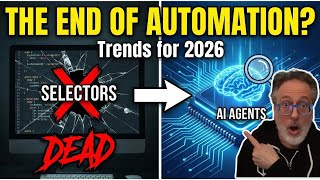
Joe Colantonio (Test Guild) presents the top 8 automation testing trends for 2026, based on surveys (Automation Guild 2026), 510 webinar questions, over 40 webinars, and 50+ expert interviews. Key trends: integration crisis (tool sprawl, hybrid legacy/modern stacks), large AI skill gap among experienced testers, risks of "vibe coding" vs "vibe testing," demand for practical examples ('show me' era), looming compliance (EU Accessibility Act effective June 2025), importance of humans in the loop, requirements as a critical bottleneck, and rising use of agentic AI. Conference CTA for Automation Guild Feb 9–13, 2026 is included.
Questions this video answers
72.8%
510
Over 40 webinars
50+ experts
62.6%
Chapters
Hey, did you know that 72.8% of testers say AI testing is their top priority for 2026? But the number one question they ask behind closed doors is is AI actually making testing better or worse? That disconnect is about to reshape your career. Today I'm going to show you what thousands of testers and 50 plus industry experts on my podcast are really telling me about 2026 and why most teams are walking straight into an AI trap. Hey, I'm Joe from the Test Guild. Over the last year, I've run surveys from our community, collected 510 real questions from our live webinars, over 40 webinars, and interviewed 50 plus of the world's top test automation experts. So what you're about to hear is not hype. It's not vendor slides. It's what working testers are scared of, confused about, and quietly asking when no one from their company is listening. All right, here's the bombshell it in our Automation Guild 2026 survey, 72.8% picked AI powered testing as their top priority and 62.6% have more than 10 years of experience. But when you let them ask anonymously, the number one most upvoted question from all our webinars was does AI generated code actually reduce the need for testing, or does it just demand more? And that's the paradox. Everyone is being told AI is the future, but no one is really sure if it's actually helping or quietly making things even worse. In my interview with Michael Bolton, he really nailed it when he told me we're trusting green builds without understanding what's really being tested. That's the secret life of automation. And the phrase lack of a correct path showed up over and over again in our responses. Not lack of tools, not lack of AI, but lack of guidance. So all this leads to trend one that I'm seeing, and that is the integration crisis. Let me tell you something most AI vendors won't the biggest problem in 2026 is not AI. It's this. You have too many tools that don't talk to each other in our webinar Question and answers, Data integration and migration was the second most asked topic, and one tester really summed it up perfectly when he said, I don't have people to help fix issues and implement changes for new projects. That's the real blocker, and AI isn't going to save you. You're moving from selenium to playwright, From Jenkins to GitHub, from scripts to AI while still supporting everything you already have. And Jason Huggins, the original creator of Selenium Napium, you'll hear more about him later in our bonus section. Said it best. Enterprises now live in a hybrid world, legacy frameworks plus modern tools. And that complexity is exploding. You don't need more tools, you need fewer, better connected ones. Right? Trend number two is the AI skill gap is huge. Here's the career opportunity hiding in plain sight in our community, only 10% feel confident with AI testing, 34% are complete beginners, and yet most have 10 years of experience. That means to me, the people who understand testing best feel the least prepared for AI. And Dan Belcher, who's one of the co founders of Mable, explained why. You don't assert AI output, you evaluate it and that is a completely different job than what you're probably accustomed to. This creates a brand new role. Things like AI auditor. I've been hearing more about quality architect, context expert, and a lot of these roles are probably going to pay more because companies don't trust AI by itself. So this is not the death of testing. Testing is still going to be needed. And so you may have different roles available, but testing still will be fundamental to all of them. All right, trend three is vibe testing versus Vibe coding. So once again, in my interview with Jason Huggins, he mentioned vibe testing, which he explains his AI exploring software like a human. But Sarit Taggar, who I interviewed on my DevOps podcast, who's a VP at Palo Alto Networks, she dropped this warning. Vibe coding is shipping vulnerabilities at scale. Developers are shipping AI code that they don't understand. So your job in 2026 becomes let AI explore, let AI suggests. But humans decide what ships. That's job security if you lean into it. Trend four is the show me era. 20% of the top questions in our Test Guild webinar said can you show me an example? People are done with AI theory. Debbie o' Brien showed me MCP agents, AI navigating sites, understanding context, writing tests without selectors. We also saw Ben Fellow showing us similar things as well. And this isn't PowerPoint, this isn't software development lifecycle. It's all about how the community wants to see not necessarily learn about another tool, but learn some implementation techniques that they can use in their day to day work using real examples. And that's what you get every year. At Automation Guild we have a bunch of awesome examples using AI correctly from day to day automation experts from what works and what doesn't work from top automation experts at their company. You definitely want to check it out@automationguild.com where you can find it using the link down below. Trend number 5 Compliance is coming for you. Most teams aren't ready for this one. The European Accessibility act went into effect on June 2025. If your product is sold in the EU, accessibility is now law and as I've seen with other countries, as they start passing laws, they start trickling down as well to the us. So this means accessibility checks need to be in your CI audit trails for AI decisions, security validations for AI generated code. This isn't going to be a nice to have. This is a don't get sued type of problem that you're going to want to be leading your teams in 2026. For trend 6 humans matter more than ever. I know you've been hearing this over and over again, humans in the loop, but 67% of testers told us over 2025 that I trust AI only and only if a human reviews it. That's not resistance, that's realism. And once again, Michael Bolton said it best. AI doesn't think, humans repair its thinking and that's your new value. Trend number seven is requirements are the real gold mine. 75% of testers said that the biggest bottleneck isn't testing, it's actually bad requirements. This has always been the case, even when I started almost over 30 years ago. AI though, is finally good at finding ambiguity that we usually missed back in the day. It's pretty good at generating test cases, spotting risk before code is written. So this really is what I'm seeing as shift left on steroids. AI can be used for certain things. Once again, you can't take it at face value, let it do some of these activities and then you as a human judge it. But I really think it's an overlooked area where you can use AI to make your requirements even better. Therefore, if your requirements are better, everything that it's built off of is going to be better downstream as well. Trend number eight Agentic AI is already here. We're going to see more of it in 2026. I've seen this from a bunch of different people on my podcast. Debbie o' Brien Once again, Dan Belcher A bunch of other people as well have shown the same thing. AI isn't just writing tests. I've actually seen examples and talked to testers who use it to watch production, spot risk and create coverage automatically. And that changes what QA means, I think. So something to keep aware of that you can use AI for these Other activities as well. And my wild card for 2026, Jason Huggins is about to break everything again. So Selenium, Appium, and now Vobium, his message selectors are dead agents of the future. So Playwright is definitely the dominant tool in 2026 for sure. But I'm starting to see a few cracks. As you know, back in the day when I started Microsoft was the evil empire. They own Microsoft, it is open source. However, they have paid plans as well to help scale it up in the cloud, which I heard are going up. They've gone through some layoffs once again, Debbie o', Brien, who's been a big advocate and the kind of evangelist for Playwright, was laid off as well. So that gives me kind of the. I don't know where Microsoft's priorities are. So that's why I think if you're betting on a tool to overtake it in 2026, maybe too early or 2027, definitely volume something to look at. And once again, really excited to have Jason Huggins join us Automation Guild to give us the latest and greatest on vobum. And if you haven't already, I highly recommend you register for our 10th annual Online Automation Guild conference, happening February 9th to the 13th. We're actually going to have a lot of the speakers that I talked about here. Jason Huggins will be there talking about vibum, so you don't want to miss it. So whether VIBUM wins or not, the direction is clear. Tool agnostic testing is the only safe bet. And we have a bunch of general strategies you can apply regardless of tooling that you are using at Automation Guild 2026. So what does this mean for you based on all the data I gathered from 2025? Well, in 2026 you are not replaced. You are promoted from basically script writer to an AI auditor, bug finder to a risk architect, automation engineer to a quality strategist. And the team that wins, they integrate first, then innovate. And once again, that's why we built Automation Guild 2026. It's hands on automation engineers showing you what works and what doesn't work. It teach you a strategy, a mindset, a technique, a tool to help you succeed in the new year. You don't want to miss it. If you want to actually see what automation awes looks like in practice in 2026. I'll drop a link for Automation Guild down below. Hope to see you there. All right, so sum it all up. AI didn't or isn't going to kill testing. It made bad testing visible and that's your advantage. I'm Joe, I'll see you in the guild and as always, test everything and keep the good. Cheers. Thanks again for your automation awesomeness. The links to everything of value we covered in this episode head on over to test guild.com forward/a574 and if the show has helped you in any way, why not rate it and review it in itunes? Reviews really help in the rankings of the show and I read each and every one of them. So that's it for this episode of the Test Guild Automation Podcast. I'm Joe and my mission is to help you succeed with creating end to end full stack automation awesomeness. As always, test everything and keep the good. Cheers. Hey, thank you for tuning in. It's incredible to connect with close to 400,000 followers across all our platforms and over 40,000 email subscribers who are at the forefront of automation testing and DevOps. If you haven't yet, join our vibrant community@testguild.com where you become part of our elite circle driving innovation in software testing and automation. And if you're a tool provider or have a service looking to empower our guild with solutions that elevate skills and tackle real world challenges, we're excited to collaborate. Visit testguild.info to explore how we can create transformative experiences together. Let's push the boundaries of what we can achieve. With hoots and lyres, the bards began their song A tune of knowledge, a melody of code through the air it's spread like wildfire through the land Guiding tester showing the secrets to behold.







