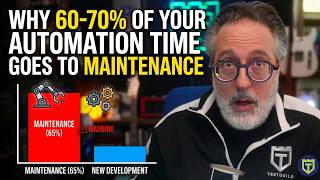
Joe Colantonio explains why test automation fails at scale: teams spend 60-70% of effort on maintenance because traditional tools can't handle complex workflows spanning legacy UIs, APIs, and services. ZapTest replaces brittle scripts with AI-driven intent that continuously executes, monitors, and records evidence across entire business processes.
Chapters
Hey testers, automation engineers, and tech leaders. Joe Colantonio here. Today I want to talk to you about something that's really changing how forward-looking enterprises approach automation and why a lot of current strategies are starting to hit a wall. For years and years and years, automation has been treated like a tooling problem. Pick a framework, write scripts, maintain them, fix them when they break. And we've heard this loud and clear at our latest Automation Guild online event this year. In fact, John Robinson, one of our speakers, dropped a stat that most teams are burning 60 to 70% of the automation time just on maintenance. That's massive. And I've seen it all. We've evolved from recording playback to code-based frameworks to CI/CD pipelines. And yet most organizations still struggle with the same issue. Execution is fragile. The core challenge? From what I've learned from working at large companies in insurance and healthcare, it's that real enterprise workflows don't live in one system. They span legacy UIs, modern web apps, APIs, background services, and often human in the loop. Many of our speakers noted that the biggest blind spots are usually in the app itself, but in the integration points between, say, 50 different systems. And the reality is most automation tools were never designed for this. They automate just pieces. They don't validate execution end to end, and that's a huge gap. When something changes, teams fall back on manual checks, screenshots, and long nights. Bob Fornell, one of our speakers, showed a horror story about a deployment that took 7 hours to roll back because they couldn't trust the scope of the failure across multiple sites. And I think that's not really a scripting problem, that's a platform problem. And that's where a tool like ZapTest comes in. ZapTest isn't just a test automation tool and it's not just RPA. ZapTest is an AI-first operational workflows platform across UI, APIs, legacy systems, and humans, starting with the workflows that are hardest to automate. So how does it work? Well, instead of relying on brittle scripts, it uses what we call human-defined intent. And this actually aligns perfectly with, once again, one of our speakers, Chris Tripper, discussed regarding intent-based testing. We're moving away from fragile locators and focusing on the business objective. And that's the way testing should have always been when it came to automation. And that's why ZapTest embraces this approach with AI structure and optimized execution. ZapTest runs workflows continuously, monitoring, validating, retrying, and reporting. Every run produces evidence. What executed? What changed? What passed? What failed? And why? And that solves the trust crisis many speakers warned us about at Automation Guild, where we need determinism and evidence, not just a thumbs up from a human. From an AI, and that's valuable not just for QA, but DevOps, compliance, operations, and leadership. And this really matters because with ZapTests, QA teams stop being script maintainers. Instead, they become execution owners. The same platform that validates releases could automate business operations, data flows, compliance checks, or mission-critical processes. In fact, Federico Toledo, another one of our speakers, said, we need to stop selling testing and start selling business outcomes. And this platform allows you to do exactly that. One platform, one operating model, built AI-first, not retrofitting. And it works where many tools can't, on-prem, restricted, and regulated environments with the governance built right in. So you might be asking, sounds cool, how do I start? Well, ZapTest engagements start with a structured proof of concept, a real workflow, clear success criteria, executive-level reporting, and they don't just claim execution works, they prove it. So if your automation works until things get complex, it may be time to think beyond tools. Checking out a tool like ZapTest is all about standardizing your execution. With AI, but with governance and more importantly, with evidence. So definitely check it out yourself using the link down below. Let me know what you think. And as always, test everything and keep the good. Cheers.