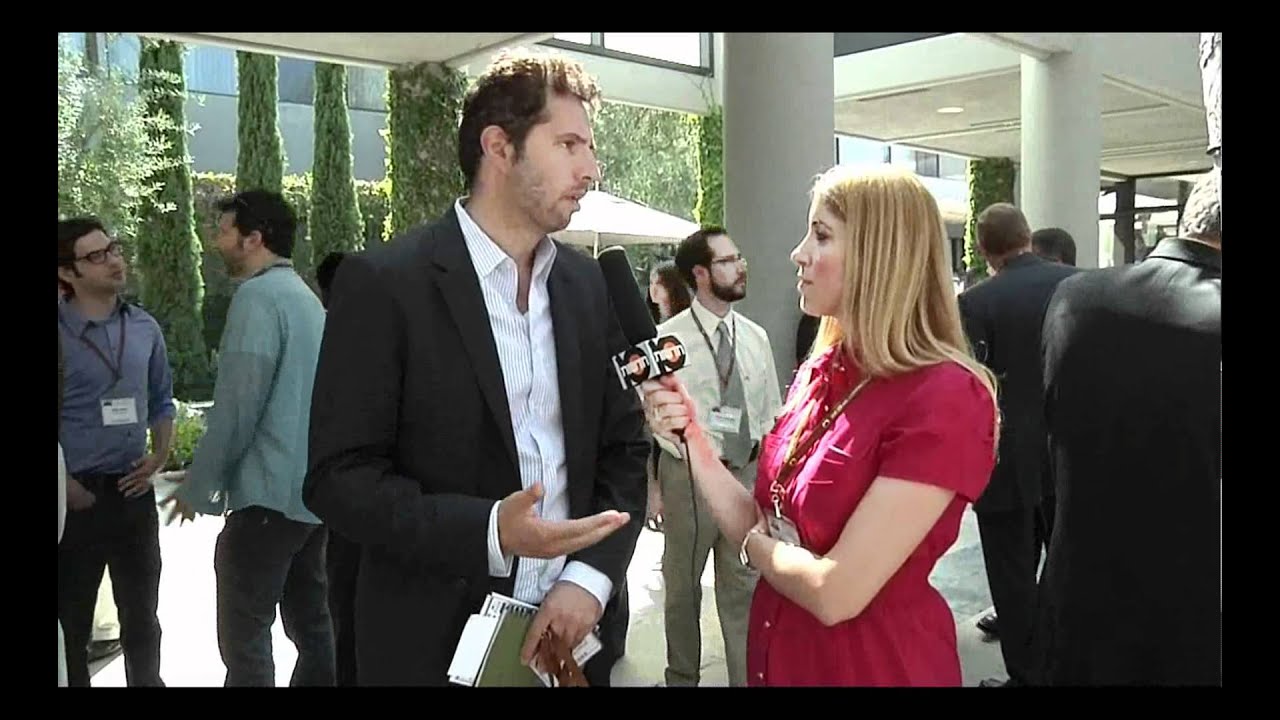
DLD11 - Hollywood Meets Silicon Valley (Guy Oseary)

Guy Oseary, who manages Madonna, co-founded A-Grade, a venture fund that brings celebrities into tech startups. He invested in Foursquare, GroupMe, and TinyChat, betting that live video chat is the next way artists connect with fans. The music industry is shifting from album sales to touring and streaming services like Spotify.
Chapters
Okay, Hollywood meets Silicon Valley, that's the theme. I mean, I'm not from Silicon Valley, but Guy is from Hollywood. But I've lived in Silicon Valley, so I can kind of understand. So Guy, I mean, reading your bio makes it kind of a challenge to introduce you. You do a lot of things, from promoting talent to selling cocoa water or—
Coconut water.
Coconut water. So tell me, what's— What's your job description? What do you do?
Well, I initially started out— I've been working with Madonna now 20 years, and I initially started out as a scout for the record label and then ended up becoming a partner in the record label, then ended up selling the record label and became a full-time manager to Madonna. I currently have a partnership in one of the top actor management companies in the world. And working on developing a lot of different brands. So my core business today is sort of what I did when I was a kid. I would go out every night, and I would look for bands, and I would listen to demos, and I would read up on new artists. And today, instead of looking for bands and being up at night, I'm up really early, and I'm looking for brands. And so I'm looking for new ideas, innovative ideas. It could be offline, online, and, you know, in finding things that I can— just like when I seeked out talent 20 years ago, I'm seeking out talent in new startups today.
So one of your latest ideas, if I get this right, is trying to connect Hollywood and Silicon Valley.
Yes.
And before I ask you how you want to do that, just tell me, I mean, having lived in the Valley for, I think, 8 years, And having been to Hollywood a few times, I mean, there's almost kind of a clash of civilizations going on. I mean, why, why this gap between those 2 places which are geographically not that far apart?
Well, putting aside the Silicon Valley meets entertainment with big deals, if you're talking about big content deals, that's not really what I'm focused on. I think, to me, the big issue that I'm focused on is these startups and the difference in culture between Silicon Valley and the world of entertainment. There's a lot of practical issues. In Hollywood, I remember since I was 17, 18, I would always hear, never put up your own money. It's something that they put into your brain. Never put up your own money. And top talent— rarely— it does happen, but rarely is paying for their own albums. They're rarely putting money into their own films. And in Silicon Valley, there's— I think that startups could really benefit from having entertainment helping them spread the message. But yet there's no connectivity there because startups are not making sponsorship deals, which is all that my world understands, these traditional sponsorship deals. So these startups are looking for— when they're doing angel investing, I believe that a lot of these startups could really use the push. If a startup knows who their audience is, and if a If they're going into the teen market and they know that a Justin Bieber would give them a leg up, maybe having him invest as one of the angels. There's 20 angels sometimes in a round. Why not have a really great talent or even a brand come into that round as an investor? So the disconnect is that Hollywood doesn't invest really talent. They're not used to it. And that Silicon Valley doesn't know how to connect to that. At the same time, I've met a lot of VCs who really don't understand the importance of that. They sometimes really discredit it. They just— they sum it up as celebrities, you know, they change their minds.
But don't you have to first overcome kind of this cultural gap? I mean, Silicon Valley is all about taking risks, and Hollywood is all about avoiding risks. So why should I, as a Justin Bieber or whoever, take the risk in investing in a startup, and we know what kind of the survival rate of startups is? I mean, I don't want to be linked to failure in a way.
That's true. So, well, there's so many layers of problems. I'm trying to figure out the solution, but that's one of the issues. A lot of— I always hear about— I share a lot of information with a lot of other talent and managers and And people will fly out to Silicon Valley for one day out of the year, and they'll think, okay, I had these 5 meetings, now I'm going to do something. Well, it doesn't work that way. You've got to go there a lot, and you have to maintain relationships, just like everyone in this room has been coming here for years, and they make friends, and they know who's right for what deal. And so, basically, you know, I found myself in this position because I go through both worlds to try to connect the dots for both people. and give the artist, the talent, security with the investment, and then give Silicon Valley the security that I know that this is the right kind of partnership.
Okay. So you've launched a fund, I think, A Grade. So tell me where the money is coming from. What's kind of the investment?
So Ashton Kutcher, who is a client at the company but also one of my dearest friends, he was out there doing a lot of his own investing, and I was doing a lot of my own investing, and Ashton and I decided one day, although we had loved the competitive spirit of what I was working on against what he was working on, we decided that it'd be much better if we pooled our efforts, because we were really the only 2 people doing this in our world. And, you know, there's people who come in and they jump in and out of it, But we are really living it. So Ashton and I pooled our efforts, and a gentleman by the name of Ron Burkle has supported us. So we raised a fund, and we've now invested into some of the companies that are here today.
Can you give names?
Some of the companies that Ashton has brought in is Foursquare, Daily Booth. There's UberMedia here with Bill Gross. We're, you know, I'm right now focused on— we did GroupMe. I'm focused on a company right now called TinyChat. I'm obsessed with the concept of FaceTime, and I think that talent can really get behind FaceTime and really propel the concept of— when I was working at a record label, or even today, for an artist to send out a tweet is really somewhat one-dimensional. Or there's a thing called Ustream, which I feel is one-dimensional. Someone is playing live, and you could see it. But to have face time, to be able to chat with your favorite artist, and be in a room with other people who love that artist, and share with him or them, is really, to me, an exciting new venture. So TinyChat, we had 7.5 million unique visitors last month, all kids. And a lot of people are getting behind it. Lady Gaga just embedded TinyChat on her website 2 days ago. So I think that artists are going to start understanding that you can actually speak to— you know, we were talking about the connectivity yesterday. Paolo was talking about, as a writer, being able to now send a tweet and have people immediately respond. Here he can go on and have the Paolo TinyChat and actually have the room full of his fans and see them, actually see them. To me, that is the next level of where things are going.
But have you actually convinced And Justin Bieber or somebody else kind of to invest in your fund or to invest in a startup in Silicon Valley?
We have talent in a lot of the things that we're doing. I don't think that on some of the cases, there's no need to promote that. They're investors. There are some things I've done that are promoted, like the coconut water thing that I did where we promoted the names of the people who invested. But there's times where there's, you know, you don't have to— you can invest and not have to put your name out there, but you can support the project. So I have people in many of the things that we've done that you'd know as names, but there's no need to promote that out there.
Okay, the other thing I wanted to talk to you about is the music industry. I mean, you've run a record label, you've promoted talent, and of course the music industry is heavily disrupted. I mean, what's your vision? How are we going to— where's the money coming from? I mean, CD sales are still going down, digital sales are The growth is slowing. The concert business doesn't do that well.
I think the concert business has done very well for us, but I— a few things. Firstly, today, currently, the number 1 album in the US is a group called Cake, and they sold 44,000 albums. It's the number 1 album today. That's how bad things are. It used to be that people would tour to promote their albums. And today, people make albums to promote their tours. So there's a whole change and the pendulum has swung. And if you don't tour, then you're not really going to have a successful business. You must be able to tour today.
So it seems to me— I mean, I think we've done a piece on the rock concert business in last week's issue. It seems to me it's not doing that well. I mean, it's perhaps doing for Madonna or the big gigs, but it's— I mean, the idea, let's use music as a loss leader, kind of, we're not making a lot of money with it and making money on the live stuff, doesn't seem to be playing out.
I think there's competitive pricing, but overall I think people are doing very well with touring. You know, it depends how big you play, depends how much you spend, right? So it's all relative, but I think the concert business is— the sky's not falling. It's alive and well.
The other thing, of course, working or being a partner in a talent agency, how do you see talent coming up these days? I mean, where do you look to find new talent?
Again, I'm spending more of my time looking for startups, looking for brands to help build. Talent rises. Talent rises to the top. You can't escape it. It walks in a room, and you know it right away. I'm sure for a lot of the companies here, they see an engineer, and they go, That guy's got it. So you— it finds you. And I think today I'm discovering a lot of music through the Spotifys or the RapCities subscription-based models that allow me to just keep listening to music and without having to go back and take a CD and look for things. It's just a much quicker way to find other like artists and learn a lot. So I'm finding a lot of things through that process.
You mentioned Spotify, I mean, which is pretty popular in Europe and perhaps soon in the US. I mean, there is— I think I've read somewhere 400 of these type of services now kind of experimenting how to sell music, how to make money with music. Is there any model you think is the model, or is that not yet decided?
I love— I like, you know, Shock and Daniel Ek from Spotify, very smart guys. I The subscription model is the way it's going to go. You can spend $10 a month and have all the music you want, or you can spend $10 on one CD. I think it's pretty obvious where things are headed. There's the disconnect again. You've got the record companies who all have their own agendas, and if they could all get together with some antitrust lawyers and really make some decisions as a team, instead of everyone picking, I'm going to support this one and I'm going to support that one. And it's so— no one wants that. No music buyer wants only Warner Music or only Sony Music or only Universal Music. They want all of it. So it really benefits the labels to sit with some antitrust lawyers and speak to each other and come up with a conclusion. It's a nightmare for any of the companies in here who are looking to do content deals. If someone comes to me tomorrow and says, I'm looking to do a content deal. I just— I don't kick them out, but I walk them out. It's just not possible. It's too complicated. It takes too long.
So you want to kind of create a cartel of record labels?
A what?
A cartel.
Well, I think that they should— like a board. I think they should have a board, and I think, you know, at the top of the board would be, you know, Lucian, who runs Universal Music, and and Jimmy Iovine, who is so well respected by artists and also by his own peers, and let them maybe be at the top of the board, but have a board with lawyers and make sure that they're finally connecting the dots in a way that is beneficial to everybody.
Thank you. So we have a couple of minutes left for questions. Are there any? Back there.
I'm always wondering why actually Hollywood and specifically broadcasting units are not really using the internet's potential for cost reductions on piloting content. Many people know that actually the production costs are not that high. It's actually the marketing costs and actually filling a slot that actually eats up a lot of the money. But we see actually very little of piloting going on on Hulu or actually using behavioral targeting to identify a group of people that a show is intended to actually be targeted on and just sampling that and asking for feedback and using sort of the feedback loop to actually avoid the excessive production costs down the road. Do you see anything, you know, with the studios that is happening, or is it— something that is still out of the realm?
Well, I think you're mentioning Google. I mean, Google is a platform. YouTube is a pipe. And so they're not in the content-making business. They're in the allowing you to reach the marketplace. You're the content maker. We're the pipe. The studios are all, again, like the music business, and they're making their own decisions. Everyone, again, not together as a team. They're deciding to either give their projects to Netflix or to Hulu or to whoever. And so again, I believe that from a film and a TV, and people are going to want to have everything. They're not going to want to have just their one channel here and their one channel there. So it's a real opportunity. for new voices to be heard, new channels to be made. And I think that while the big boys are figuring it out, a lot of new voices are coming up and being heard.
Thank you. Any more questions? I don't see any, so we're out of time. Thanks a lot, guys. Thanks, and please come back.
Thank you very much.
Thank you.
More from Guy


The Legendary Hollywood Power Broker — Guy Oseary on 36 Years of Managing Madonna, 26 IPOs, and More