In this video, the presenter shares his two‑decade experience with flex‑shaft handpieces for jewelry making, walking beginners through the four handpieces he currently owns and explaining how he chose each. He begins with the Fordham Slimline – a lightweight, reliable, pen‑grip handpiece he bought 15 years ago, describing its collet‑and‑wrench operation and why its low weight mattered to him. He then introduces a Fordham quick‑change handpiece, detailing its lever‑based collet that can be swapped in under three seconds, and quantifies the time saved (≈10 minutes per day, over 52 hours per year). Next, he reviews a Boken quick‑change handpiece (gold) that uses a different internal shaft geometry, requiring a bar‑shaped flex‑shaft alignment, and notes its use for stone‑setting. He also shows a duplicate Boken handpiece (silver) acquired after the original’s collet failed, explaining the redundancy and his preference for the silver version. Throughout, he demonstrates installation onto the flex shaft, compares weight, reliability, and ergonomics, and concludes that if he could pick only one handpiece he would choose the Fordham quick‑change for its speed and decade‑long durability. The video serves as a practical buyer’s guide, combining hands‑on demos, personal anecdotes, and a simple cost‑benefit analysis.
Chapters
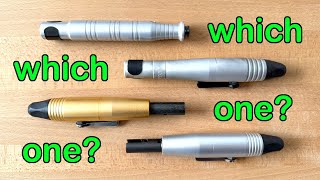
I didn't own a flex shaft handpiece when I first learned jewelry making over 2 decades ago. Actually, I don't remember which one I was provided at school. What I remember is when I needed one at my studio, I didn't know which one to choose. So when my budget was tight, it took me months to decide which one I was paying my hard-earned cash to get. If you are at the point of looking for your first flex shaft handpiece, let me show you the 4 handpieces that I own and how I make my purchase decision. As I only use 2 of them these days, I will also tell you why. And of course, I will show you how to install each of them. From left to right, this shows the order in which I bought them. The first one is the Fordham Slimline handpiece. This is the first handpiece I have ever owned myself. After comparing all the available handpieces in the market, I chose this one for two simple reasons. This is a reliable brand. I want good quality tools. I bought this one over 15 years ago, and it is still working as well as the first day it came out of its packing box. I have never done anything to maintain it. Second, among all the handpieces of this brand, this was the lightest and shortest at the time. It weighs less than 3 ounces. I consider myself not physically strong, so I worried that if it was too heavy, I would strain my arm. I didn't want to make my job unnecessarily harder than it needed to be. To open the collet, I have to rotate the internal shaft to align the two holes. Put the pin through the hole here and twist the chuck wrench anti-clockwise. Now a drill can go in. To lock the collet, twist the chuck wrench clockwise. Once the drill bit is locked in, remove the pin. So when I press my foot pedal, the drill will rotate. What I really like about this handpiece is that it has a tapered finger grip section here. This enables me to hold it like a pen. My hand is quite small, but it's very comfortable to hold. The matte finish on the surface allows me to have a very firm grip. When using different accessories. This is the second one I bought. It's a quick-change handpiece. About 10 years ago, this version caught my attention. To open the collet, all I need to do is to push the quick-release lever to one side. When this is done, the collet extends and opens up a little bit. Once the accessory is in, just flip back the handle and the collet retracts and locks tight onto it. Basically, to close it, simply push the lever back. This entire process literally takes less than 3 seconds. For the slimline handpiece, changing an accessory is a time-consuming and clunky process. It takes me almost a minute altogether to change from one accessory to another. So I thought, if I change 10 drill bits a day, using the quick-change handpiece could save me about 10 minutes a day. I work 6 to 7 days a week. That would save me an hour a week. Add this up to a year, it means 52 solid hours spent changing accessories. For this reason, I was sold on the quick-change handpiece. That's why I shifted to this design with no hesitation. This model weighs about 1 ounce more than the slimline handpiece, which is about 32 grams. Now looking back, I think I was overthinking the weight difference between these two models. It was really not that much. As I was happy with my first handpiece from Fordham, my second one is also from the same brand. If you look into the back of both handpieces, you can see the section of the internal shaft looks like a letter C. There's a gap in the tube into which the flex shaft clicks. To install these two handpieces onto the flex shaft, I align the key tip in the cable with the one inside of the handpiece and push it in. When I hear the crispy clicking sound, I know my handpiece is is connected properly. The third one I own is this golden one from Boken, a Turkish brand. As I was sold on the notion that the quick-change handpiece would save me lots of time, the third one I have is also a quick-change handpiece. I got it when I was in Antwerp. The difference between this one and the previous one is that they connect to a different style of flex shaft. If you look into this end of the handpiece, the section inside looks very different. The gap in the internal shaft goes right through the tube, bisecting it. So to install this onto the flex shaft, I first need to align the bar-shaped cross-section of the flex shaft to fit into the gap in the internal shaft of the handpiece. This then allows this external catch to click into place. To align them, it might take a few attempts, but once the handpiece is installed, as long as you don't need to change the handpiece, you can just leave it attached. The reason I bought this one was I was in Antwerp at the time, and so I was supporting a European brand. I got it along with the matching flex shaft. Also, as I have two benches, I am using the foldem handpiece for jewelry making, and the boken one for stone setting. The last one I have here is actually exactly exactly the same as the golden one. Same brand, same structure, and same style. The only difference is the color. The reason why I got the second version of the same handpiece is that one day, the collet on this golden one wouldn't open anymore. I disassembled it completely and still couldn't get it back to work again. After trying to fix it for an afternoon, I decided to get a replacement. But guess what? One week after the new one arrived, the golden one started working perfectly again for no apparent reason. Both of the broken handpieces have been working perfectly well since that single incident. That's why I ended up with two of the same design. Because I like the silver one slightly more than the golden version, I've put the golden one aside as a spare, just in case for a rainy day. That's why I use my two quick-change handpieces daily, and I'm retiring the Slimline handpiece and this golden one as well. If I have to choose from the very beginning again, and if I was only allowed to have one handpiece, I will get the Fordham quick-change handpiece because it simply saves time and it has never failed on me for over 10 years. Hopefully this helps you to choose your handpiece, and I will see you in the next video.