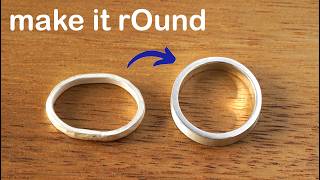
A UK jeweler with 20 years of experience shows four ways to reshape a ring into a perfect circle: rolling it on a mandrel, hammering with a mallet, using a doming punch, or a professional ring stretcher. Each method works best for different ring thicknesses and designs.
Chapters
Getting a ring perfectly round isn't as easy as it looks. In this video, I am going to show you a few simple and reliable ways to shape your ring into a smooth and even circle, comparing tools, approaches, and the advantages of each. By the end of this video, You will understand not only how to make a ring run, but the pros and cons of each method. Hi, I'm a jeweler, optical diamond setter, and a GIA graduate gemmologist based in the UK. I've been making jewelry using real gemstones and precious metal since 2003. It has taken me over 20 years to get to this point. In my channel, I help jewelry enthusiasts to start their jewelry making and hand engraving projects with very limited space at home.
The first method, you will need a ring mandrel and a steel block. Here I use my 4 inches by 4 inches bench block. I think this is the most cost-effective one. Now you have your ring soldered and you want to make it round. What you need to do is to put it on the ring mandrel and roll it just like how you would roll out dough. Gradually, you can see the ring is turning rounder. Roll it hard. Here I'm putting my body weight onto the mandrel. This ring is made of a 20-gauge wire. That's about 0.9mm. One of the downsides of this is it will only work if your ring is made of a very thin wire like this. Also, if your ring has some texture on the surface, Rolling it like this will smooth out a lot of the details, and you will have very little control of the ring size. If you don't have a steel block, any smooth hard tabletop will work just fine, but bear in mind that rolling the ring on the surface might destroy it. After about 2 minutes of rolling, My ring is finally round. With the second method, you will need a steel ring mandrel and a mallet. This method works in most circumstances. The one I use here is a rawhide mallet. You can use a rubber one or a nylon mallet. I have the link in the description below if you are interested. Then what you do next is to put the ring on the mandrel and simply hit the ring a few times. Turn and repeat until the ring is perfectly round. Because this is not a metal hammer, you can actually hit the ring pretty hard without leaving a mark on the surface. This method works for most thicknesses and widths. When you find the ring has become harder to shape, you can heat it up again to make it softer. Using this method might change the size of the ring slightly, but it won't be too much. There are two types of rings with which you can't use this method. One is if the ring has gemstones all around. Hitting the gemstones will risk cracking or even breaking it completely. Second, when the ring is not round, or if the setting of your ring has a flat back like this pink sapphire ring. You will need a steel mandrel with a groove like this one. It allows you to hit the round section of the ring without changing the profile. The rest is the same. By the way, if you use this method, make sure to wear an air defender to protect yourself. I try to use the most heavy-duty one I can find. The link for the one I use is in the description below if you are interested.
If you like this video, please click the like button. This is totally free for you and will encourage me to make more videos like this to share with you. Subscribing will be even better if you haven't.
The third method is using a doming punch set. And a hammer. It can be any type of hammer. The one I use is a random one for my household DIY jobs. Here's my not-so-round ring. I normally put it in the biggest hole of this block. Choose a punch that can sit on top of the ring. Lightly tap the other end of the punch. Make sure to keep flipping the ring to make the shape even. Because the bottom of the punch will sink into the ring, you need to make sure the punch is not touching the bottom of the hole in the block. This method works with any ring thicker than 2mm. The problem with this method is if you are not careful, you will make the edge that is touching the punch bigger and reduce the size on the edge that is touching the block. Or in other cases, you could make both edges of the ring bigger than the middle. So you need to be quite careful. But if you happen to only need to run a ring occasionally and you have this punch set to hand, It's quite a useful way. This is how my ring looks right after it's soldered. It's no way close to round. Here's a ring stretcher. This is what the professionals use. All I need to do is simply put the ring on the stretcher. And push the handle downwards. It's almost effortless, but because the mandrel on the stretcher is tapered, when doing this, I must keep flipping the ring to make it evenly stretched. This is especially important if the ring is wider than 1mm. I use my right hand to push the handle and my left hand to feel how much it has been stretched. I try to do this little by little. Doing it too aggressively will risk breaking the ring. A very important thing when doing this is you will need to make sure the ring is well soldered. If the solder is weak, stretching it like this will break open the joint. When using this method, you will have to keep checking the ring size because stretching it in this way can make it bigger with almost no effort. However, making it smaller will take much more work in this case, and you will certainly want to avoid it. With this stretcher, you can easily run almost any thickness of ring in any material. For a ring with a gemstone like this one, this method works as well, but I will try to not enlarge the ring in this case because it could weaken the joint between the setting and the ring. The other downside of this method is the ring stretcher normally costs more than $100. If you only need to run a ring once or twice, this could be quite expensive. A lot of the time, the ring stretcher comes with a ring reducer on the bottom. Basically, it's a round disc with different sizes of tapered holes in it. The size of the opening is bigger than the bottom. When working with the reducer, you choose a hole to put the ring in, so the top of the ring is slightly above the surface of the disc. Rotate the disc so the ring is under the punch. Instead of pushing the handle downwards, I push the handle towards myself. Same as when using the stretcher, I need to keep flipping the ring to avoid tapering it. Using this method can run a very thick ring. Sometimes if the ring is too thin or the size of these holes are just not right, I have to place a titanium ring on top to push it down. Why titanium? Because it's much harder than any of the precious metals I work with. The downside of this is that you could easily reduce the size of the ring. If your ring is quite wide, you might find a dome on the surface of your ring. Sometimes I find my ring accidentally reduces too much in size size, and I will then have to move it to the stretcher side to make it bigger again. With all these methods, you could combine them to get the best result you want for each ring.
Now you know a few ways to make your ring perfectly round. If you like this video, you might also want to check out this one. It shows a simple way to do sand casting. I will see you in the next video.