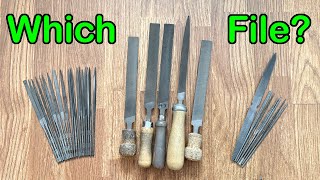
A jeweler walks through the four types of files he actually uses: standard metalworking files, Swiss needle files, diamond-coated files, and wax files. He covers what each one does, how long they last, and what they cost, plus a tip on cleaning them with a brush pen.
Chapters
Over 2 decades ago, when I was looking at the jewelry making catalog or browsing online, there were so many files to choose from. I found them looking more or less the same. Obviously, I couldn't afford to purchase all of them in one go, but I didn't know which one to start with. This video is made for me as I was then. Back in 2003 when I was a total beginner. If you are having the same problem as I was back in those days, this video shows the 4 types of files I have owned, what they are, how to set them up, the price ranges, maintenance, and how long they last. The first type of file I use these days are these standard size metalworking files. They look like this in the shop. The cutting teeth are at one end of the file. The other end is tapered. They are available in many shapes, but I only use two types of them. The first type is like this. It has a rectangular section. If you turn it around, it has cutting teeth covering 3 surfaces. The other 2 are smooth. The other shape I have is this tapered D-shaped file. It has one flat surface and a curved surface. Both sides have cutting teeth facing in one direction. I use the curved surface to file the inner wall of rings and use the flat surface for everything else. These are available in 6 grades, from very coarse to very fine. They range from 00 to 600. To number 4. So double zero is very coarse, and number 4 is very fine. In my situation, I only use gray double zero to take off surfaces in a coarse and aggressive way. None of these files come with a handle. After buying them from a shop, I have to put handles on the end I have a video showing how I install these handles. The link for that video is in the description below, so I'm not going to repeat all that again here. If you have a normal size hand, you will find these wooden file handles very useful. They are very affordable as well, only $10 for a pack of 4. I have the link in the description below as well. But if you have a small hand like me, I found these recycled champagne bottle corks are the perfect size. I got mine from sparkling apple juice bottles. If your beverage doesn't come with a cork like this, you can get 50 of these for only $12. These handles are not reusable. They are stuck onto the end of the handle forever. If you want the best quality files, get the Swiss-made ones. The tool itself is a piece of art as well. These tools were bought in December 2021. I'm due to get myself some new ones anytime now. How long each file lasts depends on how often you use it. I use this on a daily basis. It took me 3 to 4 years to wear them out. So if you use them less often, they can last for a very long time. Or you can look at it this way. My very coarse file just turned to be very fine. That's why I still have them here for when I need a very fine cut file. For this reason, I think these files last forever. These files are less than $50 each. I have the links in the description below as always. To remove the metal debris from the teeth, I use a small brush pen like this. Go in the same direction as the lines on the surface of the file. The brass bristle is extendable. Simply twist the back knob at the other end of the brush. More bristles come out. This brush lasts forever. I got mine over 10 years ago, and there is still this much left. The second type of files I use are these Swiss-made needle files. These are more or less the same as the one I just showed you, but smaller. They are graded the same as the bigger version. 00 is for very coarse, and number 4 is very fine, but the cutting teeth on the 00 needle files is much smaller than those on the big files. Personally, I prefer my files to cut fast. That's why I only use the very coarse ones. These files are for getting into small spaces which are not accessible to the big files. The tapered round cross-section file is great for cleaning up drill holes and tight internal curves. The triangular one is good for sharpening up internal angular corners. The flat file can smooth both external curves and straight sections, whilst the oval file can smooth any internal curve. The thickness of this file handle is only 3mm, so for most people, you will find a needle file with a wooden handle much more comfortable to hold on to. Basically, you put the needle file into the wooden handle and then tighten it with the chuck. In this way, your handle is much bigger than 3mm. These handles are between $10 to $20, and they are reusable. As my hands are very small, I don't need any wooden handles. I find them very nice to hold on to. Besides having smaller cutting teeth and smaller handles, everything else is the same as the big files. I even use the same brush to clean these files when needed. A set of these files costs about $120. The third type of file I have is the diamond-coated file. They are the same size as the needle files, but instead of having cutting teeth on the surface, each of them has a thin coat of industrial-grade rough diamonds on the surface. That makes the body of these files slightly thicker than the normal needle file. They have a layer of rubber wrapped around the handle. I guess that is to prevent them from slipping. This set is less than $10. I only tried mine once many years ago and found them too rough for my needs. These days I don't even know where they are. The last type of files I have are these wax files. They have lots of triangular spikes raised on the surface. I use them to aggressively shape my wax model at the very early stage of wax carving. Their handles are the same as those needle files I showed you earlier. So if you find it too thin to work with, you can put a handle on to make it more comfortable to hold on to. Other than that, they are good to go straight out of the package. My pack of wax files are from the cheapest range, and I found them to be just fine. This set cost me $10. Besides keeping them away from moisture, I've never done anything to maintain them. Because the teeth on these files are too coarse for the wax to stick onto the surface, they don't need to be cleaned at all. I got this pack of files over a decade ago, and they are as good as brand new. I consider that this type of wax file will last forever. So these are the 4 types of files I own. How about you? What types of files do you have? Which is your favorite brand for files? If you carve wax, which one do you like the most? I will look forward to reading your responses as ever in the comment section below, and I will see you in the next video.