Haiyi Tan started with a $100 5-in-1 mill, then upgraded to a Durston Agile C110 for thicker sheets and more wire options. He also found a mini Durston that packs full-size capability into 11 inches high, useful for beginners or tight spaces.
Chapters
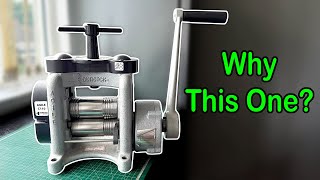
It took me a few months to look through all the rolling mills I could possibly find online. In this video, I explain how and why I chose my rolling mills, which ones I have, and why I first got the 5-in-1 combination rolling mill, and now I have settled down with my current Durston rolling mill. So if you are thinking about getting one yourself, hopefully this will save you time and give you some ideas. I have owned 2 rolling mills myself because I want to use my rolling mill to make metal sheets and wires. Both of my machines are combination rolling mills. The first one is the 5-in-1 combination rolling mill I bought over a decade ago. This was my first rolling mill for 2 reasons. First, it was only about $100 at the time I bought it. This was great for me when I had a very tight budget. Second, it came with 5 rollers. 2 of them are flat, so I can make flat metal pieces like this. With the wire roller, I can make different sizes of half-round and triangular wires. The other 2 are texture rollers. Each of them has 2 different types of textures. Together, I can use them to press 4 different textures on the surface of my metal. The sheet thickness is 0.3 to 3mm. This means if the material I want to put through the machine is thicker than 3mm, I will have to hammer it down or find a way to make it to at least 3mm. The wire capacity of this machine is between 0.75 to 5.75mm. I have a silver ingot here. Sometimes, if I accidentally melt too much silver, it could go up to more than 6mm. When this happens, and if this ingot needs to go through the rolling mill, I will have to hammer it down first. This was a very versatile rolling mill. The two flat rollers have helped me make lots of small pieces of silver and gold. With the wire roller, I mainly use the half-round grooves to make rings, and I did use the triangular grooves once just to try. They were great. As with the two texture rollers, they were very handy when I wanted to add textures on my metals.
For all these wonderful features, I chose that as my first rolling mill.
A few years after I had that machine, I moved on to my second one. Because I wanted to make square wire. This time, I have chosen the Durston Agile C110 combination rolling mill for 4 main reasons. First, the quality of the rolling mill directly affects the quality of the jewelry I make, so I want to choose a reliable brand. I had used Thurston rolling mill when I was at school of jewelry back in 2003, so I know it won't disappoint me.
Second, rolling flat sheets takes lots of effort.
The bigger the sheet I roll, the more effort it takes to push the handle. As I'm not strong, I can only use the rolling mill to reduce the thickness of small pieces of gold, silver, and platinum, so I don't need the flat area to be too wide.
This machine can take a thickness as much as 5.5mm. It allows me to roll any flat metal as wide as 55mm, which is a little bit more than 2 inches. I don't think I can manage anything thicker or wider than its capacity myself. Third, besides making small flat sheet metal, I want my rolling mill to make different sizes of D-shape, rectangular, and square wires. This combination rolling mill has 4 half-round grooves, which allows me to make 2, 3, 4mm and 5mm wide D-shaped wires. For square wires, it has the groove size from 1 to 7mm. If I need to make a wire thicker than 7mm, I will use other methods, so I don't need a groove bigger than that. If I want to make any round wire, I will reduce the wire to the closest size in square shape and then use a draw plate with my tabletop draw bench to get to the size I want. So for making wires, this machine covers all my needs. Finally, the space in my studio is quite small. This machine measures only 7 by 8 inches. It's ideal for my place. Besides what I just mentioned, here are 3 other things about my rolling mill. First, you might notice that I haven't mounted down my bench on the table. That's because this is not the permanent place I want to put my rolling mill. As long as I'm not making something too thick or too big, the weight of this rolling mill is enough to hold it down. I have also found that this machine is so heavy that even though it has not been mounted on the table, there is no problem to handle any size of wire. But if your situation allows, I highly recommend to get 4 heavy-duty bolts and nuts to fix it on a sturdy table. Actually, the ideal solution is the pedestal stand. It will make your job so much easier. Hopefully I will be able to get the stand one day. That would be my dream come true. Second, When I was making this video, I found that Thurston has the Agile Elite model. This machine costs only a little bit more than the Agile C110, but it comes with 9 grooves for rolling D-shaped wire from 2 to 10mm wide, a few comfort fit extension rolls from 3 to 6mm wide, a pattern plate featuring Durston's best-selling designs, and also a rolling mill cover as well.
All these extras are worth much more than the price difference between these two models.
So if I'm getting mine today, this is the one I would go for. Third, I have to point out that When making metal sheet, I have to get help to push the handle in some cases. So if I have no help at all, or if I have to make a lot of sheet metal, I would have definitely chosen the power version of this machine. That's the Agile Power C110 model. The 0.75 kW motor would have made the process of rolling sheet metal and wires so effortless and satisfying. While I was making this video, I went to Hatton Garden in London to get some supplies. When I entered one of my favorite tool shops, this tiny machine caught my attention. At that point, I thought it was a mini model for display. As I was in a rush. I passed by without overthinking. A few minutes later, when I had finished what I came to the shop for, before I left the shop, that exact machine caught my attention again. This time I stopped and had a good look at it. It is a mini combination rolling mill by Durston. For the first 2 seconds, I still thought it was a replica of the real machine. The thought I had at that point was, how amazing that Durston even make their display models in great quality. But as I examine the machine from left to right and from top to bottom, it has everything a real rolling mill has. When checking the joints, I found out they do exactly work. Then I saw the sign saying mini. Now I remember when I browsing the catalog, Durston does have a mini version of the rolling mill, but seeing it in real life does make a huge difference. Now I think this could be a great option if I just started jewelry making, or if jewelry making is my passionate hobby. This is only 11 inches high, ideal for anyone like me who has a small studio. And as I have been using Durston for over 2 decades, I know it will do all the jobs that I want it to do. Now you know how I chose my rolling mills.
Hopefully this helps if you are going to get one yourself.
And if you own a rolling mill, I would love to know which one you have chosen and what you think about yours in the comments below. If you haven't got one yet but are planning to get one, which is your ideal model? I will see you in the next video.