Elon Musk: The Only Skill That Survives The AI Takeover
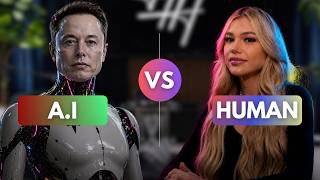
Elon Musk predicts AGI by 2026 and work becoming optional within 10-20 years. Hannah Hammond breaks down his timeline and argues the only skill that survives is learning to work alongside AI, plus building uniquely human abilities like creativity and leadership.
Chapters
Elon Musk just sat down for a 3-hour interview at Tesla's Gigafactory in Austin, Texas, and what he said is going to fundamentally change how you think about your future. He said that we are already living in the singularity, that AI and robotics are a supersonic tsunami, and that within 10 to 20 years, work will be completely optional for the entire human race. Now, I know that sounds insane. It sounds like science fiction, but Musk didn't just throw out predictions. He laid out the industrial, technological, and economic foundations that are making this inevitable. And he gave what might be the most important piece of advice I've ever heard him give. He said, don't worry about squirreling money away for retirement in 10 or 20 years. It won't matter. Let that sink in. The richest person on the planet is telling you that the entire concept of retirement savings might become completely irrelevant because we're heading toward a world with such such radical abundance that scarcity itself disappears. So today I'm gonna break down exactly what Musk said and what it means for you, and most importantly, how you can position yourself to thrive during what he admits will be a very bumpy transition. So let's get into it. Let me start with the analogy that Musk used because I think it perfectly captures what he's envisioning. He said, my prediction is that work will be optional. It will be like playing sports or a video game or something like that. If you want to work, it's the same way you can go to the store and just buy some vegetables, or you can grow vegetables in your backyard. It's much harder to grow vegetables in your backyard, but some people still do it because they just like growing vegetables. So think about that for a second. Right now, growing your own food is a choice. It's harder than just going to the grocery store, but some people do it because they find it fulfilling. They enjoy the process. It connects them to something meaningful. Musk is saying that's what all work will become— optional, a lifestyle choice, something you do for meaning and purpose, not because you need money to survive. And here's the thing that makes this more than just a billionaire's fantasy. The technology driving this is already here, and it's accelerating exponentially. Musk believes we'll hit artificial general intelligence this year in 2026. And he's confident that by 2030, in 4 years, AI will exceed the combined intelligence of all humans on the entire planet. And he said that within 3 years, Optimus robots will be better surgeons than any human doctor at scale. When Peter Diamandis asked him about this vision, Musk said something that really stood out to me. He said, it's beyond abundance. Beyond what people can possibly comprehend or think of as abundance. The AI and robots will saturate all human desire. The limit isn't what we can produce anymore. The limit becomes what we can even want. Now, I want to address something important because I know a lot of people watching this are really scared. They're worried about their jobs. They're worried about their kids' futures. They're worried that robots are going to make them obsolete. And honestly, that fear is super valid. And I'm a little afraid too. And Musk himself even acknowledged that. He said the next 3 to 7 years will be extremely turbulent. He predicted that we'll experience both universal high income and social unrest at the same time, not one or the other, both. But here's why he remains fundamentally optimistic. Peter Diamandis, who is one of the most optimistic futurists in the world, asked Musk directly, how do we head towards Star Trek instead of Terminator. And Musk's answer was interesting. He said he was thinking of Diamandis when he pinned a post on X that said, the future is going to be amazing with AI and robots enabling sustainable abundance. He said Diamandis's relentless optimism is a breath of fresh air. And then he said something that surprised me. He said, I hope you're right, and you might be right. Actually, I'm increasingly thinking that you are right. Here's the foundation for that optimism. When you have AI that can think better than humans and robots that can do physical work better than humans, and you combine that with abundant clean energy from solar, you get a world where the cost of goods and services approaches near zero. Musk put it this way. He said, in the future, the currency isn't going to be dollars. It's going to be energy. With energy, you can power AI, and therefore you can create anything. You can change the physical world. And solar energy is essentially unlimited. The sun is, in his words, everything. All other energy sources pale in comparison. He referenced the science fiction novels by Iain Banks called the Culture series, where super intelligent AI has created a post-scarcity world. Money doesn't exist in those books. And Musk said, my guess is if you go out long enough, assuming there's continued improvement in AI and robotics, which seems pretty likely money will stop being relevant. This isn't about robots taking your job and leaving you with nothing. It's about robots doing all of the jobs so well and so cheaply that everyone has access to everything they need. But here's where we need to be honest about the reality. The destination might be abundance, but the journey is going to be rough. Musk was very clear about this. He said, there's going to be so much change that people are going to be scared. He described it as being careful what you wish for because you might actually get it. If you actually get all of the stuff you want, is that actually the future you want? There's a real question of meaning here. If robots can do anything and everything better than humans, what is the role of humans? Where do we find purpose? Where do we find identity? And in the short term, jobs are going to be extremely disrupted. Musk said white-collar work is actually the easiest to replace. Digital tasks, knowledge work, what he calls bits work, that's what's getting automated first. He explicitly mentioned education as being in that bucket. He claimed that even with current AI, we're pretty close to replacing half of all jobs in the white-collar information domain. Half. And that's not 20 years from now. That's where we are today. So how do you navigate this? How do you position yourself for the transition? Well, first, understand that the people who thrive will be those who learn to work with AI, not against it. The skills that matter are the ones AI can't easily replicate, at least not yet. Creativity, human connection, physical presence in spaces where people want human interaction, leadership and judgment in novel situations. Second, stay in the information flow. The rate of change is accelerating so fast that what was true 6 months ago might not be true at all today. You need to be constantly learning, constantly adapting, constantly growing. Third, and this is the real key, focus on building assets that generate value regardless of how the economy shifts. This is why I talk so much about real estate, about businesses, about investments that produce cash flow. Because even as work becomes optional, people still need places to live. They still need services. They still need communities. The question isn't whether disruption is coming. It's whether you're going to be positioned to benefit from it or be swept away by it. Let me explain what Musk means by universal high income, because it's different from universal basic income. UBI is the idea that the government gives everyone a basic check to cover their basic necessities. It's a floor. Musk is talking about something much bigger and much more abundant. He's talking about a ceiling so high that it becomes meaningless. The logic goes like this: if AI and robots can produce virtually unlimited goods and services at near zero cost, then the price of everything drops dramatically. Healthcare that currently costs hundreds of thousands of dollars becomes essentially free. Housing becomes abundant. Food becomes trivial. Transportation becomes cheap. He said within 5 years, everyone could have access to better medical care than anyone has today. Not just the rich, everyone. Because when robot surgeons can perform procedures better than humans and AI can diagnose diseases better than doctors, the bottleneck isn't skill anymore. It's just manufacturing enough robots and building enough facilities. This is what he means by abundance. Saturating all human desire. It's not just that you have enough, it's that there's so much that wanting more doesn't even make sense. Now, the big question Peter Diamandis asked was, how does this actually work economically? If companies are massively profitable because of AI and robots, does that get taxed and redistributed? And honestly, Musk didn't even have a clean answer. He acknowledged that we don't currently have a system to make this go well. Or make this go smooth for that matter. This is the hard part. The technology is coming whether we're ready for it or not, but the social and political structures to handle it, those have to be built. But here's the thing, even without perfect policy solutions, the fundamental reality of abundance changes everything. If it costs almost nothing to produce everything that people need, then the incentive structures we've built around scarcity will start to break down and new structures will start to emerge. They have to. The question is whether that transition happens smoothly or through immense conflict. And that's where individual preparation matters. The more people who understand what's coming and position themselves intelligently, the smoother that transition will become for everyone. So what do you do with all this information? Here's my take. Don't panic, but definitely don't ignore it. If Musk is right, and there's a very real chance that he is, then the next decade is going to be the most important positioning period of our entire lifetimes. The decisions you make now about skills, about assets, about how you think about work and wealth, those decisions will compound. So learn AI, go all in, use it every single day. Get comfortable with these tools because they're only going to become more powerful and more central to everything, and they're changing at an infinite pace. Build assets that generate value. Real estate, businesses, things that produce cash flow and serve real human needs. Stay adaptable. The specific opportunities are going to change faster than any of us can predict. What matters is your ability to spot them and move on them. And honestly, take care of your mental health. This level of change is going to be very disorienting. It's going to challenge our sense of identity and purpose. Finding meaning in a world where work becomes optional, when our entire lives, our identity has been tied up in our work. This is a skill that most of us just haven't developed. So start working on that now. And if this video got you thinking differently about the future, share it with someone who needs to hear it. Subscribe if you want more content on building wealth and navigating this moment of massive transformation. The abundance is coming. But the process of getting there is going to feel very scarce for many. Don't be the one that gets left behind. AI is not going away. Robots are not going away. So we must lean in and adapt. The question is whether you'll be ready for it.
More from Hannah



Never Waiver On Your Values—No Matter How Lonely, Uncomfortable, Or Difficult The Journey Gets

Watch the full video about Ray Dalio’s prediction on the upcoming debt crisis… 👀

Stop Asking “How?”—The One Question That Will Help You Scale Faster Than You Ever Thought Possible

4 Life Lessons That Took Me 30 Years To Learn—But You Can Learn Them All In Just 14 Minutes


This Is Unfortunately How You Can Tell Your Real Friends From Your Fake Friends


