Healing Religious Trauma | LGBTQ+ Identity, Faith, and Finding Your Truth | More Human More Kind
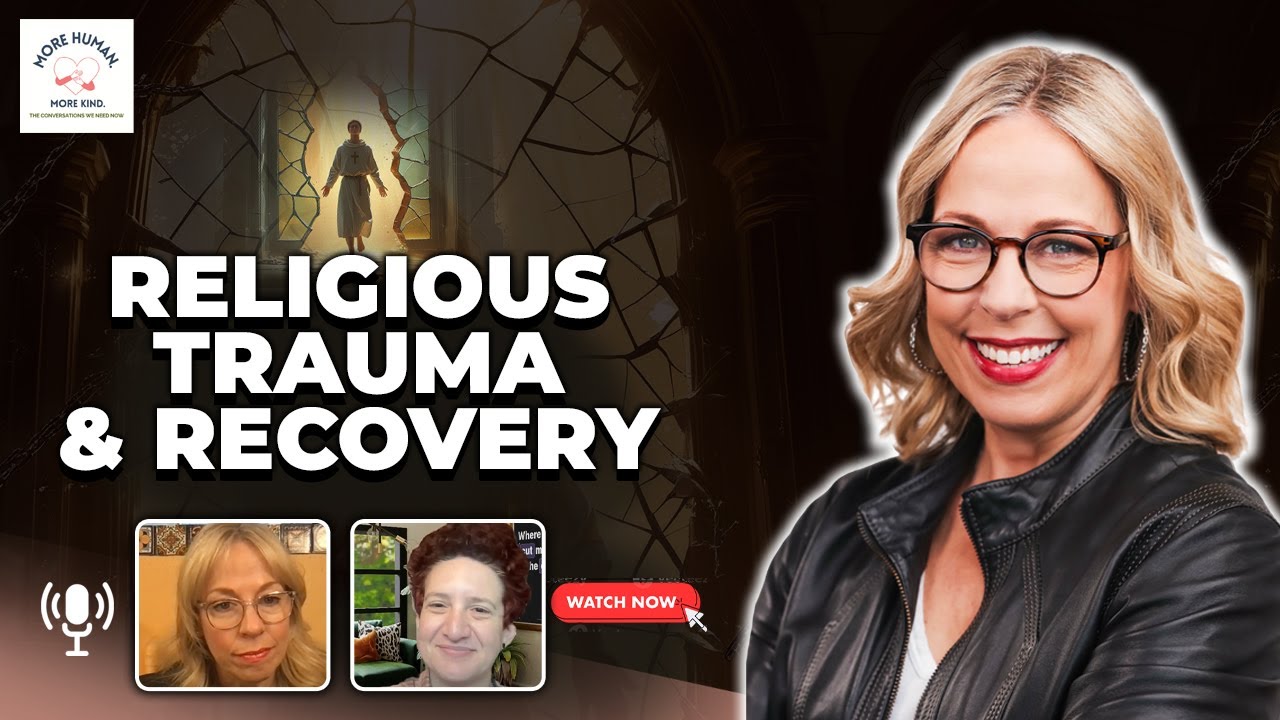
This content was created by Heather Hester. This content was uploaded by Heather Hester. This is a YouTube interview episode titled "Healing Religious Trauma | LGBTQ+ Identity, Faith, and Finding Your Truth | More Human More Kind" (published May 20, 2025). It is an interview-style conversation between host Heather Hester and guest Ann Russo, a mental health therapist who runs AMR Therapy and has a master's in theology. They discuss recognizing religious trauma (especially in high-control/dogmatic faiths), how faith and LGBTQ+ identity can intersect positively, the Religious Trauma Treatment Model (drawing on behavioral, narrative, and somatic approaches), practical healing tools (bodywork, meditation, leaning into faith, self-compassion), virtual therapy/licensure logistics, and Ann Russo's upcoming book and resources.
Chapters
In today's episode, you'll discover how to recognize the signs of religious trauma, how faith and being LGBTQ+ can intersect in a positive way, and helpful tools for helping you heal. Let's get into it. And thank you so much for joining us today. I really, really look forward to this conversation. How faith and being LGBTQ+ can intersect in a positive way. You sharing a little bit about who you are, who you are, and what you do in the world. Sure, sure.
So I'm Ann Russo. I am a mental health therapist.
Let's get into it.
And I created and run an agency called AMR Therapy, and I also have a master's in theology. So I specialize in working with LGBTQ folks on an intersection of religion and faith and all that that brings. And our practice specializes in working with folks that have felt marginalized or really haven't had the space in mental health care. So we offer a sliding scale and, you know, we do our best to, to accommodate folks.
So do you work with people just in person or do you work with them virtually or both?
We're a completely virtual practice. We were actually a virtual practice in 2018 when I opened us up because I thought, you know, if I do it this way, we can have lower rates. To our clients. And so we've been able to do that since.
So yeah, I love that. I love that. And does that give you flexibility? Just, I'm wondering, I have with kids that are kind of around the country, one thing that we often run into is, well, first of all, that in-person versus virtual decision to make or preference. And then the second is, um, some therapists cannot practice over state lines?
Yes.
Yes.
So we, I'm licensed Nevada and California, and most of our therapists are licensed in California, but we do have a couple folks that can practice out in different, different states. So we do have to watch that as well, of course.
Okay. Okay. Yeah. I always, I'm always so curious about that and that's, I've learned that's one question that we ask is, as everybody's moving around and trying to find somebody or, you know, we were lucky enough that Connor's therapist moved from New York to Texas, but they meet virtually and he can still, they can still practice or work together.
Exactly. Like I actually live right now in New York, but I can't work in New York. I have to work in California and Nevada where I'm licensed. So I mean, it's, but I think the laws and things are changing a bit. I'm seeing like compacts come up, which I think is really great.
Yeah.
So I'm excited to see that change.
That's what I feel like has been coming, especially since COVID that there has been this effort to make it more accessible. And that's one of the ways, right? Which I think is so, so lovely. So you were ahead of the curve on that. Very, very cool. Bravo. Okay, so I'm really, really excited about this topic and we started talking about it and then we had to stop because— That's right.
Yeah.
Oh, wait.
Yeah.
I know, exactly. I'm wondering how, how one might recognize that this is part of their story. Sure. Sure.
So from my angle as a clinician, I'm working on training and teaching clinicians through classes and a book coming out on how to recognize religious trauma, because we don't get that level of training either. In our programs, you know what I mean? Like, so I think that that's a really important thing because so many people experience religious trauma. And I find the more that I talk about it, write about it, I'm seeing people come from all different spaces. You're like, I experienced this. Oh my gosh, when I was in elementary school, this happened. This is religious trauma. So like, it, it is, it has affected and even, even if they be religious, have been affected by religious trauma.
I think that's so helpful and very, very clarifying. Maybe validating is a better word. But I, I will just share for me. So I think this is like the, the broader piece of it. I was, I mean, years into kind of into therapy and like pulling back the layers of everything before I was actually able to get there myself. I'm sure my therapist, like, from day one, or at least the, you know, month one, was like, "Oh, I see what's going on here." But you know, you have to get there yourself, right? And I remember being like, "Oh my gosh, that's a thing? That's real?" And then you start talking about it. And then of course it's like, there's a name for the theory, but as soon as you like know about something, it starts popping up everywhere. I remember that theory, but then I was like obsessed. I've been obsessed with learning more about it. So I'm wondering if you could actually— let's get into the nitty-gritty of this and then we can really get into like the LGBTQ pieces of this. Sure. Sure. Like, let's talk first kind of broader. What are the things that might have either caused religious trauma or things that people might have, um, experienced? That then, you know, now they're in a place where they're like, that happened.
Gotcha. So we're looking mainly at religions that I'll call high control. That's a term that I'm stealing from Merlin Winnell because it's— it— I don't— I think, you know, we have to make sure that we're We're not, I'm not saying that every person who's religious, everyone who goes to church is gonna experience religious trauma.
Right. Correct.
You know, but the higher level of control that a religion has, or the more, um, dogmatic it is, is where that trauma can occur. So a lot of the trauma, especially for women, can around sexuality, around purity. Around what it means to be a woman in the world, just in general. And what a lot of the religions that tend to be very popular here in the United States do tend to— and the more dogmatic they become and the more high control they become, the women really show up as kind of lesser than the man. So that is a huge piece that, that occurs. Sexual orientation, gender identity, of course, around issues of what happens to me, what does it mean to be sinful, what does it mean to be good, what is my free will. All of these things can cause trauma. Uh, how do I get into the next place instead of going to a bad place? How do I get to a good place? Am I following the scripture appropriately? And then there's intense pressure around even the culture of the church itself and family itself. So you may experience trauma if I don't believe this anymore. What does that mean if my family still believes this? If I believe part of this, how— and not the other part, what does that mean about finding a new church community? So I mean, there's just— it, it impacts— it can impact every level of who you are.
I'm wondering, getting a degree in theology, was that your thinking behind it? Was, I want to understand on a very kind of academic theological plane or level what all of this means so that I can better decipher how that affects us as human beings?
So here's my trauma story, Heather Hester. So I wasn't raised religious at all, you know, Italian Catholic baptized, but like I wasn't really raised deeply in the faith. And when I was 18, I met some evangelical Christians and I, I was already out as a queer person and I like these people. I went to the church, but they were very much hate the sin, not the sinner type of vibe. And there was— I had a very intense emotional connection with another woman in the church, and it was really created some issues. And that like broke my heart because she was just very much in the doctrine of that this is sinful, this is wrong, and I'm wrong, and I'm sinful. So that did traumatize me. I didn't realize how much it traumatized me until later in life, even though I went on this path. And I, so I went and I'm like, how can, how is this true? Like, how can this be true? How can love be wrong? You know? And I'm like, where is this coming from? Because these are really intense statements that people are making about eternity.
Yeah.
And do you even know what you're talking about? So I'm like, so I couldn't think of anything really at that time more important than a soul salvation, right? Mm-hmm. So I went and got a bachelor's in Southeast Asian religion and then a master's in theology with a focus on Christianity. And I just was learning, learning, learning, and I, the focus really was on something called liberation theology and queer theology. And I just, I mean, I, I went really deep into it. How did the Bible get created? Um, what does this actually mean? What happened for the 300? Like, I, I mean, it was a really deep dive. So I feel like it, it's, it's what gave me the ability now to work with my clients that are coming specifically out of Abrahamic faiths. I mean, I, I understand other faiths as well, but it gives me a little more into that, um, arena, obviously.
Sure. Well, it gives you another angle really at which to look, you know, um, probably like a very much like 30,000-foot— yeah, right. And, and then to be able to look at it in a very academic, like almost, I don't wanna say clinical, but like clinical way. Like, and then, yeah. And then that like emotional connection way. Like there's a, right? Yeah.
Because it's the thing that I tell my clients, because you know, I have many clients that want faith. They wanna keep their faith, they wanna keep their belief system. And I think it's cruel to tell people that you have to choose. God or your sexual orientation or your gender identity. I think it's, you know, so I work in that intersection. So I'm not here to say, let me tell you why you should or should not have faith. That's yours, right? I, my goal is to help you understand some of this other stuff and maybe help you hone in on what it means for you to have faith.
You know, well, and is a piece of that really kind of pulling apart the difference between having faith and being religious?
For some it can be, yeah. Especially when we're talking about that high control religious piece. Because people oftentimes, you know, when you're raised in something, and it doesn't even have to be religion, but when you're raised in something from birth, oftentimes you don't even know what to ask.
Mm-hmm.
Oh, absolutely.
Because you, I mean, it's such an overstated saying, but it's for a reason. Like, you don't know what you don't know.
Yes. Yeah.
And once you kind of get out into the world and meeting other people and different people and different cultures and different geographies, it is It's amazing.
I mean, it's, it's amazing. When I work with some clients, I will actually give them a quiz. So I'll say, okay, well, what is like staying within the Christianity framework? I'll say, okay, like here, this, here's a long quiz, you know, see you next week. But it's like, who's, who is Jesus to you? Jesus is, what's the Trinity mean to you? And I'll have like A, B, C, D, and we'll come back and we'll talk through. And they'll be like, you know, A kind of made sense to me, but then I think there's part of D. So they start kind of constructing their really internal experience with some of the church experience. And then they'll— it's very fascinating to watch because they start to really understand more what they believe and why they believe it. It's awesome.
Well, and it also like, it's like you're giving them permission to see it as a spectrum and not a binary.
Yes.
Yes. And not like you need to check one box. It's like there, there aren't boxes.
Exactly. And if, and you know, I'm also in the mindset that if it, if you really are very strict in your belief system, that's cool too. Like I'm not here to make you anything. I'm here to help you be you, whatever that might look like.
Mm-hmm. I love that. I really love that. That is fascinating. I'm just thinking, um, I mean, I'll quick give, I don't, I have not talked about my, my background for quite some time, so, um, this'll be new for, for everyone. Um, So I did grow up, it wasn't evangelical Christian, but it was definitely very, very, I say evangelical Christian a lot of times just because it's easier as a quick, like, this is the way it was.
Yeah.
Um, my, my grandfather was Church of God minister and that is definitely the way, even though we were in the Methodist church, we were raised like Church of God. And, um, and so there was the, this is how you're a good girl. There's the, this is good, you know, good, bad, right? There were a lot of like black, white, all the things. And definitely that, like, if you step a toe over the line, then oh, oh, oh, right? That kind of thing. And so that, that's just what I knew. Yeah. And, um, and, and then the, like, what you do to stay in, like, in that, right? Like, how do you stay in that system and what will kick you out of that system? And, um, and it's interesting, like now being where I am in life, being able to look back and see I'm the oldest of 3 kids and to see how the each of us really not only interacted, um, but, uh, were within that system.
Mm-hmm.
And there's a boy between 2 girls.
Interesting.
And, and how the 2 girls. The oldest and the youngest also handled it in very different ways. And so it's fascinating to me as I've been on my own journey of, you know, it's been years now that I understood that this is what I'm healing from is religious trauma, but I still bump up against it. And I recognize that because there are certain things, even that you just said, that I was like, that like I felt the fire come up, right?
And I was like, yeah.
So I'm like, okay, there's a sticking point. There's something that I still need to like work through. And so, um, but that took me forever to even recognize that that's what that means. Right. But I think to your point that you were making, even that like, uh, initial realizing like, oh, there's options. And my faith can look like this. I can still have faith, right? And I like, one of the first things I was like, so when my son came out in 2017, like, that was my thing right away. Like, that was my very first thought was, there's no way my child is going to hell, and I need to figure it out, right? And so right away I was like, that was my focus. My initial focus was he's not going to hell. Yeah, like it was not even a question. And so that right there like broke that, like that was the initial breaking point, right?
Wow, that's amazing.
Actually, it's quite wild.
Think about it.
I'm like, oh my gosh. Um, and it's— so that has never been a difficult thing for me because I was always like, well, it's my kid, and now it's my kids. Right? And, and it's my whole family, like this family that I've created. And of course my faith is going to be what I make it, and I want them to have the space to have their faith the way they want it.
Yes.
And, and that can look like a million different things, right? As you know. And so this is why I love what you're doing so much. We have to go through these, these steps of realizing it first, being like, oh crap, that's what this is, right?
Yeah. And it's hard to recognize.
It's super hard to recognize. Yes. And then I think too, I, I love that. So I really want to talk about once a person is like, whether they do that within a therapeutic setting and they are lucky enough to be with you or someone like you who recognizes that and is able to give them that support, then just like any kind of healing from any kind of trauma, there's work that has to be done. Do you mind sharing your process in that or kind of your thoughts around the process of healing? Sure, sure, sure.
So I talk a lot about— so I, in the book that's going to be coming out, I talk about something called the Religious Trauma Treatment Model, which I— it's evidence-based practice. I just kind of realized, oh, this is a model that I'm using, I better name it, right? But it's all based on evidence-based, uh, practice. So a lot of behavioral therapy and narrative therapy, somatic therapy. And what, what we're just trying to do is just really get into first, as we've been talking a little bit about already, is like, who are you? What is your value system? What is your faith belief? So just trying to just even have the person start to think about things maybe they wouldn't have even really thought about on their own, like we were talking about, you know, like, what does this mean for you? What does having faith mean for you? And then we do work around what that trauma may be, and it can show up in so many different ways. I mean, it can show up with a client who is having a difficult time being sexual with their husband. They waited till marriage, they did what they were supposed to do in their faith, and then it was like, oh my gosh, I, this, I still feels wrong. I still have a lot of shame around this part of myself, right? They can show up in the person that left their faith, but now they're just partying all the time because they don't want to think about their experience in their faith. I mean, they can show up in so many ways. So it's like when it— so when you do an assessment, you do want to ask like, well, tell me about where did you grow up in religion? What's your background? Like what— those things are really important. And if you're hearing those high control type religious speak, speaking pieces, right? That should like, you know, get the therapist to think, okay, there's, there's stuff here, right? There's stuff here for sure, right? And then we basically would walk it through like you would really with, with any trauma, but with the understanding that you're doing a lot of existential work as well, because we're— it's, it goes beyond what our physical body and mind is doing here now. I mean, we were talking about people's ideas about God and eternity and the soul. And so, I mean, you do get into a lot of that deeper stuff. And as you mentioned too, with yourself, you may— it's the resolution doesn't always come, but the journey to the resolution. You're like, it's in helping your clients see that like it is a process. And some of this trauma just lives in the body too. Right. Like you're still gonna feel some of these triggers, but at least you'll know why that's happening and what you can do to, to help decrease the frequency and intensity of those triggers. Yeah. Yeah.
What do you see as some of the more difficult sticking points? I mean, obviously, like you just mentioned, that it is very much of an existential some, not something that's tangible, right? So not like a gambling addiction or a substance addiction. Yeah. So I, I imagine that's a huge sticking point, but within that, like what things do you see people kind of butt up against that they're like, I just, either I can't, I don't understand it or I can't get through this.
And this might just be because this is more of my specialization, but I do see it a lot with the LGBTQ community. I mean, it is, it's, it's a, it's, it's painful to see. It's painful to experience. And oftentimes, and maybe this may even have been your experience, there's a narrative that's really fed to high control religious groups. Again, I'm going to focus in more on Christianity because that's my, my specialty. About what it means to be LGBTQ, and it's painted in like this very scary way. But if, if someone's LGBTQ, they're gonna have a substance abuse problem now, they're going to be promiscuous, they're not going to be part of God's plan anymore. I mean, like, they paint this like horrifying picture. And so I think that when you, you're receiving that Parents oftentimes, I think, will, if their child comes out, will think, well, I need to help them not live that life. I need to make sure that they remain saved. So I, it, it's not always because, well, I hate the fact that you're gay. It's like, I'm trying to save you from this horrible existence.
Right.
Right. So it's, it's, it's teaching communities, and this was my experience too, is when I was talking, when I was really involved in an evangelical church and I was still out, they were like, what? How you're, how can you be practicing Christian? How do you, what you, what? Like they couldn't even wrap their mind around.
Your brain was exploding.
Yeah. Like, how is this possible? You, I mean, I remember like I went on a missions trip and I, said, yo, yeah, I was talking to one of the people there, and she was like, what? Like, just shocked because it just— she had never been taught that those two can intersect. Like, you can believe in God and also be part of the LGBTQ community. So I think there's just a lot of misunderstanding. Yeah, that is occurring. Um, and then you have the studies that show up that get kind of twisted as well, because you see, oh, LGBTQ people have— do have a higher substance abuse issue, they do have a higher suicide. Well, they'll cut— they'll use those studies and say it because you're LGBTQ, but it's not.
It—
now the actual studies are talking about rejection, correct? So that gets skewed too. And if you're not if you don't know to look at it in a different way, I could see how it could be very scary, right? If someone comes out as LGBTQ or you yourself are LGBTQ, right?
Right. Well, absolutely, absolutely. And I think, you know, this— there's this, um, this fear piece, right? Because it's the fear that causes the control and, um, and I've witnessed this in family members of mine where I see like they just can't get past that fear.
Yes.
Right? So it doesn't matter how much you say, well, those studies are twisted, or here, let me show you this information here. Let me share my, you know, our experience with you, or these experiences over here, or this, the reality. Right? They are so fearful because of the dogma that has been programmed in them that they just can't get through it. It, and it, it's heartbreaking.
It is heartbreaking. It is. It's absolutely heartbreaking all the way around. It's heartbreaking.
Yeah.
And And you know, the thing that then becomes a challenge that I see with the LGBTQ community, they will, and again, generalization, there's no place for me in faith.
Right.
And because there's no place for me in faith, I'm going to kind of, I have to start mocking or making fun of, or like, or have a huge disdain because the rejection is so deep, like it hurt, it hurts so hard that you have to, for safety purposes, you kind of turn it around because you think there's not a place for you there. And that is horrible. That's, that's terrible. I do see things changing and they've definitely been changing over the past 20 years. More denominations are accepting LGBTQ folks. But that hurdle is very, very real.
It is. Yeah, it is. And I feel like it's, it's worth discussing, and I'd love to hear you weigh in on this, but circling back to that idea of faith versus religion, spirituality versus religion and dogma, and creating this space for, well, For example, my God is a God of love.
Mm-hmm.
Or I see faith as the universe or spirit or all these other like pieces that are, that are very spiritual, are of a belief in a higher power, right? It just crosses out of like strict Christianity. But it does allow a space for faith. I would love your thoughts on that and how you see that.
Personally, I, I feel very comfortable with, I don't really know and I can't really answer that question. I mean, so it's, I really have to sit with the, with a client. I think that you can move out of strict doctrine for sure. Uh, I do see how very strict doctrine is harmful to people. I've also seen that for some people it, it works. So it's it just really kind of depends on how you're showing up in the world if it's gonna work for you or not, honestly, you know? So I'm not advocating necessarily one way or the other for when a client comes in, but there's absolutely a difference between going to a church that's saying this is what it absolutely is, 100%, no questions, versus how do you know that, and let me explore this a little deeper. You know, that's— I, I, I'm weird. I'm very wary of someone that tells me they have the absolute truth when it comes to something as big as God.
Agreed. Yeah, agreed. And that's just such a personal, personal thing. I would love to know if you could share a couple of, or one or two, either tools or strategies that someone might use right away if they're recognizing, if listening to this and thinking, oh my gosh, So in addition to reaching out to a professional who can help you walk through this, what is a tool and/or strategy that you find to be very, very helpful?
So if a person is a person of faith, I would say lean, lean into that actually. Like, like just, just kind of just know God is bigger than all of this and just lean into that faith piece of that. Like, you're— as you go on your journey, things will be revealed to you. Come at it with, with, with love, and you're gonna— you will notice things in your body. And I definitely encourage some type of bodywork Some people like meditation, some people like breathing, exercising. Do stuff with your body cuz your body feels it. Yes. You know, and there are some great books to read. I, I would say be, be open to learning. Like no one's telling you what you have to believe, so just open your mind to learn. That's all. Be, be kind to yourself. We're all trying to figure this out, right?
Yeah. Give yourself permission.
Yeah. Give yourself permission. And there it— I have not yet run into a religion, no matter how they, they preach in general, that says God is anything but love, really. So trust in that. That's where you come from too.
I love that.
Yeah.
Yeah. That's amazing. Is there anything else that you would like to share?
I would love for people to check out my website. They can, um, subscribe. I have a newsletter when the book comes out. I also just like to talk to people, like I wanna be a support, you know, like even if it's in therapy sessions or if it's send me an email and I can give you a resource, like I'm more than happy to do that. Like I understand this and I very, very much am a believer that we are all in this together, like 100%.
I love that. I love that. Well, I will definitely have your website in the show notes, and I really do encourage if you have a question, email Anne.
Yeah, please do.
And don't let questions or fears or feel there's no such thing as a stupid question. And I think approaching with curiosity and just wanting to figure things out, there's nothing wrong with that. Though I just feel like we scratched the surface here today.
Yes.
There's so much here, and I'm so excited about your book that will be coming out. And your website is a wealth of of information. So thank you very, very much for that. And just creating this very special place for a specific topic that so many people knowingly or unknowingly are walking through. So thank you so much.
Oh, thank you. Thank you for all the work you do too. Like I said, right? We're all in it together.
We are all in it together. That's right. Absolutely.
More from Heather








Up at 2AM Researching Everything: What Ally Burnout Looks Like for Parents of LGBTQ+ Kids


PFLAG National Creating Pride in Families: New Resource Helps Parents Build Support Networks at Work
