A Corsair representative walks through their Thai landfill operation, where they extract decades-old plastic waste and run it through pyrolysis reactors. Each 8,000 kg batch converts roughly 1,000 kg of plastic into up to 900 liters of oil in a 20-24 hour cycle, though contamination significantly reduces yields.
Chapters
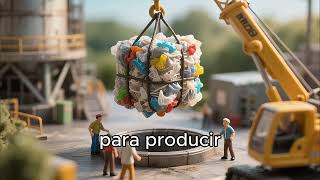
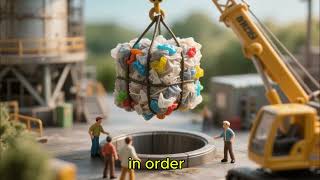
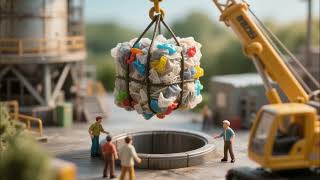
Now let's talk about the daily process of what we do here at Corsair and how the pyrolysis works. First of all, everything always begins with the raw material. For the last 5 years, Corsair has been managing a Thai government-owned landfill and waste management facility based in the city of Sakaeo. On this landfill, there has been more than 50 million kilos of mixed waste accumulating for the past 30 years. What we are doing is we are removing this many times decades-old plastic garbage out from the landfill together with receiving on a daily basis new mixed waste coming from the local community. Unfortunately, the situation here in Southeast Asia is that there is very little, any type of waste separation taking place at the source. This basically means that all the garbage goes into one garbage bin, which then gets collected by the garbage trucks and eventually dumped into the landfills. What we do is by using of both mechanical and manual sorting systems, we separate the plastics out from all of this mixed waste. Any remaining elements of metal or glass or paper is then being separated as well and provided for other recyclers while we focus on the plastic that is then processed further to be ready for recycling. In order for us to produce the highest quality pyrolysis oil, we always want the plastic waste to be as dry and as clean as possible. Therefore, in order to avoid any residue, we often process the plastic by first washing it and then drying it. Now, once we have processed the plastic, it gets baled and eventually then loaded into the pyrolysis reactors. One individual reactor is typically able to hold as much as 8,000 to 9,000 kilos of plastic waste per a processing cycle or a batch. The processing cycle to convert this plastic waste into oil would typically take between 20 to 24 hours. During this time, we are able to convert this 1,000 kilos of plastic waste, for example, into as much as 900 liters of oil. But of course, if the plastic is wet or there is any other type of material like organic waste, food waste, or anything else there, we obviously cannot produce oil from, but it will add up on unnecessary waste.