ve BINAR ChatGPT & More The Use of AI in Sales and Marketing
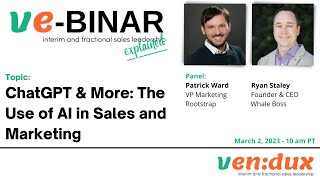
Recorded webinar (Mar 2, 2023) hosted by Henning Schwinum with guests Patrick Ward (VP Marketing, Rootstrap) and Ryan Staley (CEO, Whaleboss). The discussion defines ChatGPT as a large language model (pattern-based, not sentient), surveys practical sales and marketing applications (content ideation, lead magnets, SEO, automated reporting, chatbots for transactional tasks), highlights risks (data/privacy, hallucinations, non-enterprise reliability), and emphasizes that AI augments rather than replaces skilled human experts. The Q&A covers personalization, data storage concerns, differences between machine learning and deep learning, and likely displacement of transactional roles.
Chapters
Welcome everyone to this webinar. Very interesting topic and even more interesting guests for us. We're going to talk about AI and really triggered by chat, GPT and its use in sales and marketing, we are recording this and make it available by the end of today, early tomorrow morning on our website. We'll, we'll ask everybody to stay muted during the, during the initial portion here. There will be a Q and A. At the end we'll have, we have someone monitoring the, the chat and we'll also open up microphones for Q and A at the end. ChatGPT has been in the news. Those who've been familiar with it have known about it longer. But as far as an outside observer like myself goes, we've seen this blow up in the last two months, I would say, and it's just one of many AI power tools that are out there to help sales and marketing. The question is, can it sell? Will it replace sales and marketing people? And we have two practitioners who know their way around AI, Patrick Ward and Ryan Staley. Thank you guys for joining us. Why don't you introduce yourself? Patrick, start with you.
Hey everyone, My name is Patrick Ward. I'm the VP of marketing at a company called Rootstrap, which is a custom software development consultancy. Very excited to be here. I've been around the AI space for a number of years. Obviously, being in software development, you tend to be on the cutting edge. So I'm here to give you guys some guidance and also allay any fears you have. It is not going to come and take your job, but it is going to help you out.
Ryan. Awesome. Yeah, so my name is Ryan Staley. I am the founder and CEO of Whaleboss, which is a sales consultancy specifically for high acv, either pipeline or sales conversion go to market strategy. And so essentially at the same time, I'm also the host of the Scale up show where I interview over, I think over the last year I've interviewed like 120 SaaS CEOs on my show, which has been fantastic. And so contextually I've been obsessed with it because I've seen asymmetrical gains in my career by leveraging different tools or different strategies or tactics. And so once ChatGPT came out, I started diving really deep and then applying it to use cases. And I've been really, really impressed with the results. So on top of it too, have asked all those founders, not all of them, but a lot of the founders and CEOs in SaaS, how they're using their business, how they're using it to grow revenue. And so I'm really excited about what it could do for us. And at the same time, you know, there are things that you need to think about and be, I would say, concerned about in the future just with how fast this is changing and happening because it's different than I think any technical evolution we've seen in my entire lifetime. And I'm about 45 years old right now, so just throwing that out there.
Well, Ryan Patrick already told us that we don't have to be concerned about our jobs. How do you feel about it?
Yeah. So here's, here's what I would say in Pat right now, right now. I would say it's really not, it's automatically going to replace you. It's more so it's somebody using it is going to replace you. Right. So like think of it this way. If there's a version of you and then, or you, I should say, and then another version of you, but they're leveraging these tools that allows them to get work done in maybe 50% of the time and they reallocate that free time towards making the quality better or producing more content or doing other value added things to the organization. That's where I see, you know, there's a really unique opportunity to capitalize on that and also be cautious of. And so that's where my head's kind of coming at right now. But then, you know, there's some stuff with generative AI coming out. I've talked to people who have been researching AI for the last 12 years and have that in their company where, you know, you'll be able to do Jarvis like activities from Ironman. And so I don't think it's necessarily going to replace everybody right now, but those are the my viewpoint on it, if you will. So you have a good point and counterpoint, if you will.
Good.
Well, Patrick, like so many things that get into the spotlight, people throw around the term chatgpt without really understanding what it stands for and what it is. So in layman's terms, for somebody who's not as deep into this matter as you are, what is it? What is ChatGPT?
So the best way to think of ChatGPT is as a large language model. So what has it done? It has ingested a bunch of content from human history, specifically written content, and it's ingested all of that data and now it has allowed itself to do pattern recognition. That is when you ask it a query, it's not actually consciously thinking it is Merely observing all written information and then predicting, therefore giving you the right word that answers your query. And this is why it is helpful when you are thinking about coming up with new content, when you're coming up with ideas, to Ryan's point, saving you time. But so much of the tool is about using it in the right way. This is why there's been very publicly available information of like, why did ChatGPT get this thing wrong? Because it's not actually thinking, it is merely looking at all the scope of language, specifically English language. You know, it does tend to be based on English novels, English literature, you know, any form of written content that is out there in, in English, which is the predominant form online, and then giving you a response based on what is the most likely scenario. And so that's why you see that even one of the sort of big fears that people have is, oh my God, is this sentient? Like, you know, how do I know that it isn't able to think better than I can? And that's what I would tell everyone here. It is merely still a tool that is using patterns to give you the best possible outcome in its estimation, but it's not actually consciously thinking yet.
Ryan, anything to add to this description?
So I think Patrick nailed it from that aspect. I think the, the only thing that, to add on to it is that, you know, there, there's a lot of really great things if you have the right context and the right prompt to ask it. So basically giving it the context and the right question in the right way, you'll get amazing output. If you give it a garbage input, you're going to get garbage output. Right. So I think his explanation was, was really good at it, but that's something that I would see as well, is that it's good, but it's not enterprise grade yet. Right. And what I mean by that is, you know, it, there's going to be opinions in there, there's going to be information that's not 100% true all the time. Right. And so if you're using it for, let's say you're in the healthcare space and you're trying to use it for surgery or to make a medical diagnosis and it's wrong and someone dies from it, you know, that's a massive issue. Right. So there's situations where it's, it's, no, I don't want to say nowhere close because I don't know all the research behind it, but that it's, it's not near that level. And from experts that I've talked to say there's a long way to go before it gets to that point.
You both use the word right, right? You have to use it right. You have to provide the right kind of input. Patrick, maybe starting with you, what what what is, in a practical sense, sales or marketing application? What is the right way to use it? How are you using it today in your business?
So the way that I like to think about AI and the way I like to think about not just ChatGPT, but all AI tools is I analyze my day to day and I look at what are the parts of what I'm doing that are fairly programmatic. And so using an example, in my world of marketing, often I'm trying to come up conceptually with new content ideas. You know, that part, you know, we've all had this phenomenon where we're looking at a blank screen and we get that writer's block. And so getting prompts from ChatGPT about, hey, this is my business, this is what our service offering is. What are some examples of unconventional content ideas that I could play with that then gives me a starting point. And that's, I think one of the biggest benefits I've personally seen is that it's not that it is writing the entire content from scratch. Because, you know, to Ryan's point, you end up with some fairly generic content if you haven't given it the right prompt. But if you just start that process, then suddenly, what might have taken two, three hours staring at a blank screen, suddenly you're off to the races within five to 10 minutes. That, I think is a huge component of it, the ideation stage. And the other personal way that I found it is as a marketer, like, I hate numbers. I just really do not like any form of data, any form of spreadsheets. I like to hire people who are really good at that. And the funny thing is, now I am less reliant on that. I'm able to go to ChatGPT and ask it, hey, what's an Excel formula for this particular result? Because as you can imagine, I, like many of you, have to report to a CEO and a board, and they love numbers. They want everything that I do measured in numbers. But naturally, I would always say, you haven't hired me as a marketer if I was 100% thinking in that quantitative manner. But now with ChatGPT, I'm able to quickly spin up spreadsheets reporting that is able to report on those metrics.
Ryan, how about you? You were asked in the chat already for Examples. Can you share a little bit of how you're using it?
Yeah, so. And I would say so. For me, I've used it in a ton of different ways. Like, for example, getting to marketing and content. One of the things that I was working on a program for one of my clients, and I'm like, all right, let me just see if I could create a lead magnet for them. And I don't.
It's.
It's a technical company, right? It's a SaaS company that has technical nature. And so I asked it the right prompts and it basically created an entire lead magnet, like, for the company, right. Which I shared it with the CEO who's been in that space this entirely. He's like, this is really good. Like, there's a few tweaks I'm going to make, but this is really good. He's like, really great work. And I'm like, oh, I created this with AI by just in like five minutes. He's like, no way. Right? So to go back to Patrick's, you know, mention, you could use it for content creation, content ideation. You could use it for SEO, like literally SEO in the background. You know, at the same time, there's other, like idea acceleration or creativity. With graphics, you could type words that'll come into graphics, like in stable diffusion.
What is it?
Dall E and stable diffusion. Is it stable diffusion? Yeah, stable diffusion. Then there's probably been like a thousand different AI tools released, it seems like within the last month. And so those are other areas on the sales side. One of the things that, that I did and I was, this came as a result of an experiment. But I looked through, I'm like, okay. One of the biggest things that a lot of companies are ignoring right now is the emotional component of why people make decisions, right? Especially with larger deals. They're so focused on the product. They're so focused on the aspect of, like, how do we get things done? So. And I'll. I can share with anybody.
There's.
It's 140 C level prompts.
It's.
It's under the website aiforevenue.com if you just put your email address, it'll pop it over to you. But basically what I did is I asked three core questions so that you could sell or market to any C level executive. And I said, hey, with those questions, the first one was like, hey, what. What are the KPIs at this C level that the CIO is evaluated on, right? And it's spit out five KPIs. That CIOs are typically evaluated on, right? And I'm like, okay, what are the biggest challenges they experience hitting those KPIs. Then it spit out the answers for that, right? And then I put the third one was like, how do they emotionally feel when they are having those challenges? Right? And I reviewed the output. The output was really pretty close to the experience that I had in over 10,000 hours of like customer meetings. So I was like, holy cow, this is powerful. So you could use it in use cases like that. You could use it for basically cold email scripts, SDR scripts, things like that. You could even use it to map out like a med pick. If you want to use med pick the sales methodology. You could even use it for that to, to do questions or qualifications based on a certain framework too. So those are just a few examples that, that you could reference it and try it with.
Patrick, you described earlier what ChatGPT is. The question I would have is how is that artificial intelligence when it's really not intelligence, but rather the ability to process way more data and access way more sources than we as a human can? Is that already artificial intelligence?
So this is the biggest reason why it's not going to take your job. Because the concept artificial intelligence is just a good marketing ploy. Right now, even within the academic circles, what you would describe as powered by ChatGPT is more machine learning. And what is machine learning? It is learning based on a significant quantity of data. It is recognizing patterns within that data and then producing an output. Right. We don't truly have artificial intelligence yet. Even when you see things like that, when Bing incorporated its chatbot, and I'm sure many of you may have seen the article where the journalist had the Bing chatbot, professed that it loved them and wanted him to leave his wife for it. That wasn't consciously thinking. That's the thing to remember here, is that the machines aren't consciously thinking. So why do we call it artificial intelligence? Well, technology has an awful habit of hyping different areas and they use these certain terms to get everyone excited. Now that doesn't mean it's not incredibly powerful. I think we need to remember that this particular tech cycle of AI feels different. And why does it feel different? Because you look at, even over the last five years, we've had a couple of different hype cycles. We've had an IoT hype cycle. We've had a 5G hype cycle last year. I'm sure many of you remember the blockchain and nft hype cycle. But what's particularly different about this, funnily enough, is the mundane, right? As Ryan said, some of these applications of this technology are positively mundane in their use cases. You're able to use it in your day to day function and that arguably is way more powerful. That's the true power of technology. When it's able to take something of your day to day that is perhaps a little hard, a bit challenging, a bit time consuming and compress that make it easier for you to do your job and therefore focus on the highest value add activities. That's when you should be using technology. So yes, we don't need to worry about the term in terms of is it actually thinking for itself? I'll give you an example. A handful of years ago I was working with a client. I can't say who they publicly are, but let's just say they are a large consumer electronic space company. We were testing robots for them and they would go to the edge of a carpet and they would think they were about to fall off a cliff and so they'd get really scared. The robots would freak out. That's the level of intelligence that these robots are at now. When are we looking at true artificial intelligence? Most estimates are looking about 10, 15, 20 years. We need to remember something that I've said from the very start of my career is that there are core elements of what you do that is human oriented. It's actually really hard to consciously think like a human. And so if you lean into those components of your job, you're going to be fine.
Ryan, how do you see AI play into this? Is it intelligence or is it machine learning?
I mean, here's the thing, like for me, I don't really look at it in terms of those semantics. I just look at it in terms of utility. Right. Can it do a job or a.
Function.
As good, better or more reliable than how it's being done today? Right. Like those are kind of like, that's the filter that I look at things through from like a, a conceptual perspective. And so like I'm not, I'm definitely not as technical as Patrick at all when it comes to, you know, those details. But what I would say is here's, here's a little exercise for everybody on this call. You don't need to do it now, but you know, if you're concerned about what it could do or you're looking at, to augment you, right, like significantly augment what you're doing, whether it be taking off time or the quality of what you're doing. Just look at and think through your job, what you do on a repeated basis or high quality components to your job. And just Google right now, not ChatGPT, Google what types of AI products there are to do that. Okay, then try your job normally. What something that you do, a function of your job, and then try it on that tool. A lot of them start off as freemium tools and then see the difference in result. And so what I would say is that's a good exercise to see what you're doing and to protect yourself and kind of bring yourself to the next level, in my opinion. Right. Because that's what I did and I was blown away with the results. So.
And I'll just quickly add in there, not only to support Ryan's point about Google, but futurepedia is a great resource. It's collating all, all of these new AI tools every day so you can subscribe to email updates from them and just see the, you know, we're going to continue to see thousands and thousands of new tools every day. And that's a great way that I keep up with what's new in the space.
That's good. I never heard of that site before. Futurepedia, huh?
Yeah, futurepedia. Just like Wikipedia.
All right. Gotta check it out. That's good stuff.
Cool. Now, when I asked you to describe examples of how you're using it today, you looked at tasks that you or your people have been doing manually before, and now with the help of a tool, they're able to shed some of those mundane tasks, as you labeled it, Patrick, and focus more on the creative side, on the intelligent side of it. Now, with chat GPT in particular in tools like it, are there new business models, are there entirely new applications that you see that we haven't thought about so far that are not coming in to help accomplish current tasks, but you know, elevate the use to the next level?
Yeah, I think certainly when you look at where we're sitting right now, it's very much in an augmentation of existing work. Right. And that's particularly why it's been so influential to the creative spaces as well as to, you know, content generation and content ideation, as Ryan mentioned earlier, because you look at most of the use cases that are happening right now, it's kids, can I produce more content with less? Can I produce more tailored content? Can I produce workflows that are able to take away the mundane aspects and compress the time? What would take four hours now can be done in a Handful of minutes. And so I think that once we get over the hump of this current hype cycle, we will likely start to see more, more interesting use cases. Certainly the reason why ChatGPT specifically did so well is because of the interface. Right. Any one of us can go onto ChatGPT, ask it a question, and we don't need to have any technical knowledge. What is really interesting about the AI space is the next iteration. This is when APIs become really important and that is going to be incumbent on your technical teams. So the way that I get around that, because obviously if you want any sort of mass market adoption, you need an interface that, that anyone could use with, like I said with ChatGPT. So if you're wanting to know what's the next iteration, this is where you need to be speaking to your technical teams.
Right?
Because we look at like, why, what did ChatGPT do? It brought a lot of attention to OpenAI and it brought a lot of therefore investment to OpenAI, which allows them to do even more creative applications. So I would say, you know, if I'm given a short answer to your question, Henning, it's still a little early to tell what is likely the output of these tools right now is, you know, it'll be a far more improved output in literally three months time, six months time. So definitely watch this space, right?
Yeah. So in terms of highly kind of what's coming up and so Henny, do you want to know what I use it for specifically? Or like.
Well, you already gave us a few examples, so do you, do you have something entirely new and different as a result of having this tool available? Or do you see other people creating new products or new services that weren't even around to be replaced?
Yeah, well, there's probably going to be a chatbot for everything, right? So people are going to take Chatbots and then customize it down for things. I'll give you an example of what I see could be being replaced because I'm seeing elements of it already. There's a tool called descript. Have you used descript at all or seen descript? No. Okay, so basically what it is, is it's, it's like an editing tool. So we could use it for this, this webinar right now. Right? And basically it helps you in a very fast, succinct way, cut clips, remove the ums, the, the butts or the, the filler words that you have, make it look normal and then do other things as well. Like so you might outsource that to an agency, if you wanted someone to do that and create like highly qualified content. Whereas if you had someone purchase that tool and learn it, they could do what the agency does in a fraction of the time. So like, that's an example of what could be cut out. I showed an example to a SaaS founder of what they could do to create content and he's like, oh, I don't need to hire a blogger now. You know, I was going to spend $70,000 on a blogger and do that. He's like, I could have someone do blank, blank, blank and do this right for content as well. Like, and I don't want to keep focusing on content, but like, Jasper is one that's out there, so you could leverage it, but you got to do it in steps right now. So kind of what Patrick mentioned, you could do it for ideation, but then you could do it in terms of like creating. Let's say you look at something like buzzsumo and you look at like trending topics from there. Then you put what are. Give me 15 ideas around this trending topic. And then from the trending topic you're like, okay, write me a bullet point summary. Write me a hook for a YouTube video and then write me a blog post for it and can do all that right now. Here's the big thing with content or AI tools is you need to add the human element because it. There's sometimes where the output will be really good, sometimes it'll sound like a robot. But ultimately what's going to happen is going to get accelerated. People are going to crave human connection when it comes to those details. So that's my $0.02 on it in terms of some use cases. Other use cases on the visual side are like you could type in, like I said in those, those basically graphics models you could create stunning images for like a website. You create chat GPT for copy. There's all sorts of different use cases that you could leverage this right now. So those are just some other examples that I'm playing with and using it with.
Great, let's move slowly into the Q and A section. There are a few questions in the chat that I'm seeing that are very specific. One is, does chat GPT give the same answer to everyone? Meaning you ask the exact same question at the exact same time. Is it the same answer?
Not strictly because it is generative. So what I how I described it earlier in this webinar, it is predicting what should come next. And you can even see this for yourself, right? You can ask It a question, it'll give you a response, you can regenerate that response and it'll give you a slightly different one. But you're absolutely right. This is where what Ryan said about the human element is critical. And perhaps this is blasphemy to the technology, but you need to focus on what component of yours that is unique to you. Adding stories from your experience, those sorts of elements ChatGPT can't do because it doesn't know you. Right. And that, I think is going to be the quickest path to destruction here for poor marketers and poor salespeople. They're going to get really excited about the tool, they're going to let it do a lot of things for them, but without any modification, without any editing, that is the critical component. I would imagine that what we're going to see is a massive rise in use cases that come out of Chat GPT and a bunch of people will fall flat. And then what we will probably be left with is the people who have focused on the human element and the human connection will see even more growth. I think one of the most interesting things about a lot of these AI tools is how quickly it showed. One particular example, LinkedIn. I'm sure many of you have experienced their pseudo inspiration, pseudo motivation posts on LinkedIn. It's a lot of trash content. I would hope that now that AI has shown how quickly and easy it is to create that type of content, that gets moved to the side and we now start focusing on what is the human component, what are the truly unique stories who are the real experts in different industries and they should be able to rise to the top. So always focus on that human element.
Brian, there's another technical question about ChatGPT. Does it store your question and your data?
It's in the public domain, so anything you put on there, I wouldn't put customer data on there right now. Now if you have a, there might be a different threshold if you have a corporate agreement versus just using Chat GPT, but yeah, definitely do not. I've seen that in some of the forums, like do not put any kind of customer data or confidential data in there because it's, it's, it's viewed as, as it's in the public domain.
So yeah, okay, then everybody who has a question, please unmute yourself and, and ask. But for right now, let me ask one more that that's in the chat, the difference between machine learning and deep learning.
Patrick, you take that one, man, that's, it's probably more in your wheelhouse. Than me, man.
Yeah. So as far as I understand it, and again, this is coming from someone who is not like the most technical, but machine learning is a subsection of deep learning. So deep learning is the large collation of all these different types of like AI pattern recognition. So you can throw image identification in that, you can throw object identification, you can throw machine learning into it. All of those different components, a lot of them become fairly synonymous. Certainly if you're looking at an academic background, I'm sure they will tell you there is a bit of a distinct difference. But at least for general layman's purposes, you can just think of machine learning as a component of deep learning.
Okay, well, thank you. Unmute yourself if you have another question, we'll have guests out. Andrew?
Yeah, it's a fascinating topic. So just related to the theme of ChatGPT giving the same answer or not necessarily the Same answer if 10 or 100 people around the world are asking the same question. The point was the responses are not exactly the same. So does that mean that I have my Chat GPT chatbot I'm interacting with with my version, and the more I interact, the more not, not sentient, but the more that my chatbot is learning about me and my questions and my interest so that the responses are increasingly accurate and intelligent? Is that the case?
Yeah. So this kind of comes back to a point that Ryan made earlier about prompting. Right. So what is prompting? Prompting is literally the mechanism by which you are asking questions to Chat GPT and if you are using the same account that you've registered in order to use is learning more and more as you give it more inputs over time. So you're absolutely right, Andrew. There is a level of tailoring to you. So that's why you almost get into this pseudo conversation with it. You know, it spits out a first prompt. You're like, eh, that's not really good. Make it more concise. Or I want you to act as this expert because that was too generic or be a little more unconventional. And you go through these cycles feeding it data so that then it can exactly, as you say, give it a more personalized response to you. I'll give you all an example. This was, I was having to write a book introduction and I was basing it on five articles that I'd already written and I was really dreading it. I was like, this is going to take me like two days, three days. And this was late, late November, early December. So right in the midst of this hype and I'm like, Let me just see what happens here. So I gave it the five articles. I said, act as an author. I want you to analyze these articles and I want you to turn them into a book introduction on this topic. Few more prompts back and forth a bit later that, that was a little too generic. Make it a little more concise. What do you know? 15 minutes went by and I had my book introduction that I think is the biggest power here. Less about. And obviously Ryan's point still holds. Like, you do need to be careful. Don't use things that are, you know, confidential client information because it doesn't care, it doesn't know any better. It will just take that information and run with it. But in this use case, I was happy to do it because these articles were already published online and they were already public. When you can give it specific information like that, you're going to get a better output that's tailored for your use case rather than just going, you know, the very simple like the more information you give it, the better answer it can give back.
So the will the value of human output and intelligence go down and down and down. If I. 5 years ago I contracted you for your expertise and wisdom and insight and I paid a premium because you're the only one that can deliver what you delivered or you're one of few. So I paid a premium for that. Now, three years from now.
What you.
Are sending me, what you're delivering, you know, do, do I have a way to see if it's Chat GPT generated or if it's coming out of your experience and wisdom and there. And so the more I see, oh well, what you're sending me is, is AI generated. So the, the, the price that you're charging for you loses that premium.
I would say it actually preserves the premium if you lean into expertise, true expertise. And that to your point, Andrew comes back to both sides of the equation, understanding what expertise is, right? So if you're in a particular industry and you have exceptional knowledge that knowledge, as long as someone else is valuing that knowledge, they too should be able to see that what you are providing is of a higher caliber. I'll give you a practical example. The funny thing is, as much as I found certain use cases for some of these AI tools, the biggest part of my industry is outsourcing, specifically the function of talent outsourcing, software developers, content writers, etc. Etc. And I've asked Chat GPT a bunch of different questions to try and see, you know, does it know my industry better than me? And the funny thing is it hasn't because it's analyzed the written word and it's analyzed the words of people in the past. This is I think, one of the critical components of like when you ask what is a human element, truly original thought. That is something that these AI tools cannot do. They are learning based on existing data. You might think they're generating something new, but it is still based on something that has been created from scratch by a human. And that's I think, where we need to focus. Right. When we talk about this idea of synthesis.
Right.
Humans are able to take very disparate ideas from many different places and synthesize them into a cohesive concept. A cohesive concept that can support a business model, can support a revenue tactic. Regardless, that ability is very human. And it is still takes enormous computation power. What we also need to remember, it takes a small city worth of energy to run ChatGPT servers. Many of you may have come across it where you've logged in and it said, sorry, our servers are overloaded. There's enormous amounts of energy. What if I told you that you had more energy than that operating right here up in your brain? That's the thing we need to remember. These tools are amazing. They're going to help us do enormous potential. But don't discount your own value as an individual human.
Have you seen Humans 2.0?
Yep.
Thanks.
Fascinating.
Thank you, Andrew. Other questions?
There's a number of tools that provide almost like industry like templates and, and guides to help you build the prompts. And with the release of ChatGPT, it's just, you know, interact with it and become a prompt engineer. And I'm just wondering how you see the marketplace unfolding for those guided tools versus the, the open chat format.
I can answer this one. So I think right now prompt engineering is like massively critical. However, I think that's going to get commoditized and companies are going to build that into their products.
Right.
So, but that's, that's the value of the expertise that Patrick was mentioning. Like if you don't know the exact right way to ask the question, you're going to get a crap answer.
Right.
However, if you, if you are able to, let's say for your level of expertise, engineer the right prompts to get amazing outputs and then create that.
I.
Think that's massively powerful. Right. So I think, anyways, long story short, I think prompting is going to get commoditized. But at the same time, here's what I would tell you. I Think both sides of it. How many people here are in tech? Like, can you guys just pop in the chat? Is it pretty much everybody here in the chat or. No, just give me a Y if you're in chat. No. If you're not, holy cow. Somebody just has a really long question, so we'll get to it. Yes, yes, yes. Okay. There's a lot, right. So everybody so far said yes. Kelly is. No, but so I've talked to a lot of like insanely smart people, like sold their companies for 50 million. These are CEOs, these are executives and they've never used chat GPT. They don't know what it is. They, you know. And so I would say one thing also consider is like, you have a massive advantage because you're in tech and you're aware of it. Some people have no clue what it is or what it's possible. So lean into it and like I've showed non entrepreneurs or CEOs like what outputs from it and didn't tell them and they're like, this is amazing. What'd you do? Blah, blah, blah. So you could have a really big advantage as well if you kind of leverage it for your business.
So.
Hey, Mike, you unmuted yourself earlier. Do you have a question?
Yeah, well, it was more, more of a, a point of view if, if I can, because I'm just coming out of kind of a tangential space to this and this is what I've been telling my salespeople for the last couple of years, even before ChatGPT showed up. I truly believe that what we're talking about today with machine learning, Chat GPT is going to replace the transactional salesperson, which is for us, that's a massive part of the cost in running a sales operation. So if I can eliminate, you know, a large number of those transactional salespeople at a 50, 70, $100,000 base, I. That's a massive improvement to the company deal qualification, things like that.
I.
Where I think it's incumbent on us and what I'm getting out of this, by the way, is a great session is for us to be knowledgeable on what ChatGPT is, what AI is, what machine learning, so that we can advise on how and where to use it versus. Oh yeah, you're just going to replace your salespeople because you're not.
Yeah, I think that's a powerful point, what you mentioned with that. And I think there's elements of truth to that. I mean, you've seen buyers want to work with salespeople less because of some of the crap. And I could see that with lower ticket deals, that especially being the case, not instantly but eventually, you know. So I think there's a lot of, a lot of credence of what you're talking about there.
Hey Mike, can you expound on that?
What are what?
Give some examples or your example of where and how it's going to replace transactional salesperson?
Sure, I'll give you an example. So the company I just left was an integration technology. Our expansion sales. Many of them were customers who just needed another endpoint. So it's 5, 6, $7,000 a year. It's an order. So for them to be able to rather than talk to a salesperson, have a salesperson have to stop what they're doing, create the opportunity in Salesforce, create the order form, do the docusign, et cetera, et cetera, et cetera. And then I got to pay the sales rep the commission on that six thousand dollar order and that commission could be a thousand dollars depending upon where they are in their tier. I can automate that entire process.
So you're going to use sales automation tools, maybe like a sales loft or something like that. Combine it with your CRM and just programmatic, programmatically have it do the work that a CSR would do as well as maybe an outbound.
Yes. So to give you to really expand on it Ron, when you go to the web, so the company I just left is Jitter bit. You go to their website, there's a chat pop up. We used to use Drift. We changed to a company called Qualified Custom. The chat says or the bot says do you know, do you want sales help? Do you want support help? And then you can create a tree logic that says I'm a customer. I just, you know, I, I have a question or I just need to, to buy another endpoint and I don't have to route that to a salesperson. I can the, the, the technology can look at, recognize who the customer is, see what their pricing schedule is, say oh that if Another endpoint is six $200 a year, would you like me to send you an order form? Yes. And it's done now Jitterbit hasn't done that and, and that's part of one of their many issues. And I shouldn't have said that on a recording but we'll forget I did. But that is a very common scenario especially in tech companies. Is those really simple. You could even do renewals that way, right? Generate the renewal in an automated fashion. Why Do I don't need to have a human involved in that unless there's a problem and then the customer says they need to speak to a human.
You know, it seemed there'd be an advantage then to having a chat GPT character, that's the name of the salesperson, so that each salesperson has their own chat GPT where the routine is taken care of but they're still connected in for the higher level question.
I love that. Yes, yes. Because the. So one of the things that I've been working on is, and for the last four years really of the five that I was there is improving the very first interaction because that's deals are won and lost on that first interaction and then on the discovery. So I do see an opportunity for ChatGPT to massively and positively influence that first interaction with the prospect.
Great. Well, thanks. Thank you for that interactive discussion here. We're coming up to the 50 minute mark. Patrick Ryan, why don't you close us out each with a a little statement of what you think the future will hold for the use of AI in sales and marketing. Patrick, let's start with you.
Yeah, I think I'm going to piggyback a little bit of Mike's point because I think that is the critical component here is our biggest enemy in both sales and marketing, and especially for our two functions is not AI, it's bad marketers and bad salespeople because they are the ones who give the rest of us doing the right things a bad reputation. There's a reason why people perhaps don't trust us. Oh, I had a bad experience with a marketer or a bad experience with a sales rep. That's what I'm excited about. I'm excited about certain behaviors that have crept in to both fields that have been, you know, you look at my field of marketing, for the last 10 years, it's all been super growth oriented, super metrics driven to the point of roboticism and automation. And what I'm hoping out of this new genesis of AI is that people who are true experts in their field, who can truly understand customer needs and wants are going to accelerate and a lot of those bad practices get slowly eradicated because I can tell you our buyers don't like it that way. Our buyers certainly want to have real conversations with humans when they need to. And when they don't need to, they want it a pure, seamless transactional experience because they already have it. Now many of us, I'm sure, are in B2B spaces. They already have it in The E commerce world, why can't they have it in the B2B world? That's the power of AI, what it's going to bring to us. So I'm very excited for the next five years as what we see right now is the tools in their infancy. They're only going to get better from here.
Ryan?
Yeah, I think so a lot. I'm excited yet scared at the same time. Right. Like I think there's amazing potential and capabilities. But part of the reason why I dug so deep into it is because it, it kind of scared the hell out of me thinking both sides of what can happen and not to go the whole down Terminator 2 with Skynet, you know, that whole concept. But I think there's, there's excitement and so I would rather know what's going on and be a part of it and integrated in what I'm doing than bury my head in the sand and then have everybody pass me by. So I think it's, it's that critical to what's going to happen and in the next six to 12 months. And this is based off a collection of conversations that I've had with people that have massive, massive insight in this space is they think within that, that timeframe, six to 12 months, you could, let's say there's a process in HubSpot that takes 17 clicks to do, right? You could literally say like basically voice, text, graphics and video all be integrated together in an AI format where you could tell HubSpot, hey, run a campaign that's nine steps to this list, make sure you incorporate XYZ and the whole thing will be done for you. Like that's the level of what I've been told is going to be possible in the next six to 12 months, which is exciting but at the same time I guess that a little scary, you know that it could go to that level. So I would just say, hey, best pop on, understand with it. Worst case scenario, play with chat GPT, play with Dolly to understand what's out there and just think, you know, like how can I apply this to my business? How can this make me better, more efficient? And then I think you'll be happy with the results.
Thank you, Ryan. Thank you, Patrick. To your point, Ryan, I took some notes of things that I am going to try in ChatGPT now when we're done with this call. Thank you everyone for joining and have a wonderful rest of your Thursday. Take care. Bye bye.
Thanks.
More from Henning




ve-BINAR - The Revenue Tornado Methodology: How 3 Power Sources Create Exponential Growth


ve BINAR: Executive Cloning: How AI is Reimagining the Role of the Fractional Executives




veBINAR: Unlock Client Value: Why Compliance is Crucial for the Startups You Serve
