ve BINAR Creating Demand How to Attract an Abundance of Ideal Customers in 2025
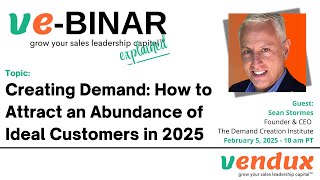
Henning Schwinum and Sean Storms explain the difference between demand creation and demand generation in B2B. They cover operational precision, designing unprecedented value, and practical tactics for solopreneurs like building reusable content and using force multipliers to stand out.
Chapters
Welcome, everybody. Thank you for joining us for this edition of our webinar series. I'm honored to have Sean Storms here with me and he'll be introducing himself shortly. Let me quickly cover housekeeping notes. We would like to ask everybody to keep their microphones muted during the duration. And when we come at the end to the Q and A portion, then we'll ask you to unmute yourself. But the sound quality just is better for everybody when people stay muted. We'll have a Q and A, as I said, probably in about 25 or 30 minutes is when we're kicking that off. We're recording this webinar as we always do, and then we'll make it available on our website so those who weren't able to join us live have a chance to watch it afterwards. Our topic today is very interesting. It's labeled Creating Demand. It's something that all of us, whether we are solopreneurs, whether we are CEOs, whether we're consultants or fractional executives, owners of software or manufacturing business businesses, for all of us, it is really important to know how to create demand. And Sean is an expert in that. And we'll cover that topic today. Sean, if I may ask you to introduce yourself and tell us a little bit about yourself.
Well, hello everyone. Thank you for having me on today. This is an honor. I've known Henning a long while. I like what he and his group does. So happy to be here. We'll try to keep the bio short. When your hair gets to be this color, sometimes that bio can be a little long, but we'll try to keep it short. So I'm a veteran of two Fortune 500 companies and the first 12 years of my career. Fresh out of school, I was really all ears and eyes. Mouth was shut. I was learning like crazy. By the time I was 27, you couldn't have told me anything. I thought I knew it all. I don't know if anybody else has been 27 before, but I was, I was pretty sure based on my mentoring, great bosses. This was at a again a Fortune 500 transportation company at the time. And I thought I knew it all. So I'll come back to that. As to when I was thoroughly humbled because I'm sure Henning has some questions around that. I then spent another two or three years with another Fortune 500 company in the industrial supply space. In between and beyond that last Fortune 500 company, I got my small business experience. Nine years, one company, few years at another. And then I started leading companies at the president and COO level. What I can tell you is when I went out on my own in 2009, because I'd had enough of that, so to speak, everything that I had learned along the way, I learned that demand creation was real. I read a book by a guy named Adrian Slywatsky. That's a mouthful. S L Y W O T Z K Y Adrian Slywotsky. You can find it on Amazon, literally called the Demand. And it was fascinating to me and I'd been using a lot of that along the way, but that's pretty much my bio. But there are stories within there that I've already alluded to. So, Henning, I'm going to turn it back over to you, but I will say this. Every company that I led after those companies that I worked for, we created demand. Demand generation is a marketing term. I'm going to say that again. This is not demand generation. That's what, that's what run of the mill, status quo marketing companies do. Most of them don't do it well. I'm talking about how in B2B, how in B2B can we bring the ideal marketplace, the ideal client, not all of them, the ones that are ideal, to us. How can we bring them to us? Us? Sixteen years in, I have never cold called, never picked up the phone, never joined all the groups locally or beyond. I've never done any of that. And Even here in 2025, kind of flush with business. So it does work. It works like a charm.
Okay, well, you highlighted B2B as a specific focus. I know from your career that that's been your focus. What do you see as the difference in demand generation between B2B companies and their efforts as well as those who are targeting consumers?
It's a great question, Henning. Thank you. And to be clear, you know, Henning, he's way smarter than I am. But it can show you we're not talking about demand generation. I'm going to be a stickler about that. It is demand creation. That's, that's where they come to you. Whereas demand generation is a, is a run of the mill marketing term. So as I studied this issue of, you know, the very, very few examples handing that I saw in B2B, it was striking to me that a lot of what I learned is, is blasphemy to people who have been on the B2B side their entire career. Their entire careers. As an example, B2C doesn't have salespeople. I am a big fan of this term or this this sentence, the only reason why the sales organization exists in B2B is because demand does not. If you could create demand, you wouldn't necessarily need traditional salespeople who have to go hunt and farm and so on and so forth. By the way, I started out in operations, then branch management, then I wrote all the continuous improvement slash total quality management training for Yellow Freight System, which was this big Fortune 400 transportation company. And I learned a lot from W. Edwards Deming. Dr. Deming. This is the guy who pretty much after World War II taught the Japanese most everything that they know. Their national industrial award is the Deming Medal. I learned a lot from that guy and I actually got to sit with him a few times, which was fascinating. And I say all that, that the difference between B2C and B2B is this. Look at the Apple store. On B2C. If you look at the Apple Store, I will often say to audiences or C level teams that I'm working with, I'll say how many salespeople are in the average Apple Store? So I don't know if everybody on this, on this call here has an Apple Store, but they'll say 10, 15, maybe 20. And the answer is zero. If no salespeople in that store. Most everybody who goes into an Apple Store is ready to buy. You gotta ask yourselves why that is. Why is it that when Steve Jobs passed away the next morning, I went to my local Apple store. When they opened, I wanted to see what it was going to look like. And there were cards, letters, flowers, people weeping and crying. I have pictures of this. It's fascinating. I thought, are they crying for Steve Jobs? Are they crying for their iPhone? Or like why so emotional? Deming taught the Japanese on the B2B side, right? Sony, Lexus, Toyota, Honda, Komatsu, Fuji, Nintendo, all of them. You'll notice that as we got into the 70s, 80s and 90s, they, all those companies became known for high quality and yet they never touted quality in any of their marketing. They never once mentioned the word quality. So we can learn a lot by this that number one, they didn't. In B2C there's no salespeople. So they have to be great if they're gonna right be like Chick Fil A, who's one of my favorite examples, Chick Fil A who recently launched drones over their drive throughs to figure out a way to, to improve the process and serve their customers better. It's just amazing Wall Street Journal article from last weekend. If anybody wants to read it in B2C you will find most of the innovators, right? Because for someone who worked in B2B to this day his whole life, I am telling you that this issue of sameness, the business disease that's reached epidemic proportions. And it's pretty easy to get a business going in B2B, launch the same thing that somebody else has, right? Try to have some incremental differentiation, which my clients, we strike that word differentiation from our vernacular. We want unprecedented value, and it's easier to do than you think to accomplish. But this, this issue of sameness, they have the same value proposition. Then they try to find some rock star salespeople. You know, 86% of them don't even reach 90% of their annual quota yet. We spend $15 billion a year in this country on sales training. That math never made sense to me. Never. So everywhere I went, where I was the fix it guy, whether I was hired as a senior VP of sales or came in to run the whole darn company, I'm telling you, these salespeople, they struggled mightily with, hey, I'm now going to pay you at least more than half of your compensation on customer observations. We'll figure out the insights later. That comes later. Want the observations? What are they doing? How are they doing it? This goes way beyond what these crazy sales training firms. I am public enemy number one to all the national sales training firms because I call them out for what they are, and that is they are continuously furthering this 130-year-old model, which has never really worked. Hence, 86% of salespeople don't even reach 90% of their annual quota. Profitable growth. Sales growth is a leadership responsibility. Right? Are we operationally precise? I have a big client right now that I'm working with. They just found out. This is part of the Deming model, by the way, which is one third of what we're talking about today. If after a year of working on this, they believe they have 40% waste and rework inside the company, that's the operational precision piece. They're a hundred million in top line revenue annually. The owner and the president is like, wait a minute, we're losing 40 million bucks a year in waste and rework? Yes. If you even got rid of 10% of that EBITDA and profitability goes through the roof. The second piece is this difference between B2C and B2B. These B2B companies that knock it out of the box. Chick Fil A, Patagonia, BMW, Whole Foods Market, they stand for something. There's very few B2B companies that people get emotional about, that they stand for something so profound, so customer resonant that strikes the genuine customer chord, that of course they're not going to create demand. They're insaneness. They're just like everybody else. Then the last thing I've already mentioned is this issue of unprecedented value. You see lots of examples. I'll stop here in a moment so you can move on to the next question. You see example after example after example. Designing unprecedented value. I brought a little show and tell today. Hopefully everybody can see what this is. It's a Sketchers shoot. Okay, let me ask Henning, let me ask you a question. Take a guess how long people have been wearing shoes on this planet. 5,000 years, 10,000 years. And yet this little company called Skechers figured out that this little lip here, right, the little lip here on the back is a slip on first ones to do it, they patented it. They now do $10 billion a year. They're bigger than Nike.
Okay, I've never bought a pair of sketchers, but let me go back to Apple, since you cited them as an example. Apple succeeded outrageously in the B2C space. How about the B2B space? In my observation, they're not prevalent. There are other companies who, who, who are better, doing better with the same product or similar products in the B2B space.
And, and would you like to know why that is? I'm sure you know.
Absolutely.
Because if you take that fabulous product that is across the spectrum, they all speak to each other, they all work together. That is not what B2B values. B2B. Right. If you get into the corporate space, it is low cost. That's how they think. And yet if you study W. Edwards deming and his 14 points for management, one of those 14 points is stop choosing vendors and suppliers on price alone. Right? But in this country we don't learn. We just don't learn. My daughter, who's 33 years old, when she was little I used to tell her the story about the auto bailouts of 2008, 2009. And she says, oh no, no, dad, that was, or excuse me, of 1979, 1980, when Carter was still in the White House. She goes, no, no, dad, you've got that wrong. That was 2008, 2009, when Obama was.
In the White House.
I said, honey, we don't learn. By the time that Deming told them it would take you 25 years Japan to get at least a toehold in the American market. Well, they did in the 60s and early 70s when the oil embargo hit, Right. So gas prices went through the roof and suddenly the Hondas, Toyotas and Datsun at the time, which became Nissan, started gaining favor. By the time we hit 1980, GM and Chrysler, they can't make payroll, so we don't learn. And by the way, Ford didn't need bailout money then, and Ford didn't need bailout money in 2008 and 2009 because they were Deming's first client here in.
The U.S. i definitely agree with you about the fact that this economy, this country, is about cheap. And I wrote a blog post about it. Let me come back to your.
Can I say one thing?
Yeah, go ahead.
That is the myopic view of US Business is we're going to keep it cheap to keep cost low today. But then as these computers break in, the example that we used and all the IT support that's needed, what doesn't show up on the P and L is all the hidden cost which gets us to 40% waste and rework. They're just not smart. Go ahead.
Yeah. The statistic you cited earlier, the 86% of salespeople who don't even hit 90% of their target, I mean, is that in your mind solely a demand lack of demand creation problem or also, are there other factors that play into that statistic?
Boy, there's an insightful question. I'll give you the biggest cause of the last half of that, the last part of that question, Henning, which is, are there other causes other than the fact that they don't have, they don't stand for anything, they're not operationally precise, and they don't have unprecedented value beyond that. One of Deming's 14 points, which drives traditionalists nuts, is to do away with all quotas, all numerical goals, which I did in every stop that I had for the last 35 years. Those lag measures, if you will, are nothing but results. And if that's what we're going to hang on people, it's literally blindfolded shooting darts at a dartboard. Yes. They have forecasts, they're never right, so they start hanging. How many times have we heard the salesperson who hits 112% of their goal, they make bonus, they do well. And what does the sales manager do? He bumps that thing up to 130% of goal the next year. It's just asinine. Deming was a statistician in terms of his trade, his education. Right. He was brought to Japan to help with the census because a lot of people had passed away after World War II when he saw what was going on in their manufacturing facilities, he teaches them all of this. And so he said, everything is a system. So, Henning, to your point, if I've got a salesperson who has the worst territory out of 15 people that I have, and it's been mismanaged forever, and we bring in the new salesperson, how can they possibly hit whatever quota I give them? Because the system isn't capable of it. This idea of not understand Systems thinking in B2B is still shocking to me. It's shocking.
One of the reasons that I would add to the list is that goals, if you set them, reflect wishful thinking by management. They are not realistically based on what a territory can actually deliver. To your point, what this system can deliver, because it's often not the person itself, it's the system that determines that.
Couldn't agree more. And that's why the CEOs and business owners that I meet with once, they say, oh, but wait a minute. The ones who achieve those really high goals that we give them, those are the winners. Those are the rock stars. I stand up, I shake their hand, I say, thank you very much for your time. I appreciate the invitation. See you later.
Yes, a lot of the folks that listen to our webinar are solopreneurs. Solopreneurs as consultants or as fractional executives, what are your recommendations to someone in that role? To stand out from the crowd, to create and put themselves out there in a way that they can create. Demand.
Well, I'd say it's a tough one, but it can be done because I've done it. And I'm no smarter than anybody else on this call. In this day and age of digital everything. Podcasting story, what's unique? So I know a ton of consultants. Some of them, you know, are fractional CFO, CMOs, so on and so forth. Rarely, when I'm asked to look at the value proposition and however they've articulated what they believe they, they stand for, it's, it's. They've tried hard, I'm not throwing stones, but they don't really understand what purpose really is. So quick freebie for. For the audience. Often you will hear individuals or companies or organizations inside of companies. Here's the mission. This is our mission. And it's three pages long. I'm being facetious. It's not what it is. Purpose statements are seven words or less. And they're if it's for a company, it's meant to inspire and it is meant to give the employees an idea beyond a paycheck as to the difference the company's trying to make in people's lives. So if it's an individual, let me keep it on track here. If it's an individual, I would say why did you become a consultant? Truthfully, why did you become a consultant and what is the difference you're trying to make in the world and or people's lives? That takes time. The mission is the short term core strategy that fulfills the purpose. Again, mission is the short term strategy that fulfills the purpose. It is the most important thing that can be done to fulfill that purpose in the short term. Consultant might be three months. Companies easily six to nine months. Vision. Vision is what is what the purpose looks like fulfilled in the future. Vision is what the purpose looks like fulfilled in the future. So you can't have vision and you can't have mission without purpose. But there's not a whole lot of people who get that. Read the Advantage by Pat Lencioni. That'll pretty much set you straight on what those three definitions are. So I think they have to have a core purpose statement that is not meant to be marketed. It's internal. Its utility is internal. From there, figure out what has to be done in these short term increments, right? Starting with your first three months and so forth. That's your strategy. Mission to strategy. I would then say it's a lot of what we're doing today. It's, you know, I had the Kansas City Business Journal Growth Strategies column, guest column for five years and then that thing went national. So for two years it was then in 42 markets. I had a lot to say about what you're hearing today and it was new and different. And you can drive a ton of of significant, exponential, sustainable, consistent, profitable growth by doing it in a very different way, front loaded. So my thing is how do we front load everything? So by the time we get to the business development and or sales component, they're like, they're like Apple people in the store. They're just facilitating. What can I help you with today? Tell me what resonated with you? What would you like to know? That's what it becomes so that we don't have to do so much traditional selling on the front end. So those are the things I think that solopreneurs need to figure out what's distinctive about what you're doing and how you're doing it. I'll say one more thing and then Be quiet. Pick a fight. Pick a fight. Professionally and tactfully. But I'm telling you, if nobody hates it, nobody loves it. There's a ton of people out there who can't stand Southwest Air. They can't stand Whole Foods Market. They can't stand Tesla. They can't stand Apple. They wouldn't partake of any of that if their life depended on it. There's lots of different ways to create distinction, to have unprecedented value in the marketplace. There's lots of ways to do it. You just have to spend a lot more time on the front end understanding your customer. B2B. 99% of the companies that I dealt with, they don't know their customer. They don't know them well at all. And so it's everything is sameness.
Okay? Something you said early on in the last two or three minutes was that the purpose is something internal. So it's not like a mission statement that you plaster all over your website or that you communicate to clients. It's not the headline that we put onto our LinkedIn profile. Purpose Statement is something internal. Does that also mean that it can be something like, I want to make tons of money?
Yeah, good question. Anytime somebody says to me, CEO of a company, president of a company, business owner, and I ask them that question about purpose, you know, and they say, well, yeah, it's obvious. We're here to make money. I want to make a lot of money. I don't walk out of the room. But I say, that's a result. That is not why the company exists. And that's not the difference you're taking. Trying to make in people's lives. That is not purpose. So the utility is internal. Here's a good example. And please remind me about how it reflects out in the marketing. It's what informs your marketing. Operational precision, what you stand for. What's the unprecedented value that's what informs the marketing, that all of them have the cart before the horse. What I just described is the horse. Get that done first. So think of Southwest Air when Herb Kelleher and his partner in 1971 were drawing that little triangle on the napkin, right? Houston, Dallas, Austin. They said, the purpose of this company is to democratize the skies, because at that time, took some real cash to fly. Democratize the skies. That eventually became. It informed their marketing, right? And their marketing was the freedom to fly. There's an example I can give you about internal purpose. How can it reflect out and inform your marketing? The freedom to fly bags, fly free. That's how we Democratize the skies.
You also mentioned that there are a lot of people who don't like Southwest who don't like Apple. I have never bought a pair of Skechers, so you know that. How much does it also have to do, and I think you mentioned that before, is understanding your audience, understanding your target market. And don't try to be everything for everybody, but be something for the audience.
That you're targeting and so you'll be happy. Finally, a short answer. And it's a great question. Thank you. Two questions that all of us need to work through. The first question is this. Well, I'm drawing a blank. I know. The second question, how do you invest in them?
Well done.
The first question is going to be, well, maybe I'll come up with the first one as I come up with the second one. So the second half of this question is. Oh, I know it is. First question is, who do you need your ideal customer to become that? Sometimes that takes months. I'm not kidding. Who do you need your customer to become the ideal client? Who do you need them to become? In my case, it was I needed the B2B to senior leadership at large, nationally, internationally, to agree with me that this very broken sales and marketing thing that's been out there for 100 years plus is not the most effective way to drive profitable growth. I needed that. So the second question now is, how are you investing in them today to ensure that outcome? How are you investing in them today to ensure that outcome? So, business journal column, tens of thousands of people reading it. Lots of keynote speeches that came out of that. Certainly things that I've written. You know, my LinkedIn feed has so much. It's not even funny articles, you know, weekly posts and so forth. Just so much relative content. So again, to. To repeat myself, is who do you need them to become? That'll help you flesh out who the ideal client is. And then once you have that, the second piece is, how are you investing in them today to ensure that outcome?
Okay. And again, that means it's not the entire market. Southwest doesn't target every single person that wants to fly, but a specific segment of that market. And that is something that every. Even solopreneur can embrace. They can. They need to define very clearly who they are targeting, who they're going after.
Yeah, without a doubt. Yes.
And use those two questions that you mentioned.
Yes. And since we're talking about solopreneurs, whether you're consultants or what have you, I'm happy to have 1% of the market at Large because. Because they align with my. My unprecedented value proposition. And yeah, you just gotta figure out what you stand for. Once you figure out what you stand for, draw a line in the freaking sand, go out there and tell it to the world. Watch what happens. You're gonna have probably the majority. If it's, if it's controversial, most people will disagree. And then a small, small portion will align with you and say, oh, I hear you.
Yeah, we'll open up the Q and A in just a little bit. Let me ask, sort of touch upon one more topic. Ask one more question. Before in your statements, as you take your ideas to market, you talk about the fact not only that it creates a steady, profitable demand stream, but also that it shouldn't be time consuming and it shouldn't be expensive. Can you talk a little bit about how that can work for, again, the. The audience, solopreneurs, people who put themselves out there, what can they do to ensure that their efforts are successful, yet they are not time consuming, which is one of the. Or maybe the most important asset for every solopreneur.
Absolutely. First thing I would say before I give you the definitive. My definitive answer is make sure everybody goes to their customer base and says, look succinctly, what do you think I do? What do I do? And see if they're telling you something distinctive and if it aligns, what you believe, what you do. So let's start there. Some of the answers can be surprising. I was a big fan of watching the television show Homeland, starred Claire Danes, some other folks like the, the, the. The show. Homeland ran for a lot of seasons, and I learned in that show, you know, CIA espionage all around the world. She was constantly collecting assets. So my question is to. For her benefit, right? Because what we're looking for here are force multipliers. Ask yourself what your force multipliers are. I finally got my head out of my rear end and in the last couple of years built a learning management system. So modules were shot, videos were shot. It's a really cool tech platform where this thing resides. And so handing it, you can only imagine how much time it saves that I don't have to be there for it. I can hop on the call once a week for an hour. Tell me this cohort, right? Tell me what you guys are facing. What module are you in? Tell me where I can help you. So in lms, all the content, this particular podcast that can be sliced and diced 14 different ways that I can send out, what are all of these assets that you've Collected that you can put out into the various forms that are out there. You all know what they are. It is LinkedIn and Facebook and YouTube and all these places make it easy for your advocates, for your, your raving fans, your customers, make it easy for them to refer you. I mean, again, force multipliers. What is it that compounds which? Henning, I promise I won't take us down a rabbit hole. This whole thing that I developed around. And by the way, if anybody wants it, I'll send it to Henning. He can forward it out if he wants. But there's a Venn diagram I have of these three pieces and how they work, of operational precision. Right? What creates demand, what operational precision it is organizational fitness, purpose, mission, vision, and so forth. And then unprecedented value, the design of it. When I hit that after 20 years in business, that's something I can give out to the world. And if people align with it, they contact me. When anybody that I know says, hey, I want to revere you, I'm doing now business with private equity firms, which is fun. Why? Because they have portfolio of companies. It's one of many. Why would I go back to one on one when I can go to a PE firm? Say, this is what works. Let's do it across all your portfolio companies. It's a win. Force multipliers. Collect assets, figure out what they are, make sure they're profound, they work, they're, they're, they're different than a lot of stuff and go forth and multiply.
Great. Thank you, Sean. Let's, let's open up the microphones. Anybody wants to ask a question, just either raise your hand in the through zoom or unmute yourself and ask a question. Andrew, you unmuted yourself.
Hey, thank you very much, Sean. Great discussion. Thank you very much. I. In the spirit of what do I do? If you line up 10 different CEOs and company leaders and you ask them, what is the role of your finance and accounting people? What's the role of your quality control organization? What's the role of your marketing lead? I think you'd probably get pretty consistent answers if you ask what's the role of your salespeople and your sales organization? I think you might get 10 different answers. My perception of this, what do you do? And the role and salespeople and sales organization. It certainly in my experience, talking with business leaders and CEOs on a regular basis, there's a vast range of perceptions of what salespeople do. And this might be one of the issues between your sales organization, your Sales mission and the customer on the other side of the equation and connecting the dots between the two, what's your perception here on what sales organizations do and that distinction of the definitions.
So again, you line those 10 CEOs up where they, they have. Sometimes their, their education gets in the way. I mean that in a nice way, believe me, but their education gets in the way. But the really insightful ones, the ones who are living in 2025, marketing is the new selling. The problem is, even if they believe in that, I'll explain that in a moment, Andrew. But even if they believe that I say marketing, they think of marketing as, as it has existed the past five years, 10 years, 50 years. Marketing is the new selling. Okay, so take the salespeople, I'm going to put them over here for a minute. If marketing is the new selling, my question to the head of it is what are you doing under the heading of marketing? Because they're going to look at you and shake their head and go, what? Right. Marketing, Andrew, is not a department, not a department. Communicates. Everything in the organization communicates. I've done this in three different organizations. I led $20 million company, 60 million dollar company, 100 million dollar company. I went to the head of HR. What do you see as your responsibility in marketing? How does it work? How are we taking care of the customer? What are we communicating to the outside world? You get the whole organization communicating like that, like Zappos does and a lot of other ones. Again, B2C examples. The sales organization literally. Well, not literally figuratively sitting by the phone waiting for that thing to ring because the outside world is feeling it. Phone rings, they go, hey, I heard, I heard about you guys. This way, that way or another way. Tell me how this works. How to the whole sales, sales organization literally. Well, not literally figuratively sitting by the phone waiting for that thing to ring because the outside world is feeling it. Phone rings, they go, hey, I heard, I heard about this conversation flips. When they call you. Let's say Henning was a. Andrew, let's say you were a, a prospect. I'll go fast. And you had called me and said, boy, I heard you on this podcast, you know, let's talk. How does this work? And I would literally just say, well, thank you for the call, I appreciate it. What resonated with you? What is it? What do you see in your organization where this might be able to help? I'm just asking questions like a two year old would. They're going to sell themselves on my value proposition and when we're done, all I have to do is say, great. Appreciate it very much. I think I understand your situation better than before. Pause, 1, 2, 3. How can I help you? And they tell you. Because all this stuff preceded us. The only reason the sales organization exists is because demand does not. Let's front load it with all the things that should be communicating within the company. Let's get that out into the world and let's create demand. So the sales organization, I tell you what I did at a Fortune 500 company and then at smaller companies. I turned them into detectives. I turned them into people flying the drone. They were all investigators, they were all scouts. And all I tasked them with was every week when you come back at the sales meeting. I didn't threaten them with termination, but I said, you had better be bringing what you learned about these companies. That's new and different. And every time that happened, about three months later, we'd figure out something amazing to do for these customers. And that. That started to separate us in the marketplace and create distinction and we didn't have to worry about selling.
Yeah, but.
But all these sales managers and all these CEOs. Cold call, cold call. How many calls did you make today? Sell, sell, sell. It's idiocy.
So the 150 billion invested in sales training should be invested in getting an organization fit to do marketing at every level of the organization and at every functional area of the organization.
Do what Deming said. Henning. On the front end, it's operational precision. Right. So we got to make sure we're rooting out the waste and rework because the customers feel it. The billing is wrong, the customer service is wrong. The customer experience is not great. Operational precision on the front end. Got to fix that one. Saves money. Profitability through the roof. Customers feel it, makes it easier for the sales organization. Let's go stand for something. Let that inform our marketing. Then let's figure out what customers really need. Let that inform our marketing. Can you imagine a sales organization where the CEO came out in a big meeting and said, we are working on these three things to make your job 90% easier?
Well, they all.
CEO responsibility. It's not a sales responsibility.
No, it is. I agree. But I think all CEOs say what you just said. They may say it in different words, but they feel that they've done everything in every other department. Right. And it's just sales not performing as a. And then, you know, the. That's why they have the target on their back and their tenure is half that of any other employee in the company.
I'm with you. You know, years ago I lived in Rochester, New York and one of our biggest accounts when I was at the trucking company was Eastman Kodak. Eastman Kodak. They thought they were in the film business. They didn't realize that they were in the photography business. Rest in peace, Eastman Kodak.
We're nearing the. Oh, Bill, raise your hand. It's yours. The floor is yours, Sean.
Thank you very much. And on the Kodak thing, I would say that they were in the capturing memories business.
Love it.
It's, it's.
You know, I've been in food for 35, 40 years and right now I'm full time W2. But I'm, you know, at some point in the next couple years, probably will get back into consulting or fractional or something along those lines. But to me, the, the superpower for marketing is creating an emotional connection with your company and the consumer or your internal external customer. I love what you said about marketing. I'm a slow adapter to valuing marketing because early in my career, marketing was just an allocation on P L that took profit away from my bonus structure. So now maybe I'm a little wiser in realizing that marketing is all of our responsibilities and a value. But I just. The Kodak thing brought. Brought that emotional piece to me and I just wanted to say thank you. I've really enjoyed the insights you shared.
You're very welcome and thank you. That means a ton to me. Let me give you one example. Was it Bill?
William.
William. I'm very sorry. William. So think about this, Henning. I promise again, I'll be brief. I'm working a bit with a. Oh, a national organization. I wouldn't call it a peer to peer group like Vistage, but they're a national organization, financially focused, a lot of fractional CFOs. So I'm helping them. William, tell me if this doesn't resonate in terms of everything's marketing. I said, so why would somebody use you, right, versus somebody else? Time and again the principals kept saying, oh my gosh, the amount of time and money we save them. It's like, oh my gosh. How many times have your clients heard that? Right? They said, no, no, you don't understand. They sign up for a year. Those first 90 days after we're done, those next nine months, we're actually making money for them. They've recouped all the costs they've spent with us annually in the first 90 days. I said, hold on. You prove that they said yes. I said why are you not going to market saying that you can help them be a profit center, that, excuse me, your organization can be a profit center for them. Do you see the difference? What CEO in the right mind is going to say wait a minute, you're going to start making money for us after three months? Yeah, I'll take that deal.
Great. Thank you. Dan, you raised your hand. I'll give you the last question before we close up.
Great, thanks. Interesting. And one of the things you said, one of the things you talked about was how quotas were lagging indicators. And, and I agree. What do you see as the leading indicator that would instead of looking at the past, begin to deal with the future? Excellent question. Thank you. By the way, one other lag indicator that actually I give to my clients once we're done because this isn't easy to do. This is growth transformation. What I say is, okay, how many unsolicited, unsolicited qualifying prospects are you getting every week? Right. Because once we do this right, we should be getting now unsolicited prospects. And you're measuring that, right?
Correct.
Okay, so as an example, I'm just a one man show. It's a consortium. I have other people that are partners on the outside. Right. This is an institute that I have two this week, Today's Wednesday. Not bad. I'll take these two so far this week that I've had unsolicited. But those lead measures, remember I mentioned my sales teams. Now remember in my, my W2 career I've had 700 sales people cumulatively across those 30 years running sales organizations, remember I came up through operations, continuous improvement. That's how I saw sales and I didn't like it. So I had to do something else. So we look at causes of the problem. First one is what you mentioned. We got to stop worrying about the lag measure. Those lead measures would be what are the observations that we're tasking the salesforce bringing into the organization every week that they have to be taught how to do that? By the way, what are the open ended questions? Are we seeking to understand or did we hire a bunch of people who were told since the age of 2 years old that they could sell ice to an Eskimo? 95% of the people that I terminated, the rears didn't work. Had to get rid of them. They couldn't change, give them every opportunity. They couldn't go in, ask but right. This is an institute that I have two this week. Today's Wednesday. Not bad. I'll take these two so far this week that I've had unsolicited. But those lead measures, remember I mentioned my sales teams now remember in my, my W2 career I've had 700 sales people cumulatively across those 30 years running. Sales or wonderful questions and take that information and say thank you and just go back. First of all, your positioning with that customer or those prospects is going to go through the roof because they're not being sold to. You're just trying to understand what they do, how they do it so you can better help them. That that's key. So that's the first thing I would do. The other part of it is if, if everything communicates and marketing is the new sales, what are the sales people doing under the heading of marketing? How are they helping further the company's purpose? How are they helping the company achieve its mission? How are they, how are they working with other companies? How are they helping their internal customers? We don't have enough time for all the things you could put on the front end but there's a lot of things that you could judge salespeople on on the front end that informs. Right. What these results are going to look like down the line.
Good point.
Great answer. Thank you.
Thank you Dan. And most importantly, thank you Sean.
For organizations. Remember came up through operations, continuous improvement. That's how I saw sales and I didn't like it so I had to do something else. So we look at causes of the problem. First one is, is what you mentioned. We've got to stop worrying about the lag measure. Those lead measures would be what are the observations that we're tasking the salesforce bringing into the organization every week that they have to be taught how to do that. By the way, what are the open ended questions are we seeking to understand or did we hire a bunch of people who were told since the age of 2 years old that they could sell ice to an Eskimo? 95% of the people that I terminated, their ears didn't work. Had to get rid of them. They couldn't change, give them every opportunity. They couldn't go in, ask wonderful questions and take that information and say thank you and just go back. First of all, your positioning with that customer or those prospects is going to go through the roof because they're not being sold to. You're just trying to understand what they do, how they do it so you can better help them. That that's key. So that's the first thing I would do. The other part of it is if. If everything communicates and marketing is the new sales.
Joining us today was a great session. I appreciate it. How can people get in touch with you if they want to learn more?
So my email address is Sean S E A n at the DCI. That's Demand Creation Institute, Sean. The DCI co not.com that's probably the best way in LinkedIn. You can find me pretty easily on LinkedIn.
Sean storms wonderful again thank you Sean for joining us. Thank you everybody for listening in today and later on when you're watching the video. Have a wonderful rest of your day. Take care. Bye bye.
Thank you. Thank you very much. What are the sales people doing under the heading of marketing? How are they helping further the company's purpose? How are they helping the company achieve its mission? How are they, how are they working with other companies? How are they helping their internal customers? We don't have enough time for all the things you could put on the front end, but there's a lot of things that you could judge salespeople on on the front end that informs right. What these results are going to look like down the line.
Good point.
Great answer. Thank you.
Thank you Dan. And most importantly, thank you Sean for joining us. Today was a great session. I appreciate it. How can people get in touch with you if they want to learn more?
So my email address is Sean S E A n at the DCI. That's Demand Creation Institute. Sean at the DCI co not.com co that's probably the best way in LinkedIn. You can find me pretty easily on LinkedIn.
Sean storms wonderful again thank you Sean for joining us. Thank you everybody for listening in today and later on when you're watching the video. Have a wonderful rest of your day. Take care. Bye bye.
Thank you. Thank you very much.
More from Henning




ve-BINAR - The Revenue Tornado Methodology: How 3 Power Sources Create Exponential Growth


ve BINAR: Executive Cloning: How AI is Reimagining the Role of the Fractional Executives




veBINAR: Unlock Client Value: Why Compliance is Crucial for the Startups You Serve
