ve BINAR Current State of Funding for Startups and How Founders Screw Up Pitches
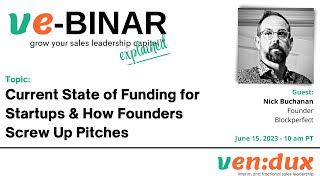
This is a recorded Vendex webinar (June 15, 2023) featuring Andrew Miller interviewing Nicholas Buchanan (founder of Block Perfect). Buchanan summarizes his engineering-to-entrepreneur path (25+ years across startups and enterprises), describes Block Perfect as an early-stage venture studio focused on AI, blockchain, IP and gig-economy startups, and explains the studio model (lean, prescriptive, faster to revenue, higher TVPI) versus traditional VC. He discusses current funding market features (dry powder, institutional interest in blockchain), practical programs (Founders Roadmap, Venture Catalyst), common founder mistakes (no market testing, poor investor-aligned financials, weak team), and tactical advice for preparing fundable pitches.
Questions this video answers
June 15, 2023
More than 25 years
$2.5 million
Founders Roadmap (Founders Roadmap Raise)
Chapters
Welcome to today's Vendux Webinar. I'm Andrew Miller, one of the partners at the Vendex Group where we focus on helping clients to grow their sales leadership capital. I am thrilled to have Nicholas Buchanan as our guest today. He's the founder of Block Perfect, an early stage venture studio that provides services to startups that are focused on AI, blockchain, IP and the gig economy. One of his superpowers, and he's got a lot, is preparing startups for funding rounds. He grew his first client to 250 million in an in AUM. Nick is also a product and an engineering leader. He's got more than 25 years experience with startups and global enterprises like IBM, PwC, Armor Scientific. As co founder and CTO of Armor Scientific, Nick developed private permissioned blockchain networks for decentralized multimodal authentication and he actually led that company through a $2.5 million seed financing. I will let Nick round out the intro of himself in a second, but a couple of quick housekeeping notes. We'll keep everyone muted for the duration of the webinar and then at the end you can either use the chat function in Zoom to submit your questions or just feel free to open up your mics and engage with Nick directly at the end of the webinar. The webinar is being recorded and will be available shortly afterwards on our site as well as on YouTube. So let's jump in to the heart of the subject today, which is the current state of funding for startups and how funder, how, how founders screw up pitches. And so there's a lot here. So right out of the gate. Nick, welcome again. Great to see you. Thanks for being here today. So tell us a little bit about your career, your background and how you got started in the venture studio business.
Oh, thank you, Andrew. I really appreciate it. I got my start in my career as an engineer, as many entrepreneurs do. I was very passionate about what I could do with computer and at the time I had a different career path. I was selling life insurance of all things and it found out that I was very, very poor at life insurance. But I was pretty good about the infrastructure necessary to support sales team teams. That was my first professional job. From there I went on, it's like, all right, I want to be an engineer. I got a job at, at EarthLink. It was acquired by, first of all, it was JPS required by EarthLink. So it's my first experience with an acquisition, went from there to EDS, second experience of acquisition, exit to Hewlett Packard from EDS. I went to Pixo, which is the, which at the time was the largest social network for teen girls and boys in UK and Canada, and put that on a timeline. This was before, before Facebook, but after MySpace. So we were chasing after that 500 and some odd million dollar acquisition. We exited Pixo for $108 million to start all. And then from there, for whatever reason, I chose to spend a decade at IBM Global Services. So I went from being very knowledgeable about very nascent, very early term businesses to okay, what's the ultimate, you know, opposite stream of that at IBM. I was there, I had an opportunity to travel throughout the world. I wrote several books on content and also on SEC regulations. Having that background, I took a dive again. It's like we're going back to the startup mode. Took a role as a product manager at a company called, oh, what was it? Secure Auth. Secure Auth is an exit of 531,541 million to Core One Security. And believing that I could build yet a better mousetrap, I launched Armor scientific. Raised about 2 1/2 million dollars, took them to RSA. I had the former COO of Raytheon Cyber on my board. I had the former CISO from Microsoft, and my chief hardware designer was the former designer of the ipod and Apple Watch, the first generation of each of those. I then went on to PricewaterhouseCoopers, did the exact same thing again. It's like, where's the other extreme? And then from there we started Block Perfect. We were recruited out of PricewaterhouseCoopers by a decentralized exchange. And then we launched Product Perfect very soon thereafter. What we found was at this particular moment in time and around 2021 to 2022, the ability to get capital for these projects was very, very easy. In fact, you could have a deck with maybe eight slides in it and no graphics and just some basic information. As long as you said blockchain protocol and a bunch of guys in their early twenties who will work all night long, that was all that's required. And I think that kind of leads into our main topic and that no longer holds any water. And we're seeing a lot of capital that is now tied up in dry powder, but people aren't able to attach to it because of the fallout from this particular industry. And that was, brings us here today.
Yeah, that's a great background. So, but, but why the switch? So I'm what is Block Perfect and the Venture Studio concept at the most basic level and then from engineering, how and why did you actually make this switch onto the business side?
Well, I'll answer the last question first. After spending a decade at IBM, I very quickly realized that the plumbing of the business is not as complicated as it's made out to be, even at the most extreme ends. So I very quickly figured out that, look, I could apply the same skills I had as an engineer to finance business and then instead of making somebody else wealthy, I could make myself wealthy. So that was really the impetus for going out hang my own lathe. Now how we what block perfect is is a venture studio. And if you've ever gone out and tried to raise capital by yourself, there's a lot of no's you have to go through. And if you're a new founder, you make a lot of mistakes. And the mistakes aren't that your product isn't where it needs to be. It's not that you know they didn't like you. More often than not, you just aren't meeting their investment criteria. And the way that they select those investments is pretty specific. There's a thing called investor discipline. And when you don't meet investor discipline, it is not in your best interest nor theirs for them to fund you. So we decided that because that results in about like 98, 99% of businesses never seeing the light of day. We wanted to create programs and services that people could start a lifestyle business part time gig or their next unicorn. And that's what we built the studio around. So we don't have to go and build a $15 million company. We can exit at two and a half million to a private equity firm. And the founders end up with the same amount of retained capital. So you get as a founder more capital sooner than you are in a unicorn anyway. So what does this mean in terms of competition? Well, everybody's heard of Sequoias and the Menlos right now if I'm a liquidity provider to Sequoia, my expectation is going to be about 1.58 times my money back or 1.8 times TVPI. And when you take a look at the studio model, right, which is much more lean, much more earlier in the stage, and also prescriptive in the way that we do ERP and everything else, so we get to revenue much quicker. TVPI typical. Typical is about 5.8 times the money invested. So that allows us to do some very, very interesting things. Two of them are most important. One is it allows us to start any company just based on a market opportunity similar to how you might choose a stock. We can do the same thing if there's product out there and we know there's a fit and we're really good at figuring out whether or not there is product market fit. The rest of it is more procedural and less black magic. We design the program such that the founders can concentrate on what their superpowers are so that we can kind of take care of the rest. And we often exit them at about a series A. That's when we, we when we're no longer an appropriate consulting firm because we want to stay in those early ones. Because as soon as we get out there, the multiples start to wean off. It's not as profitable for us. So it's a lot more fun to work in those earlier term, early stage businesses. It also allows us to do what's called refounding and that's where we'll take a business and we'll do what's called a micro acquisition and we will acquire the company in principle and then we'll find new staff, build out their executive team and then go out and remarket that company as an investable company. And to give you an example, working with one client right now they have negative revenue year of Eric's month over month. So they're actually losing cash. Well, we brought in a Vendex resource and a few others to backstop team and another resources from Block Perfect and that is a designed TVPI of 7.6. So the business is set up now to where as long as they hit their number and their number is specific month to month to month to month to month, they're going to get to the revenue number too. Right. And that's what it's all about. It's getting to that number. It's not about hey, spend a bunch of money and then, you know, kind of maybe you might get funded. Because the reality is most don't and most shouldn't.
Right.
And if you're looking at this as a long term wealth builder for yourself, you probably want to consider more than one thing than just venture capital. That's what venture studios come in in general.
Yes. So to that point. So you, your, your ecosystem of course includes in the investor side.
Yes, it absolutely does.
What does that look like? Are these high net worth individuals what, what kind of capital and what is that capital interested in? What are they looking for at this moment these days in this environment?
So we use a variety of different capital sources. Sometimes we'll use debt, sometimes we'll sell your future revenues Right, that's one way to raise capital. Another one is venture capital. What's been really popular maybe in the last 12 months is going directly to liquidity providers. And that means that the companies themselves are going out to family offices instead of going through a VC and then to a family office. Institutions are getting directly involved also. And this is not just in equities, this is also happening in the blockchain space. JP Morgan is very prolific in the Cosmos ecosystem and Visa is very prolific in the Ethereum ecosystem. In fact, Visa is producing research papers one after another as to the viability of the technology for their particular business. So, so that tells me that it's here to stay, it's going to be a mainstream technology and it's why it's one of the pillars of the things that we look at. So of all the places we have capital, we've got private investors, high net worth individuals, institutions, venture capitalists, private equity, private debt, public debt, future selling of future revenues. And that flexibility means we could do a heck of a lot more and stick and be a lot more nimble than perhaps venture capital. Because what ends up happening there is, you know, you get to a point, maybe they don't do good cash flow management and they're starting to run out of money and then you get into this desperation cycle of trying to get that round in right? And if you've ever been in a company that happens and the first time they say we missed payroll, right, Everybody kind of knows what that means. So if the only thing you're looking at is venture capital in order to grow that business, then you're going to have a very narrow bit of opportunity. Because if you're not growing the way that they expect in a venture capital fund, there's a theory of fail fast. So in other words, my companies that I know are going to be my, my, my, my money makers, I want to put my follow on capital into those companies, then the ones that are faltering and failing, they're fail fast. And if you were to compare this to an analog in the stock market, in the stock market, when you put in an order, you put in your order, you put in a stop order so that if the price of the stock falls to that point that you can get out and then you put a target order in, right? The same thing happens here, only in a fund, we don't have those things. This is private equities, these are private placements, they're not public. So in order to manage their risk on the back end, if you're not, if you're slipping, you're not getting your, your two times revenue or three times revenue, then you're going to fall into that fail fast bucket. And especially if the economy is allowing those bigger companies to perform really well. And we've seen that a lot. If you've ever been in a company, it's like, why did they make that weird decision? And it seems like we're driving things into the ground. They're driving things into the ground. That's deliberate. It's not a mistake at all.
Got it. So as, as a young company looking for capital, when do I go to a venture studio? When do I go to a vc? Are they mutually exclusive? You know, from, from the startup point of view and then from your point of view, if you're, you've got your venture studio hat on and you've got your VC hat on, what are the main differences in those operating styles or the value that's delivered?
Well, first of all, the studio model is way down market. When we're talking about venture capital, we're talking about somebody who's had a Series A. So they have at least, at least a million in annual revenues, preferably 5 to 10 million in revenues before they start to see those other funding rounds start to kick in, right? So that very much narrows what is appropriate for a venture capitalist. And then again, when it comes down to making those funds actually profitable, if they were to deviate from that investment discipline, they wouldn't make any money. Now that said is that that is still not the most optimal way to generate wealth. If you're looking at where the hypergrowth happens. It happens in the early stages. That's when you get the crazy 2, 3, 4 times multiples is because it's very easy to do when you haven't captured 15% of the market yet. Now if your plan is to say, hey, look, we're going to get out before they get to the chasm or get to the gap, then we've already made the money on the deal and we've already returned tvpi superior TVPI back to the investment. Now it's a venture capital thing. So the beauty about the system is it does two things. First of all, it's way more capital efficient. Number two, you get two bites of the apple, right? You're going to get it on the first round after the seed and you're going to get it again on the VC round if you last that long. Sometimes the VC comes in, that's your time to say, you know what, I've been replaced. It's time to do my next opportunity or whatever the case may be. And that's normal. That should be expected as well. Especially if you've come into a very, very early stage company, they have grown into venture capital and you don't have the same names in your own Rolodex that they have in theirs. That sometimes can create, create a bit of a challenge. But to go for when do you go to each. If you're building a high growth startup and you're a recent Stanford grad, go for it. You match criteria. They're looking for people, they're looking for a team at that level. But if you have something other than that, you can look at a venture studio. Venture studio is going to look at way more opportunities and way more different opportunities as well. And I'll give you an example. Has anybody been to Target lately and noticed these kind of generic looking bottles that say him and hers? They're kind of, kind of hipstery they have in an area. Well, that was done by a venture studio. A shampoo product. You wouldn't even think to do that. Right? Venture studio businesses also don't have to be super sexy tech businesses. They could be other things. There's another studio that is buying up Laundromats and then electronically managing them. All right, so there's different things you can do with a studio that you just can't get done with other ones. Give you another example, Truth Social was done by a venture studio, Turbo sbir, which is a partner of Block Perfect, which used to get sbir loans started by a venture studio. These are companies that would have never seen the light of day had the gun to venture capital.
That's, that's really cool. So I'm in, in just a minute or so I want to open up the floor and get, get folks in asking their own questions and, and interacting with you directly, assuming people want to do that. Nick, from a. You just alluded to the, the potentially very wide breadth of potential opportunities for, from a venture studio point of view. So that could mean you're spending a lot of time on sourcing and you know, kind of screening ideas and entrepreneurs and businesses. Right? So what, what's, what are some of the core things that you've got in your lens to make your screening process efficient?
Fair enough. You're right. You do have to manage resources in multiple areas. People that would do well at a venture studio and managing it would be like project managers or product managers tend to do really well because you have so many stakeholders and when you're in a studio, the attention that those stakeholders need are substantially higher than it is in, you know, a commercial sense or enterprise sense.
Right.
There's enough people around where you slack off the day. I could do that in the studio sense. You don't have that luxury. It just doesn't happen. And for it to. Pardon me, I've actually drawn a blank. I want to come back to that question. Could you ask it again?
No. Yeah, sure. The question is really about screening because.
Oh, screening, yes. Thank you. Appreciate that. So in order to screen all those, you have to be very, very data driven. Things that we look for in partners are people that have actually placed like for. For Vendex, you know, we checked the Vendex place plate before. Right. That have a track record. The other things that we look for partners is, are they turnkey, Is this something they can do, or is this something they do before they get their coffee? There's a very different sense of execution for candidates. What we're looking for are people that have the passion. Right. So depending upon where you're at, we've got one program, it actually launches in September called Venture Catalyst. And it's for anybody with a pitch deck and a dream. Right. These are opportunities that a VC won't look at.
Right.
You come to us and we prescriptively go through step by step. How do you get from my pitch deck and my dream to a fundable company? We establish the company, we incorporate it, we get your safe note done, we get your 83B filed so that you don't get stung on your taxes. We set up a sales team by working with partners like Vendux. We set up a technology team through our internal recruitment. We set up everything that's necessary other than the talent you bring to the table. And that's something that enables a lot more people to approach business than they can otherwise. The other thing that sets us apart is if you ever watch Shark Tank and you know how those guys kind of eviscerate every person that goes up here? That's bullshit in our part of my French, but that's bull. In our, our camp, we believe that most people have the ability intellectually to build a business if they have a market. That's the biggest thing, and it's the number one reason business will fail, is that there's just. Nobody wants to buy whatever it is that you made. But if you've got a market and you've got a passion, you have what you need to build a business, a very successful one. But you need those two. That's what we look for in a founder. What we look for investment has to be investor appropriate. I'm not going to take a seed level deal to people who like to do C deals. I'm not going to take a pre seed deal or a seed deal under a million dollars because nobody wants to fund anything under a million dollars. And also is why we focus on execution and getting the revenue. Way that we are able to get these companies to revenue quicker is a couple things. First of all, we have the tools to actually build out a financial plan right down to the month so we know exactly where we should be and we can put a plan together to a point where we could say this month on the roadmap we'll be able to start hiring salespeople on a KPI meaning I have to have 60% of my team at plan by such and such a date. I should be able to get, you know, individual from first introduction to, to production to actually product producing sales within 30, 60 or 90 days. Right. All those things are kind of thought out ahead of time so that you can concentrate on what you really are there for and that's the product or service, whoever it is that you're delivering on. And you know, when it comes down to it, is that, is it really helpful when someone is insulting you rather than just giving you some constructive feedback? And that's the big difference here, is that you come in here, you're not going to get this think guy. Nobody's going to make you upset because you made a mistake. The cost is set up so that you will make mistakes and learn from them. Right. One of the things that we see people screw up all the time once they have funding is they don't know how to pivot. They are so hell bent on the thing that doesn't have market, they never actually go out and find their market. The other thing is, is that people don't walk in with that expectation. The product you had envisioned, by the time you've done your market testing and you've played with it could be completely different. When we started a Block Perfect, it was not Adventure Studio. It was something completely different. But through pivoting and working and working with the group, we found exactly what was wanted. Then we design everything around that.
I'm going to come back. You said something about oh, you know, the how, how founders screw things up. I want to come back and ask a question about screwing up pitches. But first I want to see if anybody wants to chime in with questions or Comments from the floor heading to any, I do see a raised hand.
I'll ask a question. Thank you. Nicholas, former IBM as well. I was super interested in your earlier comment regarding dry powder. And particularly it's just been tough throughout all funding stages, but it feels really tough in between series A and series B. And you know, we know that the investment funds are out there that we call dry powder. I'd love to get your take on how you're seeing organizations cross that chasm in this environment that we see today. Just. And I'll, I'll go on you.
Good.
Well, thank you. So there's a couple of things that you probably want to take a step back and kind of look at the market as a whole. And if we're looking at a whole, we kind of divide everything up by investment stage. We have pre seed, seed, series A, B, C, D, so on and so forth. Getting from an A in is where we provide a lot of support and help. Getting an A in is tough, really tough because you have to be able to pass diligence. This is where a lot of people screw the pooch big time. It is a different level of scrutiny necessary at that level. And you have to start thinking more like a banker and an investor, as an investor would at that stage than you are. And hey, I've got something really cool and I'm really passionate about it and very product focused and, you know, it's really easy to get away and forget about the fact that you are, you know, running a business. Now as far as dry powder is concerned, it gives us kind of some interesting insights. If we look at all the types of funds that are out there, it skews very, very heavily to the A's and seeds. That's where 90% of liquidity is for. I mean, not liquidity, the volume liquidity, the people that you could approach that will give you money. Now we have this also very interesting thing was you have 330 billion, which is already a big number for dry powder in the air. And we're 6 months in, we're on the third quarter and not a lot of it's been deployed. Not a lot of it's been deployed. Now, can they hold on to that money? Maybe. But what happens if they hold on to that money? They're losing it from inflation. And that means that that's that much more that they have to make up in an already very difficult to manage fund. So when I go and I talk to capital, I have very, very different conversations than founders do. Right. And part of that is that, you know, we've spent a lot of money on training and so on and so forth. The resources to do that, we train with professional floor traders, OTC people that run the OTC desktop commodities futures, you know, across a broad range of assets. So when I'm talking about them, I'm talking about them about this particular deal in the context of everything else that they might invest in. Right? And then I started to talk about, here's what we're going to do for TVPI and here's how I can actually defend that tvpi. Right? So when we're doing that, we have a program called Founders Roadmap Raise, and it's specifically for the Series A. We team up with somebody who's got multiple exits under their belt, right, as part of the program. And on top of that, we go through, and we very comprehensively go through the entire business. So Founders Roadmap is a framework that allows people to better understand how the business should be structured and the types of things that investors are looking for. So when I approach from an investor, I'm approaching them as a peer, I'm not approaching them as another founder. Right? And it completely changes the dynamics of the conversation. So, you know, I can have a conversation about, you know, options on futures contracts and how much leverage I can. You know, if you're a savvy investor, you understand what that stuff is, and these people are, and they know the math. 90% of the time you're getting told no, it's because your math isn't right. So not only do we help you prepare, we also have resources. So we have subscriptions to PitchBook, subscriptions to Crunchbase, subscriptions to a bunch of different things. What that allows us to do is to engineer the deal that the investor actually wants. So instead of, here's where I am, let's see if investors interested in me instead. No, you know what the investor wants. We've designed the Performa financials based on what the investor wants. We've researched what the investor wants, what their investment criteria is and what their history has been. Where have they had other successes, right? And when you get to that very narrow, very targeted conversation, and you'll know it when you talk to capital, it'll change completely. It won't be, give me your perspectives and I'll get back to you. It'll be, how, how quickly can we do this? What resources can we bring to the table? It will take all the attention, tension out of the room. It becomes more of a camaraderie. With that, those individuals. And that's really what you want to strike, right? Because when you get to that point, you have enough relationship tension there where you can start to ask for stuff, start to be a little bit more forthcoming about, hey, look at, you know, I need the signature on this. We need a wire by such and such a date. No, this campaign is going to launch off, and you really want to build that rapport. So if you've ever been in front of capital and you've never gotten to the point where they were starting to become very receptive to you either, you were funded very reluctantly and you got it through a board vote, good for you. Or maybe you didn't get funded at all. And I've been there, I've been told no a lot. I've made a lot of mistakes myself. It took me a very long time to get armor funded because I kept screwing up. But the good thing was is that it allowed me through each and every VC that I would go to to refine my pitch that much more. And once I got to a point where I had competency, money was easy. And unfortunately, they don't teach this school. Unless you got an mba, then everybody has an mba.
Doesn't this come down to selling what the customer wants? The customer is the investor.
Yes, that's right. The customer is the investor. You're absolutely right. And you bring up a very good point, is a lot of founders will go in front of investors and get really excited about the product. It's like, that's great. You have a Ferrari. We're building a Ferrari factory. I like Ferraris, but I want to know how many of them you can build so I can sell them. Right. You have to be in that mindset. And thank you, Andrew, for bringing that up. The first, as soon as you start realizing that the investor is a customer, it'll start to change how you approach them and the diligence you go through in order to make sure they feel comfortable with what you're doing. There's a common misperception, and I'm going to say this. I read this segue that how people get funded is through a relationship and a pitch deck. The only time you get funded with a relationship in a pitch deck is if you're Peter Thiel, Sam Altman, or somebody who has such a huge name where they can walk into any of these firms and already be known. Right. So it generally doesn't happen unless you're very, very fortunate. Getting funding, especially at Series A, is very prescriptive, deliberate process.
So what if you don't have the relationship? You only have the pitch deck.
That's beautiful because the relationship's actually the easiest thing to get. Believe it or not, investors are ravenous. Ravenous for good deals, ravenous. You got to bring them a good deal, though if you don't bring them a good deal, it doesn't fit their investment criteria. So if you've got a pitch deck and a dream, this probably started at the wrong point. Pitch deck is something that you do at the end. Very first thing, very first thing I have everybody do is write a sales letter, write an email to your very first customer, develop an icp, your ideal customer profile, and then go out and do some market testing. Don't build something hoping somebody wants it. Survey, figure out exactly what they want early on. Be willing to fail fast and often. But once you have something that's working, you gotta back the bet. That's the time you stop iterating. It's the time you start focusing, Right? Those are some critical steps that make a big difference to your ability to have something that's, you know, a pitch deck in a dream and then something that's actually viable. So I would say that if you've got a pitch deck and a dream, go back, put the pitch deck aside, write your icp, write your sales letter and then go look at your pitch deck and see if, see if that changed it at all. Also at the end of it, your pitch deck should be selling something. A lot of folks will have something about the product. They never ask for the money. They never ask the money. We are raising two and a half million dollars for growth to invest in vende resources, example, and we anticipate this revenue model. And here's how it's going to break down month to month to month. And here are the metrics that we're going to have to maintain. And here's how we measure those metrics, right? It's just a search me simple math after that point and you start to remove reasons for them to say no. The biggest one, though I would say a very early term, is going to be the team. If you don't have highly, highly specialized knowledge in something, it's going to be really tough.
Excellent.
And the VC side, the studio side, you know, there's still viability there. But if you're going vc, you don't have highly specialized knowledge and you're unable to demonstrate that highly specialized knowledge in front of them, it's going to be really tough. The ideal goal is because anybody I don't know if anybody's into finances or not. I'm a finance geek. But if you're gone and listen to an earnings call and what a snooze fest that can be unless you have a position, it's quite boring, right? If you can get to the point to where you are so knowledgeable, to where you can say something. And I go, I don't know what he said, but he sounded really smart. Then you have the specialized knowledge. Now you got to have them to believe. Now they believe in you, right? And you have them believe that the business is viable.
Great. Any other questions from the floor? For the moment, I think I have one more and then we will. We'll move to wrap up Nick with some, some final words of wisdom and how we can contact you at the end. Anybody else want to chime in? Nick, one more question. On the, on the venture studio side. So you, you've got a lot of moving parts once you start to. When you take on an investee, a client, whatever, you, you know, a startup company that's coming now, they're in your program. You are focused on product, people, technology, finance, right? You, you, you're looking at this, the whole ecosystem of this company to, to prepare them better to grow up and to get, you know, proper funding. So what are the typically in, in all of the work and all of the things that you see, what are the one or two key areas of focus where most young companies that come into the venture studio, where do they need help? Is it on the people side, is it on the product? And the tech side is like what, what are common themes there?
Well, if we're starting a new company, it's market, market, market, market. Always market first for anything at front loads. Everything else, if it's an existing company, you know, we need to go through and we do a needs assessment, we figure out what's missing. So for one company we picked up, we found out that they have negative earnings and it was a financial assessment and they didn't know it. They had no idea that they were actually spending themselves out of business. And then when we take a look at, you know, what the viability of the business would be after going through and fixing the balance sheet and the cash flow statement performer, mind you, we could get them to the point where they actually had positive revenues again and actually built them from something that's worth probably about 800,000 now to a company worth about 66 million in 30 to 48 months. 38? Yeah, between 30 and 48 months, roughly. So it makes a huge difference in what the value of that company is when it comes to a existing company. Oftentimes it's the market, the team and then their ability to really understand that market and attack it. So sometimes we see folks that do have product market fit, but like we're saying before they have those negative earnings because they just don't know what to look at. When we take on every client, the very first thing they do is there's an assessment, six stages and there's different milestones. And from there you should understand what programs are most appropriate and where you need help. So that's what that tool actually does for existing companies. It's either going to be founders roadmap operations or founders roadmap raise. Operations are everything that isn't the product and then everything that founders want raise is the whole enchilada. How do we get this to a complete company so that it is actually an investable company for a series?
Excellent, Excellent. Thank you very, very much. I think in the interest of time, we, we're going to wrap up here. Nick, any parting words? How do people get in touch with you? You know what, what, what's next for you?
Fantastic. You can contact us at blockperfect IO or you can email me at buckylockperfect IO. If you go on our website, you can book me directly for a discovery call. More than happy to talk to everybody. We do probably 1200 calls a year in discovery. So please don't be shy. Put some time on my calendar and have a chat. Love to talk to you about we have in Portville or maybe you want to start something yourself. I don't know.
And anybody listening either on this call today or in the recording they should be mentioning they saw you or heard you on the Vendux Vibinar and yes, you will put them in a different line.
Yes, yes. Please let us know that you came from Vendex. Vendex is a core partner for us. You guys get a higher priority than just so many off the street. So please mention Vendex. All right, guys.
Nick, thank you very much again. Great to have you today. Love working with you. Thanks everybody for your participation, for being here and your time. We'll see you on the next v R Have Have a great rest of the week. All the best.
Wow.
Thanks, Nick. Talk to you soon. All the best.
More from Henning




ve-BINAR - The Revenue Tornado Methodology: How 3 Power Sources Create Exponential Growth


ve BINAR: Executive Cloning: How AI is Reimagining the Role of the Fractional Executives




veBINAR: Unlock Client Value: Why Compliance is Crucial for the Startups You Serve
