ve-BINAR Deal Coaching for Fractional Executives
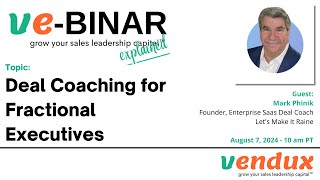
Webinar transcript of “Deal Coaching for Fractional Executives” (host Henning Schwinum; guest Mark Finnick). Mark, a longtime enterprise software seller turned fractional deal coach, explains why he chose deal coaching, how he engages with seed/Series A SaaS startups, common mistakes he sees (talking about yourself vs. translating value to C-suite), pricing/contract practices (retainers, capping hours, avoid hourly rates), and networking/referral strategies. A Q&A segment addresses market dilution of ‘fractionals’, positioning, and practical outreach tips.
Questions this video answers
Between five and eight companies (he references being “pretty much full at seven opportunities”).
Chapters
Welcome, everybody. Welcome to this latest edition of our webinar titled Deal Coaching for Fractional Executives. And we're very proud to have Mark Finnick with us who'll be introducing himself in just a little bit, a few words about housekeeping notes. We are recording this session. We are making it available on our website in probably by tomorrow. And we'll be sending out an email to all those who signed up for it. I would ask you to keep your microphones muted while Mark and I will have the exclusive pleasure of talking with each other for maybe the first 25 minutes and then we'll open it up for Q and A. It just helps the sound if mics are muted along the way, helps everybody to listen in. So without further ado, Mark, welcome to Vendax's webinar. I'd love for you to tell us a little bit about who you are. Sure.
So I'll, I'll start by telling you a story. I watched a video of a friend of mine several months ago who pretended that he was at a networking event and he was standing there all suit and tie pretending he was at this event and he was holding a cookie and he said, look, this is an or d' oeuvre and I'm at a networking event and you want to talk with me. Maybe I'm an investor, maybe I'm a prospective client of yours, but when I start chewing that cookie, you start talking. When I stop chewing, you stop talking. And when, if I want to learn more, I'll learn more. So in answer to your question, for series A and seed company that are selling SaaS into large enterprises, I coach their sellers on winning those deals and I help fractional and full time sales leaders focus on strategy and operations. So that's me in a nutshell. And by the way, my friend was done chewing the cookie after I did that about 20 times and used ChatGPT to reword for brevity. Many, many times.
Good. And now I'm curious and interested. I'm done eating my first hors d' oeuvre. And before I stuff my mouth with the second one, the follow up question, what brought you into this particular line of work?
Yeah, sure. So Henning, as you know, so I've, I've been in, I've been in software sales my whole career. I, I started at a point in time where you had a choice. You can go to a large company and IBM and Microsoft and Oracle, or you could go to entrepreneurial companies, startup companies that had the promise of becoming one of those organizations And I, I, I chose to do the latter. So I've been with startup companies my entire career, almost four decades of, of helping startup companies grow. I've always been a top sales producer selling to larger enterprises against those much. Nine of those organizations that I was with, we either sold or took public. And when I retired officially last May, which lasted about 72 hours by the way, I was pulled into a couple other opportunities to help these startups who knew me sell enterprise deals. They were not, their deals were not moving in the pipeline. And so I was asked, can I help? And that was the first time I ever heard of the word fractional. I never heard of it before and boy, did I embrace it after that. Long story short, I now work with between five and eight companies who are, you know, seed or, or series A startups who their deals are not moving through the pipeline and I'm helping them do just that.
What do you think makes you in particular successful in that, in that role? Is it just the experience that you have or what else is it that that makes you the expert in this area?
You know, I, it's the mustache. No, it's not. You know, I, I really don't have an answer for that. But I'll share with you something. When I did retire, I felt obligated to call and I would encourage everybody to do this. If you're new to fractionals, this is one of the first things you want to do. You want to call your entire network and let them know what you're doing. Former employers, former investors, former partners, former clients. And I'll share with you, number one, no matter what kind of relationship that you have with them, number one, they'll only remember the positive. As much as we like to think that people think of us when we leave a room, it's not the way it happens. They go back to their lives, they forget about anything good bad about you. And that's just human nature now. Now if you, if you take that to heart and you take the initiative to reach out to somebody, number one, asking them for help is a sign of respect. They'll appreciate that. Number two, the higher up an organization is or the wealthier they are or the, the more of a go giver that they are and truly embrace the notion of pay it forward, they'll view your call as an opportunity to do service. So Henning, what I did was I started calling all of my former investors who I made money for, employers who I helped elevate in their career, clients who I helped elevate in Their career partners, who I made money for. And I just, I reached out to everybody and in answer to your question, what I, I started asking them, I told them about my first fractional deal and I told them about what I'm doing to help this one startup. And they said, mark, this is what you were meant to do. And I said, well, tell me a little bit more about that. And this is where it gets a little prickly, especially if you're asking friends to tell you what your superpower is, right? You're going to hear some sarcasm from them, they're going to tell you silly things. But then if you're silent and you're listening, you'll get to the heart of why they're your friend, why they trusted you as a partner, why they trusted you as an employee. And I asked the question, what do you think I did? Well, what do you think? What do you think is. I hate to use the term superpower because that implies that we're super, but it's, people understand it. I said, what do you think I'm really good at? What do you think my superpowers? And henning what I heard. And I brought my wife in to hear the same conversation. So, you know, because, man, it was, my ego was blowing up. I started hearing from every single person that I met with. Mark, you were meant to help sellers advance deals at the large enterprise. This is what you've done your whole career. This is how you've sold billions of dollars with a software. So it wasn't so much me choosing what I wanted to do as a fractional blank. I was coached by very, very successful people to adopt the role of a deal coach. Now I'll also share with you, I could have gone the route of a fractional CRO, but as soon as I got involved with Fractionals United and some other communities, what I learned, there's a lot of people doing this fractional Sierra. There's a lot of people that are, that really enjoy doing hiring and, and, and firing. You know, I've had to do it firing on Christmas, on all too many times with my time, my roles at IBM and with hcl. So I didn't want to do that. I don't want to do CRM. I don't want to do sales stages. So I, what I found was if I focused on coaching sellers on deals themselves, you know, the real hard stuff, the real stuff that it's like, it's like plumbing. I was complimenting a lot of fractional CMOs and fractional Croes and Those, so that's, those are my partners. And it, it just works out very, very nicely where we collaborate. So, yeah, that's, that's, that's. That, I guess, kind of sums up why I'm doing it.
Yeah. And I, I mean, I like the fact that you use the phrase superpower, because that's exactly how I talk about specific skills. After 30 years of leadership experience, sales leadership experience, we all have done very similar things. We've all done the whole gamut of activities. We all like to think that we're good at all of these things and if in doubt, we could do them. But the question is, is it something that you're really good at and you want to do going forward? And I guess in your case, the deal coaching was affirmed by many others as being your superpower.
It is. And I'll share this with you again. This is if, if there's people on the line who are new to fractionals. I live in Chicago, I'm a Midwest person. And talking about myself and, and boasting about success sounds like hubris. And it's, it's, it's boastful. My dad would come down from heaven and smack me if I was bragging about anything. And so I, like many, I don't do a good job selling myself. Now that's going to sound odd since I just told you all these great things about what I'm doing. Let me share with you. When I was calling on my friends and former investors and former employers, I was one of the first things I did was admit I don't know how to sell myself. I sold the world's greatest technologies. I, I've sold the world's greatest teams. I've sold multi hundred million doll deals before when I was with larger organizations. But I always had the brand name. I always had something. I always had some box or an object that I was selling. All of a sudden I'm selling myself. I don't have brochures, I don't have garter reports. I don't have analyst reports about Mark Finick. I didn't know what to say. And somebody gave me some very sage advice. They said, mark, stop trying to do that. Pretend that there is a metaphorical mark, an avatar, a pretend mark. What has that individual done to help their clients improve their business? What has that individual accomplished not for themselves, but how have they helped their clients increase sales or reduce cost or increased efficiencies? And man, I'll tell you, all of a sudden, that person was a superhero. I was able to Come up with that person's superpowers very, very quickly. As I had to tone it down, I was so good at selling that person's capabilities. So I share this with you because one of the things that I see in most fractionals, we're all practitioners, we're good at what we used to do, but now that we have to do it on our own, it's not natural. It's not natural. So one word of advice, if you're interested, and I could chat with you offline as well, but take this to heart. Pretend that there's another version of you and start thinking of what that person has done to help improve their client's business. And I think you'll be amazed at what a superstar that person is. It's you.
I'd like to expand on that because that's really the. Now that you've. That you are out there coaching fractional executives or doing deal coaching for fractional executives, what are some of the common mistakes or common shortfalls that you're seeing?
Yeah, and to clarify. So my, my focus is very acutely on coaching, seed stage and Series A SaaS startups. So there's pressure in the system. They've received investment money, they've got six to nine months worth of Runway, they have to start selling. That's my focus. Where I partner with fractional CROs is where they don't want to do the things that I do. So that's my, that's the, that's the intersection with fractionals. What I see, whether it's a startup or a new rep or it's a fractional. One of the most common things I see is too much talking about what you do. No, nobody's interested in what you do. They, they're not. They're interested in how you're going to help them improve their business. They're interested in helping and how you're going to help them make their lives easier. If you think about job interviews that we've always, you know, that we've all had in our career, throughout our careers, I, I took it upon myself very, very early on to have empathy for the hiring manager and figure out how am I going to make this person's job easier by hiring me? Think of your, think of your future clients. And by the way, I don't use the word prospect. I don't ever want to be called a prospect. Why would I call a future client a prospect? I think that's a derogatory term. So when I'm speaking with future clients, which is Also aspirational and hopeful. Right. I hope they're going to be my clients. My focus is on what's important to them and if they had a magic wand, what, how could they improve their business? And it might come down to features and functions of a technology or skills that you possess as a practitioner. But it needs to be phrased in terms that they or their C suite use. So if you're selling to an organization that you're dealing with, the, the CEO or, or the, the ultimate approver, what, what's important to them? How do you help them improve their business? If you're selling to a larger organization, how can you help the people you're working with? Your, your champions, translate your skills, translate your, your, your services and product into the language of the C suite, which no surprise always has to result in increased sales or reduced cost. That's what businesses do, they generate profit. And those are the only two ways that you can generate profit. Increase sales or reduce cost. So if you're selling, you know, whatever service it is, it ultimately has to translate into business outcomes that will help the organization improve their business.
So the, the notion about talking less about yourself and more about what you can do to help the organization or the person that you're, that is your, your future client, it sounds, it, it does sound like a no brainer, right? But why do you think so many salespeople make the mistake of focusing on themselves rather than the client?
So that, that's one of the reasons I'm actually doing this. I recognized when I was with large organizations such as IBM where I ran global sales, I had thousands of people indirectly generating revenue for me. I was, I was responsible for the sales of a particular product that we then sold to HCL Software. So I had global vice president of sales, responsibility for a number of people. And number one, if you ask everybody for a 3X pipeline, guess what? You're going to get it. But that also means that two thirds of your deals are going to slip every single quarter. So we always accepted and we managed to. That. Right. There's only so much control that you have when you're dealing with organizations at that scale. When I retired and entered into the fractional world, when I. This now put some time context. So I, I became a fractional deal coach last May. So that would have been 2023. I started realizing that there was a generational skills gap between people of my age who had gone through scores of sales training programs. Sandler, IBM, Xerox, Gap, Challenger. So many. I, I have so many Sales books. I have, I have attended so much sales training but then pandemic hit and all of a sudden nobody's allowed to go meet. So what did so many organizations do? They directed their salespeople to product specific videos that their top salespeople created. It was fascinating. So there was such a, such a skills gap between what I grew up with doing, which is relationship selling, walking the halls of an organization and finding, you know, who's responsible for this and who's responsible for that versus sitting behind a zoom screen and watching a video. This is what our product does and the features and functions about. So the first thing to answer your question Henning, what I saw is a, a generational skills gap, many gap between people of a certain age and many people who are just entering the workforce when you could not meet somebody face to face. Sales is about buying from people. Customers might be large organizations, but people buy from one another. People buy from people who they trust. If you're selling any IT services, for example, one of the things any seasoned IT executive will tell you is every product is going to break. Unfortunately, we saw that with the largest and most successful and, and, and, and important cybersecurity product. We saw that last week with CrowdStrike. They sent out a bad version. Well seasoned IT people know that stuff happens. The question is, is what's that organization going to do to fix it? Now fortunately CrowdStrike has stepped up and the point being I know things that people 30 years my junior don't yet know yet. And so Henning, one of the things that I saw was a genuine need. And this is what I started hearing from VPs of sales and VCs and, and founders. There's a genuine need to coach the sellers who are responsible. Because look at me, I'm old, I'm not really that old, but I'm, but most of the, most of my peers are either VCs themselves, they're CEOs, they're CROs, or they're retired or they're sitting on their own 100 foot yacht. I just love doing this.
Since you do it and you coach, deal coach, both full time employees and fractionals that are contractors, is there any difference that you're seeing between those two groups as you work with them as a coach?
Yeah, it's a great question. So I don't think there's any difference. What I am seeing is a trend. I think it's the same mentality. You either you either know how to translate technology into the language of the C suite or you don't doesn't matter if you're fractional or full time. And by the way, the fractional versus full time discussion, I, I personally have a problem with that. I don't, I don't go to a store because they take cash or credit. I don't buy software because it's perpetual license or it's SaaS. Why are some people leading with how you transact business? I'm more of the opinion you should lead with the service that you provide and how you're going to help your client improve their business. But to your question, there is a trend that I'm seeing and I'm seeing an awful lot of fractional people take roles for fractional rates. In other words, less than a full time, fully loaded fte, no benefits, no bonus, no salary, no payroll tax. Right. But they're taking a reduced rate with the mindset that I'm going to have a bunch of clients and hopefully the cumulative income that I receive is going to be significantly greater than a single job. That's why we're doing this force multiplier. What I'm seeing is fractional people, especially sales people, because deals work at the, deals work at their own cadence. There's no such thing as a.
A.
Deal that progresses every Tuesday at 10am let's meet and, and talk. Deals progress at their own cadence as a result of that. What I'm seeing are too many fractional people spending far too much time as a fractional employee. Their, their employers are just, it's slave wages, right? They're, they're just, they're working 30, 40 hours for fractional rates. And what I do is I coach them. You should, you should negotiate a full time role. If you're working 40, 50 hours for somebody for fractional rates, that's not an equitable relationship. It's a, it's just an observation.
I mean, I see similar trends and similar developments. The, the question then would be how do we fix that? Because it, it ultimately is detrimental to the fract industry. The, the, the whole of all fractional executives. How do we fix that?
So I, I cap my hours. I cap my hours. So I, I, and let's also talk about hourly versus monthly retainer in this discussion. I think this is also going to be maybe helpful for some of the new people. Let me start with that. So I'm of the opinion that if you are a fractional executive and you work on an hourly basis, you're basically setting yourself up to compete with upwork employees who have the same title, but they're 35, $40 an hour. Just my opinion. And so everything that I've ever done and everything I coach my, my, my colleagues on and, and other, you know, friendly fractional execs and my clients on everything is value. What's important to the client, what's the value to them in business outcomes. And then that's what I base my price on. That's what I base my, my, my monthly retainer on, which is never based on or never contains terms. No services are rendered until I have cash in the bank via Venmo or PayPal. This is just how I work. Because the two times where I've offered somebody, oh, I understand. You can't get me my payment in advance. Don't worry about it. I trust you. That didn't work out. Those, those turned into very, very contentious conversations where I basically said, until there's cash in my account, I don't work. I was ultimately paid for those two situations. But I'm advocating for you stand by the value of what you're offering. Come up with a monthly retainer that's based on the value of what you're providing. And, and we'll talk about that in a moment. How to create, how to understand the value, but in terms of stopping bad behavior. But you got to put it in the contract. Got to put it in your contract. So I know a number of people who work. They, they offer a, they offer their services on a monthly retainer as, as do I. And they provide X number or up to X number of hours per week or per month. My world is a little different because, again, deals work at their own cadence. So my offer to the client is, you have ad hoc access to me, unfettered access to me 247 based on the cadence of the deal. But I cap those hours because in reality, there's only so many times that a salesperson really has anything to share with me. They're not going to. It's not practical to think that they're going to call me and for 40 hours a week they should be out selling.
Yeah.
So I put it in the contract.
Okay, great. Mark, we're at the 30 minute mark and I would like to open the mics up for anyone who has a question for Mark. So I'm done hogging the conversation with you. Andrew, Courtney, Lisa, any, any questions that you might have for Mark.
I do.
Thank you. Hey, Mark.
Courtney.
Nice to meet you.
Nice to meet you.
Definitely appreciated this. And I have two questions. First, I'm a proud Chicago girl, and Mike Ditko would be very proud of your. Of your mustache. And I wanted to make sure you saw Hard Knocks. Chicago Bears were the feature this season.
I did, yeah. Excellent.
Second question. So from my seat. My job is to sell companies on needing a mark, which, like you, I'm very passionate about the industry. I see the value in every way after, you know, the. The pitfalls of sales for 20 years without the fractional option. However, I have noticed a trend just in the last six months that any executive sales guy is now considering themselves a fractional just because they have fallen on hard times. And it's very convenient for, you know, someone that was, say, laid off and couldn't find something else to all of a sudden even join Fractionals United, declare themselves a fractional CRO. And. And good for them. Let's help everyone. But I found that that's really diluting the. The pool and my pitch. For instance, do you have any advice on kind of how to preempt that?
Yeah. Courtney, could you clarify your role and what service you're offering again? Yeah.
So I work directly with Vendux. I am a partner, and all day I am reaching out to CEOs of emerging companies and selling them on the value of fractional support.
Ah, okay. Thank you very much. Got it, Got it.
I'm Vendex branded.
How many. How many deal coaches do you have with great mustaches? I'd like to be a part of your bench.
That's a weird thing, but you deflated me when you said you're pretty much full at seven opportunities.
So it's. Yeah, here's what I'm seeing. So, a year ago, I never heard the word fractional before, and a friend of mine, Shelley Morales, who's an HR person, real special lady, she and I were part of a very, very big IPO. I don't know, 20, 30 years ago, 25 years ago, second, second largest IPO in history. First one was Netscape, then us. Now others have. Have taken that mantle. And so Shelly. I called Shelly, told her what I was doing, and she said, oh, my God, you got to join this. Fractionals United joined Fractionals United. And I think there were 5,100 people. How many people are in it now? 10,000, 11,000, 12,000. And let's. Let's be candid. There's entrepreneurs, there's entrepreneurs, there's. I'm not. I'm not. I'm not being disparaging, but there's people who were told, this is what you should do. My first question to them is, can you go six to nine months without a paycheck. If not, let's change the conversation. Let me help you build your resume and go get you a job. That's. That's just a tactic. But, you know, there's this many fractionals in the world. Not and, and not only fractionals. There's this many people who are looking for jobs. And let's be real, there's this many jobs. This is. This is. We all understand that. So, yes, I'm in favor of promoting the model to executives because it is smart. You don't have to pay benefits. There's no payroll tax. You know, you can get somebody and you're paying for impact, not time. Right. I love that. But what I am seeing is a very, very crowded space where people are saying the same things. My words are, I'm seeing. I'm seeing other people. I always take a risk doing something like this. Somebody on this call could just come, oh, I'm a. I'm a fractional deal coach. That's fine. That's fine. Competition is good because competition tells you that there's the market. So what, what I'm. What I'm firmly believe is that for these professional services, just as it works for a lawyer or a doctor surgeon, you're not going to go out on LinkedIn and do outreach programs and say, hi, you need a new spleen. This is a referrals business. This is a networking business. And if I look at the clients that have engaged me, it's as a result of. And I can. I can look at each single one. Courtney. The first one, I met somebody at a Fractionals United meeting or a luncheon, and they introduced me to an investor who had a portfolio company that had limited Runway. There was pressure in the system. They were either going to wind up as a statistic going out of business, or are they going to get flipped to a private equity fund at a discount? And they introduced me to the CEO. It's a very cool company. This is an organization that sells AI to detect breast cancer faster. So they sell to radiologists, and they free up radiologists time to spend more time with patients. They're reducing mortality rates. They're helping women avoid unnecessary treatments. And I asked them, why aren't you selling? And they said, well, because we're selling to radiologists. That's not who buys. I said, okay, great. Why aren't you selling to the cfo? They're like, mark, we're not going to sell to the cf. We're not. We're never going to get to the CFO of Cleveland Clinic or Kaiser Permanente or Mayo Clinic. And I said, bingo, what can we do to empower the radiologist to go get money? And I said, I don't know your business very well, but let's just play a game. Let's just say I or a family member, God forbid, are in need of your services and I go to Cleveland Clinic, who has your technology. What do they call that? Oh, that's increased patient volumes. I said, guys, why don't you just write that down? What do they call that if they. I give them money? Oh, that's average revenue per patient. Those are KPIs that you find in a financial statement or in an annual report. And therein lies what I do differently than the myriad people who are expert at setting up sales processes, go to market plans, setting up CRM sales stages. And I don't pretend to want to do that business, which is why I partner with those people. So, Courtney, I think what it has, I think what this comes down to is understanding your icp, what you are and what you're not, and articulating it in the order, style, fashion that we started the call with. Being able to say, hey, if you run across a, a seed or a series a SaaS company that's struggling with enterprise sales, I coach them to win more deal more deals. If you can get your value proposition down to that, that's, that's going to be very, very important. Try to coach people when they get on networking calls, not to spend 17 minutes of that call talking about themselves and their career and where they were born and what their brother's name is and blah, blah, blah, blah, blah. I, I'm. Does that make sense?
100% very much appreciate.
Mark, can we stay on the topic of this networking for a moment? Because I think everybody hopefully is doing it a lot. Your days as a fractional should be filled with networking calls and you should start the calls off with, hi, I'd like to use this time for you to equip me so that I can introduce you as opportunities arise. Anything else is a narcissist. If you start to call off and all you're doing is talking about yourself, you've, you've blown it for the, you, you, the other person knows that you don't know the secret handshake. The secret handshake to this business is to be a go giver, not a go getter. A go giver. Give more than receive. And if you could do 28 minutes with Courtney, you and I telling you telling me what you do and then end the call with say Mark, oh my goodness. We spent 28 minutes on me. What about you? I only need a cookie to talk about me, right?
100%. Thank you so much for that.
Yeah, go bears.
That's great advice. And we came full circle with the cookie story or the cookie analogy. That's great. Mark, thank you for being our guest. It was a pleasure to have you and we will put the recording out by tomorrow and then more people can enjoy listening to you And I again appreciate the fact that you took the time and joined us for this, for this episode. Thank you Mark.
It was my pleasure. And please, if I can be of any assistance to anybody, I'm going to pay it forward mode in my life. I, I welcome the opportunity. So thank you all.
Thank you. Thank you. Bye, Mark.
Bye Bye.
More from Henning




ve-BINAR - The Revenue Tornado Methodology: How 3 Power Sources Create Exponential Growth


ve BINAR: Executive Cloning: How AI is Reimagining the Role of the Fractional Executives




veBINAR: Unlock Client Value: Why Compliance is Crucial for the Startups You Serve
