ve BINAR Delivering Tailored Solutions That Drive Growth
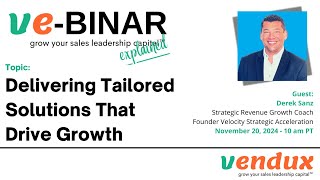
Webinar (host Henning Schwinum) with guest Derek Sands on delivering tailored solutions to drive revenue growth. Key themes: run a focused assessment to identify 2–3 high-impact improvements (messaging/ICP, sales process, marketing ROI), co-create sales playbooks and enablement, use AI to accelerate playbook creation, and prefer targeted outreach (e.g., curated events, phone/video) over noisy mass outbound. Medtech firms face added regulatory/commercialization constraints; an example engagement produced ~500% pipeline increase from a targeted event and closed about $1M before year-end.
Chapters
Good morning, Good afternoon. Depending on where you are, welcome to this webinar of ours. It's the third to last edition for the year. We'll do two more and then we'll pick it up back up again in January. A few housekeeping notes. We are recording this session. We're making it available on our website and everyone who participates or has signed up, we'll send a link to and then it's available also on our YouTube channel. We will ask everyone to stay muted for the duration of the webinar and only unmute towards the end when we're opening it up for Q and A. That just improves the sound quality for all of us in this call and for the recording. And we'll go, you know, I'll have the exclusive rights to our guests for the next 20, 25 minutes or so and then we'll open it up for, for a Q and A. Our topic is delivering tailored solutions that drive growth. Interesting topic for of course for everyone on the call that is a sales or revenue leader, but even more so for those that are on the call that are business owners and are looking to drive growth in their respective organizations. Our guest is Derek Sance and I will ask him. Derek, I'll ask you to introduce yourself so that we can get the firsthand account of why you are particularly suited to talk about this topic.
Thank you for allowing me to be here today. Like I said, my name is Derek Sands. I'm based in San Diego, California and I'm not sure where you guys are all located, but I'm pretty sure you're probably jealous of our weather right now because it's like 70 degrees in sunny. But I spent about 20 years in sales capacities in the health tech industry. I worked with several startup companies as well as enterprise companies, primarily in the commercialization field, scaling sales teams, doing go to market strategies, new product launches, overall sales execution strategy. Also international markets and distributors and channel partners as well too. I've been doing fractional and advising work for about five years and I've had the opportunity to work with a lot of early stage founders and growth companies and startups as well too. That's a bit of background on me.
Okay, thank you. As we're dissecting the title, I don't think we need to define what growth means in the context of revenue leaders. That typically means sales, sales dollars, revenue and the growth that comes with it. But what are tailored solutions? Derek, what do you think when you think of tailored solutions? What are you referring to?
Yeah, so I think the Main thing really is defining what the actual needs are of a prospective client or customer. You mentioned growth, right? That's just a general term. And we all equate that to revenue growth because that's what really means in most businesses. But usually there's underlying causes of why a needs help with growth and revenue. And so really digging in to find out what those specific things are and then tailoring the specific processes and solutions around those things will drive that revenue. If you just take it as a macro kind of look at it, you're going to miss some things. And so by digging in and really finding out what the needs are, where the, the issues or sticking points are, then then that's what I consider tailoring the solution to drive that growth. So typically it's not going to be one large thing. It may be two or three smaller items that we can attack and see improvements in action within, you know, 30 or 60 days.
Okay, so when you walk into a client that you're helping to drive growth, does tailored to you mean that you walk in with a blueprint or you walk in with a white sheet of paper and ready to take notes?
Yes, I would say somewhere in between. One of the first things I do lead with is I like to do an assessment and I have access to a library of different assessments that are completely customizable across all business functions. And so what that allows one to do is really sit down with the founder or the CEO and just get an outside perspective what's going on inside of the business. A lot of times they don't know what they don't know yet. And so just by having somebody, you know, with a bit more experience in say, sales ops or revenue growth, really looking at what are the items in each category and how are we performing within the organization and having the customer do an introspective thought process about that, to really dive in and think about, you know, are we doing this right? Are we doing this well, are we even doing this at all?
Right.
And then once you start getting that out to bubbles the surface, then you really get, you know, clarity of what some of the issues might be. And that's where you can specifically tailor your solutions to, to attack those two or three things that may be the lowest hanging fruit or have the highest priority to make an immediate impact.
Okay. And when, when you walk in and, and do that assessment together with the stakeholder or stakeholders in, in the organization, give us a few examples of things that you typically find are off the mark and need improvement with your help.
Yeah. So Maybe on the sales side, a lot of times the messaging might not be correct. So the sales process, the, the, the sales stages and cycle is off a little bit. Their product marketing alignment may be off. Maybe they're not going after the right icp, just really defining what the service or product is and who the actual customer is. I feel sometimes just it's close a lot, but it's not really there. If they're a larger company to have a marketing budget, for example.
Right.
Where are they spending their marketing dollars and are they getting the correct ROI with it? A lot of times companies, I feel, just spend marketing to do it and they don't really have an endpoint of what the ROI should be. They're really honing into finding that and then making improvements where allows so that, you know, every dollar is very valuable in a small organization. So to maximize the ROI is very important. So those are a couple of things that we can look at, you know, pretty quickly and find possible improvements there.
Okay. And the, obviously you already distinguished between smaller companies and larger organizations. I'm sure there are a few other differentiating factors that you've seen. I would imagine industry, maybe even more differentiation in sizes when it comes to growth stages that companies are in. What have you seen in that arena?
Yeah, so a lot of times the larger companies, they still obviously have growth and revenue goals, but that growth might be a bit slower pace than maybe startup that just got a bunch of funding that's building out and so their needs and resources are going to be a little bit different. But industry, you know, I spent a lot of time in medtech and health tech and so there's a lot of regulations and regulatory you have to worry about as well too, and a lot more moving parts on the clinical side. So a lot of times you got to slow down before you can speed up, depending on what those hurdles are going to look like, you know, in the future. So for example, Medtech, if you make any significant product improvements, there's a good chance you have to go back to the FDA to get a 510k on that.
Right.
And so that could be a significant hindrance to growth where that cost you several million dollars and maybe 12 or 18 months of time before you can make those improvements. So when looking at it, you gotta really be strategic and saying, okay, what can we do right now that has the least resistance and maximum value? And then also what are the longer term goals that we can do for the.
Let'S talk a little bit deeper about sales and sales performance and, and Working with sales teams to make them better. Because now you're now. So we're below the, the founder or owner or the, the sales leader. If you come in on the, on the side, but the team itself is out there and selling. What, what have you seen as the, the shortfalls that exist throughout that need then that you need fixing in order to improve the team's performance.
Yeah. So I think one of the major things that's consistent across the board is just a lack of the correct messaging or prospecting. Right. If they're like an SDR team and they're going out and cold calling and doing cold outreach, that messaging has to be pretty locked down and consistent. You can always A and B test, but if, if they're not communicating the proper thing to the proper people, they're not going to get responses. And so really again, defining who is their I, who is the real person they talk to and then what are the real problems that they need solutions for? And it may not be exactly what you're. What you're tell telling now. Right. But they may have a need for your product or service. You just got to make sure that messaging is aligned. And then when it comes to, you know, looking at the performance of the sales team, really finding out which ones have the will and the skill to be good, a lot of people, you know, have the will and they just maybe don't have the training yet. So making sure that the sales training and onboarding process is really tightened up, I think. And I'm a big believer it's the organization's responsibility to ensure each salesperson is equipped to do their job and do it well. And that should be an ongoing process and continuously development and continuously education and just, you know, making tweaks here and there. Right. You know, no salesperson is perfect if they think they're the best, they're probably should be on your team and everybody can always get better. And the flip side of that is you really got to find out which people really want to be there. I've done, you know, build sales teams across a lot of organizations and different industries and you come across where people just don't have the will to do that type of work. And that's okay. There's probably something else better out there for them that just this specific job might be. Might not be the one for them. And so really digging that out.
Right.
Having those conversations to make sure that you consistently level up the sales team will definitely help improve performance.
And obviously, especially when you come in and there is an existing Sales team, someone hired them, someone trained them, someone is coaching them right now, or was coaching them before you arrived. You know, what are those conversations like then with the person who is responsible for that, which often is the founder or owner of the business.
Right. Yeah. So that could be a tricky conversation. Right. And I think it's always good just to come in as like, look, I have a lot of experience or whoever comes in. Right. Love experience. Here are some ideas. Let's try these things. Right. Maybe what you're doing now is getting you some result, but we can always get better. And then implementing those ideas and measuring them against performance and you know, if you come in and you help people do better and make more money, that builds trust really quick to make their job easier, make them better at their job. They're going to trust you fast. And, and coming in as a sales leader with an existing team, that time to trust is critically important. Right. You know, you have to build it quickly. They have to be on your team and on board with you. And if they're pushing back or if they're not kind of getting there, you know, that's a different conversation to have.
You at the beginning talked about the fact that you, you don't come in necessarily just with a white sheet of paper. You have a set of tools available that you're bringing in like most fractional executives do. Can you talk a little bit more about the nature of those tools that you're using? Sure.
So a lot of it just kind of like templates and frameworks. So if we're doing like say a sales playbook, for example, you don't have an outline diagram of what that kind of looks like. Right. But the, the specifics are not filled in yet. Right. What I like to do is really engage with the key stakeholders and the leadership team. And even if it's sales, some of the sales leaders as well too, and maybe the high performing sales reps and have them all come together to create it themselves. I'm there to help coach them along and keep the process moving. But I find that if they produce this playbook that comes from within, they're going to have a lot better chance of success with actually deploying it and for their internal engagement. Because now it's not somebody from outside coming back and say, hey, here's your play playbook, go do it. It's like, hey, this is the playbook we created together. Let's now execute it together and work as a team. I feel like when, when that happens, the entire company is way more Engaged and you get a much higher response and belief into the, the system itself.
Definitely a best practice around any type of change management that you want to implement. Find ways to create the buy in. What do you find the sort of the most common tools that you need to use? Obviously before you walk in the door, you might have an inkling, but you don't have the exact idea of what tool might be the most needed one in this particular assignment. Where do you cluster the most used tools that you have to bring to the table almost every time?
Yeah, so I think I always lead with some sort of assessment, one or two of them. Right. I'll go, I'll go over it with the, the customer client, the key stakeholder. Right. And at the end of that, that's an exercise that maybe takes 15 or 20 minutes. Typically I like to do it with them or have them do it. Right. And then send it back and we'll go over it together. And once that's done, there's going to be areas that will bubble to the surface. Right. And then that's, that's where we can then say, okay, we need a sales playbook. The next tool then is a sales playbook or we need, you know, something that's around CRM enablement. So then bring a tool to really help that we need something that's around the competitive landscape and then have a tool in the tool bag that's catered towards that. Right. And so it's kind of an ongoing process of starting, you know, higher spectrum and then really narrowing down and providing different types of tools and, and things that can really clear, clear, clear, define what the needs are for the organization.
You obviously do this as a fractional executive consultant that comes in and works with organizations in that regard. Can you describe an average assignment or I hate the word typical and always tell people there is no typical, but typical for what you're doing and how you're approaching it in terms of length, in terms of team size, in terms of intensity, meaning the hours per week that you need to put in. Can you describe what an average or what a typical looks like?
Sure. So I would say I'll just stick with like maybe the small organizations tend to work with those more if they're already in market, then those engagements tend to be, I think a little bit longer. So it could be three to six months that they need somebody just to come in and you know, shape up the sales team or redo a go to market strategy or build out a sales process or really define the customer profile or the messaging or build a sales playbook. So that's, I would say that's typically the length of the engagement. I would say like hours. I don't bill per hour. I like to do per deliverable. So if I'm doing like a playbook right, I think typically the most of the time is going to be on the front end working with the team, getting all the information, probably doing a weekly call after making sure everything is coming together. Then I will use some AI bots and put the playbook together. And that all doesn't take too much time once you have all the information and then typical size organization. I've worked with just single founders before, maybe one or two people up until about 20 or 30 people I think is kind of typical for me and maybe like in my sweet spot of where I work.
Well, let's talk about results now. Since we, we we titled this as aiming for growth. Can you share maybe use some examples of growth that you have accomplished or that organization have accomplished with your help?
I had an engagement a little bit ago with a medtech company and the CEO who was engineer by trade needed help with revenue. Right. They've been flat stagnant for several years and they're getting pressure from the board to really, you know, ramp it up and so we need some help. Guy was really a engineer but was lacking on the sales side, which is kind of typical.
Right.
And so I came in and we just sat down for a few hours and had discussion, did some assessments and we looked at where the business was and what were the areas that needed improvement. And one of the things that stuck out to me was his marketing budget. Right. So they're going to all these big trade shows which are very expensive and unless you have a lot of resources to really stand out and have an impact there, you kind of get lost in the sea of booths at a trade show. Right. And so a lot of this marketing spend was not creating an roi. So instead was I took that that marketing budget and it moved it to more of these curated one on one live events which we were able to get in front of several C suite executives or hospitals who are actively looking for solutions that this company provided. And the result of that, within two days we had about a 500% increase in sales pipeline just from that event. And the cost was less than going to a big trade show. And you know, you know the sales cycle in hospital is very long. So I can't say that was, you know, that was responsible for X amount of dollars of revenue growth. But by the pipeline increasing that much, it just really enabled the sales team to close a lot more deals and get more real deals going. And it showed a lot of progress for the organization. And we did close about a million dollars before the year was over. That was directly because of that one, one event.
We did good. I'll, we'll open the mics up soon for the audience to ask questions. Let me just hone in on the, on, on, on the, on the audience and ask you a question about it. Obviously, we typically have an audience between fractional executives and business owners. And let's assume for a moment we have business owners listening to this later on or watching this later on who are not on the call, not able to ask questions. What's the message that you want to send to someone who, who owns a small business or is the CEO of a small business? And, and you know, when they, when they are, then when they feel that they're not growing as much as they should.
Yeah, I mean, I think, you know, if you're, if you have an issue with, with revenue growth, if it's stagnant, it's declining, you know, it's a time to maybe get some outside help. Also, if the founder or CEO is working too much in the business and they're doing all the things themselves, they're probably working themselves to death a little bit. So I find that taking some of that responsibility away from a CEO really helps them focus more on more CEO directed activities. And so I find that a lot too. So in each case, if somebody's really looking to make a change to either step out of that role or then also to get through some stumbling blocks or grow, then that's where we come in.
Great. Well, obviously you are one of those executives that we work with and I can only second everything that you've said. Call on us and count on us to help address the problems that you're facing. Let's open up the mics here. Let's see if we have questions from the audience. Just unmute yourself and speak up, Andrew. I see you waving your hand.
Thank you very much, Henning. Thanks, Derek. I appreciate the thoughts and comments. A couple of quick questions on tools broadly. I think, I think I heard your use of AI, AI bots around Playbooks, if I heard that correctly. Can you just talk a little bit about, you know, how you're leveraging of AI for these Playbooks, like what are you doing, how does it work? And then anything else with, you know, how else are you leveraging AI in your work and then the other question evolves around outbound cold email campaigns broadly. What, what have you been seeing? What are you seeing about the effectiveness or the, the changes in that landscape perhaps recently? And what are you doing about that, if anything?
Sure. So, yeah, thanks, Andrew, for the question. So the first part way I use AI for AI for me right now is more about like speed and ideation. It allows me to do a lot more faster than if I was just do it on my own. So if I'm creating say a playbook and I have a template, a lot of information, I can put questions into the AI bot to then get answers that I can then input, I mean, copy and paste into the playbook itself. It's going to be from the material that came up from the meetings, but for me it just really decreases time to creation. Right. And then also ideation too. You know, these, these bots are very smart and they tend to, they, they learn you as well. So the more questions you keep asking it or have asked for opinions on something, or here's a couple of different, you know, bullet points on something, it's going to spit out some things that maybe are new for you that you can then look and say, hey, you know, this would be a really good addition to this as well too. So it's not creating a playbook that's done, you know, with the internal team. It really is just taking all the information, putting it out there and maybe make it more concise, if that makes sense. And there's a lot of bots out there. There's probably thousands of different AI bots that you use for a lot of different things. So if you're creating an assessment, you can use a different bot for that and different questions and it really line it out nicely for you. And then the second part is a cold outreach email. I've, I've seen a decline in efficiency and response rate a lot. And not just for like my own projects, but people I've talked to as well too. You know, there's a lot of restriction now on email blasts. I've seen, you know, a lot of companies spin up and try to sell you marketing things for, you know, hey, we're gonna do LinkedIn, you know, outreach for you too. And I've tried some of them and the results have been not very good. So I think really the main thing is always thinking about how you can differentiate, differentiate yourself and do something different than what everybody else is doing. There's a lot of noise out there, right. And I think that people keep doing the same things. Even if the best outgoing email script, cold script, it's still a cold outgoing email.
Right.
So still people see it and it's still going to go right to delete or get, you know, caught by a firewall. So finding other ways to do reach outs, I think is going to be beneficial.
Thanks.
Yeah.
Bruce, you raise your hand.
Yes. Derek, what are the, what are the three things that you run into in the med tech companies that you see? It sounds like one of them may be the owner doesn't have time for sales. And how do you handle each one of those?
So the mic was a little low. So you said, what are the three issues? I see mainly med tech companies.
Yeah, they're the three main issues. And I think one of them might be that this, the owner doesn't have time to do sales, which is a common problem.
Yeah.
In that industry, we see a lot of founders are physicians. Right. It's their product, it's a service, it's their baby. They know it well. They're just not very well versed on the business or sales side of it. So I think that's one of the biggest things. And there's a lot of good ideas out there. And sometimes I've seen founders hang on a little too long before bringing, you know, outside help in. You know, funding runs out and some of these ideas kind of go by the wayside. So I think that's one of the biggest things. Another one too is not having a clear pathway to commercialization. If you have a device at any time, you're going to have to go through the fda. Right. And depending what type of what class of device it is, that that journey could be vastly different, vastly more expensive and a lot longer. So that's another big hurdle as well, too. And then also not having a clear strategy of how to go to market or how to sell. A lot of people think, okay, I have this product or service, I'm ready to go. Let's spin up a direct sales team and hit the ground running. Sometimes that works, but a lot of times there's better, less riskier ways to do that by partnering with channel partners, distributors, people who are already in this space that they can help you promote, especially early on, because, you know, cash is everything. If you burn through that cash and the company's not going to survive. So I think those are the three main things that I see with early on med tech companies.
Great.
Thank you.
Sure. Thanks for the question.
Great. Any other questions?
Andrew kind of hacked into my brain and asked the two Questions that I was after, but kind of going on that. So we've got AI who you know, with a couple training sessions can pick up on the best sales messaging out there. And we've got bots communicating to bots on LinkedIn on email. A lot of noise for sure. And now I think more people spend time blocking the bots than proactively moving forward with solutions that are innovative and work. So aside from the obvious noise, have you, and without giving up your industry secrets, but have you found a channel that is just under tapped, underutilized right now that is sort of obvious and working as much as the others are not?
I would say, you know, pick up, pick up the phone works. Phone calls, you know, I think are coming back because there's so much inundation with everything else. It's like, oh, someone's actually calling me. And people, I tend to have a better response rate just calling them, even just leaving a quick voicemail if they respond back or text me if you can get their phone number also depending on who your target client would be. So like I look for VC funds and PE companies. So go into those websites and then you can filter down to what their portfolio companies are and reach out to them directly. A lot of times they'll have the work email on there which is that, hey, you know, I saw you on Y Combinator site, which is a good link, right? Having that link back to something I feel got a bit better response, you know, and then always starting with adding value. Like I never pitch on the first couple engagements, obviously I don't think anybody here does. But you know, just being, you know, hey, I'm here to help. Want to learn about what you do, you know, hey, I've got connections here, maybe I can make some introductions. If you're raising, raising around stuff like that tends to kind of resonate with people because you don't come off as a salesperson trying to sell them your services, but you're actually trying to help them. And even if it doesn't turn into engagement now, I guarantee you, like if you help somebody raise around, they're going to think of you when they need something next time or refer you to somebody, know who, who might be, you know, better tuned at that position to bring on a fractional, but it's a longer play, right? So it's kind of doing everything at one time, right? You got to have your short term goals and then you got to be, you know, setting up, planting the seeds for down the road as well too.
Like the good old Days.
And I think it's come back full circle, right. I mean, technology is making everything so much faster and easier, but then you get inundated with all this noise and then it doesn't work as well anymore. And then you have regulations like with email and LinkedIn blocking things and all that stuff. So, you know, and it's only going to get worse as far as the amount of volume of stuff going out there. So I think it's, it's easy to get stuck in that kind of cycle of just doing what everybody else is doing because that's what everybody's telling you works and, but focusing on, hey, what's a better way to engage with people? And I've had conversations with people who send gifts to their, their client. They want to go, they want to go after, right, like an actual physical delivery to their office, something just like a video card or whatever it is. I mean, there's some elaborate ones and there's some basic ones, but doing something different. Right. To stick out, I think is, is what is key in, you know, this day and age.
Thank you for being here today.
I appreciate it.
Great. I don't see any more questions, Derek, so. Oh, Bruce, you're raising your hand.
Yeah, I just wanted to point out that one of the successful things that's being done now is sending a video to the person so they actually open it and they see and hear you and that catches their attention. If you can get it through the firewalls. That is a differentiator that I've heard a few people use that works pretty well and it's kind of unique, so you might want to try that.
Yeah, actually I received one of those like two days ago.
Did you?
It was cold outreach on my LinkedIn and it was about a 1 1/2 minute video from this gal trying to sell me some marketing services. I thought, you know, I didn't respond, but I thought it was a different method. But maybe I'll ask her what her response rate is and, you know, see how that's going for her. Because it is different. I don't see too much of it, but I have heard of people doing that more. I think you see a lot more people posting videos on LinkedIn itself to try to drive engagement. You know, in the industry I go to, there's, there's a lot of live events, not, not just like networking meetings, but like events where startups and early stage companies try to come and connect with, with strategics and investors and stuff like that. And that's always a great way to get your name out there to make partnerships and network above and beyond just regular networking meetings. But go where your customers are, where they go because they're going to be there anyway so might as well be there too. Right?
And I'd just like to add one more thing, that of all the emails you've received that video email is the one you remembered, right?
Yeah. Well it was only a couple days ago but that's a good point. Right? So it did stand out for sure.
Thank you Bruce for sharing that and Derek, thank you for being our guest. Really appreciate it. We will put the video up by tomorrow and send around the link for everyone to revisit or listen to it for the first time for right now. Have a wonderful rest of your Wednesday and a great rest of your week.
Thank you everybody. Thanks Henning. Appreciate it.
Thank you.
Bye bye.
More from Henning




ve-BINAR - The Revenue Tornado Methodology: How 3 Power Sources Create Exponential Growth


ve BINAR: Executive Cloning: How AI is Reimagining the Role of the Fractional Executives




veBINAR: Unlock Client Value: Why Compliance is Crucial for the Startups You Serve
