ve-BINAR: Effective Working Relationships Between Generations
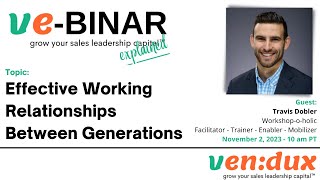
Travis Dobler discusses how Baby Boomers, Gen X, Millennials, and Gen Z work together differently. They have different communication styles, values around purpose and work-life balance, and often hold stereotypes about each other. Companies can bridge gaps with clear policies, cross-generational pairing, and training.
Questions this video answers
November 2, 2023
Travis Dobler
LinkedIn (search 'Travis Dobler'); website: learningiscool.[domain]
31 (he says "31 this month")
Chapters
Great.
Welcome everybody. Thank you for joining us for this webinar. We're really excited because I think we have a fun topic to discuss the working relationships between generations. And while we in, in our warm up to the show, talked about all other aspects of life that are impacted by generational differences, we'll try to focus on the workplace, especially the subtitle of our webinar here, how to Harmonize Different Generations as a team and in the course, maximize the performance of Every individual. Our guest today is Travis Dobbler. I will ask you, Travis, to introduce yourself because if I Look at your LinkedIn profile, you are a workshopaholic. That's a very interesting title. Tell me a little bit more about what that means and then maybe talk a little bit about your background.
Certainly. So thank you for having me here. This is a really exciting topic for me. You might be able to see between what I Talk about on LinkedIn or what I've done for work, it's all over the place. I certainly care about how things like DEIB impact the workplace. And I am constantly at this position between stakeholders who have a lot of expectations and a lot of experience for what they might want a sales training or a new enablement function to look like, as well as people that might be fresh out of college in their first SDR job, sharing a training space with somebody with 25, 30 years of experience in a book of business that comes with it. So whether it's for my W2 job where I work with quite a diverse team in terms of generations internally or training them, or if it's in my consulting and side work that I'm working with teams, I am constantly between these different generational demands for activity or respecting different types of wisdom and intelligence. And just a little bit about me personally as well, I. I grew up in Daytona Beach. I actually grew up in a household. I had to do my research on where the generations marked their line. I grew up in a household where we were four generations and there was a fifth generation next door in my great grandparents who are from the silent generation born in that Great Depression era. So I think I've always been privy to different types of needs, different ways of communicating and work styles. Seeing the various jobs and schooling that everybody's gone through in my house and having a mom who was a teacher really set me up for success in these cross functional and cross demand workplaces.
Yeah. And I think you and I, Travis, represent a generational gap already. I was born in 65. That's sort of on the cusp of baby boomers to Generation X, though I've always considered myself and talked about myself as a baby boomer. How about you? What generation are you?
Yeah, it's a good question. And there's split. Split camps over this, so I always called myself Generation Y. And it might be that that's what I've always heard. And Generation Y is between. If you're born between 81 and 97. But William Stross and Neil Howe coined that term Millennials, which goes from 82 up to 2004. So I've been called both. I feel like I'm an older soul. We were talking about some classic rock I grew up on and the vinyl records I have. So maybe that's why I favor that Generation Y. I also think that my family are on that same cusp as you. Born in, like, 67, 69, and they've always called themselves baby generation. Stops at 65. Maybe it's something inside of us likes to feel. Feel wiser or more connected with the older generations than trying to play to the youth. I don't know, but I would call myself Generation Y.
Okay, so in the workplace, since we said we'll talk about the workplace, obviously we're encountering the Generation Y. We're encountering the baby boomers. What other generations are in the workplace today? Because the silent generation you mentioned is already retired, hopefully, right? Yes.
Yeah, I would hope that they are. I definitely have a lot of Generation X that I work with as well. Like you said, there's that cusp between baby boomer and Generation X. I certainly work with Millennials, and in the last few years, I've been working with more and more Gen Z that are entering the workplace. So that kind of TikTok generation is how I like to think of them. Or I thought I was good with a computer, and I normally had computers growing up in my house. These are people who always had cell phones in their house, always had their own cell phone or their own iPad. So it's a little bit different to keep their attention. I think the generation after is generation Alpha, but none of them are really entering the workforce in a serious way right now.
Okay, then let's start at a sort of a high level. If you look at, based on your experience, key differences in work style, in communication between those different generations. And you can group them together as the older ones like me and the younger ones like you. But what are key differences that you see in work styles and communication? Sure.
So two really important areas. And the good thing is that even though they're tricky to understand about somebody. They're easy to ask. And you can ask really early on in your working relationship. So when I think of things like work styles, I think of what time of day people like to get things done. Sometimes there are early risers. In my generation I like to get up early, but it's not for work or hard work. It's to have my morning with my family. It's to go to the gym and have some me time, selfishly, before I might start my work day. A lot of people in my generation, I think we fall victim to, like the show Hole on Netflix, just that next episode or something. We might be inundated with technology all day, so we're able to stay up later or we get some of our best work done at night. I find that an older generation on the other side, generally speaking, is very good at waking up early. They might need less sleep and they get their morning routines done quicker than I get mine done. They might have less distractions or kids are out of the house, so they do some of their best work in the morning. What's tricky is just because somebody has energy and does their best work, that can mean different things. So for instance, my job a lot of time is working with people, facilitating conversations. So good work for me means being in meetings and being online, whereas admin stuff or making presentations, I can do that with little brain power and do it in my afternoons or toward my evening. Whereas somebody who is older, I have a colleague I've worked with who says he runs out of words by like 3 or 4pm and he can't talk that much. So he prefers to do his focus stuff in the morning, be able to make the PowerPoints, the communication back and forth in email, and then by the end of the day he's just shooting the breeze. It's easy for him to talk to people because that requires less energy. So I think it's a matter of asking people when they get their best work done, when they'd like to work with people, or when they would like to have alone time. And for people who are owners or managers of those people, trying to get ahead of that and ask that so that you can set up team meetings and one on ones at the right time of day. It goes hand in hand with communication preferences. Like you said, super important. Maybe I have more energy in the morning, so it's easier for me to be reached out to in the morning, but more so for that when I think about the medium is the most important part. So you can ask somebody. I used to do this all the time in sales. Hey, I've got your cell phone number. I pulled it down on a site. Do you prefer me to call you on the phone to talk about things? Do you like texts? Quick and easy. Do you want everything through email? You separate church and state. You want everything through email? No problem. It's the same way for our internal employees or as we're growing our teams figuring out, well, just because we have slack or teams, should I overuse that stuff and expect everybody to always be on? Should I set a culture of we're going to use email for things that require response and documents? I find that the communication preferences are a little bit more about how people can interact and how they get energy. So I find that maybe younger folk are a little bit more social or their families don't drain their energy.
So.
So they might have more energy to talk in all of these mediums. Their communication preferences might be to talk face to face or in zoom because they're picking things up. They might be tired of talking in Zoom and FaceTime so much. I find that an older generation might appreciate, hey, I've always done things through email. Keep communicating with me through email. I'll tell you who cold calls me the most when I just get a call from one of my stakeholders. It's definitely the older generation. They're not afraid of the phone or that social interaction. And maybe sometimes my generation is been privileged to not have a face behind communication and you get these like Internet warriors because of it or something. So it's not that one person fits in these boxes. You might have an introverted younger person, extroverted older person, but it's a matter of just asking what those preferences are and trying to meet people there. But I do certainly see some general differences based on how we all grew up.
Yeah, I definitely fit the. The work style or timing that you group the older generation in. I get up early. I get a lot of stuff done, mostly admin stuff early because no one's available to talk to me. And that's good because there are no disruptions and I can knock admin stuff out quickly and come 8 o' clock or 9 o', clock, then the sequence of call starts and by three or four in the afternoon I'm out of words. I am. I'm done talking. I need. I need some.
Run out of your words. Yep.
So back to your.
Yeah, absolutely. And everybody needs it. It's just a matter of when it comes.
Yeah. Back to your description of the different Communication channels and mediums that we're using in. In a workplace environment where all of these generations in all these different communication types and tools are present, how does a company best manage this? Is there it should a company be prescribing one channel for everything and everybody or should they be open and allow people a choice of channels? What is your recommendation?
Interesting. Yeah, you know, I'm always going to push for the, the worker and your lowest individual contributors to be your biggest assets. So as much as I want to say flexibility is important in meeting people where they are, I think you can leave some of the nuances of communication up to an organizational management or department head. In terms of the company, once they invest in tools, they want to see roi. So if we buy Slack, we want to see people adopting slack and using slack, but only if it's actually going to help us if it's going to overwhelm our teams or we need to define new lines. I think it's really important to be transparent about that. What I would say is really important is to have a clear policy. As businesses change and evolve and you introduce a new tool, you've got to be able to clearly communicate centrally. Leadership popping in and saying, hey, here's how we do things from the CEO down. They use slack or they use slack for quick follow ups and updates and they use emails for things that require brain power and you to upload a document. Leadership top down has to enforce that in order to have a clear policy and leadership take on that policy. I think it requires regular follow up just like any behavior change and clear expectations on what we're doing making things exciting. It could come from one central email. You could think of your HR teams or your operations teams and then various VPs and leaders within your structure need to control their teams and talk about it in a face to face way. It's like the old saying that the truth is whatever is said the loudest and spread the widest. The same thing's true in your company. Whatever people are saying is true about how to use zoom and teams or what your culture is, is what's going to be true. So you need to control that from the people. And I find that leadership is the best place to start any new policy or shaping any culture.
And to your list I would add the aspect of change over time because I mean the evolution with which new tools are coming to market is continuously increasing. So whatever tools we look at today and talk about today, that might already be yesterday's news five years from now because there Are a whole set of new tools available so policies are put in place top down. Needs to be, needs to be subject to change.
Yeah. Or be the same tools with just an AI facelift or something like that on top of them. But you're going to have to invest either way. You're right.
Yeah. Let's, let's talk about values. The values of different generations as they pertain to the workplace. What have you seen? What, what are the key differences between those older generations in the Gen Z's that are in the workplace and maybe even younger millennials or Gen Ys like yourself?
Yeah. Interesting, because I, I see it as this Venn diagram. There's totally things that are misaligned that people don't share as values. But I think there's a ton we have in common and that's a message that doesn't make its way through to the public. Your way too much so in terms of our work values, I think that prior generations were able to reap a lot of benefits of their hard work. They worked hard and you were contributing society and you felt attached to your work and this is what you've always witnessed people do in the home. And maybe you were thankful to work in a private sector instead of have to be a part of something in the public sector or a part of some war or something like we've seen a lot of older generations have experience in. So I think there was a lot of pride in work and almost just for the sake of the work. The fact the company existed meant that it was valuable in society. So if I'm pushing paper, if I'm moving paper clips from one pile to the next or shoveling stuff in the street, I understood that my work was valuable because I'm doing it. I think the younger generation does want to work hard, despite what some of the misconceptions are out there. And we can talk more about that. But I think they want to work hard. They're just having trouble working hard for things that don't align with their values. The way our values have shifted or over time, we've been inundated with so much new information. The same way anybody's values might have shifted in this country the last 50 years in terms of what we prioritize with technology, how efficiencies are able to let us put people first. I want to have my morning with my dog and my fiance. I want to have my tea. I want to work out. I want to take care of myself before a company. Maybe it's a sense of Community that we have this desire for. And I notice a lot of people in older generations volunteer, they help out with their kids, school, they're on their PTA meetings, stuff like that. They have a sense of community too. I find that younger people not starting families early are kind of in search for how to make their day to day align more with helping people or feeling that sense of community, that sense of making a difference in the world. So I think they're pursuing jobs instead of minimum wage at a fast food restaurant or instead of physical, laborious work, they're trying a really hard task to align what they're good at, what they can offer society with what is good for humankind. So even though that value might be for all of us, the younger generation doesn't have the time or access necessarily to those things to feel fulfilled in that way with their job. So I think that explains some of why people might be searching or some of this great resignation. How the pandemic opened our eyes to how healthcare is kind of tied with work. Things like that have caused our generation to move their focus slightly. And I still see today, even people I work with in older generations just, they love what they do for work. They'll even say, I just love being able to show up and talk with salespeople. I would do this for free. So I think there's some of the differences.
Yeah. And certainly if we look at values, then the whole range of values that you mentioned is important. And I mean it's in the word, it carries value. So in a workplace, I think a company would want to strive to bring all of those together and benefit from all of them collectively. So what, what is it, you know what, what is the right strategy to bridge those gaps that exist between the generations and bring. And allow a company to harness the value of all, all, all. What all generations have to bring to the table?
Yeah, that's a really good question. I would say first it's, you have to check your stereotypes and your biases at the door. I, I know I sent you a fun quiz ahead of this, the Harvard Implicit Bias Test. They have all sorts of ones, race and sex and stuff. But they have an age one. And I took the age one because I hadn't before. And I thought it'd be interesting before this. And what was your result? Maybe just because of who I am, my generation, apparently I favored younger generations. They kind of have you click when you see a picture of somebody young or old on two different keys and then they have you click the words good and bad. On two different keys and then they'll combine a picture of somebody young with a bad word. And you have to break that bias of young is good to say, oh, young is bad. So I did that test and apparently the rate at which I responded, I am a little biased toward a younger crowd. I enjoy working with them more. I was more likely to associate young with good at a 30% rate, which is I associated older with good at about a 15, 20% rate. They showed in different levels, but there was clearly a little bit of bias. So for me, I have to now show up in the workplace and check that if I'm managing a team, if I'm working with a team that has stakeholders in a different generation, I can't just dismiss their opinions or think that they don't understand how technology works and our zoom meeting is going to be the best. They've got some wisdom behind that that I need to appreciate and they know their teams well. Same thing. If I'm working with a varying level of people I'm training in sales, I've got to be able to check that bias and understand people from an older generation. 25, 30 years of sales experience, have a lot to offer the younger people in the room. So that was the results of my test. But back to your question. It's hard to do. It's hard to just implement something and bridge that gap between younger and older generations. So I would say, of course, invest in those types of trainings that help people understand the different shapes diversity takes. It's going to start with your leadership, top down, and I'm going to pin a lot of this onto your HR teams and onto your internal communication teams. I think that people in those positions can train everybody, but they're the ones who attack this from a programmatic standpoint. So I've seen, for instance, larger company I worked at that was in the Fortune 700 range, they did not have a lot of ways to give their people mediums to connect over. They didn't have the slack channels. The leadership was stuck in this old boys club mentality. So they didn't necessarily cater to new ideas or new processes. And the company ended up falling a little bit behind in the market for where they wanted to be in the pandemic. They sold back to go private under a private equity firm. So because they didn't embrace that culture, embrace this new way of doing things. I'm not saying it's just HR is why or the people connections is why that slipped. Right. It's probably something the tech too but they weren't successful in retaining people. And it can be so expensive to hire and fire. You want to create that bridge as much as you can. What I've noticed at other companies I've worked with and where I W2 is they're really good at creating these programs that are centered on people where you can get along with anybody. Over a social club. We might have a cycling or a music lover, Slack channel, a coffee lovers group. They send each other beans from around the world or when they're on vacation. And there's. I see the generational bridges totally cross there. The other thing that managers can do is hire diversely and then when you have people with different skill sets, use them. So if I'm somebody really good at staying organized and playing the video game of your business, then let me own programmatic things, set up the organization and teach other people what that organization is. Now if somebody on my team used to sell to the exec level and they had 25 years of sales experience before getting into training, I can probably learn something about value selling, accessing the C level from them. We should design a workshop together, have people work together on a project or say hey, they're working on this project because they're really good at this thing. I want you to tag in with this thing you're really good at. So understand what those different skills are. And if you check the stereotypes at the door, somebody that's on a team I work directly with, he's so good at learning new tech and videos, he made me download a new video software, use them for that stuff and then have the other person who can balance that skill out learn from them. It helps you in case somebody leaves. It helps everybody be the most efficient and effective at whatever you're trying to achieve. So anywhere from corporate all the way down to the management tagging people in that can do different projects or what I would say is responsible for creating that harmony.
Yeah, I took the same test yesterday that that you mentioned and the outcome showed that I have a slight bias towards the younger generation as well. Oh look, I think it has to do with the fact that while in the workplace I may be at the tail end of my career. I don't consider myself old. When I think of old people, I think of people in their 70s or 80s. And now we can digress into politics. I do think that we need younger politicians to run the country because I think they have more vision and more are more future oriented than looking back at the past.
Interesting. I thought you were going to Talk just about like physical capabilities and people falling asleep at the podium.
No, so that's my, that's my test results. So we align there. Maybe that's why we're having such a great conversation here. What would you tell a, like a, a young startup founder who goes and hires people just like him and leaves out older generations? Or what do you tell a, an old CEO who only brings in people 50 plus and wants to keep the younger generation out when we think of the multi generational workplace as delivering the greatest value.
Yeah, really good question for good advice there. And you know, I myself am a co founder at a tech startup. They that's like Monday.com but just for RFP response and project management. And we're not at a point where we're scaling to hire yet, but we always think of that and we brought on a third person soon we're bringing on a fourth person. And while I say that a lot of them are of our generation, they have a lot of different skills. But we always think that we're going to need somebody who actually can invest. Right. Angel investors or somebody with the sales wisdom who's brought a startup to being funded. You know, we feel like we're going to need somebody in that realm and the reason we think that is because they are going to come with that thought. Diversity. When we study other entrepreneurs and other teams, they might have young ideas, new technologies, new markets, they see but, but they always have to work with somebody who is wiser in order to be successful. You can only get so far before you're going to be too big for your britches. I don't care whose program you went to, Harvard or Princeton or somebody. I don't care whose program you went through. If you grow too quick and you don't have somebody who's been around the block, you're going to end up failing because you don't know how to negotiate. You don't have the connections I think of like Shark Tank and like oh, we've got our connections and who to use here. So I would tell that startup founder to look around at other startups that have been successful, not people you're swimming in the same you're swimming next to right now who's ahead of you, what did they do and what are they doing? And you'll see that not to sell based on the competition, but you'll see that they can't hire people just like them. That some of these big tech startups, when they are myopic, that's when they fail. When you look at somebody like Juul, or you look at svb, right, the bank, when there are these people that are myopic in their views for what they want to change or how to go about business, or even conversely, the stakeholders want to see some money out of this thing instead of the change that you said. So they're only thinking in one way. That's where companies start to really fail, keep secrets, care about making their own money more than changing the world, whatever it is. So that's why I would tell the kind of the startup scene. When I think about an older CEO, it's the same fears. If you're an owner of a company and you know your process has worked, you probably also understand there's things in your process that give way to innovation, new ways to doing things. You've fired your bullets before your cannonballs. There's things that you've tried to do. And so you understand why diversity of thought matters. You understand that as a CEO, you don't want to be the smartest in the room. You want to have diverse people around you who can contribute in a lot of different ways. So I would again, show them the competition and be like, well, aren't you afraid of this person? You might have made a market, but this person's capturing a lot of your market. Now why is that? Are they doing something innovative in a new way? My business around the RFPs I just mentioned, there's a couple other softwares out there, Lupio and Rfpio, that are kind of legacy. They look like Windows 98. They made a content library and said, this is good enough. People click in here and use it for what it's worth.
And.
And they stopped being customer obsessed or customer centric. They're no longer evolving or bringing new ideas. They've made clunky technology and it's hard to make that flexible and to change things in it. Now it's bloated with features. So again, Mr. Mrs. Old CEO, you've got to look at what innovation is coming in the market behind the wake that you're making and bring some of that into your market. Fortunately for them, sometimes they can just buy it by the teams. But maybe how you work with the different communication and work style preferences is going to matter if you're successful or not with that acquisition.
So your Windows 98 reference, is that one of the stereotypes and misconceptions that are out there?
Yeah.
What do you see?
I mean, in terms of tech or who works with stuff? Yeah. I can tell you that small businesses in general Maybe. Right. We don't have so many tools or a big budget to buy. The newest, shiniest thing, we get the basic versions or the, you know, whatever the lowest class version is before the premier one. So it can really be hard. I'm expecting to click in this work, so I'm expecting you to ship me a Mac, you know, and now you've got these legacy processes, these legacy tools. Yeah, I don't think anybody here. We've all been trained. Windows and Mac have all trained us. Apple's trained us. We need things to look a certain way and understand how I want to work in. Click. Otherwise I'm onto the next site, onto the next vendor, and you're losing money.
Yeah. So other fun stereotypes that you've encountered or misconception that you encounter in, in the workplace.
Yeah, fun stereotypes and fun misconceptions. Sometimes they're fun when they're true. So somebody will say, oh, like Travis, you're so organized. You know how to use Miro and like make your workshop so interactive. I like to just lecture at people. Normally that's successful. So sometimes it's fun when we get to teach people something new. And then I would say it's the same way. It's fun for, I think my older colleagues I've worked with to surprise me. I had a director I worked with one time and she would always roll her sleeves up and like when Zoom came out with an update, PowerPoint came out with like the new translation feature. Right. Something like that. She was always letting me know, I'm like, I'm supposed to be your junkie down here, making the PowerPoints and knowing how to work. Work with everybody. I turn the wrenches, you know, not. Not you. And she would always surprise me. And I think she really got a kick out of it because she was starting a family and she was just like a generation ahead of me and like I was on the team, the new young whippersnapper that knows everything about technology. And I would watch her show me things. I was like, wait, what is that? How'd you do that? How the other. She's like, oh, you don't, you don't know that. Here, I'll show it to you. That person I mentioned who makes the videos and made me download a new video software. I think they get a kick out of that stuff, you know, improving people. Wrong. Some people are motivated by that in a lot of their day to day. But it's always fun when you can surprise people. I think a lot of my colleagues get impressed when I know who like George Carlin is, or if I had show them my. I have every Beatles vinyl. I've got a hundred vinyl records. You know, some of that stuff is fun for me to surprise people too. And they think, oh, you must just love silent discos and techno or rap music or whatever. And it's like I'm all over the place. And to that point, when we get to personally know each other and we trust each other more, it makes all the task stuff kind of move a little bit easier or the tension in that chain feel a little bit more manageable. So I think a lot of the stereotypes and misconceptions are fun. In our personal lives and at work, we're constantly surprising each other because we're demanded to.
Yeah, we'll do another webinar in the future and we'll talk about vinyl and share the, the greatest, the greatest records we have in. In our respective collection. That would be fun.
I'm thinking about what costs more or what's like most rare. Yeah, we'll have to save another 30 minutes for that.
Yeah, I kept every single record I ever bought starting when I was 13 or 14 years old, so. So a lot of what I have is vintage from the early 80s onwards, but that's a different topic. We'll open the mics for questions here real soon, but before we do, one more question from me to you. In our community of fractional executives, we most commonly have people who are in their 50s and 60s. So older generation, what advice do you have for someone my age when they step into a company that is mostly made up of younger generation individuals? What advice do you have for them as they try to get into this workplace, connect with their co workers and be successful individually and as a team?
Yeah. So really good question. I think it's a few things. One, I've been reading a book lately called Yes, I can say that I forget the author's name, but she's an older comedian and she talks about how when we're all so sensitive in society and they start coming after the comedians or they come after jokes, that there's bigger problems going on and it's nothing to do with your free speech. Right. Like we should be able to say things. What I see as most successful is when we have a healthy balance of humor and human ability. So yes, we can joke and you've got to feel out the personality for people on your teams. But I like to call things out, you know, when I'm the youngest on the team, which I've been Plenty of times I like to tell people, like when I catch them, I'm like, oh, you didn't expect a young guy to say such a wise thing or hey, I'm new to this. I don't know these things. Right? Same thing for the older generation. I hear people joke all the time about I ran out of my words for the day or I gotta go take a nap or too much technology. You're better with this stuff. I don't know how to click that. To have a sense of humor around it is really important. And then also to be human. If somebody can't handle jokes or doesn't like to joke about that, then I think it's important to meet them and understand and go through your apologies or your sensitivity. Learning how you learn that with people is through time is through play. These off site team things, the stuff that doesn't directly move the needle for your business, but that has that soft value that will move the needle for your business. Keep people around, make them more motivated to work for you. So I would say to embrace it, whatever it is, call it out, own who you are and be humorous about it. The second thing I would say is that there's a misconception. Old dogs don't learn new tricks. That's just not true. Old dogs are going to vet out if the new trick is worth getting up for. Is the treat good enough? Am I going to make enough money off of this? Right. So I would say to evaluate which things you're not good at that you think also could be valuable. What does your boss say? The younger person on the team is getting benefit out of or at the culture? As you observe the company culture, what do they get value at? Do they Love Slack and GIFs? Don't be afraid to make them feel like an expert at something it's give to get. We're naturally respecting older generations. Sometimes I don't know, maybe, but we should. And so it's easy to say like you're an expert on that. Wow, I'm so glad. Thanks for sharing how to get to the C level. Thanks for sharing value or your business insights. Ask young people for things they're experts at. Hey, I noticed you're clicking around in Slack or in Miro so fast. Or I can't tell you how many times I've sent a GIF and I've had people reply back, how did you do that? And that's.
That's fine.
Ask people whatever it is that you want to become an expert in or whatever you notice they might have new tools or new processes, don't be afraid to give them a little bit of respect. And that's going to flip a lot of stereotypes they probably have in their head, and they're going to respect you in the same way.
Yeah, I think respect is. Is a key word here in. In both directions or in all directions in an organization, because the. It is not necessarily disrespect when you challenge or. Or. Or introduce new ideas. That is not disrespect. On the other hand, you can be very active, proactive on the respect side, the way that you described it by simply embracing some of the new things that you're seeing and asking, how did you do that?
Yeah, exactly. And it's up to those internal teams. It's totally a culture thing to make a culture of learning, a culture of helping each other, a culture of respect. It might be setting up employee resource groups. It might be communications trainings and retreats. Tons of ways to do it.
Yeah, I've asked enough questions. Let's open up the floor for a quick Q and A. Just unmute your mic and ask a question if you have one. And, Leslie, may I call you out because you put a comment in the chat.
Leslie, off mute. Put in the chat who the author was of that book. Judy Gold for that book. Yes, I can say that.
Yeah. Okay. Leslie's coming back from getting her coffee. I love this conversation. Great to have you here, Travis. Thanks very much. I'm gonna quote you on that. Old dogs are really good at vetting out new tricks. I love that.
Pun in there. Yeah, it's.
That's good. So you. You're 30, right?
Yes, 31 this month. So hangovers are gonna start being four days, I think.
Congrats. Join the club. You're getting closer to Ari. So. So now you look back, you're working with. With folks coming right into the workplace. 19, 20, 21 years old. So you look back, and you're also working with older people in whether you're training them or they're your clients. So who do you relate to more at this point where you are. Do you think that folks coming into the workplace are all, you know, snowflakes who really don't want to work that hard and who are all sensitive and scared of cancel culture? And then, conversely, you know, the old guys are dinosaurs? What is flak? What are you talking. Just let me be on the phone.
Yeah, yeah. So really good question. A couple of thoughts with it. So I'm totally at that inflection where I think I Relate a lot to what salespeople went through and younger salespeople went through. Because I did. I know what it's like to be in a boring training. The thing is, I can use that from my younger days to also understand when enterprise level salespeople are like, this training is bad. It's off note. It's boring. For me, I think I can relate and easily share stories with people from a younger generation, but I'm starting to totally relate and strive for wants to spend time with people that are older because my values are shifting. My values are going from young want to network and socialize and go out and have fun multiple nights a week to I love going to bed at 9:30 and hanging out with my dog. And I have visions of how I want to start a family and start a business and own businesses. Right? So I think I'm starting to shift and relate more with people who are doing that. And again, to break some stereotypes, I've also worked with enterprise level people who are like big kids. They're like, they just never got past the age of 21 or 22 and they still want to go onto the company retreat or the company trip and spend a bunch of money on the corporate card and drink and have fun. I totally see that as well. In terms of the cancel culture and snowflake thing, it's so funny because I think those are also inflection terms. I think that they totally started with a younger generation calling for things or thinking that they were special. And I think what's changed is that everybody's starting to value maybe just since we're so efficient at work, we're like valuing human lives more and we think everybody is special and everybody's a snowflake. I know I certainly see some people online that are a little older maybe don't know how to use Facebook well and share too much on Facebook where I'm like, that person is also a snowflake in terms of what they value or they think their political opinion or whatever is the best. And the cancel culture, I know we've talked about that just a little bit too that I think there's a middle emerging. Whether we're talking politics or generations. There's this like middle emerging of people who are logical and not so emotional, you know, relating to this Judy Gold book here that we can say things, we can do things and we don't need to cancel that. In fact, canceling does the opposite of what you want. It's counterproductive. When we can take a moment, highlight Talk about things and learn. Whether that's because you're wrong or you're right and somebody critiquing you needs to move a little bit more toward your school of thought. So really tough things to balance. I totally feel that inflection and I guess I gave you both as an answer. He's younger and look up to the older.
I'm going to ask one more question. I'm open up the floor to others, but we could go on and on. This is such a great conversation. In brief, what do you think think is the future of selling, particularly B2B selling from your point of view with, you know, you stretch out the time frame over the last 10, 20, 30 years. Selling was very personal, very human, very relationship oriented. Back in the day, so to speak, we didn't have the data right that we have today. The tools, the bells, the whistles, the information. It was very personal. So that pendulum has swung to the tools, bells, whistles and data. So as you look so given, given that, what do you think is ahead? Are we just moving much more towards technology, information, data, AI increasingly separating people? Or can you foresee the business of selling being much more people oriented in the face of tools?
Right.
What is your perspective around the corner?
My perspective is that I think there's kind of two camps emerging that are good for two different types of business. I agree with you that those are kind of how you can look at the technology and that maybe when we had less data, less info, less tools, we had more critical thinking, we built relationships better. I think some of that stuff is what we recognize are missing because my generation younger always have these screens. We're slow to respond because we're like letting it go through all the process filters in our brain. So I think that technology that helps people build relationships better, such as video introductions or zoom calls with cameras on, versus just used to be the phone call or you had to fly in. Technology that helps build relationships will continue to grow. I don't think we're ready for the metaverse. I don't expect us all to wear like Facebook goggles and be meeting with dinosaurs and hippos and stuff like that. But things like that that are going to bridge the relationship are going to be good pieces of technology as well as technology that helps us think critically. So that's how I see people being successful using AI right now, is they're just saving time. Instead of reading a whole 10k or public report or something, they're able to load that in a PDF reader or they're Able to load that into a large language model and say, what are the top three priorities as they relate to this industry? Which Personas might be responsible in this company for this type of change? And they're able to ask it these questions and it helps them think critically and read things for them or give them things they didn't think about. But you can't stop there. So I think what we're going to see is the general emerge that will stop there. AI, cheap relationships and they'll be good for faster transactional sales. How you can make somebody at the point of sale feel like they're more connected or businesses that just need a tool and they've done a lot of their research because. Because they have a lot of data. Fine. The next school that I think is that we're working toward is how to get as human as possible. People that do want to get back on site. I feel the difference when I train in person than when I train virtually. I feel the difference from an in person conference versus I'm watching like somebody virtually play guitar as our band and entertainment for a kickoff. Not going to call out the company I was at, but I think that some of us are moving toward that need for human interaction where I'm on this screen and then I go look at my TV and I'm looking at my phone while I'm on my tv. It's like, how many screens can I get between my face and the wall? Well, golly, if something's important, I want to do it in a really human way then. And so bigger deals, more complex sales cycles. I read in tech the average deal is going to cross 14 desks this year. That's a lot of people to just loop in virtually or manage the relationships of. So I think that we're going to be in two schools. One will rely on the AI and basically be done a lot by robots and fast transactions. Spam mails, not going anywhere. And then the businesses that are critical, that are bigger, that are going to actually make waves, they're going to still lean a lot on that critical thinking and ability to form in person relationships.
Great. Thank you, Andrew. Before we close out, since we're almost at the 50 minute mark here, any other questions from the audience? If they're not? Travis, how can people get in touch with you? How would you like to be contacted? What's your channel?
What's my channel? Communication. So I put my cell phone number in all of my email signatures, but I'm not going to broadcast it out just yet because you never know I get enough cold calls and that I don't need to put it out. Best way to communicate with me around business around any needs if you're looking for sales training, if you just want to follow up and tell me more thoughts you had or you want to argue about some new tool or process I mentioned, LinkedIn is my preferred method. So you can look up Travis Dobler D O B L E R and you can add me there and message with me back and forth. I also have a website. It's called Learningis Cool. Learning is cool. So there's another new trick and tip for you. There's more than dot coms and iOS out there. There's Dot Ninjas and Dot Cool. So if you want to check out my website, I'm always taking feedback on it, adding things under the free resources, most recently how to present well so you can find my email through there as well.
Great.
Wonderful. Thank you Travis for taking the time. It was a great conversation. We'll do the vinyl webinar a little later, but for now have a wonderful rest of your day. Take care. Bye Bye.
More from Henning




ve-BINAR - The Revenue Tornado Methodology: How 3 Power Sources Create Exponential Growth


ve BINAR: Executive Cloning: How AI is Reimagining the Role of the Fractional Executives




veBINAR: Unlock Client Value: Why Compliance is Crucial for the Startups You Serve
