ve BINAR Embrace Evangelist lead Growth - Your Business Needs a Community to Succeed
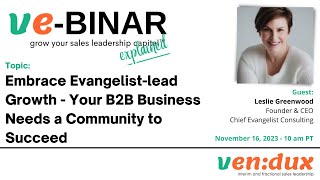
Webinar transcript of a conversation between the host (Henning/unnamed speaker) and Leslie Greenwood (founder & CEO, Chief Evangelist Consulting) about evangelist-led growth and how companies can use communities to drive B2B outcomes. Leslie defines evangelists (everyday customers who talk about a product without pay), distinguishes them from influencers/ambassadors, and explains that communities make identifying and scaling evangelists easier. She outlines business outcomes for communities using David Spinks' Spaces model (Support, Product, Acquisition, Content, Engagement, Success) and gives operational guidance: need for critical mass (~100 people), realistic activity distribution (1% super-active, 9% active, 90% lurkers), dedicated community management staffing, multi-month to multi-year resourcing (18 months to see ROI, ~3 years to maturity), platform selection tied to audience and outcomes, and handling negative communities as listening opportunities. She also offers a practical exercise for prospective builders (articulate company values, list ideal members, conduct customer interviews, identify "sticky glue"), and describes Wednesday Women as a related project. Contact: Leslie Greenwood on LinkedIn; websites: chiefevangelist (site) and wednesdaywomen.org.
Chapters
Welcome everybody. Good morning, Good afternoon. Depending on where you are, I'm excited to kick us off here for another webinar, a few housekeeping notes. We're recording this session and we'll make the link available later on. Please stay muted for the beginning part of this webinar. We'll open up the mics later for a Q and A, but for right now it just improves the sound quality for everybody. We're here with Leslie Greenwood, a CEO, a chief evangelist officer. Love the title. And Leslie, we are going to talk about evangelist led growth in B2B. Why don't you introduce yourself and let us know what you've done so far and why you are the expert on community and evangelist led growth.
Well, all right. Well, thank you so much. I don't know that I'm, you know, like we talked earlier, I'm a Midwesterner, so I'm not sure I'm going to just tell you I'm an expert. Like that's so anti my culture, but. Hi all, I'm Leslie Greenwood. I'm the founder and CEO of Chief Evangelist Consulting. I work with both B2B SaaS, companies and paid membership communities to build, rebuild, optimize their community strategy. I was employee number five at then revenue collective now Pavilion and built their member experience to really create evangelists that went out and, you know, drove the growth of the membership from 2,000 to 10,000, I think in two years. So. And now I help other companies with those same kind of strategies and bringing that into their business or their community.
Great. The first time I came across the term chief evangelist was about 25 years ago and I was sort of on the receiving end of a pitch, a visit by a company. They were pitching their services to me and when they were all done, take note of this, that I asked the question at the end, I said, and by the way, what's your role in the company? And the person said, well, I'm the chief evangelist. Turns out he was the founder and owner of the business. But to your point of Midwestern moderation, he came from Kansas City, Missouri and didn't want to call himself out as the founder. So he said, I'm the chief evangelist. I'm sure you have a little better definition of what an evangelist is.
Well, you know, you really tap on a really good point. The person that should be your first chief evangelist should be your CEO and founder out, you know, talking the talk, walking the walk. I advise companies all the time, their founders really need to have a presence on LinkedIn and in other communities but an evangelist. So we can jump into that. Of course. When I started chief Evangelist consulting my mom wanted to know if I had start going to church. And I told her alas, no, that's not the evangelist type that I'm talking about and because that's I think kind of the, the old, not the old but it's the way people think about it and it's really, you know, spreading the good news. Today you're going to see many people have the title chief evangelist. It's becoming more popular. People like Guy Kawasaki, Ethan Butte, other and other people coming up having the evangelist title. There are really couple different ways to look at an evangelist. So one is that company evangelist. So you're hired by your company to do that and go out and talk about it and that may be your main role. Maybe you have metrics and ROI attached to that. You sometimes people confuse that a little bit with an influencer. So that's definitely a paid relationship. This is not a paid relationship. It doesn't fall into that kind of camp at all. The other thing that you know, people think about like ambassadors or advisors, those I think are oftentimes some type of paid relationship. Like I'm going to give you some stock, I'm going to give you some notoriety and then you're going to give me back this. Talking about you talking about the company. And in my mind the way I look at evangelists is like every, every customer or every community member can be an evangelist. So it's like the everyday Johns Janes that are the ones that I'm talking about. I'm not talking about the big, the CEO or you know, the, the well known name. I'm talking about the average consumer of your, your product that just really loves it so much that they go out and talk about it. No one's usually asked them to do it. They're not getting paid to do it but they love to do it because they love the product.
And just to be clear, I'm a huge fan of Apple products. Does that make me an evangelist just by product?
Do you talk about it? Do you tell people about it? Do you, when your friends have androids, do you poo poo them like my family did me and said you definitely got to get an Apple. What's wrong with you?
I no, I don't. And I think that's the clarification. So you like the product or you like the service and you talk about.
It, you talk about it. So you have to share the news. So I, for me it's a, a great, a couple great examples. Like I have a couple of products that I use that I really love. I talk about and hope that people send me grove cookies all the time because their founder is a veteran. He was co founded with his wife, so it's veteran and woman known. They make the best freaking cookies and they allow me to really customize what I'm sending to people and they've given me a service beyond my expectation. I email him, he emails me back. I'm like, I don't know how to make anything canva. So he made me my whole Canva thing, you know, thing for me. And so that's, that's a service beyond expectation. And I will talk about them all the time. I tag them in post. I'm not getting paid a dollar. I think once they sent me 12 free cookies.
Good. Well, I, I did call myself a chief evangelist for fractional and interim sales leadership. I think that would be true on LinkedIn. So I think, you know, I'm a fan and I talk about it constantly so that would, that will qualify.
I would absolutely give you that title 100%. You'd have to talk to Andrew to see if he'd agree to that title, but I'm going for it.
Good. Wonderful. Then, but then let's move away from an individual evangelist, a single person, to the, the aspect of community. So how does a community come into play when we're talking about individuals that are fans or like a certain product or service?
For me, the, you know, you can do it both ways. You can do it with a community, you can do it without a community. For me, with the community is a, it just, it feels easier and it feels more scalable, although I hate that word and natural. So you have a group of people who've already decided they're going to invest their time with you. They, you're, they're logging in maybe once a week, maybe it's once a month, maybe it's twice a day, maybe it's as much as Henning and I are on slack at Pavilion, who knows? So they've already decided that you're worth 15 minutes to their time. You can measure them, you can find them, you can watch them and see if they're active. You can see if they're giving to the community or they're asking for things. And then you can then identify them either, you know, by the ones or by the tens and then start to amplify them through programming, through a special group, through extra benefits that you give that type of person. So for me a community is just an easier way to do it because you've already kind of gathered some fans. Now it's just like how do we take these people who will give me 15 minutes and turn them into evangelists that will go out and talk about me in public?
And that's different from being paid as an influencer or as, as an ambassador to your, to your differentiation earlier?
Yeah, yeah. 100. I mean I, I don't know if. I mean I'm an ambassador for at least one company and I will tell you, I don't do much. You know, once I think that it goes into like, if you've read the book Drive by Daniel Pink, once you put in like a token or a carrot or something that you're getting for doing the job, it takes some of that aspect and, or funness of the job away. And that type of left brain thinking doesn't need that kind of reward. And so I just feel like I, people don't engage as much once you've moved into that semi paid thing unless you're fully paid is like in, you know, you hired Kim Kardashian to be your influencer and obviously they have to deliver.
When I think of communities, my, the first thing that comes to my mind are those peer to peer learning communities of which we know there are many out there, most of them are free. And it's, it's a, it's a community, it's free. Feels like a community for the community's sake. But now we're in the B2B world and you know, companies have a very specific interest in selling, generating revenue, generating profits. And how do you, how do you into your example of the cookie company? I'm sure they fall into that, into that category as well. So how do you as a company now, not as the evangelist, but as a company, how do you balance your economic goals and interests with having a community that is truly there as a community and doesn't necessarily sit there and say buy more of their cookies so that they have higher profits 100%.
So that's where I think a lot of people, some companies will come to me like I want to build a community. And the first question is why? And then what's the business outcome that you're looking to achieve by building this community? So there are multiple types of business outcomes that people can have. They can have a combination of them. There's a model by David Spinks called the Spaces model. The first S is support. We've all participated in a support community at some time you have a problem with your Apple product, you go on and you get into their chat room and someone answers your question, maybe it's another member, maybe it's a paid person. Now I'm making the money by reducing the cost per ticket closed. The next one is products. So you may be doing it to get product feedback, have beta testers, et cetera. I think that's a great way for any SaaS company to use a community. Although probably just it'll be the side reason, maybe not the main reason. A is acquisition. So that's the one. Like I'm going to work with companies on the revenue side. So it'll be on acquisition, it'll be on engagement, it'll be on customer success. So something that drives revenue. So acquisition is you have a company. So Henning, let's say, I know we're gonna, we might do this later, but you and Andrew wanna build a community. You build a community around not your company, you build it around the idea of the value of fractional leadership. You want to give value over and over again to people who are thinking about either hiring fractional leaders or fractional leaders that are either, you know, experienced and need support or something. You open that up and then guess what, then your service is known to many and then people, then you're going to acquire customers through that. And so you can measure, and companies can measure whether a customer comes into their community first or they go into their sales pipeline first. And then you can easily figure out ROI from that. The next one is content. So content's a great thing. I think people underutilize the content that's put in their communities. Like think of how much you know, how much actual knowledge is in there that you could turn into some marketing collateral, testimonials, etc. E is engagement. So you know, how do we keep them engaged? How do I keep you wanting to learn more about my widget or to how to be better at your job? Which creates these positive feelings because if I'm in your community and I'm company X, not X, ooh, company Q. And you love my community. When you think about buying a product in the Q brand, that positive relationship that you have, the community will be associated with the company. And so that, that is another way to look at it. And the last one is success. So customer success. A great example of that is gong. They use their community as their long tail customer success. So if you're not assigned a community, a customer success manager, you go into their community and then they're able to give customer success at scale through both their team and members helping other members which increases their experience, increases their retention, et cetera. They're actually one of the best ones I know that do that. On the customer success side, yeah, you.
Gave a number of great examples. How about timing? Let's say you are gong or any, any of the other examples you cited. When is the right time for you to begin to build a community?
I mean if I, if okay this, let me just tell you what my dream. I'm going to throw out in the world what my dream customer is and then the universe is going to bring them all to me. I want to talk to maybe earlier stage founders who are forward thinking that understand that building a community from the very beginning, which actually goes hand in hand with customer success, customer service. How will you treat your customers from the moment you interact with them? I want that person but they probably just need to have gotten series A or a seed round so that they can afford the time and resources and everything. So like that's the mindset I would love to have. So, but to go back to your question, what do you need to do like community does? It never runs itself. And that's what I think a lot of people don't understand. And I use my experience, you know, at Pavilion is like we had a team of 18 people underneath the engine, underneath the scenes, running the community. You might have seen them in places but you didn't understand there was an entire, entire machine under there. But it felt smooth to you underneath? Oh my God, we were going crazy all the time. And so when people say I just want to build a community, great. Tell me about what your resourcing look like. Who's going to, who's going to run the community? Who's going to moderate the community? Do you have headcount that you can dedicate to this project? Are you willing to put 18 months into this to see Roi? You know, if they're under big pressure and all they need to do is sell like it's not the right time. So it's when you're ready to put in a longer term effort and, and, or yeah, when you're willing to do that and you're willing to invest in it because it's not, you know, it's not free and it's not easy and you have to invest and if you're not willing to do that, it's definitely not the right time.
Scenarios where you would, I mean aside from not having these factors in place, are there other things where you would say, you should not embark on this project now or ever. And I'm thinking of companies with really bad products or really bad services. You know, in all fairness, there are those out there as well and they still are in business and somehow successful. But are there factors like that where, where you would say don't do it?
I mean, you obviously have to have a product that people will love enough to want to, you know, put their time into it. The other factor is, especially on the newer, for newer companies, is that it's a lot easier if you have enough customers. So like a critical mass, you know, I need to have about a hundred customers, you know, or 100 people that might come into the community because there's this 991 rule, which I think goes into different things and I think there's a name for it and someone will say it and I don't ever remember it, but like 1% will be super active. So 1% are the hennings, 9% are kind of active, and 90% don't do anything. So unless you have at least 100 people in there, you're only going to have maybe 10 active folks. So you need to have a critical mass. A lot of people, the founders, they want to have a community, but they don't have a following. Like there's no community to bring into because they're not known in their industry. They're not, they don't have enough of a following either personally or professionally, or the company doesn't have a following. Or the other times it's like they don't really have a differentiator. Like if we can't get to that glue, you know, I call it the sticky glue, we can't get to the glue that's going to make a customer come back to you for 15 minutes twice a week. What, what problem are you going to solve? What's interesting enough about your, your offering that people are going to come back? I mean, there are times, I mean, I, I'd say at least a third of my conversations are one. Either it's, this is not a, this would not be a valuable community or this would not be a community I would recommend. Or the conversation is, let me tell you, a couple communities to go to be participant in and then learn from your customers there, then figure out if you could have a product market fit for a community for your customer at one point. Or we just talk about strategies on how to be a great community member and still do a crap ton of business, which, you know, we've all seen People do quite successfully if they do it right.
Yeah. So let's assume There is a B2B startup who fits all the right criteria to be community, who would want to benefit and could benefit from a community, but they are lacking the funds. They can go and engage Leslie and have her and other resources internally build that community. Are there things that businesses can do sort of as a precursor to having the funds and then embarking on this project later?
Yeah, I mean if you're an early stage company and you have, you know, the people, your early adopters who are already super crazy about you and if, if the only thing you can do is, and I'll just probably kick myself later is throw up a slack, call them the wonderful wonders of XYZ company, give them a name, make them feel special and they get to have access to product, they get access to the CEO. You made them feel amazing. If you can do that way, that's fine. The other way is like I said, go hang out in other communities, you know, pay the membership fee or you know, go to other free communities and participate there as a member, not as a salesperson. Give your knowledge away for free. Be known, be seen. So that when the opportunity for someone asking for your product, either someone will tag you in the post or they will come to you because they already know you.
I assume those are. This is great advice in, in the current economic climate when, when funds and funding is very tight, it. What have you seen in regards to that in the, in the last year, what's different now versus a year or two ago?
Let's say last year when I started my company, when, oh wait, yesterday or today is my one year anniversary. So gay me. There was so much talk about community. Like community was everything. Evangelists were popping up everywhere and there's so much interest and then the SVB and then the kind of like detraction of the economy and everything. And so many of those that I thought were like we are going to close this, we are going to move this forward. And a lot of them got, a lot of them got pushed. So where I was seeing a huge amount of momentum starting last July. You know, it's a lot of customer education right now. And I was telling Henning and Andrew before we jumped on, like I, you know, have a new client as of Monday and it's been 13 months that we've been interacting and so it's just, you know, taking the time for them to really understand and to be in the right place to make the investment and really understand what the investment makes to them. So I think it's just lower on the community front than what, what I think it was a year ago.
You already hinted at the fact that I'm going to abuse the fact that you're a guest on our podcast here or not podcast on our webinar. Let's do a little bit of a case study here around Vendex. You know, our business model a little bit. You know, we have executives on one side and clients on another. What would at a high level and maybe in the next 3, 4 minutes your recommendations be for us in, in the community in the evangelist field? Yep.
Well, the first thing is I have a, an exercise I have all of my customers do. It's just my community POV exercise. I'm happy to send that to anyone. It really, it starts with company values. You know, some of the people don't have them already made, but it's like I want to know what those are because if we're going to build a community, it's got to. Those things have to intertwine. So what does it feel like to be a community member? What does it feel like to be a customer that needs to be to me a seamless, you know, transition so that you're putting that value, your values into the community. The other thing is list 5 to 10 ideal community members for you. Whether they may be people, they're probably people known to you that would get benefit that you think would get benefit from being part of your community. And then you're doing customer interviews. You know, if what problem could be solved for you? What would be different about this compared to other communities? What you know, you might even if you're, you're what you wouldn't charge. But you know, then it's like testing what the, your pricing strategy on people. So it's like a lot of customer interviews because I will say that 70% of the people I start working with, they have an idea of what the value is that their customers want and they want to deliver. That is not actually the case all the time. They, the customers actually want some. It's, I mean, goodness. It's like every product out there, the customers actually want something a little bit different. And since we are talking about a human to human product, you have to talk to humans to understand what that is. After that it's like figuring out your sticky glue. So we kind of even, you know, talked about that. It's like you are the chief evangelist of fractional work. So like what, what would you bring to your membership and what you Know, what would the value be that you'd bring to your membership? Is it education around fractional leadership? Is it, you know, is your icp? That's the other question I asked. Who's your ICP and what are their Personas? Is your ICP people wanting to move into fractional? Is it people want already in fractional and want to do it better? Is it people wanting to hire, you know, fractional leaders? So it's like you kind of have to do that and then figure out, like, what's going to make, you know, what's going to make Paul or John or Mark or Lisa log in twice a week for 15 minutes every week. And then once you decide on that, are you committed to delivering that value time and time again in perpetuity? And if the answer to that is no, and you're going to tell me you think the community will run itself, then I shall boot you to the curb and tell you to go kick rocks.
Good. I look forward to being booted before we even get there. Let's, let's think about this. We're in essence a marketplace. We don't function necessarily as a public marketplace, but we bring two groups together. Is that a scenario where you say that's one community for everyone involved? Is it two communities, one on each side? Is it just one community on one of the two sides that we bring together?
You know, that's, that's a rough one because you want to continue to be the marketplace. So you put everybody together and now you've intermingled a little bit. So I wonder if that would be a challenge. But you could have private spaces. So if I think of just, if I think of a slack community that there's a private space for, you know, your go to market leaders and a private space for people to talk about their challenges in hiring and how they're using fractional leaders and how they're onboarding them and offboarding them and, you know, those kind of challenges. So maybe it's one community with two separate kind of spaces within it. But that's just my first thought. I would, I would. This is spot consulting. I would need to think a little bit more about that one.
Good. And I don't want to, I don't want to abuse the opportunity too much.
I'll send the invoice.
Good. And I also want to give the, the, the opportunity for others to ask questions. So get ready. And, but before we get to the Q and A part, let me ask you, Leslie, about other things that you're doing because If I Look at your LinkedIn profile, if I see what you're doing out out there in social media, Wednesday Women is a big project that you were involved in that you're spearheading. Tell us a little bit about that.
Yeah, awesome. Thank you so much for asking about that. Yeah, I have a. An act. When I decided to start one business, I guess I decided to start two. And the second one is Wednesday Women. Our charter is to just spotlight and highlight women executive leaders that sometimes won't spotlight themselves to get them on more stages, podcasts, keynotes, etc. And our goal is to not ask the women to do one more thing. So we are not a community. We are creating community without a community. And our goal is to deliver service to the women with no effort on. On theirs. And to be, you know, hopefully a place one day where people goes, like, I don't know where to find my next speaker because I hate when I hear that online. I couldn't find any diverse speakers. Bulldo. So, you know, like, you think of Wednesday Women and you'll come, come see us. And in the meantime, we're just popping everybody up to the top and hoping to increase their exposure. So little passion project. Cool.
Well, congratulations and thank you for undertaking those efforts that we all know are extremely necessary and worthwhile. So thank you. Wonderful. Let's open up the Q and A. Anyone who has a question, since we're a small group, just unmute yourself and ask the question. John, you were the first to unmute. The floor is yours. Yeah. Hey, Leslie, Curious. You've mentioned Slack a few times. I've seen a lot of digital marketers use Facebook groups. You know, I'm a member of some LinkedIn groups. What do you find are the most effective venues for creating a community?
I will. Here's the answer. It depends. It depends. I think the first thing you have to do is decide what your outcomes are, and then you work back towards that. You also have to look at your audience. You know, Henning and I, we live in B2B Tech SaaS. Everyone in our network is already on Slack. So getting them to log into yet another portal or something like that is going to be a big change management project that probably we will not win.
Right.
I have another customer and their. Their community is. Is not tech savvy at all. They may not even be on Facebook. And so we, we chose ed regular community platform that has a forum that has a very easy user experience and that will work just fine for them if you're a dev community. I Think most of them are on like Discord or something because that's where the devs are already hanging out. The things My, my biggest client, I help them move off of Facebook and onto Slack. Challenge with Facebook is, you know, you really just don't have any controls. You know, it's very hard to moderate. You don't have multiple channels. You cannot put in some of the good strategy that I would want to put in into a community. But then sometimes you just have to say, you know, you start where there's less friction.
Right.
But for any kind of B2B company or paid membership community, I would never do it. I mean, honestly, I'll just be, I would never do it on a social platform because I'm just. Then you're beholden to them and you can get banned, you could get shut out, you could, you know, somebody could close your account, which has happened to people. And I'm just, I don't want to put my, my eggs in that basket.
Got it.
All right, thank you very much.
You're most welcome.
Thank you. John, other questions. Andrew, I'm calling on you.
He's talking, but he's still on mute.
Great, great perspectives. Thanks, Leslie. With With a business and a revenue hat on, we like anyone, the core business is what it is, providing products, providing services. And in the course of a period of time, a community grows around these products and services. And one day the business leaders wake up and they say, oh my gosh, we've got a mailing list of 50,000 people and oh my gosh, we got people that are chiming in and communities like, but we're not doing anything with them formally. But there's a community that has now evolved. What is the balance between looking at this community with dollar signs in your eyes and say, oh, how can we monetize this community? Can this community somehow over the next couple of years make an impact to our top line revenue numbers in some way? So my question to you is, is that even a realistic way to, to think about. One way to think about a community is monetizing the community. And secondly, do you have specific examples in the work that you've done that can point to, oh yeah, this company didn't do anything with their community. And then over a period of time they did this and this and this and there was an impact to their bottom line, a positive impact, and this is what they did to get there.
Right. I don't have any examples from my work on that question. I think probably every business leader is going to think about that like no one wants to just start a community for community's sake. There's always going to be a business outcome attached to it. I think you're thinking of it just like, you know, like a board member or a CRO looks at it but then you have to flip it and say what value am I going to give and how can I commit to doing that over and over again that's going to lead to the business outcomes. So yeah, everybody's thinking about value. It's just whether our outcomes are ROI on it and more mature companies, like I said, gong sixth sense, they use a lot, do a lot of customer marketing. Heather Fay is amazing. She's head of customer marketing in community so it helps her get the, the information out. They do it amazingly well and there is very much a, an ROI attached to it. So I think what you're thinking about is right, and it's like, do I want to gather? So you have the, the community. It's kind of like community in the wild or community without walls or something like that. I'm kind of making that up. Do you want to gather those people into a place? What would you want your business outcomes to be and then what method do you want to give, you know, to get which ones of the outcomes do you want to choose or which couple and then what value you're going to give and can you figure out what that value is and then start your customer research? I mean, I think a lot of people start that way. You just have to turn it around.
Yeah. And just start, I suppose turn it around. Right to the community is oh, you know, you've been part of our community for a period of time. We value you being here. But now what, how can we add more value to you? Is there, are there things that we're not doing that you'd like to see us, etc. Etc. Right. Then it's then using that information to formulate some plan or strategy.
Well, if you think about, if you have a really amazing content engine that people may or may not be seeing that information and then you had a community and people were in there, then they're more than likely going. I mean if you look at email open rates, the amount of times like I do or do not see henning stuff on LinkedIn, you know, algorithms and all that kind of stuff. Like there's no, like your open rate of a Slack is like a text your, you know, there's no algorithm to mess with. So it's like, do I, you know, can I give this content to people in one place, are they consuming it enough that they would want to have access to it in one place instead of having to try to get it in different places is another way to look at it.
Thank you.
Thank you, Andrew. Any other questions, Lisa?
Yeah, go ahead. I'm, I'm just curious, in your experience with all the different clients that you've worked with, where do you typically see community be the most successful in terms of someone owning it inside the company? Like where do they report? Is it a marketing function? Does it live with cs? I'm curious, you know, your take on who, who should be like accountable internally for it to have the biggest impact? I got to tell you, it depends. Depends on which one of the business outcomes you're looking for. If it's the customer success, then the customer success owns it. So Nisha Bakshi from Gong, she reports into the customer success Org. Heather Fay reports into the marketing org some. So it's usually, I'm usually talking to, honestly the people I talk to. I'm either talking to CEOs, founders or CMOs. But that's just because I'm fully like, you know, I'm focused on the revenue side. So maybe the person reports into the support or because it is a support based community. So there probably could be many different owners. But you know, most likely I'm going to fall into CMO or CEO. It's who has the budget, who's going to own it and who's going to put the 18 months to. Because three years is a mature community. So who's going to put the time in and is going to have the continued budget to run it for that long? Thanks.
Great. Thank you Lisa. Last chance for questions. If Andrew.
Yeah. What about on the dark side of communities where communities have popped up. You know, back to Henning's point about companies that make lousy products and services and communities grow up to hate and bash and you know, these are like the neg, the negative, the cancelers. That's, that's, that's one community. Do, do companies. Is it incumbent on companies to get a community manager to help ameliorate those negative communities?
Well, every community should have a community manager. It's full time dedicated staff, not full time dedicated staff. Whether it's four hours a week, I mean, you know, four hours a day, 10 hours a week, whatever it is, it's dedicated person that is not your events manager or social media managers. Extra job to do the community because it will never happen and you will fail miserably. So is it Their job. Community really needs to be, like I said, I would love if I only talk to CEOs. Community needs to be owned by the entire company. You should feel blessed if you have a community and your product sucks so much that people are going negative because you have voice of the customer in your ear right now. And every single executive should be in that community and figuring out what the problem is because you have, I mean, that's a true gift. If they've got. You got people bashing you in your community, that's a gift because guess what they're doing, they're also doing it out in public that you don't know about. So. And I'd say no, it's not the community manager's job if, unless it's about a service issue or, you know, something like that. But if it is, you know, a true product, overall customer service, customer success issue, then that is, that's their job to bring all the feedback together and make sure that leadership has an ear into the community if they are not in there. And that, that is all bubbled up. Oh, you can get me riled up about that one, Andrew. I'm like, no, it's not their job and the CEO needs to get his butt together.
Cool. Yeah, I agree. Those, the, the, the complaints and the bashing that, that's a gift to just listen, understand, pivot and turn haters into lovers.
Yep. Some of the best, I mean honestly, some of the best relationships I have with people now in pavilion were people that were unsatisfied. Like we NPS responder or every detractor on NPS we would, we call them to have a conversation with them. And some of them, I mean I can name them right now and some of them still send me referrals for Pavilion and I don't work there anymore. And it's just because, you know, we listened and really kind of like you said, actually used it to, to make a difference.
Yeah. Excellent.
Wonderful. Leslie, thank you so much for being our guest and taking the time. How can people get in touch with you?
Well, I'm unfortunately on LinkedIn way too much according to my screen metrics. So LinkedIn is just. Leslie Dash Greenwood, you can. My website is being redone, but Chief evangelist. The chief evangelist. You can find my website and then wednesdaywomen.org for my other website, but pretty much just find me on LinkedIn.
Great, wonderful.
All the time.
Thank you, Leslie. Thank you everyone for joining us and have a wonderful rest of your day. Bye bye.
Thank you all. So nice to see you.
All.
More from Henning




ve-BINAR - The Revenue Tornado Methodology: How 3 Power Sources Create Exponential Growth


ve BINAR: Executive Cloning: How AI is Reimagining the Role of the Fractional Executives




veBINAR: Unlock Client Value: Why Compliance is Crucial for the Startups You Serve
