ve-BINAR Engaging Your People
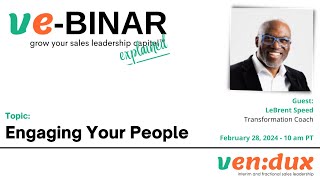
Henning Schwinum and Lebrent Speed discuss why employee engagement is dropping and what actually works. They point to four foundations: nutrition, exercise, purpose, and relationships. Leaders need emotional intelligence and psychological safety, not one-off programs.
Chapters
Wonderful. Two minutes past the hour. Let's get started here. Welcome everybody. For this webinar, a few housekeeping notes. We're recording this call as we always do and make it available on our website by tomorrow. We will have a Q and A at the end.
So.
So you have two choices to post questions. You can put them in the chat and we'll monitor that along the way. But you can also save your questions for the end. And at about the 25, maybe 30 minute mark, we'll pause for the Q and A session. We will let admit participants along the way. And please keep your microphones muted during the session unless you you're asking questions in the Q and A. That just improves the overall quality for all of us. Our topic today is employee engagement, and I'm very, very happy to have Lebrent speed with us. Lebrent is a transformation coach and I would love him to introduce himself and tell us how he got to do what he's doing today. LeBron, welcome.
Well, thank you, Henny. I really appreciate the invitation. I appreciate the opportunity to share. Always love talking to people about transformation. So my background as a transformation coach, what that really means, I'm a speaker, I do a lot of speaking and also focus on a lot of health and wellness with a background in sales and marketing, which I don't know if you think that's all interrelated, but I found that to be very interrelated for me. So years of service has been incorporations have been sales and marketing. I also lead a sales and marketing team for a startup company as well. But my passion is health, health and wellness. Because what I find is that people are not what we do. We are. We, we, we are who we are. And what that means is who we are is more valuable than what we do. And if people are not tapped into who they are, what they do doesn't really matter. And so I love talking to companies about how do we focus on who we are and who our employees are so we can make a greater impact on the world.
So all the research tells us, labrant, that we're not doing a good job or that employers are not doing a good job. Gallup and other polls continue to show a decrease in employee engagement. Maybe that's a good starting point to kick us off. How is that being measured and how can we say for sure that there is an objective trend, an objective decline in employee engagement?
Good question. I would say the employee, the Gallup poll and other polls are just measuring pretty standard questions that employee surveys are Going out on, how do you feel about working here? How do you feel about your role? How do you feel? Do you feel valued? Do you feel seen? All those different basic questions are put into these employee surveys and what, by a large part, many of the employees do not say that they feel valued, they feel seen, they feel engaged in the mission of the company. And so now we're seeing more and more that many of our employee engagements dropping. Recent numbers tell us about 50% of our employees are not engaged and 25, at least 25% or more of our employees are actively disengaged, which means one out of four of employees are actively looking for another job right now. So if you have 100 employees, 25 of them are looking for another job. Now that's staggering when you start thinking about 1 out of 4 actively looking for another position. And when you add that to the divide in terms of generational divides, within 10 years, 70% of the workforce will be millennials. And many of us are Gen X or baby Boomers. On here we know statistically baby millennials are not as loyal to companies as we were. And for good reasons. We've never been really loyal to them. And so if they don't feel engaged right away, they don't feel part of the greater mission, then they start checking out and then start looking for other opportunities. And so then those dollars or few dollars or thousand dollars here or there matters a lot. So keeping people engaged with the mission and value of the company is really, really important. And for us to re engage them so they feel like a part of.
To, to, to start there with people, individuals within companies, what is it that makes us happy as an employee, as a, as being part of a company? And maybe you can talk a little bit how that's different generationally as well. If there are differences, there are differences.
I would say millennials and the, the other generations are typically more missional focused our generation, or I'll speak of my generation, Gen X, who often gets forgotten. And the baby boomers were very, you know, do what you're told, follow the rules kind of things like that. And didn't matter if they were loyal to us, we'd be, we're loyal to them, like all that stuff. They're not thinking like that. So let's talk about two different things. So one, I want to talk about what makes human beings happy, period. Right? So that's important. Understanding what baseline happiness comes from or fulfillment or contentment comes from is important. To then build a template of what makes an employee happy. So when we all. We're all human beings, whether we're at work or work at home, so we don't become something else when we go home or something else at work. So Harvard did a great study, for many of you might be familiar with that, the Harvard Happiness Study. They wrote a book about it called the Good Life. The Good Life is based on. The Harvard Happiness Study was done in 1938, and it's still continuing today. So this study is the longest study done in not only American history, but worldwide history. This is the longest study that we know of what they did. To give you a baseline of the study, they took a bunch of kids from Harvard and they took a bunch of young people, teenagers from. From basically the streets of Boston, who are usually immigrant children in the 1930s, and they put them in the study. And the retention rate of the study was 85%, which is extraordinarily high. They followed them entire lives. They did blood work, they did scans, they followed. They went to their house. They had to fill out studies every few years. And so what they did was from there, they started to. The whole question they posed with this study was, what makes a human being happy? That's the baseline question. And they understood that these were all, you know, as they studied this, now they're studying their children and their grandchildren because most of these men are past, and they knew it was all white men. So they're like, what. What are other studies? So they took other meta studies from the south, they took other studies from Europe to figure out, is there some delineation in terms of what makes human beings happy? And what we found is that there isn't really. We all are basically once our baseline Maslow hierarchy of needs, once our baselines are taken care of, food, shelter, then we go into what brings fulfillment and happiness. So what they found was there are four things that make a human being happy. These are the baseline. And everything else stems from these four things. Number one is nutrition. Number two is exercise. Number three is purpose, and number four are relationships. Now, in regards to companies and organizations, you're not there to necessarily feed your employees and work out. But if you have a holistic health approach, you definitely can fixate on the purpose and you can definitely fixate on the relationships. If we create an environment where we have healthy, the people know their purpose and we're connected to their purpose, and we create environments of healthy relationships, people are less apt to leave companies where they have embedded relationships, even to pay more. They talk about this in the book that some people Feel. So, you know, some of us have relationships that, I mean, all of us probably have experiences where we stayed on a job longer than we should have because we were so ingrained with the relationships. And so employers can do things specifically to foster those type of relationships. And so we can go on that more detail. Simon Sinek has done some really good work and writing on that as well. But I think understand the baseline and what makes people happ. We should really surround everything we do around those four key markers.
So just to make sure I understand this correctly, there isn't really a difference between how to make people happy and how to make employees happy. The same principles apply.
Absolutely. Because again, we are humans wherever we go. And so if we understand the baseline of happiness, then we can create programs, we can create a system that really fosters those four key areas.
Okay, then let's talk about those systems. Because you know, when I think about making people happy and having healthy relationships or fostering healthy relationships, it sounds to me like it's a one on one exercise. But of course within the context of a company, even one that has just, you know, 20 or 30 employees, that's impossible to do. So you have to have systems. So what can employers do to create systems to ensure employees happiness?
So one thing I would suggest is that, and you know, most of the people on here are leaders. I think, you know, all of us have been in situations, I, I, I can't speak for all of you, but I assume this may be true, that we've all been experienced situations where you had a boss that wasn't bet, lack of a better term, competent. How many have maybe had incompetent bosses before? Okay, lot of raising hands, double hands, all that. One of the things I thought was fascinating, especially being an African American man, you know, typically when I've taken leadership positions there's always these questions of affirmative action. Did you get this role because of some kind of thing like that? Now think of them. I always thought that was funny. The reason I always thought that was funny because most of the boss I've ever had were white. And most, most of them were incompetent. And when I started to break down incompetence, what I was thought of was not that they were not just good at their jobs, which a lot of them weren't. Beyond not being good, they just had no emotional intelligence. And I think one of the best things we can do for our employees is have emotionally intelligent leaders. Because I would suggest, and again, if I'm speaking out of school and I Work with a lot of companies, been doing this for a lot of years. I think you all can agree, many of the leaders I've met, executives, presidents, CEOs, managers, are some of the least emotionally mature people I've ever met in my life. It's like, what are we doing here? Are they taking the time to really at least. I couldn't agree more. The self awareness is lacking. So what I suggest is that companies with vision, CEOs, leaders say, what do we need to do to get our leaders in a position of self awareness, emotional maturity, so then we can foster that within our teams. And I think that sounds trite and it sounds simple, but I think that is where we got to start. Because if we say, hey, we're going to create this new program for wellness and thoughts and this, that and the other, and as soon as you create this program and someone says something to their boss like, man, I really been struggling today because I'm, you know, my dog got, you know, my dog is sick. You're like, yeah, whatever, what about your numbers? Like if, if you have bosses, no matter what program you create, your managers and leaders will destroy it. And so we've also heard that you know about strategy, you know, culture eats strategy for lunch. So if we don't have a great culture, your strategies are irrelevant. So I believe it's really, really, really important for us to really foster leadership and emotional intelligence amongst our leaders. And then we can create systems that foster that. I think that's super important. And I don't believe enough companies spend time in and money on that, which is we. Do they hit their numbers or not is not just the only question we should be asking.
So when you speak about fostering emotional intelligence, is that truly a trainable trait within people? Can you turn someone who has a total lack of emotional intelligence into someone who can then be a good leader in turn?
So first of all, yes, I believe you can. You know, there used to be a train of thought from old IQ test that once a person had a certain level of telling, so I was in graduate school, they used to teach, you know, that your success is EQ +IQ. Emotional intelligence plus innate intelligence equals success. And that at the time they used to teach that emotional intelligence, the only thing you can actually grow, that your intelligent quotient can't grow as a human being. Well, neurosciences now tell us through epigenetics and neuroplasticity, we actually can grow our actual intelligence. So your intelligence can grow. It's not based on some tests you took in the fourth grade, you can actually become more intelligent because our brains were made to develop. And neuroplasticity is telling us that our brains were developed so we can grow our actual intelligence. You can grow your emotional intelligence. Goldman in his book Many. You might be familiar with the book Emotional Intelligence. So all intelligent emotional intelligence is very simple. I always say there's a root word for emotional intelligence. The key phrase in emotional intelligence is empathy. And every person, unless they're a psychopath, but most people, and there's only 0.5% of them, 99% of people can grow in empathy. So if we can have people grow in empathy, empathy allows you to be able to relate with different groups of people. Even as I do a lot of work in dei, what I consider DI and make it all the fancy terms, diversity, equity, inclusion and belonging. Now all those different terms, all that, all those simple terms are very simple to me. Empathy. Can I for a moment take myself out of my seat and put myself in your seat? Can I for a moment take myself out of my eyes and see the world through your eyes? With no judgments, with no. With no prejudice. Just. We all have our own set of prejudice and all that stuff. But for a moment, can I take myself and listen to you? That can be learned. Take it from a person who's been divorced multiple times and was told I would never increase in emotional intelligence to what I'm doing now? I can say I'm the poster child, that you actually can increase in emotional intelligence. So yes, you can increase in emotional intelligence. My wife says I'm highly emotionally intelligent and I appreciate that because I was not told that in the past. So I would say, yes, you can, girl.
Thank you.
I'm glad you can.
Congratulations on that. But now that you identified yourself as the poster child, how do you take this into a. Turn this into a tangible program that you bring into a company to affect that same change?
Okay, so if we deal with the baseline, Simon Sinek has several books. One of them is start with why. Why do we do what we do? I think it's important before we look on the employees, is that we create these systems where every individual in our company organization ask themselves a simple question. As I look at people on this call, why do you do what you do to tap into the why of who you are? Why do you get up? Why do you work at this company? How did you become a leader? Why is this important to you to really tap, to really spend time, not, not the pathetic, hey, five minute session, really spend time with this now I'm going somewhere for a moment. If you really tap into why you do what you do. Now I can tap my why into the company's why. I can like call it, I call it plug up. I can, I can take the company's mission and vision and I can tap it into my own mission and vision. Martin Luther King says it like this. If a person has not found out what they're willing to die for, they're not fit to live. So understanding your vision and your mission in life, now I can tap into the company's mission and vision. Now we create systems where we can listen to our employees as leaders, find out their mission and vision. And now we have this synergy between us, them and the company. And I believe how we create systems like that we have to have times of listening to them, ask them deep, engaging questions and creating a psychological space in which they can share without being judged, without being, without fear and retribution. Can I share this or. And am I going to be penalized for it? So we got to create psychological safety for our employees so they feel as if they can share in this space. So that's one of the most important. Instead of systems where we talk to you, how to create real conversations amongst them. You know, one of the things I do is that we, you know, one of the companies that we did, I have, we created an app specifically for employment engagement. Because I'm not, I'm not here to, I think I'm a pretty decent speaker and I can motivate people and energize you. You bring me into your company, they're going to leave there like, yeah, we can do it. But yeah, that wear off by the weekend and come Monday, what's next? Like, you know, all that sounds good. You know, one of my journeys I share is, and I help with a lot of high level professionals is I lost like 135 pounds. So I used to be 350 pounds. And so what I did was I, I really had to tap into this. Is this who I want to be and my greater why? And so I was able to use a program to lose this weight. Well, why is that important? Because if what's going on inside of my being eaten up, everything else is faltered too. So taking care of my personal health really impacted my professional health. And so I think creating systems in ourselves first, making sure we're holistically healthy, then we can create systems for our employees that they can be holistically healthy. So we don't just have some programs, we're Throwing out there, we got to take care of ourselves. That makes sense.
It makes perfect sense to me. But we'll have the Q and A in a few minutes and see what the audience thinks. Since we started off on metrics, let me now ask you, you know, when you come back in, when you come into companies and they, they measure the impact and they want to see more than people coming back in on Monday and returning to their same old self, you know, how continuous do these programs need to be? I assume it's not just you coming in, giving a speech and leaving. There has to be an ongoing effort to support employee well being or employee happiness.
Yeah, there does have to be ongoing. Now companies do like to just write checks and have people like me show up. So that's usually the easiest thing to do. Especially, you know, a few years ago when DI was very popular. They're like, oh, let's get a bunch of people to speak about this. And you know, now we've seen, even using DI as a template for all this other stuff, we've seen people say, make a lot of statements and then a Kareena crash. Now whether you're on here and you like dei, you don't like, that's not even relevant what I would say. My personal opinion from a person from the Twin Cities is this, companies got to get away from performative stuff. If you're not into it, just don't be into it. Own it, just own it. We're not into it. We don't want to do it. Like you don't have to. I, I listen, I'll tell you right now, I love transparency. I love honesty. I love people who, you know, where they are. As a company, you got to own what's important to you. Jim Collins, in his book Good to Great, one of the things I love about his books, those, his books about Good to Great is he talks about high performing companies have leaders who are very, there are visionaries who are very fixated on what they believe their mission is and they don't teeter from that. We need companies that are not pulled away by whatever they believe the cause of the day was. And say what, what do I need to do? What is our mission? What is our value? What is our system? Do if that's true, stick true to that, no matter what, no matter what's going on around there. Treat people with respect, to treat people with dignity. Obviously you got to make sure you're, you're complying with the law. You can't be openly discriminatory. But in the same token, don't be performative because if you're not performative, you're not just doing stuff based on some, some pressure somewhere. You can have long term systems so not only have a. Speakers, you can have, you know, quarterly situations. You know, again, you can have an app, you can have conversations, you can do things that are more embedded in the culture of the companies. And that's what great companies do. They have longer. They're not trying to have a quick fix. They're really clear on what their mission and their, their mission and their values are. And from that mission of value, everything flows from that. They're not trying to reinvent the wheel every week here. You know, one of the most frustrating things as a person has been an employee in a lot of different companies is it seems as if the mission and value changes every year. We got this new this, we got this new this. How many have been a part of this? Like this new fangled shiny object? It's, it's, it's the, honestly it's, it's just the biggest show of emotional, lack of emotional intelligence because we keep trying to grab even from a sales perspective. If you want a good productive sales team, stop giving them just incentives to give them incentives to raise up, raise up the numbers. Look at your product, look at your people and look at your purpose. If you look at your product, is it effective? Look at our people, are they effective? Look at our purpose, is it effective? And then create stuff along with your product, people and your purpose. To me, that's the way to go versus some new shiny object. We're going to do this now. No, no, no. I don't even want to do, I don't even like working with companies like that. It's a waste of my time.
You, you distinguished earlier a little bit what you're doing from a classical DEI program. And it seems to me that you address, you know, broadly a, an approach and as opposed to very narrowly focused just on, on DEI aspects. But I'm sure there is some form of tie in that you're seeing between the two. Can you talk a little bit about that?
Yeah, I do. So again, I don't do a lot of DEI work. I've done a couple of talks, but that's not really my focus. The company I have is a DI app, one of the companies I have. But one of the things I would suggest about that think of like DI work or any of this work like your own children. So I see Lisa on here say if me and Lisa were brother and Sister. We're adopting, but people don't know we're brothers and sisters because we're adopting the same family. But they don't see us and say, oh, they're brothers and sisters. Now Lisa's going to have a certain desire for me as her brother because we grew up together. We have the same mom and dad to have place in a company, to have voice in the company, because I'm her brother, right? It wouldn't matter if people don't think we look alike. The fact that she has concern for me because we grew up in the same. We have the same lived experience. Not the exact same, but we have a very similar lived experience. And she's going to be concerned about me. I like to ask people all the time, just imagine these employees, your co workers or your siblings, your children. What would you want for your child? What would you want for your siblings? Would you want them to have the same opportunity as you? Most people, again, if they're not a psychopath, would wants our narcissists want their children and their siblings to have the same opportunities as them. If you think of it like that, it makes things a little easier, right? It makes it easier to have the. So I like to think of it from abroad, because if I empathize with people, if I say, listen, this is not about, you know, against. I'm not against white men or white women. It's not about that. It's like, how do we all share this space and share this world and share resources and share community together? Because we all need each other. We all need each other. We can't all just separate into our own worlds and never touch the other people. We all need one another. So I think making sure that I go from that perspective and then I talk about personal health. It's hard for me to be concerned about your health if I'm sick and I can't focus. And it's hard for me to care about what's going on in Chicago. And I just got out of an argument with my wife on my way to work, and my kids are screaming in the backseat. Like all these things are more present in my head than some other issue about a thousand miles away. So we have to start where people are and then get them to where we want them to be. And. And it starts with us caring about their personal situation. You know? You know, marriages and children and families and sicknesses. All those things are very pressing issues. And I think we can't act as if, hey, we pay you to be here and focus only on this for the next eight to ten hours. Yeah, good luck with that. You know, the average American spends one and a half to three hours a day on social media. I. I'm here to tell you, they do it at work, too. So, hey, FYI, I don't know if anyone, if I'm breaking news here, but I think some of your employees are using social media at work. So I don't know, maybe. Maybe I'm breaking news for some of you. So.
Oh, no, you. You broke the trust of the 370 million here in this country. But what you just described is really subsimized under empathy. You call it out as the one big thing that we can teach people. And if you start there, if you can empathize with someone who just got out of a car with screaming kids or came in having had a fight with their spouse, then that's a good starting point for building healthy relationships at work.
Yeah. Because I think to my, whether you're black or white or Asian, Latino or LGBTQA plus, no matter what, we all have relationships. And again, relationships is the most important thing we have. So if we all can empathize, no matter what our cultural background is, we all can empathize with relationships. So I believe we starting there with a conversation about relationship. That's why I use an analogy of brothers and sisters. Because once you. Even if I even take you there, psychologically, Lisa is going to be more in tune to what I'm saying now. Because I said me and her brother and sisters. Look, I bet if you asked her, she would say yes. Because. Because I personalized that. That's just what human nature does to us. Right? I. We can't help it. It's kind of our old reptilian brain. We can't help it. We always are looking for safety and comfort. You know, it's just what it is. You know, we're all looking for safety and comfort. Does this feel like home or does it not feel like home? And as soon as it doesn't feel like home, my fight or flight kicks in. And if my fight or flight kicks in, it's hard for me to be analytical and wise and intuitive. As long as I feel fear, I'm automatically not going to feel safe. And so we've got to be able to break walls now. That's why psychological safety in companies is so important right now, where people feel safe and they feel as if they have a place they can share. I mean, obviously we're still at work. You're not going to be putting your Feet up on the, the, on the desk. But in the same token, we got to let people feel more comfortable in sharing who they really are. Instead of some of us going to work feeling like we have to be, we have to go in there being only part of who we are. And I feel like people of color and, and people, minorities often feel as if when we go into these spaces, you only can accept a small part of me and you get to be all of you and I get to be part of me. That's usually not a good place to start.
Thank you. Thank you for, for sharing that. Let's, let's open the microphone for, for Q and A here. Is there anyone who would like to, to ask a question?
I'd like.
Thanks, Henning. Thanks labrent. There's a lot in you and next time you're in San Francisco, I'd love to invite you for dinner.
Well, I've never been to San Francisco, so you could be my first visit, so that's great.
That's great. You cover so much ground. And we are both alum from Thomson Reuters. Different times, different decades. But good to know that the language of. You use the word employee a lot. You haven't used any other word to describe a relationship, I. E. Employer, employee. That is a relationship. The words have implications of a relationship. There are companies that use different words. Associate, member, principal, partner, etc. Do you, is that just cosmetic or do you feel that, do you see out there in your work that the language that's used in, in these relationships can make a difference to, to bridge the kind of gaps that, that you see and that you work on?
Well, well, first of all, thank you for pointing that out. Maybe that's just the, the Gen X and me, we think in those kind of terms. So we all have our embedded biases. You know, my, from my vantage point, again, this is my vantage point and what I've seen 30 years and corporate America is that yes, many companies, they call them partners or, you know, things of that nature. There are some companies, I feel like that language does matter and I think that's where it starts with your mission and your value of your company and you can start to determine that language again. There are some companies that's just performative. They, they can use any term you want, but if you don't treat people with respect, dignity and honor, it doesn't really matter. And so I think terms are important, but what's most important is our true values. And once I tap into our true values, then we can go into what terms? You know, ultimately, I've been companies where I've been called partners. I've been companies, I'll be called employees. I've been companies where we're called associates. Whatever term they use, the companies I felt more safe with, I couldn't. I couldn't remember what term they called me. I just remember feeling like this was a good place to be. And so I think it's more important that we create a space where it feels like a good place to be, where, you know, our managers, our leaders just know how to communicate with our people. I think that I've seen so poor communication amongst managers, leaders, whatever. It's just. It's like. It's like they're walking around, don't know how to communicate. So I think that's, in my opinion, more important. I think that's the things we need to focus most on.
LeBron, thank you. For some reason, Zoom does not seem to recognize on this call that I'm a paying client, and I'm afraid we're going to be kicked out within a minute here. LeBron. Just to make sure, how do people. How can people get in touch with you?
Well, I'm easy to find on social media. Labrent, speed, Instagram, I mean, LinkedIn, Facebook. I use Facebook and Instagram on LinkedIn a lot, so labrentz, speed.
More from Henning




ve-BINAR - The Revenue Tornado Methodology: How 3 Power Sources Create Exponential Growth


ve BINAR: Executive Cloning: How AI is Reimagining the Role of the Fractional Executives




veBINAR: Unlock Client Value: Why Compliance is Crucial for the Startups You Serve
