ve BINAR Executive Social Media Best Practices & Benefits
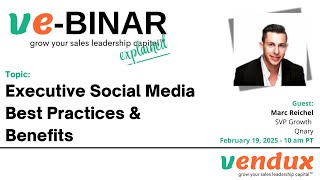
Mark Rischel from Canary explains why executives need to control their online presence on LinkedIn, X, and other platforms. Focus on three content pillars (professional, industry, personal), post consistently across formats, and prioritize engagement over follower count. LinkedIn's 30,000 connection limit is a real constraint to manage.
Questions this video answers
About 13 years; Mark has been at Canary roughly 12+ years.
LinkedIn study: content shared by executives gets 8× more engagement than company/brand channels.
LinkedIn connections cutoff at about 30,000.
Chapters
You welcome to today's Vendux Webinar. I'm Andrew Miller, one of the partners at the Vendux Group, where we focus on helping clients to grow their sales leadership capital. I'm really thrilled to have Mark Rischel as our guest today. I'm going to let him introduce himself in a second, but in a nutshell, Mark is a digital and social media strategist with a passion for marketing and emerging tech. Mark has worked on digital and social marketing campaigns with top brands and agencies such as Ritz, Crackers, Oreo, Trident, Timex, Dick's sporting goods, Verizon, McCann Worldwide and many others. He also works with individuals and businesses to optimize their digital footprint to help them build up their personal brands. Mark comes from the perspective that our offline and online lives are continuing to merge and those that are not adapting to the digital world run the risk of becoming obsolete. Today's Venducks webinar topic is Executive Social Media Best Practices and Benefits. So we'll dive into this topic in a second. But first, a couple of quick housekeeping notes. We'll keep everyone muted for the duration of the webinar and there'll be a Q and A at the end. You can either use the chat function or and submit your questions or just feel free to open up your mics and engage with Mark directly at the end of the webinar. The webinar is being recorded and will be available later today on our site and on YouTube and socials. Mark, welcome. Great having you with us today. Yeah. Tell us a little bit about your, your journey, brief intro and how did you get to where you are today and about the Canary business.
Absolutely, yeah. Andrew, thank you for having me and really, really good to be here. I think you definitely captured in a nutshell. Currently I'm an SVP here at Canary where we really specialize in working with senior and C suite executives and elevating their presence and thought leadership online and organizations working closely with them to help really activate their key leaders from a thought leadership perspective. And, you know, this has been quite a journey for me. So I've been at Canary for, it'll be a little bit over 12 years. So we've been around for 13 years and prior to Canary, I was very early into social media in terms of helping, you know, brands understand and leverage social media in general from a marketing perspective. You know, right when Twitter kind of first launched and I remember, you know, meeting with Canary's founder, who's a guy named Bant Breen. You know, and right before I joined, you know, he told me the idea for Canary about, you know, building the presence and thought leadership for executives, you know, versus companies and brands. And at the time, I was in New York City in my office, and I looked out the window and you see all these professionals walking on the streets everywhere. And you start to, you know, the light bulb went off and it's, you know, everyone has their own personal brand, everyone has a professional brand. And even then, you started to realize and see the shift where people's reputation was living online. Increasingly, what people found about you, found out about you. If you had very little or no online presence, it was almost kind of looked at as odd or suspicious. And it's kind of gone more and more in that way, you know, even much more where now you really see that's where the attention is. And so for me, I joined canary, was the 10th employee here. We've grown quite, quite significantly over the last 12 years. And we, we have a very large mix of clients that we work with, from, you know, Fortune 500 senior and C Suite executives all the way down to solopreneurs and individual consultants and kind of everyone in between.
Huh. Fascinating. It's a great story. So, like, right at the top, Mark.
Yeah.
Executives building an online presence. Why, why do that? And particularly now, you know, you say on the one hand, if you don't have an online presence, it looks a little bit suspicious. But on the other hand, there's so much noise out there and AI and odds and the, the increasing risks around our personal information. So, yeah, high level. Why do this? And where do we go from here?
Yeah, absolutely. I think, you know, over the years it's, it's become quite clear that people's attention is increasingly online. They're looking at information online and they're using social media and, you know, specific channels, you know, depending on the person executive to really understand more about that person, you know, understand their credibility, whether you're applying for a role or whether you're a CEO of a company looking for investment, trying to attract top talent to your company, trying to drive business development and so forth. So I think what's really happened is it's no longer something that is a, maybe you have to have an online presence. It's just about owning and controlling that online presence. So how do you own it in a way where it's not, you're not worried about putting out too much information and the vulnerability of it, but you're actually building a presence where you control what people find about you. And I think that's the big thing is, you know, building a presence that highlights you in a very positive, consistent way, showcases you as a modern, you know, digitally innovative executive and leader and building one that you own and control. Because all of these various social media channels, you know, at the end of the day these channels, they have a ton of users and attention, but they also rank extremely well in search engines like Google and others. So by having an optimized presence on many channels, you're actually going to further own and control what people find out about you, which actually leaves less room for vulnerability and for others to kind of shape your reputation for you.
Sensible. So, so you're a busy executive out there and you, you know, you need to build your presence or augmented or bolstered in some form to reflect your experience, your credibility. So. But you don't have the time, right? What do you do? How do you get started? Do you, do you do it yourself? Do you get help? What are your thoughts on that?
Yeah, so I mean, that's part of the reason that we exist as a company because there are so many senior executives that don't have the time to do this. They don't know where to start and they know it's important. They know they have to do it. We also know, you know, LinkedIn recently even released a study that shows content being shared by executives gets eight times more engagement than that of content being shared by company and brand channels. So what's really happened is the shift in behavior on social is such that people want to follow other people. They want to hear the thoughts of the leaders and the executives versus just following company and brand profiles. Now if you're a busy executive, you need to focus on what's going to drive, you know, the most impact on a day to day basis. You have busy personal lives, so there's things that you can do that will help you get started. And you know, what we do is we exist because we're able to really do this in a very methodical way, customized way for each executive we work with. One of the things that, you know, we always do for our clients, but I really would recommend everyone doing this is if you're thinking about building your presence, one of the first things you should be thinking about is what is your target audience? Who are you really looking to reach? Because the content that you're sharing, and we can touch on that too, everything should really make sure that it's adding value to your target audience. And audiences could be different too. You know, there could Be your potential customer or client. That's one audience segment. But then there could be media and journalists in the space if you're looking to be interviewed or profiled. There could also be investors. You know, if you're looking to get investment, there's industry talent, if you're looking to drive, you know, kind of talent recruitment partners. So think about those audiences and you know, that's, that's a really good starting point is to really hone in on your key target audiences. What's also going to be important then is fine tuning and thinking about what are the three topics, three topics at most that you want to be known for. And the reason I highlight this is because a lot of executives now, even if they are sharing content and they are active, they'll tend to post about so many different things or they're sharing content very infrequently, so there's no real consistency. And so the focus of having three core topics is going to be really valuable so that all the content you share, Whether it's on LinkedIn, on X, you know, there's emerging channels now that we're seeing are very valuable for professionals like Blue sky and, you know, whatever the channels that you're sharing them on, making sure that your content tees up to those three key topics. And what I would recommend when it comes to those three topics is there's a professional topic, we call that a pillar. So this is a topic where, you know, you are sharing thought leadership around a topic that you have professional expertise in. So you might be in a certain industry, but within that industry, what is your actual expertise, you know, from, from a business perspective or technology perspective, marketing, so forth. Then there's the industry topic. So this is where you'd want to identify what is, you know, in the industry you're in, sharing content and insights around the industry as a whole and where it's going, showcasing you're on kind of the cusp of trends, innovations in the industry. And then there's a personal topic. And the personal topic is also very important because you want to humanize your presence. You don't want to come across like a robot. You don't want to come across overly corporate in some ways, right? You, you want to really drive an authentic brand for yourself. And so this could be anything from leadership style and your approach to building teams and leadership to certain social impact causes that you're very passionate about personally. And then you can weave in content around that topic. So those would be, I'd say, the two really important things to Think about before you get started is target audience, your topics and pillars. And then the third thing would be consistency. So just understand that it is going to take consistency in order to build a really strong professional and personal brand. So, you know, you want to have a long view on this. You don't want to go into this thinking, okay, I'm going to get really active on LinkedIn or blue sky or any of these channels and in a month or two I'm going to become an influencer, you know, or my content's going to go viral or I'm going to just grow this huge audience. Does it happen? Sure, it can, you know, but it's something that you want to think about a year, two, three years down the line, even more because it all adds up and it compounds. So if you're sharing content, you know, insight oriented content a few times a week, you know, and we can kind of even go into frequency, you can imagine that compounds quite a bit. So over the course of even one year, you know, you've shared hundreds of posts and it exponentially grows, usually in terms of visibility, if you're doing it properly and your audience and network grows. And so that's what the other thing I would say is, you know, there's target audience, there's the focus on your key topics and pillars and then the approach that, you know, thinking about this from a consistency perspective and a long.
Term view that, that resonates so much every so often. And we as a company, we put out a fair amount of content with regular newsletters and blogs and articles and every so often we're getting emails from people that say, oh, you know, I've been, I've been getting your newsletter for a year, I've been reading your content for a year or more and I think it's time to have a conversation. So, you know, it's a prospective client and for sure, yes, you touched on a couple of things which also prompt questions. You know, Blue sky, you mentioned Blue Sky. So my question is for executives, what are the key platforms to be thinking about?
Yeah, no, it's a great question. You know, I would say the obvious one of course is LinkedIn because it's, you know, channel for executives and professionals across the board. If you don't, if you're a professional and executive and you don't have a profile on LinkedIn, you know, I would say that would be considered very odd and suspicious to a degree and, you know, just a hugely missed opportunity. There's a lot of people who have profiles, but they're just not active, which is also a very big opportunity. But you know, you need to have a profile on LinkedIn if you're an executive at this point. It's, it's much, much more than just an online resume. I think, you know, when LinkedIn first launched, it was of almost thought of or branded as this is your online resume. It's way more than that. It's a place where you can really stay top of mind and relevant and you can really build your reputation in your industry much more. Now LinkedIn's going to be key. Yeah, you know, that's probably the more obvious one. There's also X, formerly Twitter, we find, which is the preferred channel for media and journalists, conference organizers. You also have the VC investor, private equity community, investors, tech leaders, policymakers, very active there. Now X has also sparked the creation of very similar channels. Blue sky is one that has grown significantly over the last year. It's the same founder, co founder as X, Jack Dorsey, and he founded it in 2019 and it grew significantly in 2024. And you're seeing a lot of business leaders, technology leaders across the board become very active there and they're sharing thought leadership, they're sharing content, they're kind of using it as a channel to build their professional presence even more. And so certainly I would recommend everyone go and check out Blue sky and start to be active there because it's grown quite significantly and you're starting to really see a great audience there. The other thing is there's an early adopter benefit to being on it. So when any of these channels pop up, you know, initially when they start, the reach that you get on your content and your profile, the organic reach, is usually very high. And eventually what happens to many of them is you get so many users and they start to do paid advertising where you can do promoted accounts and you can pay, you know, for extra advertising or reach. And then when that happens, it's harder to get the organic reach, you know, it becomes a little bit more Pay to play. LinkedIn doesn't do this with individuals quite yet. On a mass scale, they have some things that they're testing out, but they do it for company profiles on LinkedIn. So if you're a company on LinkedIn and you're sharing content from a company profile, for instance, to really get high reach and engagement, you need to do some sponsored posts and promoted posts, which is why the individual content is so valuable from an executive or individual, because the organic reach reach is still very high. Now when you're early on to a channel like Blue sky, the, the organic reach is at the highest that it's going to be. So if you are an early adopter of a channel and you stay on it and you stick with it and it continues to grow, you really have an advantage, you know, in terms of the visibility that your profile and that your content's going to get overall over time. And so Blue sky is definitely emerging channel we're seeing that's very valuable for professionals and business leaders. Meta thread. So Threads, it's owned by Meta, it's, it's connected to your Instagram profile. This is also a channel where you're seeing a very big uptick in professionals and executives using it. So people might have a more personal Instagram profile that's kind of more friends and family, but then they're sharing content through threads to, that's more professional and business related. And you can build an audience on your Threads profile as well that's more professional. It's got over 200 million users. Again, it's owned by Meta, so they're a huge powerhouse. So that's another channel that was I think really developed to compete with X with Twitter. And then there's a channel called medium.com that we find is very valuable for building executive presence. It's for more longer form blogs and thought pieces where you see professionals of all types, senior C suite executives, founders, entrepreneurs, investors, VCs also very active on Medium. And so it's another great channel for long form blogs. A question I do get quite often people ask about Substack, which is another channel that, you know, I'm sure a lot of people have heard about and it's a blog publishing platform. And what I'll tell you about Substack is it's a channel that can be very valuable to have a deeper connection when you've really built a large and engaged audience already. When you've built, you know, kind of a larger professional or personal brand, you've got a large and engaged audience. Substack's great to have a deeper connection and offer more premium content, but we find that it's not as helpful for initially elevating and building your presence and thought leadership. And so the ones just to sum it up that I would really recommend is, you know, certainly LinkedIn, also X, blue sky and Threads. And the content you share across those three channels can actually be pretty much the same. It's. They're so similar in nature, but getting active on those channels is going to be very valuable. And then medium.com.
That'S a lot of information. That's great. What is the, I forgot the name of the platform that allows you to create a post or content once and then put it out on multiple platforms. Appropriate those platforms.
There's a lot of tools, but that will actually let you do that. So there's different tools out there that will let you schedule content. It's basically a schedule or publishing tool. There's hootsuite, you know, there's other tools like that, that, that do that. What they're basically helping you do is when you create a post, you know exactly what you said, you can schedule it and that post can go out across multiple channels. The thing I would say is that ideally you really want the content to be customized to the specific channel. So LinkedIn, it should be customized for LinkedIn. When it goes out on X, it should be customized for X. Now Blue sky and Threads and X are so similar that you probably could share the same posts on those three channels. But then you know, each, ideally each channel, you know, the content, the way that you tag things and so forth is customized to that channel.
To what extent are, are you working in TikTok for professionals and executives and companies or companies?
Yeah, so with TikTok, you know, it's been an interesting journey for them. It's a massively popular channel. You know, the demographic definitely skews on the younger side. So we don't really typically work with executives on TikTok. There's certain industries where it can be valuable, you know, when you have much more of a consumer facing audience. But you know, there, there is initially kind of privacy and data concerns, data privacy concerns with TikTok. And you know, I would say now it's, it's very valuable in that there's a quite a large audience, but it just depends on your audience. So you know, when you're working with professionals and executives and you're kind of building your presence and thought leadership, we find it to be, you know, for the most part not as important as those other channels.
Gotcha. Okay, so let's, let's look at a couple of, of topics around LinkedIn because that's, that's the 800 pound gorilla social media platform for professionals and executives. So what, what are the most important elements of having an optimized LinkedIn profile that's visible and establishes authority for you and your industry?
Yeah, so if I were to, you know, having the profile optimized in a few ways is going to make a big impact. So you know, there's a lot that can go into it. But one of the first things people notice when they come to your profile is actually your background image, your banner image. Now I, you know, there's a lot of people out there that don't have anything there. So it just kind of shows this kind of grayscale image that LinkedIn defaults to. So you can customize this. And ideally you want that image to establish credibility and authority for you right away. So, you know, ideally you want an image like you speaking on stage or speaking on a panel or being interviewed. That's great for establishing credibility and authority. It can be a split with an image of the company's logo, your company's logo or mission statement to showcase you as an evangelist for the organization. You know, it can be an image kind of like a custom image where it has your name and like the, the key expertise that you have and an image that kind of is in line with your expertise. But you want, you know, overall that banner image to actually elicit some kind of feeling from someone when they first come to the profile. And you ideally, you know, of course want that feeling to be this is someone who's an expert and who, you know, really kind of a leader in their industry. Now the other important part of a profile, and there's really several, I'll just go through the top ones though is your headline. This is extremely important. This is right below your name on LinkedIn. A lot of people will typically just use this to put their title. So you know, CEO of XYZ Company, CMO of XYZ Company. What you want to do is you can have your title there because there's credibility established with that at a senior level. But you also want to include other keywords or topics that you want to be known for because from an SEO perspective, LinkedIn gives the most authority to the keywords in your headline. So meaning your entire profile is going to become more visible based on those keywords and topics. So, you know, I'm just giving an example. If you're a technology leader, you know, in the SaaS industry, you know, you may have something like, you know, CEO of XYZ company business and digital transformation leader, you know, SaaS and customer experience, Innovation. Maybe it's a fintech company. So you know, fintech AI scaling, growth and operations, Change management Advisor, speaker, Board member. So that's just an example. And the reason I gave that as an example is, you know, there's the title, if you're a senior level executive is valuable. It's got keywords that you may want to be known for. So again, just examples, but the whole profile becomes more visible. And then keywords like advisor, speaker, board member are great because they're associated with credibility. And if you are looking at attracting things like speaking engagements or board or advisory roles, having that in your headline is going to be very helpful for that as well. So just just things to think about. The other two elements that I would say are very important for building out the profile, there's the about section, which is basically where you want to have your professional bio and summary. Now the what we find works best here is you may have, you know, a few paragraphs that outlines your experience in the industry, your expertise, but then bullet point out your current areas of focus and the mile, the key milestone achievements that you've had in your career. So it makes it very digestible. And then below that is the featured section, which is also a very, very valuable part of the profile where LinkedIn, you know, basically it's best used when you're using it to link to any earned media articles you or your organization has been mentioned in. So kind of positive or in media, maybe conferences you've spoken at, any awards, recognition that you've received. So what we find happens is a lot of executives aren't even leveraging this section, the featured section. Sometimes they'll use it almost as a way to pin certain posts, which that can be okay too. But the idea is again it's about establishing credibility right away. So what we find happens a lot is you'll look up an executive online and they have all this greater media, they've been quoted before, they've been interviewed before, they've spoken at these great events. But it's, it's really all just like scattered throughout the Internet. And you can actually showcase that in a very visual way right in the featured section. So right when someone comes to the profile, they'll see the recognition you've received in the industry. So it's great kind of third party validation right away. Those would be, I'd say, the most important parts of the profile. There's others too, of course, but if I was just to give kind of a real high level, the other thing that I would always just remind everyone of is privacy settings. So with LinkedIn it is, it's going to be, you know, you want this to be your public facing profile, you know, you know, I would recommend, unless there's kind of a certain specific reason you would want to keep the privacy settings pretty much off, you want to make it as public as possible. You want people to come there, be able to find out about you professionally. This is the channel where, you know, you, you want people to find you.
Right. So then, and then down below you've got the experience section. So that's where you for sure you can put in two bullet points on your experience or, or 20.
Right.
What's your perspective and perhaps the best practices.
Yeah.
For senior executives.
Yep.
How much detail to provide these. I mean, I've seen, you know, swings where there are times when people put a lot of detail on their experience, especially with numbers and quantitative information. And then other times, this, there's hardly anything. It's just the title and where they worked and the time frame.
Yeah, no, and I think it can kind of depend on the executive a little bit. What I would recommend, what we'd recommend is you have a little bit more information about your role at the organization and the achievements that you were able to drive in terms of business impact within your role. And so that might include some data for sure, you know, and it might include other types of qualitative, you know, achievements that you were able to bring to the organization as well. But having information like that, that's, I think, you know, very direct and to the point, even like bullet point fashion, that just kind of showcases what impact you were able to make from a business perspective or team building perspective or so forth within the organization is what I would recommend in the experience section.
So to, so to that point, you know, in our ecosystem with our executive roster, our CROs, our VPs of sales, very senior sales leaders on the one side and entrepreneurs, CEOs, business owners on the other side, what's the cut off? If, you know, you've got 25, 30, 35 years of experience, you've got stuff, you got a lot of great stuff, quote unquote, that you did in the 90s.
Right.
These. What's the cutoff?
Yeah, I mean, I think, you know, you want to make you the. It's going to be most important that you do you. The more detail you go in for your most recent experiences. Right. You know, you don't need to probably go into crazy detail for, you know, if you had a job for one year right out of college and you've been in the industry for 35 years and you've had seven jobs since then, you know, so I would say, talking.
About senior roles that people would have had in the 90s, for example.
Okay. And then so I would still get, I would say that you really want to look at it as the highlights you know, so there could be a lot. But you really want to distill this if you go too long, you know, I just, no one's going to really go through all of that. So in general, when you're, when you're going through details for that experience section, it's just thinking about what are the highlights, you know, five to 10, kind of key. It can even be three, you know, if it's really sums it up, you know, key achievements you were able to bring to the organization.
Yeah. Okay, good. What, what about posting and, and just getting stuff out there? Do you know, do you have best practices that weekly, daily. What are you doing out there? You know, you could have a large, you talked about large, large and engaged audiences. Yeah, you could have a, you could have thousands of followers and you know, contacts, but they're not, there's no engagement or little engagement.
Right.
So what are best practices around particularly building engagement.
Yeah. So the way that we find it to be most valuable when you're sharing content, there's a few things. One is you want to make sure that your content is adding value to your target audience. So it should really go through that filter and that lens. You don't want it to be overly promotional. There's times where you may want to highlight something that you're doing and that's fine. But in general you want to think about is this content giving people a reason to want to follow me? You know, are they getting, is my target audience getting value? What we find right now on LinkedIn is that a mix of four different types of posts each week is the frequency where you can really leverage the reward from LinkedIn's algorithm for visibility. And what I mean by that when I say different types of posts and mix is there's, there's several types of posts you can share on LinkedIn. Right. You can just share what we'd call like a text only post with just your insights, your own original insights posting it. You can share a post where you have, where you share an article that's really relevant to your industry or your expertise and then you give an insight, a point of view on that that's also really valuable. It associates you with a topic and it shows that you're a forward thinker and on the cusp of trends in the industry. You can share a post with text and an image, you know, that maybe adds additional value to your post. Video content on LinkedIn is very popular right now. Video content, I would say the two most people, most valuable types of content because we're going to talk about engagement oriented content too is going to be, you know, posts where you're sharing kind of like text and an image video content as well as engagement oriented content where you're commenting on someone's post re sharing their posts with an insight. Right. So these are all different types of posts. So when we talk about that mix of four blended posts, it's four posts per week, but different types of posts, ideally to change it up. So LinkedIn, their algorithm rewards consistency, but they also reward the type of content you're sharing. So we saw for there was a bit where carousels on LinkedIn were performing very highly where people would share a post and it would have a carousel of images almost like looked like a slide deck. And so there were times where that was performing highly. But it really just what's most important is mixing up the type of content that you share ideally. And video content is doing really, really well right now. So authentic videos, like 30 second to one minute videos, even just you out at your desk, maybe you're out somewhere, doesn't need to be highly produced, just kind of you sharing your industry knowledge and insights through these short authentic videos. That content is receiving a very high engagement on LinkedIn right now.
You, you read my mind into with my what my next question was going to be around the algorithm but you provided some good insights there. I, I do want to open up the floor to, to questions.
Just to.
Does anybody have a question now does to jump in and engage directly with Mark. Yes.
Yeah, Mark, thank you. Back in the old days when we were all about newspapers, the saying was that even bad press is good because you're in the press. How is that on social media? So if I put a post out that is controversial and that gets a lot of negative commentary, is that a good thing or a bad thing for an executive brand?
Yeah, so it's a great question. What's going to happen is if you put something out there that's very controversial, gets a lot of engagement, it's going to get a lot of visibility. Right. Because ultimately it's that engagement is going to lead to more visibility. I, you know, I would say that reputation management is extremely important. So I would not just go for what's the most controversial thing I could say to drive engagement. There could be certain specific types of people where maybe there's some kind of business value in that, but I would definitely not recommend it. You, you want to manage your reputation and that's actually really the whole point of this is you're associating yourself with topics you want to be known for. So if you put something out that's really polarizing and it gets, you know, a lot of negative commentary, or the majority's negative commentary in general, I would say that's not ideal. You wouldn't want to, you wouldn't want to focus on that. If you put something out and it gets a lot of good commentary and it gets a little bit of negative comment, you know, ultimately you want to look at who's giving the negative commentary. Who are these people? You know, are these highly credible people in your industry? Are they relevant to your target audience? Is it someone that you know or don't know? Because, you know, on LinkedIn, you don't really see this very often. LinkedIn's a really much more of a professional channel. But on other channels like, you know, and these are channels that I would say are less, much less important for professionals in general, like Facebook, Instagram, you know, you can see sometimes that negative commentary can build and build. And you want to look at who, who is actually, who are you following, who are you and who's engaging with you? Is this someone that should actually be blocked? Ideally, you don't want to have to block people, but you want to look at who that person is or who those people are in general. But to answer your question, I would say especially, especially for a channel like LinkedIn, you want to focus the content on insight oriented content. If you, if it ticks that box and it's a little bit polarizing, I would say that's okay. If you understand that if the majority of your audience is reacting positively to it, that's what's going to be most important.
Thank you.
Joe. Hop in. Yeah.
How's it going? Thanks, Mark. And thanks for putting this together, everybody. I had, I guess, really three questions. I don't know if you want me to ask them all now or what, but a couple of them are related. You said earlier, Mark, about LinkedIn's algorithm rewards, you know, certain things. I'm curious to, to what that means. What does the reward mean? And I've also read that posting in the comments, even of your own LinkedIn, is probably a way to better engage the post that you just maybe put out there. So what does that mean by the algorithm re? And is that true on the comments of your own post or even anybody else's post to kind of get further engagements? And then I guess the last follow up question to that would be, what metrics should we be looking at on LinkedIn that actually matter? I Mean, is it impressions? Is it the number of people that are following us? How do we see our progress?
Yeah, thank you, Joe. Those are great questions. And so, so to answer your first question, when we were talking about LinkedIn rewards, I'm talking about it rewards consistency of sharing content with visibility. So the reward is increased visibility, essentially. So if you share content consistently and you share different types of content, what we find is that that is rewarded. You're being rewarded by LinkedIn as someone that they're considering to be a highly active user. And because of that, you're getting more visibility. Now, there's things that they do the opposite with. They not only don't reward, but they actually almost like, I would say, like degrade, which is, you know, you might, let's say you have 5,000 connections on LinkedIn and you are sharing content and you're doing, let's say, any of the few things. And you'd have to do this pretty consistently. One is you're constantly just misspelling words all the time. That actually gets flagged by LinkedIn. And there's three buckets that they have when they, when they look at content being shared by someone. It's like high quality, low quality and spam. So if you're constantly misspelling words, if you're constantly what we'd call like hashtag clustering, where you just throw a ton of hashtags and I mean a lot, and they're going to also ding that, right? And that's more likely to go to their spam filter. The other thing is if you're tagging people and those people are not engaging back. So if you just go on and you tag 30 people in all your LinkedIn posts, right? But none of them are really engaging back over time, LinkedIn is going to say, okay, this is someone spamming other people. And what happens there is you might have 5,000 connections, but if you're doing these things, you're going to get either very little or no reach on that, on those posts. And eventually, if you do it enough, it's going to be hard to dig out of that. You know, it takes time. Now the spam bucket is really, you'd have to do things like tag people and no one's ever engaging back. You'd, you know, things like, like, you know, follow me, you know, or certain things like that. The low quality bucket is more, if you're misspelling things, hashtag clustering. So ideally you want to have three to five hashtags within your posts. Really no more than Five and what's even better is if it's like degrees of, of detail in the hashtag. So if you're a technology leader, like, you know, digital transformation and then a little bit more niche conversational AI and then even one that's even more niche. So just as an example, but so to your question, that's how it rewards. And I know I went a little bit of a side path there just to go through the different types of buckets that LinkedIn has regarding commenting on your own posts. So this is something people used to do a lot more of in some ways where they would share if they had a link, they would post a post on LinkedIn and they would share the link in their comments. You know, and there was a time where that was an effective Strategy because ideally LinkedIn doesn't want you to go out of their platform. Right. However, what we found is that, that it really doesn't make much of a difference anymore in terms of sharing the link in the comments. Now, commenting on your post by itself, you might see some slight change, but minimal. The bigger thing is commenting on other people's comments. So you always want to comment back or engage with other people's comments. So ideally you would post something and ideally a few minutes later or within an hour, you're getting all this engagement, right? And people are commenting and you're, you're commenting back. Always comment back. Ideally, even if it's like a week later and you comment just real quick.
Why?
Because they're rewarding engagement and conversation. What they really want is they want that conversation to take place. And so this is why when you go to LinkedIn, you might see sometimes at the top of your feed these like, kind of almost like semi viral posts sometimes where it's like a thousand comments, you know, a thousand likes, 500 comments. That post is just continuing to get so much more and more engagement, even to people beyond your current audience. So you have 5,000 connections and now because of all this, you've had so many people share it, their connections are now seeing it, now their connections are sharing it. So it just amplifies so much. But that what LinkedIn really wants is that conversation. They're rewarding that engagement heavily. So always comment back, even if it's just thanking someone for a nice thing they said. And then, you know, the, the other thing that I would say is, is also really important is when you're, when you're sharing content on LinkedIn and, and people are, are commenting and engaging with it, really look at the people who are commenting on it. And, you know, this is just from like a business perspective and driving business impact. You know, it's, it's really great to get an idea of who are the people that are commenting the most on it. And then those are the types of people that you may want to try to connect in with more and more, because those are the people that are, you know, your content's resonating with.
Got it. And then real quick, just what about what metrics should we pay attention to so we can see momentum and progress?
Yeah, so I would say, like, engagement is going to be the most important. Audience size is really valuable, you know, but there's going to be times where there's people who, you know, they'll just connect in with anyone. And so what I would say with LinkedIn is it's much more important to have the right audience and the right target audience than just anyone for this channel. So the filter I always would recommend is you want to ideally be connected in with on LinkedIn, people you either know or want to know. Now, the key thing is the want to know, and you need to be deliberate about this because you might be a CEO of a company and there's so many other people, other CEOs or senior decision makers or investors or so forth, that would be valuable for you to be connected with with. So you have to deliberately connect in with them and, you know, grow your audience that way. But just having tens of thousands of connections on LinkedIn, if it's not the right audience, it's really not going to do much for you. In fact, it could, it could hurt you quite a bit because LinkedIn does have a cutoff of 30,000 connections. So now what that means is that you can't connect with more than 30,000 or so people unless you're like a LinkedIn influence influencer, which is a separate program that you'd have to, you know, be opted into by them. But you can get followers as many as you want, which means you might have 30,000 connections, but you're sharing such good content that even though people can't connect with you anymore, they're following you, which means they see your content in their feed. The difference between a connection and a follower is when you're connected with someone, you see a lot of info about them. You can even see, typically, the email they signed up to LinkedIn with. If you're just following someone, all you're. All you're really seeing is the content that they're sharing in your feed.
Love it, man.
Awesome.
Great. Engagement. Engagement is going to be the most important. Okay, perfect.
That is a really interesting point about hitting the 30,000 limit of, of connections, you said.
Yeah, connections.
So if we are running outreach campaigns through Navigator, for example, and part of the strategy to, for demand generation is connecting with others and we're getting, let's say we're up at 25,000. And many of those connections, for one reason or another, are not engaging. They're not becoming clients. Should we be sitting down for a couple of hours on a weekend and disconnecting? Disconnecting, disconnect. Going through the list and unconnecting with them?
That's what I would recommend. If you're at that 30,000 or near limit and a lot of the people are not engaging, they're not adding value. Ideally you'd want to scrub that list every so often. Right. Because that's a lot of people. And so you would want to scrub that list and you want to withdraw connections from people that, you know, maybe looking back like, okay, this, it's not going anywhere. I'm getting no engagement from this person. Maybe you've reached out a few times, even directly, and you're still not getting the engagement, you know, so you'd, you'd then consider withdrawing because at the end of the day, that 30,000 is, is the threshold for the maximum connections. Unless you're a LinkedIn influencer in which it's, you know, you, you can get a lot more.
But, so, so you and I are connected. I disconnect from you. I, I, I, I remove you as a connection. Are you still following me or would you see my content even though we're not a connection anymore?
Probably not. I mean, the only way I would still see your content if I was already engaging with your content quite a bit, because LinkedIn is going to then push you into that person's feed because they're engaging with you. But assuming if you're disconnecting, that person's not engaging with you. So no, then they're not. And they're, they don't. Also they're not going to get notified that you disconnected. Right. You know, it's just probably would have. No idea. Very likely.
Okay.
Wow.
Got a question here.
Yes, Dan.
Yeah.
Could you talk about Navigator for a little bit? And I mean, that confuses me how to use that because, I mean, you've only talked about LinkedIn and you got this Navigator over there, Nick. And yet, you know, I just don't know how to use it.
Yeah. So LinkedIn has what's called LinkedIn Sales Navigator, which is kind of like a premium platform that's attached to LinkedIn, but it is its own separate platform, so you'd still access it by logging into your LinkedIn. And it's. It's basically much more robust in terms of allowing you to identify relevant, you know, really relevant people and leads and companies based on certain targets. So you have way more filters that you can use to identify lists of people that you may want to approach from a business perspective. It lets you then send in mails to those people. So the difference of an InMail versus sending, like a message through LinkedIn, when you send a connection request, your first connection, you can send that person a message is inmails. People will know it's coming through inmail. They have to actually accept the inmail. LinkedIn gives you, when you purchase a Sales Navigator seat, a certain amount of inmails that you can send each month to people. And, you know, so you could. You could send messages to ideal prospects. You could filter and identify ideal prospects with much more robust features. So LinkedIn's kind of, you know, standard profile that you have. It does let you search for people, but nowhere near with the amount of filters that you have versus LinkedIn sales navigator. So LinkedIn sales navigator is going to be very valuable for prospecting, identifying people, especially if you want to get very filtered. And then it also lets you send in mails. Sending inmails, like cold outreach can be very, very valuable, but also it is an art form, you know, so personalization is super important. You're going to get a much better success rate when you're sending much more personalized notes, you know, so the idea is, if you're going to do that, you know, and this could obviously vary to a degree, but you want to not kind of spray and pray when you're sending out those messages. You want to make it more. More personalized to the specific prospect that you're reaching out to, and that. That's what we see gets the most success. Cool.
Thank you. Sure.
This has been extraordinary, by the way. It's wonderful. A lot more people need to see this, your presentation.
Thanks.
Thank you. Thank you. Yes, thank you. The same way we. I got another 50 questions easily, but we. We don't have the time. Does. Does anybody who has not asked a question want to ask a question before we begin to wrap up? Oh, yeah, Go for it. Joe, I think you're on mute. Sorry.
You didn't mention podcasting and business development as a result of that. What's your take Quick take there. Obviously we're running short of time here.
So business development as a result of podcasting.
Right.
So podcasts can be really valuable in general. What we find is that you want to have, have built somewhat of an audience and a foundational presence before the podcast so that you're not spinning your wheels. They can, they can also be very costly and time intensive. So what we would recommend is you build a foundational presence, build a, you know, pretty decent size audience, start getting engagement and building out, you know, kind of a clear, you know, expert, you know, showcasing yourself as a clear expert in your industry. Then the podcast is going to be valuable for driving a deeper connection with your audience, for getting on industry leaders, maybe interviewing them and so forth. So it can be valuable. But I would say if you have very little or very little online presence right now or, you know, presence on LinkedIn, you'd want to focus on building that first.
Fair, got it.
Thank you.
Yeah, great, great question. Okay, we've gone over our usual time, but this is very engaging, very insightful. Lightfall is terrific, Mark. We will have to do round two over the next couple of months.
Yeah, absolutely.
How so? People that are listening today and that are here or might be listening to the recording down the line. Any parting words? How do people get in touch with you? Any potential follow ups with you?
Yeah, absolutely. You know, you can get in touch with me on LinkedIn. You can see my name right there. Mark Reichel. R E I C H E L. You can also email me, you know, and if you're interested in, you know, learning more about Canary or talking in general. My, my email is first name.last name a-r y.com and also for anyone you know, who's, who's attended and listening. If you wanted to get kind of a complimentary online presence analysis, you can email me, just let me know that you, you heard me from this webinar and we can set up, you know, a quick call to give you to go through your current online presence and kind of more specific recommendations for you in terms of building it.
Wow, that's tremendous. Thank you very, very much, Mark. Really appreciate your time and your insights, perspectives. Very useful, very timely. I do absolutely 50 questions I could ask particularly those around AI, because that is now a whole new set of, of challenges and opportunities that are in front of us all in one form or another. So maybe, you know, in a few months we'll do a round two. We'll focus on the impact of AI within our social media presence.
Can definitely talk to that, too. And my quick thing right before we leave is that ideally, you want to make sure your content isn't formatted in the in a way or come across like it's obvious that you're using AI. And so AI can be a great thought partner. But you definitely, definitely want to edit it heavily, you want to add your own twist to it, and you want to make sure I'm sure everyone's kind of seen that standard format. It almost makes it look obvious like this is AI driven content. And so that would be my my kind of parting words on that. But we can do a whole nother webinar on that for sure.
Excellent. Good. Again, thanks everybody for your participation for your questions. Mark, again, thanks a million for your time. Look forward, stay in touch, do more together.
Yeah.
Have a great rest of the month.
More from Henning




ve-BINAR - The Revenue Tornado Methodology: How 3 Power Sources Create Exponential Growth


ve BINAR: Executive Cloning: How AI is Reimagining the Role of the Fractional Executives




veBINAR: Unlock Client Value: Why Compliance is Crucial for the Startups You Serve
