ve BINAR: Financial and Tax Planning Mistakes to Avoid
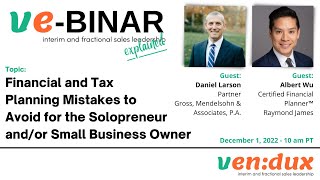
Webinar (Dec 1, 2022) hosted by Henning Schwinum featuring CFP Albert Wu and tax partner Dan Larson giving practical advice for solopreneurs and small business owners on tax and financial planning. Key themes: choosing and evolving business entity (LLC vs S Corp) with attention to FICA savings via S Corp reasonable-salary/distribution strategy; retirement-plan choice (SEP vs Solo 401(k), Roth within 401(k), catch-up contributions, cash-balance plans for high earners); commonly missed deductions (home office, travel/mileage, spouse payroll); S Corp election mechanics (IRS Form 2553 and typical timing); year-end timing strategies and the need for succession/estate planning.
Questions this video answers
Form 2553
About $80,000–$100,000 of steady taxable income
$147,000 (Social Security wage base for 2022 mentioned by presenters)
$20,500 (employee salary-deferral limit referenced)
$6,500 (catch-up amount referenced)
Chapters
Well, hey everybody. Great to see you. Welcome to this month's webinar entitled Financial and Tax Planning Mistakes to Avoid. For the solopreneur and small business owner, it's a. It's another timely and important topic, even though it's not the favorite topic for most folks, myself included. But the more we know, the better that we can make smart decisions, particularly in an area like this. So we're very lucky today to have two distinguished guests joining us bringing their expertise and experience around helping people to navigate basic decisions around tax and financial planning. Albert Wu is a Certified Financial Planner with Raymond James As a fiduciary, Albert specializes in guiding individuals, families and business owners with achieving their financial goals. He takes a comprehensive approach in incorporating retirement estate tax, investment and insurance planning. Dan Larson is a tax Partner with Gross, Mendelsohn and Associates, Baltimore based CPA firm that specializes in providing tax business planning and outsourced accounting services, including financial reporting and monthly financials to government contractors, business owners, individuals and nonprofits. So before we jump in, quick housekeeping note, as Henning mentioned, we'll keep everybody muted for the duration of the webinar and there's of course Q and A at the end. You can either use your chat function right in zoom to submit questions or just feel free to chime in and ask your questions directly right after the webinar. Albert Dan, welcome. Great having you. Thank you. I have a few questions to start us off and I'll let you guys decide who takes the question. Then I'm sure we're going to start to get some audience questions questions pretty quickly. So first key question, what are common mistakes that you see small business owners and solopreneurs make in terms of a tax structure?
I'll take this one first since it's more up my alley. I would say the one I commonly see from basic startups to a few members kind of coming together is kind of going with an attorney who might have a fixated view on how to start up a business either as a C Corp. S Corp or an llc. Just a one member LLC is really just kind of not looking at the long term kind of view of where you want to take the company or where you see it going really makes a big difference. You know, instead of just saying, well I know my friend did an llc, I'm going to do an llc. That's the process and not really knowing what steps or what's involved with that. A lot of people will bring up the LLC to me in conversations. From a tax perspective, the LLC doesn't mean anything. It's. It's a legal liability protection structure that a tax tax item. So jumping into that is probably the biggest, I'd say the pitfall, you know, where people take the LLC which traditionally, if it's a one person llc, just gets filed with your individual return as a schedule C. That might not be the best advantageous route for most owners or small businesses from the tax benefits you can get from other structures such as the S corporation. So that's, that's the part of really kind of looking at it from the get go, where you want to be or where you see yourself going and really setting up that structure from the get go, if not adjusting it soon after once you get to certain sizes is the main key area.
Yeah. And to that point, I think adapting the structure over time, as you grow your business, it changes, your revenue grows. You might add employees. A lot of us might start out as LLCs. Dan and I were just working with joint client together. He's earning, you know, 500, 000 good income in his side business. And he hasn't elected to be taxed as an S corp. He's an llc. Anyone that has an LLC structure can be elect, elect to be taxed as an S corp. So he doesn't know that. You know, electing as an S corp you can save a lot of FICA taxes. You can save a lot on not paying certain Medicare and Social Security taxes, depending on how much you w2 yourself. So when folks elect as an S corp, they have to now pay themselves a W2. They're no longer classified as a sole proprietor, which is the default for an llc. As an llc, you're default to a sole proprietor. Taxation and all your net schedule C is tax for employer and employee to FICA taxes. An S corp changes that equation quite a bit. So you got to pay yourself a reasonable salary though in the eyes of the irs, they want to make sure that you pay yourself a reasonable salary. But the goal is to not necessarily maximize your W2 to minimize it and then save on FICA taxes. And Dan, you probably add more on that.
Yeah. And to some of those points that you mentioned, Albert, is, you know, the IRS does make you set a reasonable salary, you know, when you convert to an S corporation, which again, that is kind of the preferred route for most small business owners. But once you get to certain sizes, things of that sort. But the reasonable salary has never really been defined. You know, that's one area they don't really tell you. You have to take X amount of salary. But it is something that, you know, you need to kind of look at. You know, I'm trying to balance it out. You know, if you're a doctor, for example, you know, you wouldn't take a reasonable salary of 30,000, you know, and take 800,000 out as distributions, which you can do as a, as a S Corp. So it's, it's kind of looking at the common sense on some of that as well. But that is one of the key things with the conversion to an S Corp is you have to take a W2 salary, which again has some costs associated with it, is you probably need a payroll company to run that. That W2 once a year, if nothing else is, is a key function of it. But to Albert's example, he's right. I mean, we have a mutual client that, you know, was making half a million dollars a year as an llc, as a Schedule C. And again, you max out your Social Security, you know, at 147,000. But the Medicare tax is, is, goes on forever. And that's where they were really getting hit hard with the overall, you know, taxes that you can avoid with the S Corp structure. Even if you set your W2 at 147,000, you know, we're still talking probably $10,000 in taxes that, you know, that business owner got no benefits from for paying in Medicare tax alone. You know, so those, those are real key things to look at, you know, when you have steady income and growth that you expect, you know, why pay all this money in? Which really does compound over the years by, by keeping it. Maybe a Schedule C structure when you, when it's escorted might be more advantageous.
Terrific. So what are some of the considerations to make when setting up tax deductible retirement plans such as a SEP IRA or a 401k for example?
Yeah, great question, Andrew. So I'll jump in here. So one mistake we see people take is they default to a SEP IRA right away because it's easy to set up. There's not much administration to it. But oftentimes a solo 401k for a solopreneur is superior in a lot of ways. One of them is that In a Solo 401k, it doesn't take a lot of administration set up. And if you're an S Corp, essentially you're going to get a lot more money, a lot more efficiently into a 401k over a SEP. What do I mean by that? If your W2 as an S corp is a hundred thousand, then you can put away 25% of that into a SEP IRA. That's the rule. 25% of whatever you wt yourself. So that's 25 grand. If you have a solo 401k set up, you can put that 25% plus an addition, additional 20,500 in tax deductible contribution. Why is that? Because a 401k has an employer and employee portion. You're both employer and employee. So as an employer, you're taking the 25 profit sharing, giving it to yourself, but you're also doing 20,500 as a salary deferral. So. And if you're 50 and over, there's an additional 6,500 catch up. Right. So we're talking about getting away, getting 40,500 into the plan tax deductible. The other thing is it allows for a Roth in a foreign world. You can do 20,500 into Roth, no questions asked. A lot of people in this room, they probably earn too much income to contribute to a Roth ira, and so they might not. Or maybe they're doing backdoor conversions. In 401k world, it falls under a different IRS code than IRAS. So 401k world, it doesn't matter how much you make. You can max out your 20,500 into Roth and you can earn a million dollars. No one's going to stop you from doing that. Why would you, why would you want to do a Roth at this point? Because we're in historically low tax brackets right now, and those are set to sunset in 2026. So brackets are going up. Unless Congress changes something from now until 2026, they're definitely going up. So taking the tax hit today and growing your money tax free makes a lot of sense.
I'll chime in on just that Roth part that Albert mentioned, because again, I, I've been bringing it up to a lot of people lately. Just, I mean, I do a lot of individual tax returns along with the business return side of things. And the old adage was, you know, tax defer, you know, defer your, you know, your taxes now, you know, and pay it later because when you retire, your income levels would be lower. So it's a great way to get a lower tax bracket as you, as you retire. That has kind of been blown out of the window, I'd say probably the last 10 years with a lot of my client base where the market has done well. Usually when you get closer to your retirement years, you know, Albert mentioned the 20,500 for the 401k, well if you're over 50, you get to do an additional 6,500 as a catch up contribution. So most people, after your kids grow up, you got more disposable income. You're stashing a lot of money away into these 401k vehicles, tax deferring. So what ended up happening with a lot of my client base is they had much more income in retirement than they did during their working years because their 401ks got so large. So they with a Roth, to Albert's point, you know, paying now is not necessarily a bad process on that front. And having that vehicle inside a 401k is crucial to be able to take advantage of that. Where you might be limited based on your income levels to doing it outside wise is key. The other part I'll mention, on just setting up the retirement vehicles that you have at your disposal, if you go an S Corp route, know that some of that does affect, you know, certainly if you have a SEP, how much you take into W2 will affect how much you can contribute to a SEP IRA. So that's one of the kind of the balancing acts that you kind of have to look at too, depending on how much money your, your potential S corp is making as well.
Most, most people in this room are way far off from this. But the new required minimum distribution age is 72. When you're forced and take money out of pre tax vehicles like 401ks IRAs, a Roth vehicle completely avoids that rule. The IRS wants to collect money from you, but they only do it once typically. And so with a Roth they take it on the way in, it grows tax free forever. So it's not subjected to required minimum distributions. When you turn 72, you can keep that in there forever. You can even pass it on to your kids, your grandkids, anyone, tax free to the next generation. So it's a, it's a legacy building tool as well. The Roth vehicle.
Yeah. So look at it from more of an estate planning, you know, also from the Roth, not just for yourself but you know, for the beneficiaries who get it. So a lot are using it from that estate side as well.
Great stuff. So what, what is the break even point when deciding to be taxed as an ex, as an S Corp versus a sole proprietor? And how do you make an S Corp election? Is, is there a time frame that you need to make it within.
Yeah, so I'll jump in on, on this one. So traditionally what I tell most clients, you know, when the right time to kind of make that jump to an S Corp kind of. Two factors. One is you need to understand the fact that when you make the S Corp election, what that now does is it takes, you know, your schedule C outside of your individual return and makes you file a separate tax return, standalone return as an S Corp tax return. Now that that return will then produce what's called a form K1, which has all the taxable income information which then flows down to your personal return onto a schedule E. Getting in the weeds here, but just saying, you know, there's additional cost associated with that S Corp where you're going to have a separate tax filing which is going to have tax prep fees on that. You also have the W2 of having to run payroll at least once a year with having that reasonable salary requirement. So there's going to be a cost associated with that. So knowing those costs are roughly around maybe 2,000 or 3,000 for most companies, the break even point I have found is between 80 to 100,000. You know, that's the key kind of, you know, income level. With that being said, once you make that S Corp election, you have to file as an S Corp, you know, going forward unless you elect out of the S Corp structure. So if you make that election, make sure you're confident that your income levels are going to stay at that level to make it worth your while to do that. As for how to make that S Corp election, very simple. The forms called the 2553. It's a pretty much a 12 page form that you have the owner or owners, you know, basically sign off that you're electing to make the S Corp, you know, change to that status tax structure. With that, traditionally you want to make it by March 15 of the tax year. You can always make a late election that's accepted through Rep Prox, but it's preferred to do it in the first basically three months of the year. From a time standpoint, the IRS will tell you it's between two to three months that you'll hear back from them. Accepting the S Corp status change, which is retroactive, it'll start January of that calendar year that you make that election. Two things to know about that. It's very, very unlikely you'll see it within three months. From the history I have with clients, usually takes a lot longer, but you'll still operate as if you're going to get the acceptance. I've never seen anyone denied the S Corp election change. That's the key point. The other One, I would mention that if you do make that election and they will eventually send you the form saying that you've been approved for that, that change, make sure you keep that letter in a very safe place because I hope all the business owners do very well. And eventually when you want to sell, and hopefully can sell your business in the due diligence process, you know, whoever's buying you is going to want that letter to, to confirm that you're an S corp. Why? So keep it in a safe place after you get that, that letter back approving the change.
Hey, Dan, I don't know if you answered this question, but Louis asked this question. The break even point for S Corps when you elect for that.
Yeah. So that's 80,000 to 100,000 range of taxable income that your, your business generates. It would be the key kind of sweet spot and that you think you can continuously, you know, make that, you know, worst thing you want is hit that, that mark and then the next few years be below that where then you have this additional 2 to $3,000 cost which you wouldn't necessarily have as, as a Schedule C. And I think.
A key misunderstanding with when you elect for S Corp, you don't avoid federal and state taxes. It's all flow through. So electing an S Corp is flow through to your personal tax return. What you're potentially avoiding is the Social Security and Medicare tax portion of it. Oftentimes when we talk about S Corp, we have people say, hey, I'm going to avoid federal income taxes. No, that, that's not how that works. It all flows through to your personal return.
That and also I think some of the liability, I mean, we're not attorneys here, but I mean, you do get a little more liability protection by breaking it out from inside your individual, you know, assets, if you will. And I think it helps also from the individual standpoint that you get at W2. The hardest thing for most business owners that are schedule Cs is whenever you try and refinance, you know, you, you have a hard time going through the underwriters signing off because your income in their mind isn't, isn't guaranteed and hard to hard to determine from a cash flow standpoint. So as an S Corp, you know, being that separate entity where you get a W2, it at least gives a little more peace of mind for the underwriters and makes it a little easier from a financing standpoint as well.
In terms of other tax deductions, what other tax deductions are commonly missed?
That's right up my alley again. And it's a perfect timing, especially with, with year end coming up. So I think the, the main areas that a lot of people forget about, especially small business owners, you know, that are in a good situation, certainly with a pandemic, you know, not needing rental space of an actual office space. Like, like I have in a sense is you're usually working from your, from your house. You have an office in your home that is designated, you know, purely for, you know, your business. You know, that is a huge area that there's a lot of expenses associated with it that most forget about or don't even think about including. So you know, it's not just the square footage percentage of your house, you know, of the, the desk and supplies you have in that space. But you got to also think about it as if, if your house was, you know, a big office complex, you know, that have CAM fees, common area maintenance fees. So you know, a percentage of your house expenses are associated with that percentage use of that space. You know, so your utilities, you know, your, your insurance, you know, things like that, those things need to be kind of captured and included as expenses overall and into the, you know, the operations that you have from the business income to get those deductions and kind of reimburse for the use of that, that office and home space. The other kind of main key area that most business owners don't think about is, is the travel costs. Again, you're working from your house most of the time, but you're leaving to go for meetings, business meetings, for meals, things of that sort, keeping that log or at least an outlook counter that you can kind of summarize at the end of the year to quantify all the mileage rates as well, as is a key area that most people forget about as well.
I'll jump in here as well. For solopreneurs. If you have a spouse that's working in the business, whether helping out with administration or business development, whatever they're doing, if you're putting them on payroll, well, they can now participate in your 401k plan, even a solo 401k plan, because husband and wife, they follow under solo world as they is as two, they can count as a non group. Once you hire an employee, typically you go, you get into group 401k world, which is a lot more complexity and compliance required. But if you're putting your spouse on payroll, you're still under solo 401k world. So if you pay yourself 20,500, he or she can defer that into the 401k plan plus participate in the profit sharing portion as well. So you're deducting taxes right there. And I mean, whose spouse is not helping out in some way? Right.
And that situation exists in an S Corp structure.
That situation is Regardless, that's a 401. You can set up a 401k for a sole proprietor or a S Corp. So that's independent of that classification of whether you tax as S Corp or a sole proprietor. And standard.
How many people can an S Corp employ? Is there, is there a limit? Is there any issue? I mean, you have an S Corp, you can employ your spouse and any other number of people.
Yeah, no limit. I mean from size wise, there's no limit from an employee standpoint of how many people you can hire. The big limitations, you know, with, with S Corps, you know, is, is I wouldn't, I wouldn't necessarily say they're drawbacks, but just two things that people should know is you can only have one, one form of stock with an S Corp, you know, where, you know, some people want to grow it to a certain size and have different levels of stock for preferred stock and common stock. Can't have that with an S Corp. Most time it doesn't affect small business businesses. The other one is S Corps cannot have more than 100 owners. You know, that's the only kind of limitation that they have from an ownership standpoint. From, from an employee standpoint, there's no limitation there whatsoever. Even with, even with the 401k plan. Certainly, you know, Albert can talk about that from a solo. You then turn into a regular 401k plan which then has different rules once you get over 100 employees, you know, for audits and stuff like that. Got it, got it.
I'm just looking at the clock. I, we could probably go on for a long time with this topic. This is golden information. If any of you have specific questions you'd like to chime in either, you know, in a couple of minutes or so, I'm going to open up the floor and you can ask your own questions or you can type them into the chat, into the chat bar. I think one more question for me, guys. I suppose it comes around best practices. What other best practices would you suggest for business owners with respect to tax and financial planning?
I mean, I think from the tax side, I mean there's. Every business is unique and different of what they do and, and having someone kind of look at it from a different lens, you know, is, is always Helpful, you know, for things that you like. Me and Albert do these kind of things on a daily basis. So we, we, we know things that you guys would never kind of run into just because if we're having to look at tax law or different changes in retirement plans, things of that sort. But you know, a lot of people are so busy bogged down in the weeds of the work, they don't realize that there's benefits, especially from the tax side. You know, if you're developing software or doing some sort of improvement in technology wise, you know, that might create opportunities in research and design tax credits, you know, so the Inflation Reduction act that just passed, there's a lot of, you know, innovation that they want created. So they've increased some of that R and D credits that are out there. So, you know, looking at those kind of opportunities that you might not be thinking about, I think is always beneficial. But always keep the R&D's in the back of your mind because a lot of people miss that when they're actually developing something or creating something through software or just making something better. It might meet those qualifications to even get some tax credits that you can really take some nice advantage of in that regard. Definitely. The other thing is, certainly every state's different with how they deal with things. I'm in the Virginia office of my CPA firm. I know the state of Virginia and other states now are looking for more tax revenue, things like that. So right now a big area is they're going after sales tax and use tax things. So you know what, we've found that in use tax, if you don't file any use tax returns, you know, the, the state can come after you. So even if you file one a year, it avoids them from kind of digging into areas that will cost you time and money for, for just stress that you don't need. So those things are kind of unique, but kind of keeping up with those kind of state specific items that are going on is, is also a crucial area. So it doesn't bog you down from doing what you guys do best.
I know we're running out of time, but I'll jump in quickly. Catastrophic and succession planning. Most business owners don't even think about or do this. I work with a fractional CRO. She's partnering with other fractional CROs. And I say, hey, you should probably have a plan where if something happens to you, your partners in the CRO will buy you out so that your spouse is not inheriting your business and getting involved there. Your clients don't like that. Your spouse doesn't like that. So catastrophic planning and succession planning and estate planning in general. No, nine times out of ten when I talk to folks, they haven't had it done in terms of estate plan. And I'm a big advocate of revocable living trust. Especially if you're in California, you want a revocable living trust to avoid probate. So that's a mistake. I see.
Golden Henning. Let's open up the floor for a couple of minutes and take any incoming questions. I, I may have one or two others just in a selfish interest, self interested way. But anybody would like to ask any questions.
JC if you don't mind. Daniel, am I up?
Am I good?
For sure.
Okay, thanks. Appreciate it. I didn't want to jump over top of somebody else here. Daniel, you had made a comment about one of the things that people miss is his home office expenses. And I totally get that. You know, percentage of this, percentage of that depending on whatever, whatever you use. My understanding was that that unless that adds up to larger, a larger amount than your standard deduction, standard tax deduction, you can't claim that. Or can you still claim that over and above that?
No, I mean if you got, if you got a business, I mean that, that doesn't go on the standard deductions or itemizing, you know, that's, that's completely tied directly to your business. So it'd go on a schedule C as a business deduction there or you know, if you're an S corp, you'd be taking it a deduction inside the S corp tax return. So yeah, so it's not affected by your standard deduction, you know, whatsoever, you know, on that, on that front, that's completely just your individual deductions. Since this is inside the business kind of bubble, it's not limited there. Now if you're a schedule C, you can get this percentage of deductions for your house or your rental that you're in. Or you could take the simplified method that they have right now, which is $5 per square foot up to 300 square feet. So you could get a 1500 dollar deduction if you're using 300 square feet of your house without having to go find all the expenses and tying them together as well. Right.
Which the expenses can easily add up to more than the 1500.
Yep.
All right, I need to have a conversation with my accountant officer. Thanks, Daniel.
Great question.
And the other question I had real quickly is I heard two different numbers and I want to make sure I Didn't confuse them, I believe Daniel, it was you that mentioned both them. One was 147k and the other one was 80k. So is it the 80k that if you're over 80k steadily that you should be seriously considering S corp or is it, or where does the 147 come into play?
Yeah, the 147 is the max Social Security for 2022. So once you go over that, then you just pay Medicare tax. So you know, if you're making 100,000, you know, is the way I look at it, if you're having steady taxable income of 100,000 then you could take a reasonable salary of 80,000 and then 80,000 of it's not subject to self employment tax like you would have in on a schedule C. You would take that 20,000 out just as a distribution. It would be subject to just your ordinary rates on federal and state side. So that 20,000 saving is now not subject to the employee and the employer portion of FICA taxes, which is 15.3%. So that's $3,000 of taxes that you're not paying into Social Security or Medicare tax. That's kind of the 80 to 100,000 range. Yeah.
And that Social Security taxable wage base is increasing TO I think 1, 6, 60 next year or more.
Yeah, exactly. Yep.
All right, thanks a lot guys for the information. It was really useful. Thank you.
Dan. Albert, you, you guys are physically in the Virginia D.C. area in terms. Dan, you just, you referred to state level tax matters. My question to you is can you or do you operate and serve clients anywhere in the country or to what extent is your work geographic?
Yeah, I mean I'll talk to my end. I certainly am not limited geographically. I mean I've got a, in the D.C. area we have a lot of government contractors. So I've got clients in pretty much every state as well as overseas. So not limited from that and not intimidated by those. But some states, if you're in Texas, you know, makes it easy, don't have too much to have to worry about. But, but other states wise, like I said, handle all those those states and then in the US as well as do foreign reporting for some of my clients as well. So not, not limited there.
Yeah, similar here. We're licensed in 20 states and it's pretty easy to get licenses for a financial advisor in different states.
Right, okay, great. So presumably you're. If we can send out your, your contacts to anybody that would be interested in following up with you directly. Okay, thank you. Anybody else want to chime in with a question or two? All right, 35 after the hour. Albert. Dan, parting thoughts? This has been, I'm certainly going to be following up with you. I've got a, a couple of questions and interested to maybe change my own structure based on what I've learned.
I'll just jump in.
Yeah, go ahead, Albert.
So for those who are have reached like high profitability in your business, there is a something goes beyond 401k. It's called a cash balance plan. It's a 401k on steroids where the cap is not 61,000 anymore. It can go up to 200,000 or more in tax deductible contributions. That is when you are highly profitable. But we set these up for solopreneurs all the time and it's a great way to deduct well above beyond that 61,000. So.
Good to know. And I'm, I'm always focused on the tax side of things. And as we enter the last month of the year, you know, I would just say to all of you, you know, a lot of the tax planning comes down to a timing game, you know, with, with things. So try and strategize if you've got expenses that you can pay by end of the year to kind of drive your income number down, you know, do that, you know, instead of paying it in January, try and pay before the end of the year. Maybe if you've got large invoices, you know, that, you know, pay like clockwork on, you know, 20 days after I submit the invoice, maybe wait to the, you know, the 12th of December to send it in so it comes in in January the following year. So those are more timing games that you can do but use those as your advantage to kind of keep you down in lower tax brackets and doing tax planning before the end of the year, you know, put your mind at ease. You know, if you've got an account or anyone you're using, look at those before the end of year so you're not stressed out going into April what you might owe. You know, it's, it's like I said, it puts a lot of gray hairs on all of us. You know, when, when you don't have that knowledge and you're kind of going in blindly. So if you can, I'd advise you all to kind of take a look at that too.
Actually, from a timing point of view, how long would it take to set up an S Corp from scratch and kind of just get it up and running.
I mean, that's just the election. I mean, the S Corp is, like I said, as long as you've got an LLC or a business and make the election. I mean, it is, it's no different than the llc. The LLC doesn't do anything. It's just a legal structure. Just like the S Corp is just the tax vehicle. So it doesn't change how you operate as a business with the S Corp. I will mention this as well if it, if you start winding down your business and you're saying, I don't want to do this structure anymore, you can always elect out the S Corp structure and go back to your original, you know, filing. Just know it takes, you know, if you then regret that it takes five years of a waiting period before you can elect back in to the S Corp structure. So just keep that in mind. That's all right. Great. Very good.
Can't thank you enough. Really appreciate your time and, and perspective and pearls of wisdom. Thank you. Have a great December. Happy holidays in advance and thanks everybody for your participation in being here and we will see you for the next webinar. Henning everybody. Have a great day.
Great month.
All the best. Thank you.
More from Henning




ve-BINAR - The Revenue Tornado Methodology: How 3 Power Sources Create Exponential Growth


ve BINAR: Executive Cloning: How AI is Reimagining the Role of the Fractional Executives




veBINAR: Unlock Client Value: Why Compliance is Crucial for the Startups You Serve
