ve-BINAR: From Profile to Profit - LinkedIn Strategies for Explosive Fractional Growth
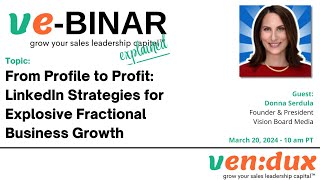
Donna Serdula shows fractional executives how to turn LinkedIn profiles into client magnets. She breaks down what actually works: a strong headline and About section, authentic storytelling instead of resume language, and having board resumes and one-pagers ready. Her firm has helped over 8,000 executives since she started.
Questions this video answers
March 22, 2024
LinkedIn-makeover.com
Over 8,000 executives, entrepreneurs, and professionals
2005
2009
Chapters
Foreign Great to see you. Welcome to today's Vendux Viennar. I'm Andrew Miller, one of the partners at the Vendux Group where we focus on helping clients to grow their sales leadership capital. I I am thrilled to have Donna Serdula as our guest today and I'm going to let her introduce herself in a second. Today's webinar topic is from Prof. From profile to profit. LinkedIn strategies for explosive Fractional Business growth at a high level. Donna is the founder and president of Vision Board Media, a professional branding company that helps individuals and companies tell their unique stories on LinkedIn and beyond, bringing dynamic brand storytelling to the masses and empowering people to dream big. That's the ink in her pen. It's her website, LinkedIn-makeover.com where she and her team help people mesh with opportunities and transform their professional lives with forward looking career branding. She's authored two editions of LinkedIn profile optimization for Dummies. I'm one of those readers and Donna hosts the podcast Dream Big with Big Dreamers. She has shared her LinkedIn expertise at global conferences, presented keynotes and workshops and has been featured on a number of high profile news outlets. So a couple of quick housekeeping notes today before we jump in. So we're going to keep everyone muted for the duration of the webinar and then as many of you know, there's a Q A right at the end. So you can either use your chat function in zoom to submit your questions or feel free to open up your mics and engage with Donna directly at the end of the webinar. The webinar is being recorded and it will be available later today on our site and on YouTube. Donna, greetings. Good afternoon. I know you're on the east coast, so great to have you. Before we dive into the strategies for leveraging LinkedIn, can you please share a little bit about your journey and what has led you to become the leading authority in personal branding and LinkedIn profile optimization.
Thank you, Andrew. Thank you so much for having me. Hello everyone. It's great to be here and I look forward to this and answering your questions at the end. You know, I, I think for me, you know what really got me on this, this path. I had been always an early adopter of technology and then being in corporate America for years and really finding myself in situations where I was working with a CRM salesforce automation tools, developing them and then later getting into a really cool cutthroat sales environment and finding that I kept turning to LinkedIn very early on to get past the gatekeeper and to prospect and, and to do competitive intelligence and business research. And so by the time 2009 rolled around, you know, I'd spent all this time really using LinkedIn and using it successfully that I said I want to, I want to start on my own path, I want to start my business and I want to help other people embrace this, this amazing social network. And so in 2009, that's exactly what I did. Since then, we've worked with over 8,000 CEOs, executives, professionals, entrepreneurs from all over the world. And I absolutely love what we do. I love helping people articulate their story so they achieve amazing success.
That, that's great. I, I just got a congratulatory note from LinkedIn not too long ago for my 16th year anniversary. So I, I remember those early days when, when LinkedIn was first launched.
Yeah, 2005 is when I, when I started and it seems like such a lifetime ago in some ways.
So let's talk a little bit about like impact value. Can, can, can you share a little bit about how you've directly helped your clients, especially fractional executives? How have you helped them achieve improvements in their businesses through optimizing their LinkedIn profiles and just overall personal branding strategies?
Yeah. For so many fractional executives and just, and professionals, it's hard, it's hard to write about yourself. It's hard to see yourself objectively and, and it's really hard to understand how to align your value and your story to what your target audience needs to know about you. It's, it's just, it's very, very difficult and it takes time. It's not something that you can just do quickly and have it, you know, and have it out there. So, so to do it and to do it well. But the nice thing is when you, when you do spend the time and you create that story, you create that messaging, you're able to strategically align yourself to that target audience. Amazing things happen. You truly can collide with opportunity. Your phone can start to ring and it's because people have found you and your message resonates with them. And, and that's when my clients, they, they attract board seats, other things like, like, you know, new, new clients and investors and speaking engagements. These are all things that can come, but only if you put in the effort up front to that profile and to your activity on LinkedIn.
So from, from the perspective of a fractional executive, what are some unique challenges that Execs face on LinkedIn when trying to establish their credibility and authority in the industry. And how would a well optimized or better optimized profile overcome challenges?
Yeah, you know, when I intersect with, with fractionals, they are at a, almost this crossroads, like a transitionary period in their career. And the way they've described themselves and the way they've branded themselves in the past, it's no longer relevant to their future and what they're doing. And so it really takes a shift in that brand and that story that they've always used and it's really making sure that it's written to this new audience and it's not just a regurgitation of an out of date resume. Right. Because they're not looking for a job. They are, they are looking for partnerships. They're looking for these, these, these, these clients who, you know, they can work with. You know, it's, it's no longer that let me interview for a job situation. Right. And so it's, it's a different message that they need to really be, be putting out there. But again, you know, it's, it's all about, you know, striking that balance and, and writing it in a manner where it's not so salesy that it feels almost inauthentic, but it's writing the profile in a manner where you are human. Because right now we're in the midst of this AI revolution and, and anyone can hit a button and generate. But what, you know, is this authentic? Is this real? Is it something that's going to spark interest and, and confidence in your target audience? That's, that's important.
Yeah, yeah. What it's like in the, in the financial sector, what past performance is no indication of future performance. So what you've done in the past and everything you know is, is relevant, but you have to tell the story differently.
Exactly.
Yeah. So, so in the landscape of, of LinkedIn, there are profile elements, there's lots of elements there. So, and some elements carry more weight than others in making impacts. So from your, your experience and expertise, what, which sections would you consider the most crucial for fractional executives to focus on? And what considerations should people keep in mind to ensure that their profiles not only stand out, but are also resonating with their target audience? And is there any correlation to SEO stuff that's going on in the background from a, from a profile component point of view?
You know, when, when you look at the LinkedIn profile, the very top has a lot of imagery, so it's important to have that profile picture, to have a background graphic. It's important to, to have that featured section. And very few people have a featured section, but it's a great way of, of really putting in the links and work samples that are located outside of LinkedIn and bringing it into your LinkedIn profile. But, but once we get past just the, that, that imagery section, you know, the LinkedIn headline, that is a hook and it really should catch your, your, your, your future clients eyes and get them interested and, and, and compel them to keep reading. You know, and then we have the about section. And that about section really should be your heart. Right? It needs to be this authentic story that builds confidence and, and almost produces that feeling of hope in, in that reader where they're thinking, this person might be the one who can help me. This might be the person who can get me out of this situation where I need growth and I need sales and I need all this help, and I think this person might be able to do it. And then, and then we have that experience section and that really should be the backbone. You know, like, like you had said, you know, this is where you're going to show your past successes and it's what's going to qualify you in that reader's eye and it's going to get that person to then want to reach out to learn more about you. So again, you know, what, what are the most important parts? It's the headline, it's the about section, it's the experience section. And this is where you want to tell your story. And when you do it well, your phone is going to ring, you're going to find that you have clients, you're going to find partnerships, you're going to find those investors, you're going to find the really good things and they're going to come for you.
What about endorsements and recommendations? I, I still have probably endorsements and recommendations on, on my profile from 15 years ago. Are, should I delete those?
You know, it's not so much that you should delete those old recommendations, but definitely add new ones. So if you're looking and the last one you had was 2011, it's time to spend a little bit of time and reach out to some people that you know that you've worked with and ask them to recommend you. And I agree with what you're Saying, which is LinkedIn has really removed that focus. At one time there was pressure, there was this direction. Get these recommendations, they matter. We don't hear that that much, but the truth of the matter is they still matter, but you have to go after them. And I will give you a secret. And the secret is if you want recommendations, write them yourself. So give it. So reach out. Say, hey, Andrew, I loved, I loved working with you. I know you're a busy person, but I really want to have a recommendation and feature you on my profile. I've written, I've written a recommendation that you can use. Feel free to edit it or change it completely, but, but let them know what you'd like said. And oftentimes they'll copy it and paste it completely. Sometimes they might edit it a little bit, but I will tell you, they will be very grateful and very thankful that you took that odious task off their desk.
Yeah, it's a great tip. So let's, let's talk a little bit about content creation. Right? We hear this content, content, content is all about the content. So it is an underpinning of success on LinkedIn. Right. So if you agree with that, can you share some of your top strategies for, for fractional execs to create and share content that positions them as, as thought leaders and attracts the right audience?
Yeah. You know, the LinkedIn feed, it should be the people you know talking about the things you care about. That is the mission statement that LinkedIn has, has, has, has put out there and, and said this is, this is what's important to us. It's the people you know talking about the things that you care about and about it. Almost as that virtual networking group, you're going on there because this is really a form of networking. It's a way of getting your word out. It's a way of interacting with other people and engaging and, and being memorable. Getting that top of the mind awareness that we've always, you know, that's something we've always, you know, strived for. But when we look at that LinkedIn feed, you know, you, you will see there's, there's so many people out there talking about ways of hacking it, ways of, of, you know, utilizing the algorithm and, you know, in kind of strange ways. But I will tell you, I've been doing this a long time and success on the LinkedIn feed is very much determined by one thing and one thing only, and that is engagement. You want to put out good, quality information that engages your audience. It gets the people who are reading that feed to do something. It's not enough that they read it and they move on. But you want them to stop at the post. It has to catch their eye, get them to stop a little bit. It needs, you want them to hit the, see more if It's a long enough post because that, once that triggers within LinkedIn, hey, someone's, someone's interested. So we want to click the see more. We want them to be very clear that they've read through it. And it's beyond just hitting like or comment, right? Those are, those are important things. But, but can we get them to do a little bit more? Can we get them to repost it? Can we get them to share it? Can we get them to save it? And those are some things that you don't even see, right? They're not publicly out there on the post, but when you get a person to do something like that. So beyond just liking and commenting, but clicking to see more, clicking repost, clicking to send it to someone, you know, clicking to save it because it was so interesting that they want to go back to it. Those are the, those are the actions that really will get that post seen by the most eyes. Because LinkedIn says there must be quality here. There's information here, there's value here. Let me keep sharing it with more and more people.
Is this a game that we are playing with algorithms?
The truth of the matter is it's, it's a game that you're playing with yourself, which is to say to yourself, how can I help people? How can I inspire? How can I provide good, relevant, interesting content? But here's the thing, Andrew, it's not about quantity. It really is about quality. And so there are people out there who can post every day and good for them, it's not easy to do. The only way in that manner is to compete is just to say, wait, you know, I'm not going to post every day and that's okay, but can you post once a week? But when you do post, post something from your heart, post something that you know is going to, to add value. It's going to, it's going to help improve someone. And if you do that, you're going to find a lot of success. Now, and I will say this, yes, you want to help them and improve them and all of that other things, but you can also look at it and say, how can I share myself? You know, how can I provide that value and let them get to know me? And good things happen when you do that too.
So, so to that point, so content from the heart, get to know me. So we are fractional executives in the world of sales leadership, and many of us will post content about sales and tips and hacks and experience and use cases and perspectives, etc. Etc. What about the line between the professional content and the personal content. Oh, you know, here's my daughter and she just completed the New York Marathon, or she just did this, or, you know, so proud. Here's my daughter in the picture. Or there's a lot of professionals who are posting personal stuff as well on LinkedIn. What's your perspective on that content? On both sides of the table.
The world has changed. Once we started working from home and we started turning on our camera and people could see where we live and they could see our home, a lot of things change. But if you think about it at the same time, did it really change? We still always walk to the water cooler and we would talk with our, our prospects and our colleagues and our, you know, our friends, and we talked about these things. It wasn't that unusual to say, yeah, yeah, just, just celebrated my kid's birthday, just did this, just did that. And these are things that you would have, you would share in the office. This is now just an extension of that as well. And so I think it's a great thing. And I think what you'll find are sometimes those are the posts that do better than all of them.
Yes.
The question you have to ask yourself is, is it too much? Am I open to this? Is this something that I want to, you know, do I want to share this? And if you're comfortable sharing it, go right ahead. There are, there are levels, though, I think, of acceptability. You know, we're not talking about, I want to say we're not talking about television shows, but I read some really great posts about Ted Lasso, so I can't even say that, you know, anything is really off limits. But, you know, as long as you keep it professional, career oriented, I think you're going to be fine.
Great. Let's, let's talk a little bit about, like, additional marketing material. So beyond the LinkedIn profile, I know your, your team also specializes in helping, helping execs create board resumes, networking briefs, one, pagers, pitch decks, websites, other personal and branding materials. So how do these components complement a LinkedIn strategy for fractional execs looking to expand business opportunities?
You know? Yeah, and they really should act as an extension of your LinkedIn strategy and your brand, but they should offer a deeper insight and a broader narrative. And we really want to get very, very specific in terms of your target audience and what it is that you offer, what they need from you. And we want to make sure that as you're out there and you're networking, if something is needed, you can Immediately send it off. I like having these things in your back pocket. You know, it's, it's the worst thing in the world when someone says, oh, my goodness, we've got a great, you know, board opportunity for you. Do you, can you send me your board resume? And then suddenly you're like, give me two weeks to, to figure that one out and, and create it at that. By that point, the opportunity is, is gone. They've, they've moved on to somebody. Know, as you're walking, as you're, as you're moving down this, this, this journey through this, this, this, you know, this road, you want to make sure that you're ready for any of these opportunities. So if that CEO says, yeah, send me some information, you've got something to send. And, and it's succinct and it's easy to read, it's easy to understand, and, and it's polished and professional and sets you up at the right level. Right. Because that's when, that's when the right opportunities are going to come, come across your desk.
So, so you're sending the links or the link to whatever the content is that's being requested.
Well, you can certainly, you could certainly send a PDF via the messaging, but you know, truthfully, often times you'll meet someone and then you'll connect with them on LinkedIn, you know, and then from LinkedIn, they're going to look at your LinkedIn profile and they're going to really understand who you are and what you do. At that point, hopefully there's going to be a conversion that takes place where they're going to reach out and they're going to call you or they're going to, you know, message you, whatever that next might be. But then it's having, having the, the, the knowledge that whatever that opportunity might be, you have something to, to provide, to keep it moving forward.
Got it, got it. Great. Just a little bit about, you know, your services and specific success stories. I know throughout, you know, your, your career, your, your profession now in this business, you've helped, I think you said 8,000. You've a lot of executives, entrepreneurs and professionals from all over the world with their LinkedIn profiles and personal branding. So Donna, can you help? Can you highlight some of the success stories or transformations that really stand out for you that you can share? How do these experiences shape the services that you offer at Vision Board Media?
You know, we, we, we, we really have started to do so much more work with, with fractionals. And, and one of the things that I find is they know their value. They know their value, but they really struggle to articulate their value proposition. They are, they struggle to articulate exactly what that value means and how they're helping. And so, you know, to have, to have high level partners, you know, a team of people that they can turn to and talk to and really collaborate and hash out, you know, what is this messaging? What is your story? Why does it matter? How does it align? How does this work? And then to be able to have us create that, that story and that messaging and put it together, it's, it makes a huge difference. We just recently finished a, a, a project, a, a, oh my goodness gracious, my brain just went deep for a second. A general council. Oh, and that was her issue. I mean, she's an absolute rock star. An absolute rock star. But she knew her value. She couldn't articulate it. She just couldn't articulate it. And we were able to work with her to create that story, to create the messaging, to put it all together. And within a month she had her first client. And this was something that she'd been struggling with for months before that. But once she had everything together, nothing could stop her.
You touched on an interesting point because, you know, you work with fractionals across many different functions from legal or accounting or ops or finance. Marketing. Right, and sales and business leadership.
Yes, that too.
Do you, do you see any particular functional group that's more adept at marketing themselves? Well, I mean, the marketing people and the sales people, are they a little bit better than the, the legal people in terms of the sharing?
Andrew, I'm going to tell you the truth here. Going to tell you the truth. They can market and they can sell other people and other companies and their products and services, but when it comes to yourself, it doesn't matter. It's always so hard to write about yourself and to see yourself objectively. There are very few people in this world who will say to you, I love talking about myself. I can't wait to sit down and write all about who I am and what I enjoy and how I, that gives most people the heebie jeebies. In fact, what I have found with most of my clients is they will say to me, I've tried to do this on my own and I know I can do it for other people, but for myself, I, I would rather clean out my garage, I'd rather reorganize my kitchen before I sat down and did any of this. So in some, and, and that's the other thing that I find so Many people, their big challenge, it's, it's the procrastination. But there's also this, this level of perfectionism, which is, oh, I'll do it when I'm really clear on my message. You're never going to get clear until you sit down and start hashing it out. That clarity comes with action. And a lot of times you just procrastinate because it's not something that you want to do.
We see it every day with very successful sales leaders, business professionals whose documentation doesn't match who they actually really are. Very interesting. So we're going to open up the mics shortly for folks to ask questions and engage with you directly. But as we begin to wrap up this webinar, Donna, can you offer the audience perhaps three actionable steps they can take today to begin transforming their LinkedIn profile into a more effective tool for business growth and opportunity attraction?
So, first off, I would say give yourself time, Give yourself time to really think about where you've been and where you're going and, and really think about your target audience and think of, think of what makes you different and think about that story that you want to share. So, so really take the time. It's not something that you can just do very, very quickly. You really want to, you want to do the strategy up front. The next thing I would say is visit my website, which is LinkedIn-makeover.com and click on Free Resources. I have a slew of material there that's free for the taking that can really help you move through. I have a LinkedIn headline generator tool which will absolutely help you create a headline that, that buoys your profile up in search results, but also compels a person to want to click. To learn more about you, I have, I have a personal branding survey and assessment that you can take to really see what are the things that you should be thinking about on your profile. And I also have another thing that I, I think is really, really fabulous is a text formatter. So if you want to format text on your profile or even on your posts, you can't do that natively on LinkedIn. But this is a tool that'll allow you to type in what you want to say and then it will bold it or it will italicize it for you. So it's just visit LinkedIn-makeover.com and you'll see everything. It's on the, on the, on the menu bar, it says Free Resources.
Tremendous. I have a hundred more questions, but let's, let's open up the floor. Please. Either chat your question or just open up your mics and, and ask Donna directly. I know there's a lot of folks here. Okay, who's going to ask?
So, Donna Heming here, someone asked again for your website. Could you repeat that again, the URL, please?
Sure. It's LinkedIn. Hyphen or dash or minus, whatever you want to call that little midline. So it's LinkedIn-makeover.com.
Thank you. And then I'll, I'll have a question. When Andrew asked you about whether it's a, a game of playing with the algorithms, you know, you said, no, it's not. It's playing with ourselves. But isn't it also a game of keeping up with the Joneses? Because if everyone listens to your best practice advice, how do you stand out?
Well, you know, I, I think when you look at LinkedIn, consider it, you know, a place to go, not just a post. Right. It's not just a place where you have to crank out content, but it's a place to go to engage. And so, you know, have that list of your target audience, you know, the people that you want to intersect with and, and see what they're posting, see what they're doing and, and make sure that you pop in and comment when they do. All right, so it's not just you creating content at nauseam, but it's, it's you finding this as a cond. It a place to go, to intersect, to network, to have, have fun, believe it or not. You can, you know, and enjoy your time there. Enjoy it because you're giving back, but you're also taking and you're, you're conversing and you're engaging. It's, it's, it's not something that I don't want anyone to think that you have to spend your entire Life on LinkedIn, but it's a place to go, to dip in, to enjoy, to find that, that commonality, to find that conversation, that engagement. And then you, and then you move on and meet people online, meet people offline, you know, have phone calls, have coffee. And life is good. Good things happen.
Thank you. I think. You see any other questions on, in.
The content question about what to post? And that is oftentimes I try to. I have a varied background from product development to marketing to sales, and I think that people often look at my, my profile and say, well, you kind of did it all. What do you want to do? It's kind of hard to cut certain things out when really I Don't think that people really understand that. If you don't, if you've had the background where you've worked in product development and you owned a lab, if you worked with R D chemists or with universities or on boards to create raw materials and then create a product, that that end product is, is actually a result. It results in good sales. And how do you bridge that gap in helping people understand that? Because I've actually just, I'm really considering rewriting my LinkedIn just to just focus on the, not focus on anything else that I've done. Because it seems though, you just can't. I don't. It's different than it used to be. Even 10 years ago, people would connect it, they'd connect, oh well, they create product and that's what they do to sell the product. They actually create the whole formula that create the, the packaging they create, you know, and they source things and they're environmentally conscious and everything's recycled and everything is green. But people don't necessarily always put it together as being part of what you do as a service that creates a sale. And I'm like, I get the question oftentimes at the end of an interview or a conversation with someone as a fractional consultant or even just an interview, what do you best at? But do you really focus on this one area? Because I really need this area taken care of. And I'm like, yep. But now let me go through my resume or just my LinkedIn profile and say, these are the things that I have accomplished, but I've accomplished them because at the end of the day, new products and new concepts and new marketing are new sales, right?
And Brian, you have been given a gift here because, because now you understand where, where the story needs to shift, right? Because if people are struggling, that means that it's not being articulated in the best possible way. There is a story to tell that's going to connect all of these items together and, and showcase you in the right light. So my, my thought is when, when another person, not yourself. Because when you look at your, when you look at your profile, when you look at your resume, you know where you've been and what you've done and, and why it makes sense because you've lived it and you've experienced it and it's so, it's so close to your heart. But I think for that person looking in, they're seeing it in a, in a different way. They're seeing it more afraid or maybe more fragmented. And so we need to look at that profile and say, all right, what, what is the most, what are the most important parts? And how do they relate and how can we weave this together? So you, in fact, are articulating and you are taking them through. So they go, oh, now it makes sense. I get it. But I think it's, it's telling that right. The right story. The other thing is, and this is something that a lot of people struggle with, it's okay to cut things out, even though these might have been great, you know, things that you enjoyed, if they don't lend to your future and they don't lend to that story, sometimes we do have to remove it just to make that story as clear and succinct as possible. Because a lot of times people get, they get, they get lost in the minutiae of it. So those are the two things that I would, I would say to you. This is, this is a story that needs to be told, but I think you might sit a little too close to it. But we do need to connect those dots and, and you hear what people are struggling with. Now that we know what people are struggling with now we can, we can, we can fix it. But I also think this is telling you what you can be doing in the newsfeed as well. You know, this is the type of content that you're going to want to create, which is telling those stories that showcase how by working on these white papers and working with this, it resulted in sales. There's, there's stories to be told there that I think people will find very, very educational and valuable. Okay, I hope that helped.
I. Brian, I think, you know, this is, so, it's a great point because we all have the experience of having multiple resumes, multiple stories, depending on who our audience is. We, we've learned how to customize our story in a particular document that we can send to one person, one company that, that paints a picture about our relevance for that one audience. Now, on LinkedIn, you know, Brian's pointing to, to this challenge because we, we have multiple stories that, that can resonate. Resonate with many different kinds of audiences.
Yeah.
So on LinkedIn, it's one, it's one platform, it's one. One viewport, many different eyes.
Yeah, but it's, it's finding the right, really recognizing. But, but also, we, we don't have to tell everything. Right. We don't have to be everything to everybody, and we don't have to tell them everything. Everything. We need to say just enough that whets their appetite, that gets them Interested that that sets the stage. So then we can. We can start to tell all of these other stories when we're on the phone or in person with them.
Less is more.
Yeah, more often than not, less is more. But at the same time, I, I also think we also get caught up in, oh, let me create like a resume type of portfolio. Like, let me just have bullets. Let me just, you know, describe ever so briefly. That in itself is, you know, that can also create issues because it's not dotting the I's and crossing the t's and, and telling a person exactly what to think.
I think that. I think somebody has their hand up, so I don't want to take a lot of time, but I, I have actually really severely trim down what I do. And what I find is that even after I do that, somebody will say to me, all of a sudden I've repositioned myself, like, really just focused on sales and, and getting sales because really all the other things kind of lead to that. However, then somebody will come back to me and say, well, but we really want you for product development. And it's not, it's nowhere listed on your. I'm like, okay, yeah, I can't have five different profiles. So, I mean, I'm trying to zero in. And, you know, when you have 35 plus years of experience and you've been an entrepreneur and you've owned five companies and you've also been a vice president at large companies, it's really difficult to, you know, say to somebody fractionally, you know, yeah, I can do all those things for you. I mean, just relax.
Is there, Is there something that. Well, let me, Let me do this. I think I would love to talk to you after this call, and maybe I can give you a little bit more individualized help. But I will say this. You also want to say, this is what I want to do. You know, maybe I can do product management, but is that. Or is it really sales that you want to do? Yeah, you know, it is okay to narrow that field and not, you know, aim so wide and low and, you know, but it's also okay to say, this is what I want to do at this point in my career. I'm not talking about product management, because, yeah, I could do it, but I don't want to. I want to do what fulfills me. I want to do what excites me. And there's enough opportunity out there that, that you can be more precise.
Right.
Okay, good.
Excellent.
Thank you.
Anybody else have.
Rick has his hand up right Yeah, I, I trying to follow the zoom requirements of, you know, so I have rose my hand. So. Donna, question for you.
Yeah.
Hi Rick.
Hey.
And it's, it's a bit where Brian is. Because at certain point you get to a point where you know, yes, I can run a global supply chain, all that. That's not where my focus has been in, in, in the fractional space. It's not sales actually either. But, but, but for putting maybe potentially a map of. Because visuals help some people. Right. What do you do? This is the pieces where I interact and then you can, you know, would that work? Because again is you can't be a Swiss army knife. Right. I think in this space what happens is it's an ocean and nobody ever finds you. What do you think about that in the context of like a visual? It's like, hey, this is a space in which I operate and this is the way that I interface or I interact. Right. Which may be different from that. I mean just those kind of things to try to. Because words can get really busy.
Yeah.
So the thought process of like a map, it's like I'm here, I'm not the three year interim or you know, that's not what I'm about. I'm about helping you reset your organization, you know, whatever that is and then, and then I move on. I help enable your, your success going forward and all that. Yes, I can help you sales, but no, I'm not the sales leader. No, it's not that. It's just, it's something different. It's just kind of staking out a territory that is more clear and visual to show, hey, yes, I can help this, but I don't do that. I do this, I don't do that. Have you seen that? Has anybody done that?
Yeah. You know, a friend of mine, Mark Finnick, has one of those. I can't remember what they're called, where it's like those inter. Inter locking circles to show where he fits within the ecosyste. And I think doing something like that could work really well. And there's the featured section, so you can absolutely upload that. I mean you could even have a. You could go to Canva and create a document, a PDF document where I'm not talking like size, you know, 12 point font, but I'm talking like really look at it and you know, in very large, you know, words and some imagery you can say this is who I am and this is what I do and this is how I'm helping. So, so there's there's different ways of infusing this, this, this, this content into your profile, you know, and I think that the, the featured section would work fabulously for you.
Okay.
But I also think that you're about. Section, don't. Yes, we want to sell people and yes, we want to tell them who we are and what we, you know, what we do and how we're helping and all of that value. But you also have to remember that people are coming because they want to know, know who you are, you know, and what do you stand for and why does, why does it matter? And you know, you know, to open yourself up a little so they see that human and, and they can, they get that sense of, you know what? He also seems like a really great, interesting guy that I'd like to work with.
Yeah, Opinions variant, probably.
I'm sorry, say that again. I miss you.
But anyway, no, I appreciate that because I've done maps on the other side. But the problem is, is a map of where you came from is going to be more broad than you can sell.
Right.
I don't, I think it's too varied and even though in words I've tried to do that, I think they try to create a visual and I like the diagrams that you're talking about is like, this is where I operate. This is typically the period of time and this is what the deliverables are that I would do. And then, then I, you know, then I move on.
Right.
You know, and, and recognize people are coming to your profile. They want to have confidence in you. They want to know that you're real. They want to know that you're serious. They want to know that you're. They want to know these little things that they can tick off, don't over sell and don't over bury them with too much information. There is a balance to walk and, and so much of what we're talking about is so individualized. It's. I want to sit down, I want to open up your profile, I want to go through it with you. I want to really understand who your target audience is so we can understand how can we best really put forth the right story. So it's really hard to do that on this zoom call, but it really is walking that journey and striking the right balance and making sure they get what they need to know. But not too much.
Thank you.
Just enough that they want to talk to you.
Thanks. The appetizer. Don't serve the meal.
Yeah, yeah.
Henning, do we have time for one more? If there's if there is one more.
If there is one more, let's do one more. I think Tatiana just unmuted herself.
I did.
Thank you so much. Thank you, Donna, for this great advice. I've been working and I've worked with a couple of coaches and getting my profile and bio, and I think there's opportunity to continue improving. My question to you is more around exam examples that you had of people that have portfolio careers, like many of us, which is not my focus, even though it is the, the. The interim fractional is a huge part of my focus. Is not the only one.
Right.
The board. The board seats, as well as my consulting business, which is tied to what I'm doing. So they are connected, but they're. They're different and they're different audiences. And so when you're talking about that, and you mentioned that briefly before, and I was hoping you could elaborate a little bit more on the examples you have of folks that, yes, you gotta focus on a certain audience, but what if you have multiple audiences and multiple people that you're trying to impress in the same way? Because that's your business card, if you will. Right.
You know, and it really is weaving. That's the story together. And a lot of times, Tatiana, what I find is clients will. Will say to me, you know, these are very disparate audiences. That's very. It's very different. But then when I listen to it, it's not really that different at all.
It.
They really do lend, you know, lend very well to each other. And, and when, when we do tell the, the full story, it doesn't, it doesn't feel jumbled. But a lot of times, because we're so close to it, we see that, that, that we ourselves see how they're different. But when we walk back a little bit and you look at it, they really do care about a lot of the same aspects of who you are and the value that you're. You're bringing. So whether it's a board seat or it's a new client, they care about certain parts of your background, and those are the parts that we want to talk about.
Right.
Thank you. I will. I'll be reaching out to you as well, because I would love. I would love to, too. Like I said, I've been working with some. I've worked with a couple of different professionals, but I think there's an opportunity to integrate that further with the consulting business.
So.
Thank you.
Well, thank you. I welcome. Thank you.
Great questions. Very incisive, Donna. Tremendous content. Really. Many, many pearls of wisdom and insight. Thank you so much. We will have to do this again in the not too distant future. Perhaps a version two, kind of the next level. In the meantime, thank you everybody very much for your participation, your questions, for being here and joining us today. Donna, a million thanks. And we will be in touch and have a wonderful rest of the week. Close out the quarter strong and keep. Thank you, everybody. All the best.
More from Henning




ve-BINAR - The Revenue Tornado Methodology: How 3 Power Sources Create Exponential Growth


ve BINAR: Executive Cloning: How AI is Reimagining the Role of the Fractional Executives




veBINAR: Unlock Client Value: Why Compliance is Crucial for the Startups You Serve
