ve-BINAR Get Beyond the Day to Day and Focus on the Bigger Picture
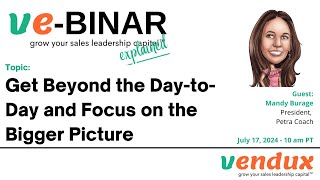
Mandy Burridge of PetraCoach discusses leadership coaching for companies with $5M to $20M revenue using the Scaling Up framework. PetraCoach has worked with 600+ organizations over 12 years and currently serves 125 active clients, helping founders reduce bottlenecks and set measurable quarterly goals through two-coach teams and peer cohorts.
Chapters
Welcome, everybody. Welcome to this next edition of our VBinar. This one titled get beyond the day and day and focus on the Bigger picture. And our guest is Mandy Barrage. No, Mandy Burridge. Burridge, sorry. I trained myself for minutes before the call and still got it wrong. Mandy, thank you for joining us. She's the president of Petra Coach and in a little bit I'll ask her to introduce herself. We want to cover the leadership coaching space for small and mid sized businesses. That's where Mandy with her company is active in and see how that kind of coaching is helping businesses to mature, businesses to grow, businesses to excel. We will have about 20, 25 minutes of conversation between Mandy and I and then we'll open up the microphones for Q and A. The session is recorded and will be available on our website by tomorrow. Everyone who is showing up and who's not showing up will get an email with the link and can watch it later on as well. Keep your microphones muted please, during the first 25 minutes. Improve sound quality for all of us. And then as we get into the Q and A, please unmute yourself and speak up. But I'm also monitoring the chat. So if you want to put a question in the chat, that'll be something that I can read out later as well when we get to the Q and A. So Mandy, welcome again. Why don't you introduce yourself, tell us a little bit about yourself, who you are and how you came to be in the role that you're in.
Sure. Thank you so much for having me. Mandy Burridge, President at Petracoach, as Henning mentioned, and I have been a part of coaching or strategic plannings for probably 18 years. So essentially my entire professional career, I came into Petra really as a startup. So our founder Andy Bailey and I worked together in a previous organization and we were the recipients of coaching. So in that previous organization, it was in the telecom space, we implemented a methodology called Rockefeller Habits Scaling up. I'll talk a little bit more about that later. And we were the recipients. We did what I'll call a DIY model where we attempted to do self implementation based on the book and then the trainings did that for a couple years, worked okay. Brought in a coach. So we brought in a coach into our organization and watched the difference of doing something on your own versus with a coach. And then after that business exited, we started this business to do the same thing for other companies. And it started off really as just the two of us doing this for local companies in Nashville. So taking the certification through Rockefeller habits and working with local companies to implement that. And that was 12 years ago. And that has grown and grown and grown. Essentially we just did not have enough team members to fulfill the need that was at the door. Great problem to have. So then we hired another coach and then another team member. And so now we're a team of 25, we are located all across the US and Petro coach. I've been here, you know, essentially since day one and grown it from just the two of us to now 25 coaches that coach across the country. And then in total we've probably worked with 600 plus organizations over the last 12 years to grow their leadership team and to kind of reduce owner dependency, which are some of the things that we focus on with clients.
Okay, let's start with sort of the definition of who your target audience is. Who are you working with? And why do you think that that's a group that's particularly in need of your coaching?
We have kind of what we call our sandbox, our icp. So companies typically come to us when they've hit, I'll call it like maybe a 5, 10, $20 million price range as kind of the starting range for companies coming to us. And what I hear often is I'm an entrepreneur. So we mainly work with entrepreneurs, privately held organizations that stumbled across growing their business to get to where it's at now, whether it be a passion project or something they fell into. We do work with a lot of family owned businesses. So this has been passed down generationally. And I have now had this organization in my hands and I've got it to this place, whether it be 5, 10, 20 million, whatever it looks like. And now I don't know what to do. And so from there they go. I'm not sure what to do. I hear often I got it here and I don't know what's next. And so we work with entrepreneurs and their teams and I think that that's one of the biggest differentiators in our group is because what we saw was if a coach is working one on one with an executive, I think that's a phenomenal tool. There's phenomenal growth there. But then that's a heavy burden on the executive to go disseminate the information that was talked about that was learned to everybody else in the organization. And we work with companies anywhere from 10 million to 500 million. If you have that large of an organization, the timing to roll out a new system, meeting rhythm, even priorities and vision can take an entire quarter and we're wanting to see that change happen faster. And so we actually bring those people into the planning day to participate in the vision, in the direction and to have a piece of that piece. So who I'm looking for is, you know, an organization that is entrepreneur owned that has a leadership team and that either has like an opportunity that they're wanting to chase or they have a challenge that they're wanting to fix. Like one of those two needs have to be present, otherwise you will not make change. This process is change. And personally we've all probably had like a weight loss goal or maybe some sort of vice that we were wanting to, you know, get rid of personally. And something has to happen in your day to day or in your personal life for you to like finally commit to say, I'm going to stop eating that like dessert after snack, after dinner, or I'm going to finally get on the treadmill that I've been meaning to do. Like, something has to happen. It's no different than your business. You can operate your business as you've been running it, but when you're ready to do things a little bit differently, there has to be something that is pushing you to make that change.
You mentioned owner dependency as one of the challenges earlier. And I've looked at owner dependency in businesses as something that impacts the value of the business when you're looking to sell it. So what part of owner dependency situations do you encounter and then in particular, what are you doing to fix it?
Yeah, we start with kind of assessing where that owner dependency lives. So we actually have an assessment tool looking to go live on August 1st on our online platform. So that should be coming soon, I'll call it. And in that it's going to start assessing where actually is your owner dependency. And it'll start ranking things like every decision the organization has made by me, all of the top priorities, like I have a hand in. So you can start to assess like how actually owner dependent am I as an organization and a lot of these organizations, it's not a bad thing. But you just find that as an owner you always have your hand in sales. You're touching finance to see what's happening and you need to have, I think, a knowledge of it. But having a working hand of like I have a piece of this priority or this decision can't be made without my buy in really drags down the entire organization. It stops the organization from being able to grow at the rate that you probably want it to grow as a leader. And so we kind of Start with assessing what it looks like. And then the next level is leadership growth. And we have kind of this visual, if you can imagine like a, like a little chart here. So as the organization is going from you know, year one to year five to year ten and it's growing in revenue, if the leadership team is not going at that exact same rate, then your CFO, that was phenomenal at 5 million, when you're at 20 million, they have to have done something differently or they are not going to be able to grow at the same rate as the company. So what we work to do is bring those folks in. So number one, let's get you a part of the planning day. Let's get you part of the vision. Like have a say in where the direction is. They have accountability one on ones. So our coaching team actually works directly with not just the CEO or the leader, but everybody on the leadership team. So they're getting, I'll call them like monthly check ins on what's working, what's not working, where are you stuck? And then the last thing is we go put those department heads inside of peer to peer forums or masterminds or cohorts. But I'm going to go, you know, pick my CMO. So I'll pick my top marketing from 10 different organizations and go put them on a call once a month with other, other CMOs to go get their challenges solved by them. Which as a leader that's a relief off of you, that's one less like meeting you have to have. And quite frankly they might be coming out with better ideas or something you haven't thought of because they're getting it from an outside source. And so our entire goal is what we call closing that gap. So making sure the leadership team is growing at the same rate as the organization.
So or the size bracket that you mentioned earlier, 5 to 20 million, that's the, the same bracket that we're seeing on the fractional executive side and where we place fractional executive. So how often do you encounter a fractional executive being part of that leadership team that you work with?
More often. And I said oftentimes, I'm not even sure because they do such a great job of being a part of that leadership team. And so in the fractional space when we do a quarterly planning session, we are setting, reviewing what happened last quarter and then where's our vision for the next 12 weeks so that fractional executive will sit in on the planning day. Obviously it's incredibly helpful for them to understand the direction of the leadership team and the CEO of where we're going. And then when it comes time to, here's the top five goals for the company. What piece of these five can you take? That fractional exec is sitting there taking ownership, aligned with the organization. They have priorities and tasks and next steps, just like the rest of the team, you know, but in their area of responsibility. And so it really helps kind of that whole vision come to place. And I think it's helpful for them, too, especially if they're in a newer placement they can come and be a part of, I'll call it the planning session, or if nothing else, they can go and review the plan for where we're going and imagine being a new hire and saying, like, hey, where's the direction of the company? And all of that lives. We have software that we run, so all of that lives inside software. You can view what's been happening, where are we going? What's the vision? So, so you can get caught up really, really quickly from onboarding and then be a part of that in the very next session.
Yeah, well, you're right. Those fractional executives are meant to blend in. They're not meant to stick out like a sore thumb, but rather be part of that leadership team. And there should be no difference in how they work with people inside the company or people like yourself that come in from the outside as a coach. So, good, good to hear that you're observing what, what we believe a good fractional executive does.
The only way, I'll tell you, the only way that I actually know that they're fractional is that we'll sometimes look at KPIs. And so if you have a goal and you're looking at how to measure it, you might have a goal that says like X number of hours. And so we'll look at what is your totality hours that you could possibly work on this project. And then we'll start, you know, backing into it of how much is this going to take? So we can see, is this the right project for this quarter? And I can only tell because my fractional people, I'll say, yeah, you know, 40 hours a week times 12 weeks. You know, here's your total hours. And they'll always go, oh, actually, I have a shortened. And that's the only way that I can ever tell that they're fractional.
Yeah, the, the Rockefeller habits. What are those? I, I mean, I, I told you before and I had to Google what it is because I had no idea. So, yeah, a little bit about that.
Here's my purple book. People have either heard of this or they haven't. But in business, you know this to be true. There's not a whole lot that's, that's brand new. Like business has been business for forever. So Vern Harnish is the, the creator of Rockefeller Habits. Mastering mastering Rockefeller habits or scaling up is kind of the next version. And so what he did was he went back to John D. Rockefeller and he looked at the habits of these organizations over time. Like, what were the things that made the great companies so great? And to no surprise, there is nothing that is brand new, but it's focusing on kind of four areas. So what is the strategy of the business? How are we doing around our execution? How are we managing our cash and growing that? And then what are we doing around people? So I'll call it there's four kind of pillars within Rockefeller Habits, which is the framework that we operate under. And then from there it's a planning schedule which consists of those quarterly plannings with individual priorities per person. What are the meeting rhythms and communication. So this always hits kind of HR and kind of the rest of that group is like, if we set this goal, what is our cadence that we're checking back in to check on the progress of it, who's the team associated with it? And all of it comes down to if you've ever looked at a kind of a one page strategic plan. And I ask, sometimes candidates are like, I have, I have a plan. Like, where is that plan? Like, well, we had a consultant come in and we haven't like a Google Drive. I haven't looked at it in three years and I hear that often. Or it's like stuffed in a drawer somewhere. So our job is to get that plan and bring it to life and look at it at such a consistent basis that you cannot not know where the direction of your business is. We have this example of if you've ever bought like a new car, Penning, what's the last car? You don't tell me all the details. What's the last car that you bought?
Oh, I can tell you. Should I?
Yeah.
This here?
Yes. Girlfriends.
BMW x3.
Okay, x3. What color is it? What color?
Dark gray.
Metallic is a very nice color. So prior to getting this BMW, like probably saw a couple of them. And then when you thought you were going to buy this car, you saw a couple more. And then the day that you bought that car, all of a sudden there were X3s all over the interstate, like you were driving down and you're like, there's one. There's one that's my color. And this car that you felt like you were kind of the only person that was going to get you now just saw everywhere. And that happens because it was so imprinted in your brain. Your Raz filter was going like, yes, I'm clear on what this is. Like, I know it. It's now my car. So now I see it everywhere. Our goal is for the organization to have that same level of clarity of this is the direction of where we're going. We are seeing it. It's in front of us, it's in our software, it's in my plans, it's printed. I know exactly where we're going. That way, if an opportunity presents itself that's going to get me there faster, I cannot miss it. And so it is truly habits inside the organization. It is habits of how we meet, it's habits of how we talk, it's habits of our culture so that we are driving towards our plan faster.
The example was spot on. And it's true with a lot of things. You know, once something catches your eye and it's important to you, you see it everywhere, always.
And that's the goal for a business. Yep, same thing.
So we, we. You spoke about the owner dependency as one. One of the things that you're looking to address. I mean, what are some of the other shortfalls or problems or just situations that inhibit growth and scaling that you're looking for? And saying, this is a perfect candidate for our coaching.
We kind of look at kind of these six different pillars. So we talked about owner dependency strategy is one. So oftentimes I hear from. From CEOs or member leaders of. I have a vision in my head and I cannot disseminate that to the rest of the team. And the team, quite frankly, is looking for where are we going? Like, people want to know what they're a part of. They want to know the direction. And sometimes it's a lack of communication or a lack of getting it out of their head or a lack of putting it into terms that everybody can understand and actually see. But having some strategy of where we're going and what the plan is to get there is always where we start. We start with, why are we here and where are we going? Kind of like a puzzle, you know, we'll have some analogies and stuff to kind of get people the understanding of what strategy looks like. So I think it's hard to actually Google it. There's 100 different definitions of what strategy is? Essentially, it's a plan, but it's a, you know, here's where we're going. You have to know where you're at, you have to know where you're going. And then our plan is to figure out like, great, what do we do in between? And what do we do in between starts hitting on some of this execution. So we said we were going to do this. How are we actually doing it? When you looked at last quarter goals, what were your top five goals for the company and were they all completed? Were they written in a way so that you're clear if they were completed? Example, if you said, like, improve communication, it's very subjective into what's improved. But if you said, we have three new meeting rhythms and they've been rolled out to 45 team members and we're using them on our Monday and Wednesday huddles, there is no. It's, you either did it or you didn't. So creating that culture of accountability as well. So execution is, hey, let's go do the things we said we're going to do. And accountable is like, do I have kind of the right people in the seats to, is my team accountable to doing what we said? So defining KPIs for roles and for individuals is oftentimes where we start as well. So if somebody's in a seat, how, how can they, you know, quantitatively, at the end of the day, say that I had a good or bad day. There's a feeling that's associated with that. But I want a team member to be able to look and say, like, man, I didn't feel super great, but I hit these five numbers and these metrics are what make me know that I'm, I'm excelling in my role. So I feel really great about that. And a lot of roles miss that. So there's an accountability kind of as aspect there as well. And so there's just communication is another one. I would say of those communication is probably one of the top two that people reach out to us for. If you start with two people, you know, communication goes back and forth here and here. If you add a third, then it's like 1, 2, 3, 1, 2, 3, plus these two. Then you had a fourth. And there's kind of this matrix that you can see how difficult communication gets as you continue to add people in the team. And so I hear oftentimes, especially as organizations get larger, that we are very, very siloed. This group doesn't talk to, this group doesn't talk to this group. So what meeting rhythms can we put in place? How can we have information flow up and down? How are we getting customer information into the team, back to leadership decisions being made and back out to that customer? You'd be surprised. A lot of companies don't have customer flow. And so you're kind of looking at these different elements. Communication, strategy, owner dependency, accountability, and it, it varies per client. So right now we've about 125 clients that we work with. And I'll tell you all, 125. We're working on different things depending on where they're at in the process and where they're at in their growth as a company. We might have really solid strategy and we are completely, you know, changing up our leadership team. We might have succession plans we have to go build and that has to be like information that's pushed down. And so there is a bit of a customization that comes with every single member because they're all different. Every company we work with has kind of, I'll call it the same core challenges, but how we approach those is different every time.
When you first connect with a CEO of a company like that, do you find that most of them come to you with a well defined definition of their challenges or is it something that you tend to uncover in a discovery call or in discovery sessions before you even get started?
Probably both. I'll say that, you know, half the people come and they have heard of this process. We have. Most of our new members are through word of mouth referral. So somebody's working really well in their chapter, their forum. So they go tell 10 other people. And that call is, I don't know what you guys do or what I need, but so and so told me to call you and I need this for my business. So there's a, a section of that. But a lot of times it's. My business is going pretty well. Like we're hitting our numbers pretty well. I have five new people I have to hire this quarter and we missed this target. Not really sure what's working or not working. Doesn't feel maybe as fun as it used to. It was really fun the first 10 years and the fun's kind of going away and I don't really know if I enjoy this anymore. And like, maybe I actually want to sell it because it's not fun anymore. So you're starting to feel like this loss of this was. We were building stuff and it was growing and now we're in growing pains. Like we've hit this $10 million mark, or 20 or 50 or whatever the, the milestone is for you, but you've hit this mark. And what was fun before now is a lot of work. And I think that my opinion is that, you know, all of that work, if you have a set plan for it and you're working through the plan of, here's what we have to go do to get there. Anybody can follow a plan. I think it's a little bit more fun when you were just winging it and walking in every day to fires and just putting out fires all day. As a leadership team, that is not fun. And it probably is not going to help you hit your KPIs, because you probably don't have a KPI that says like, put out 15 fires this week. And so you find yourself being busy but not being productive. And so we're looking to kind of shift that. And so those are the feelings out there that people call. It's not even that they call and say, like, I need meeting rhythm implementation or I need a defined plan for the next quarter. Very rarely do I get those calls. Most of the time it's, you know, this isn't fun for me anymore, or I feel like I'm just working in the business every day and not on the business. And it was fun when I worked on the business and now I'm just like a cog in a wheel. And this is not as much fun as it used to be. And so we want to make it more fun for everybody.
When you described earlier defining goals, setting goals that are actually achievable and measurable, it reminded me a lot of what EOS does when their implementers come in and talk about rocks and put them in 90 day buckets. How do you feel what you're doing aligns or does not align with eos.
So if you've heard of eos, then you can pick up what Petra is pretty quickly. We take most clients that they get to a point with eos, and EOS is a phenomenal tool. So a lot of our clients start on eos, especially if you're a smaller organization. It's a great starting tool to get in the habit of those L10 meetings and setting the rocks and kind of getting that framework. When people hit anywhere from 5 to 10 million. I get a lot of those calls of I, I need more like, what is the next level of this? How do I get more advanced? How do I get more people on my team? Or like, this has been helpful for me because it's typically One implementer to one member leader. But the rest of my team now isn't getting anything for them. And so it's really. I would call it the next step. So if you're on eos, I think it's a phenomenal tool. Typically, at some point, I think people outgrow it and they're looking for what's next. And that's typically when somebody calls me. So we do a lot of. I call it like EOS 2.0 because we move them to the next level.
Yeah, that is an interesting description, because most people that I know who are an idiot EOS talk about graduating, and that means they have taken all the structure and made it inherent to their organization into their processes. But then what you're saying is they still need help, but they need different help.
We're wanting to get the help out to the leadership team. So I do think that people graduate because they have the structure, the meeting rhythms are in place that have KPIs set, and I think that's phenomenal. And then you look and there's 15 people on the leadership team or eight people on the leadership team. And they didn't have a hand sometimes in creating some of that, where now they're having to disseminate that down to their team. And they've never been a part of that. They've never participated. They don't know what KPI development looks like for a team. And so that's what I'll call the next level of it. And so that's where we always have two coaches on all of our engagement. So we have one coach that has been a past entrepreneur. So they've all scaled and exited their own business successfully, and this is a second career for them. So there's a lot of just institutional knowledge that come from already walking those steps. And so they come and work directly with the CEO. And then I have a secondary coach that's an accountability coach that works with the rest of the leadership team to say, great, we have, you know, five scorecards that need to be created this quarter. Who does that look like? What are the roles? All right, let's start looking at what are the objectives, what are the competencies we need for this department? And so they're not filling that out on their own. They work with a coach to go and build that stuff for their team.
We'll open up the mics in just a little bit for audience questions, but sort of at the tail end, let's talk about Mandy. What makes you particularly successful in the role that you're in. Why? Why you? Why not somebody else?
You know, there is a, there's a level of discipline that I think that we expect from our members. And it's hard to expect that level of discipline when you yourself don't have it. I'll put myself in this box and I'll say a lot of the Petrons, which is kind of what we call our team members, are high executors and high implementers of their own process and their own project. So what I mean by that is, you know, this group, when we set goals for ourselves, we set strong goals, we complete them. I have been a part of a daily huddle every day, which is like a 15 minute morning meeting for 18 years. I did the math on it one time. It's a big, it's a big number. But I'm highly disciplined in my ability to believe in the process and to do the work. It is no different than having a personal trainer for yourself. You've worked with a trainer and there are some days that it is not fun. But if you look at any great athlete, if you go look at, you know, Kobe Bryant and Michael Jordan and all these athletes, they talk about the discipline of just being relentless in the basics of your craft and that is what makes you really skilled. And I myself am just really disciplined in the basics of our craft. That is being goal oriented. That is doing the small steps like huddle every day. I can't ask somebody else to do it if I myself won't do it. Sometimes people will say you guys kind of seem like machines a little bit. Like you're just operating on the next, the next, the next. And it's how we operate as a team because it's how we encourage other people not to get to that level. I realize it's like a high level of execution, but if you can start to kind of turn that tide a little bit and have some, some discipline in, in the small things, you'll start to see the big things develop over time.
Yeah.
And lastly, I think I just have a passion for entrepreneurs. I've been surrounded by entrepreneurs my whole life. They are, you know, I would not actually put myself in that bucket. I'm going to be more of like the, I, I get all the, the behind the stuff, behind the scenes stuff done. But the creativity, the ambition, I always call it like the crazy squirrel moments of like, we should do this. No, we should do this. How about this? What about this? I love the energy that comes with that. And so grabbing that from an entrepreneur and then like helping boil that down into what's really important and then getting that out to the team is, I think, a skill set that I myself have created over the last 18 years. And so I can work really well with clients to do that as well.
Yeah, that's energy that needs to be channeled. And if it's channeled, it works really well. Otherwise, it's just goes out into the universe.
Yes, it does.
Thank you, Mandy. Let's open the mics. If you have a question, I know we have a small group here. Please unmute yourself and ask Tim.
Hi, Mandy, this is Tim Kelly. My question is related to the reduction of ownership owner dependency, which sounds to me a lot like delegating better. So when you start working with that next level of leaders that you need to grow alongside that highly motivated CEO founder, do you often see, you know, unwillingness to grab the baton and, and run with it? I'm. I'm seeing this in a couple of organizations. And. And how do you overcome that? Well, that guy's the leader. I just take orders. And like, how do you instill that second level to really buy in?
Yeah, it's a great question. And I'll tell you that all of our setup of clients are different. Majority of the time, I always look back to that owner founder. So, you know, hey, we brought this person in. What are the skill sets that they have? Have they been clearly told what their objective is and how they can succeed here, or are we just throwing whatever random project we have? We're delegating any and everything this week and then nothing the next week. So there needs to be a level of consistency, I think, in execution from the member leader to that individual. And, you know, I think more often than not, sometimes this process, oftentimes this process actually uncovers who's connected to the organization and wanting to do good work and wanting to grow themselves and who is not in a room of 10 people, which is, I'll call an average kickoff. So a lot of times we start with a kickoff. We put 10 people in a room and start to build the plan. 80% of the time, there is one person in that room that does not like this process. They're just not. They have been at this organization forever. They have been kind of coasting or, you know, skating by now, all of a sudden we are talking about what are your three to five goals that you yourself are going to own? Specifically, what is the deliverable? Here is the due date, and it's going to be visible so that everybody can see your progress. We're talking about it every week. And if you've just been used to coming in and kind of doing whatever, whenever it's a. It's a significant shift that sometimes results in some turnover of leadership if it's not the right person on the seat. You know, we ask member leaders, would you. Would you enthusiastically rehire your leadership team and do some talent assessment? And talent assessment is based on how well do they fit the core values? Have we defined the core values of how we deliver our product and service and how productive are they based on the outcomes that we've given? Not busy. A lot of people are busy, but actually producing the numbers that are associated with them. And if you kind of rank your leadership team or the entire company, quite frankly, on core value fit and productivity, you can start to get these placeholders. And then that allows us to see great. Who is just overworked with, you know, emails and meetings. And they're actually phenomenal team fit. We just haven't given them a chance. Like, let's go work with that person differently than the person that is highly producing because they have, you know, maybe a couple great accounts that are underneath them, but they're not a core value fit and they're a bad apple and they're bringing everybody else down. Let's work on a next plan or maybe an exit plan for that individual. So I think that there is some customization on. You got to start with, again, where are we now? And then, what do we need as a. As a team? And so there is delegation. I find there's two sorts of people in the planning day. There's either people that are not for this, like, I don't want that level of accountability and discipline and structure, or there are people that have been doing phenomenal and they thrive in this because they can finally see how their work moves the company forward and they excel. And I think that that gives them more opportunity to grow within the organization. So there is a bit of, we call it like a transparency flashlight. Like, you're kind of looking at every person, every task in the organization gets them covered a little bit. So it's hard to kind of hide stuff, which I just think is really the first step as a leader to say, like, you just. You don't have time to look at it all. And so it seemingly looks, well, gray, but when we start kind of pulling stuff up a little bit, you can go, wow, I didn't really realize this. So there is, you know, I'll call it the first quarter or two of really just Uncovery of what's working and what's not working.
And that's, that's really the CEO or you know, who's ever responsible to say, okay, here are, you know, you got to give me three to five quarterly goals of what are you going to accomplish, what are you going to get done? And then make sure that the next quarterly get together, you actually score those and do that. That's the accountability part. Right. And is that typically the CEO or is that a coach doing that?
It's the coach. So the coach as a room, we're all setting like here's where we're going, here's the direction. We have these five big initiatives. Now who's going to own that? We need one owner. And they always say, oh well, a team, sure, let's put a team on it. But who's the one owner that's responsible? And it's a bit of a red flag to me when it is like CEO, CEO, CEO, CEO, like you can't possibly own these. So who's the next person? And somebody might go, gosh, I'm going to own it. I'm a little bit nervous and I'm not sure how to get started. It's a perfect first step. Like we will help you create that and we'll set you the meeting rhythms. But I'm looking for more people to start stepping into that role of accountability. And then let's work together on what it needs to look like for the 12 weeks. We'll help you build whatever the project is.
Yeah, great. Thank you.
Yeah, very much. Thanks.
Thank you. Tim, any other questions that we want to throw at Mandy?
Gently toss to Mandy.
Good. I guess there are not. So thank you Mandy for taking the time. Really enjoyed the conversation. Appreciate how you were able to share your insights, not only about Petra and the approach, but rather what you're seeing out there in small and medium sized businesses. And as we talked about, we're in a similar active, in a similar space bracket and, or in a size bracket of company. Therefore that makes it really, really relatable to myself as well as other fractional executives that we, that we work with. So thank you for taking the time. Have a wonderful rest of your day and a wonderful rest of your week.
Thank you.
Thank you. Bye bye.
Bye bye.
More from Henning




ve-BINAR - The Revenue Tornado Methodology: How 3 Power Sources Create Exponential Growth


ve BINAR: Executive Cloning: How AI is Reimagining the Role of the Fractional Executives




veBINAR: Unlock Client Value: Why Compliance is Crucial for the Startups You Serve
