ve BINAR Grow Faster and Increase the Value of Your SMB
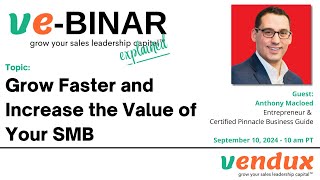
Anthony McLeod built Allied Pediatric Therapy to 8 locations and 300 staff using Pinnacle, a business operating system that aligns teams and clarifies vision. He explains how it works: a kickoff session, then quarterly leadership meetings and annual summits with ongoing coaching. Best fit is service businesses over $2-5M revenue with owners ready to commit.
Questions this video answers
Quarterly (every 90 days) plus one two-day annual summit.
A basecamp kickoff lasting a few days to establish foundation and tools.
Certified Pinnacle Business Guide.
Typically above $2M, most value around $5M; he has worked with companies as small as ~$1M and as large as $20M+.
Multiple years is common (Anthony worked with his coach 4+ years; some clients 10+ years); two years is a common reference point but not a hard finish line.
Chapters
Well, good morning, good afternoon, good day, everybody. Welcome to today's Vendux vbinar. I'm Andrew Miller, one of the partners at the Vendux Group, where we focus on helping clients to grow their sales leadership capital. I'm thrilled to have Anthony McLeod as our guest today, and I'm going to be letting him introduce himself in a second. In a nutshell, Anthony grew up witnessing the challenges of entrepreneurship as the child of small business owners. He launched his first business in high school and later worked with entrepreneurs learning how to make companies more valuable. In 2017, he co founded Allied Pediatric Therapy, a company dedicated to helping children with autism, drawing inspiration from his personal and professional experiences. Under his leadership, Ally expanded to over eight locations with 300 team members. The company was recognized on the Inc. 5000 list three times and named twice as a Phoenix Business Journal Best place to work. He was also honored in the Phoenix Business Journals 40 under 40. After a successful majority sale of Ally in 2022, Anthony now helps entrepreneurs overcome obstacles and realize their visions, using frameworks like EOS and Pinnacle to drive success. Today's Vendocs vminar topic is grow faster and increase the value of your SMB by leveraging the Pinnacle os. So we'll dive into this theme and topic shortly. But first, a couple of quick housekeeping notes before we jump in. We'll keep everyone muted for the duration of the webinar. There'll be a Q and A at the end. You can either use your the the chat function in zoom to submit your questions or just feel free to open up your mics and engage with Anthony directly at the end of the webinar. This vibinar is being recorded and will be available later today on our site and on YouTube. Anthony, welcome. Before we dive into today's V, could you just share a little bit about the key parts of your journey and what are those key ingredients that have gotten you to where you are today?
Yeah, thanks for having me, Andrew. You did a really great job kind of summarizing the story a little bit here, but I think the only thing I'd add there is so when I was first starting out of college, I was working in investment banking and I was helping companies that entrepreneurs that were looking to have a sale of your business and started to see these really amazing stories of entrepreneurs and the impact that they were having within their companies, their teams, their families, their communities and have just been the rest of my career so obsessed with the good that you can do from entrepreneurs and kind of turning that passion and that vision into execution and performance. And so I really spent a lot of my time learning, how do you do that? And as building my organization and my team, my company learned a lot through that journey. And Pinnacle was a huge part of, you know, us being able to grow and realize our vision. And now I'm just having a ton of fun helping other entrepreneurs kind of realize that and, you know, spend the time where they want to spend it and live their best lives and still have a really great impact within their companies and their industries. And, you know, it's just. It's been a lot of fun so far.
Wonderful. Great. Well, great to have you. So let me start with the first question right at the top. Anthony, tell us a little bit about what a business operating system is.
Yeah, I, frankly, I hadn't heard that term when I started my business back in kind of 2017, that time frame. And it sounds like it should be like an oracle, like ERP or something like that. And that is absolutely not what it is. It's. It's not a software solution or anything like that. Every single business out there has a business operating system, even if you don't know it. It's really the way in which we say, all right, where are we trying to go as an organization? What's kind of the vision for the company and how are we going to do it? How do we organize our resources, our people? How do we solve problems together? How do we collaborate? So how do we go achieve that vision? So that's really all a business operating system is, is really saying, let's, let's. How do we define, you know, what's the vision for the organization? Where are we trying to go? What's our core purpose? Who are we? And then how do we execute a bit on it? So how do we have, you know, playbook to execute upon that? How do we have people, the right people in the right seats? You know, how do we really define that vision, that purpose? How do we then, you know, also perform on that? Right. So that's. That's really all a business operating system is. And, you know, we want to be as deliberate and intentional as possible in getting those aspects right, because it's going to allow us to have a better likelihood of achieving what we're trying to achieve and also do it in a faster way.
Well, that's very straightforward. Makes sense. So many on this call have probably heard about EOS or the book Traction. So tell us a little bit about the landscape and the evolution of these systems.
Yeah, you know, business operating Systems have been around for decades, even before that kind of term business operating system was used. So, you know, it kind of goes back to four disciplines of execution. Great game of business. E Myth, you know, some of the concepts from the Rockefeller habits, right. So these things have been around for a long time. And then really what us did and the book Traction and a few others that they've written, they did a really good job of kind of packaging some of those concepts that had existed before into a pretty clear and compelling system. That's what I kind of stumbled upon, EOS first. And it was introduced to it by another CEO in Arizona, where I live. And so that's kind of what I use at first to start building my organization. And as EOS kind of changed their organizational structure and some of the model was kind of evolving there, the implementer that I was using, the coach that I was using, moved from EOS to a new system called pnacl and a few different systems kind of spun out of eos. And so that's how I started getting introduced to pnacl and kind of go, can I say beyond EOS and a little bit deeper and really kind of found a system that resonated with me and it kind of fit with me and my company and you know, kind of helped even accelerate what we were building upon. And I think it boils down to, you know, I think, you know, a lot of the system of Pinnacle is really kind of built upon the foundation that EOS has laid, but it's done so in a way that is really trying to say, you know, let's not have a closed, rigid, one size fits all approach like, like, you know, EOS and maybe some other systems have. Let's really try to have one that is looking across different systems, different tools, different philosophies to say what' best in class, right? What's, what's out there that we can, you know, bring the right tool at the right moment for that client and really customize the system around when, where they're trying to go as a team, as an organization, so that we're really trying to dial the system in and have it fit well with where they're going. So I think, you know, when you're able to do that, you have a really customized, you know, system that's bringing kind of best in class tools. And by doing that, it really allows that, that system, that framework that to get really entrenched and for the team to get the most out of system when they're using it for, for many years. And you know, I think the other thing too is it's, it's, it's evolving, right? It's growing, it's learning, it's, it's getting better and better. Right? So there's some systems out there that just haven't changed in 15 years. EOS is kind of one of those. Whereas, you know, Pinnacle is really trying to say let's keep getting better, let's bring, let's have an open source kind of framework, let's bring the best in class tools and thinking and keep, keep evolving and keep getting better. Because we want our, our clients and our team to get, keep, keep growing and keep getting better too. So we want to grow with them. And en, that's kind of how I've seen the landscape evolve. Obviously I used eos, now I've used Pinnacle, now I'm coaching with Pinnacle, right. So I have a little bit of a reference point for good, bad and the ugly of all systems. But I just think it's so important for clients, companies, entrepreneurs to have a system and really kind of go all in on the system that's going to resonate with them.
Well, that makes sense. If operating systems weren't evolving, we'd still be on Windows 3. So let's get a little bit more granular. Let's talk about some examples. How can these systems, or how are these systems helpful to companies? Can you share some examples of what you see, what you work in, what you implement?
Yeah, you know, I, I think I can kind of speak a bit to my, my own journey, my own company and kind of how it helped us right when we were building Ally Pediatric Therapy. And you know, I think the hard part for, for myself and for many entrepreneurs when we're starting to build something is you, you have a good idea of kind of what you're, you're trying to achieve and kind of where you want it to go or maybe where you want it to look like. But the hard part really comes in kind of translating that, that vision into execution, right? How do you get a team of people and we're all, you know, emotional, flawed human beings and we're trying to grow and we have our own motivations and things we're working on. So it's like, how do you really, you know, kind of translate that, that vision, that purpose into execution? And I think that's really where operating business, operating systems are very helpful. Right. So it helps you clarify that, that vision, right, for where you're trying to go, but then has a structure to, to really help execute upon that. So when you think about, you know, we think about Pinnacle, we really all about the 5 psych and we have it all start with, with people. So we want to make sure that we have, you know, the right people in the right seats. So that means looking to say, okay, what's our, what's our organizational structure, right? What is that like today? And what does it need to be as we look to grow? And so if you're able to do that, have a really great people, you're really, you're coaching them up, you're developing them and you have the right seats for the organization, you're going to, you're going to grow through the kind of ceilings faster, right? So because we were like, when we were growing, we were looking, we had a pretty small team at first. We were probably when we first started our journey with an operating system, we were like, I think less than a million of revenue, maybe 750k in annual revenue. So we were pretty small. But we said, okay, you know, we want to grow to have, you know, more than just the one clinic that we had at that point. We want to have, you know, multiple in different parts of the city. So we started to think about, okay, what are the things that we have to do in order to get there? And you know, I knew I couldn't sit in every seat, right. I couldn't do, I couldn't wear every single hat. So we had to think about, you know, what are the roles that we need to bring in or hire for or develop from within in order to help us break through that ceiling, that first ceiling, right? In order to have, you know, not just, just me or someone else doing, doing all that thing. So all I say is kind of, it helps you define like where, you know, with, with where you're trying to go, what are the ceilings that you're going to hit and how do you break through them faster rather than kind of get hit that ceiling and then plateau, right? So we want to kind of be breaking through those ceilings to help us get to that next level for us and that higher peak. So that's, that's what we're trying to do. So that's kind of one example there. You know, I think, you know, a lot of the issues that we all kind of think that within our own companies that we're leading or you know, sales organizations that we're leading our own teams, like, we all kind of think like, oh, geez, my problems are like, are so unique, are my industry. This industry is so unique, you know, that nobody else can understand having these types of problems. But, you know, now having, you know, worked with a number of clients and, you know, spoken to so many entrepreneurs over the years and led an organization, there's those similar kinds of problems that we're all dealing with, like we're all banging our head with. And so, you know, we try to pull, you know, lessons from those and, and try to, you know, get, solve. Identify those issues faster and solve them faster. And so that's a lot of what we're trying to do is, is figure out what are the main issues that we're going to have to solve in order to break through and how do we, you know, put them on the table and get them solved.
Right. So then from the, the client perspective, is or are client challenges and issues and problems the same? I mean, to the extent that you just described that just about every client has a similar set of issues. It's a matter of scale and size and scope and number of zeros. So are client situations always appropriate for you to jump into and to be able to bring a solution? Or are there times where you say, actually, you, we're not right for you, you're not right for, for us, it, it would not work for you.
You know, I think it's all about the mindset of the visionary and the entrepreneur and what they're trying to build. I think that's where it really is defining for, is this going to be appropriate? Can I be helpful? A system like Pinnacle be helpful? I think if it's someone who's saying, hey, I want to build something really special, I want it to be a category of one type business, I want to grow, to keep growing, keep learning, keep achieving something, be a great place to work, work, you know, things like that. If they have that mindset, that's where, you know, having a guide or coach, you know, or in a system is really helpful to that type of person. Right. So, you know, like, even thinking about my own journey, right, Like, I started with an operating system and a coach when I was very, very, very small and probably even before a lot of folks would typically recommend engaging with, you know, a coach in an operating system. But I knew where I wanted to go and I knew I wanted to get there faster. And I knew I was having issues and challenges that I wanted to solve faster. And so that it made sense for me to do and to make that investment. And look, I wasn't, I think back then I was barely paying myself too. So it was a, it was an investment. It was A choice, but it was one that, you know, I was so glad I did. Right. So I think it's really about the kind of mindset of what you're trying to build now. Look, if you're, it's a, if it's a solopreneur that doesn't have a team, it's not going to be a great fit for engaging with someone like myself. I think to, to invest that type of, you know, the resources and dollars and time that goes into it. But I think there are lots of different size ranges and industries and business models where, you know, this can make a lot of sense for it, I think. Go back to mindset.
Gotcha. So then, you know, when, when does it make sense to hire a coach and a team and a, you know, in a proper heavier rollout versus buying a book or in reading a couple of books and a couple of seminars and kind of the, the do it yourself approach?
Well, look, I, I think there's always value into reading and learning and talking to other business owners and, and you know, understanding what others are facing, what's working for them, what's not working. Right. Like that is. I think every, every, you know, entrepreneurs should be had that kind of thirst for knowledge. And certainly I did. And that's, you know, all those books I mentioned, like I had read them and I probably had a little bit of like hubris or naivete like of saying like, I can just do this myself. And so, you know, early on that's what I did. I tried to self implement eos. You know, I brought my team together. I had kind of traction off to the side and was, you know, as I was trying to be the facilitator but also the CEO and as people would ask questions like, I don't really know the answer to that. Let me flip to page 54. And it's just, it's hard, it's hard to be the kind of the facilitator who's really managing the energy, being the subject matter expert, trying to push and run to the danger, but also like then having to be, you know, held accountable to your, to yourself as like, you know, when you're sitting in different seats, right, and being on the same side of the table as your team, like I found that pretty hard. And so as I was Talking to other CEOs, they were like, you got to, you got to hire an implementer or coach. And so that's, you know, that, that the reasons he kind of, you know, that recommended to me did play out right. It's you know, someone who can be, you know, a true facilitator who can manage the energy of the room. They allows you to be on the same side of the table with your team, really participant working on the business and side by side with them, you know, they're going to see things that you don't. Right. Because you're going to have blind spots as the entrepreneur and the visionary and, or integrator and you're going to, there's, there's things that someone who's external and not in the, in the weeds of business will see. And then the other thing too, that I, maybe, I guess I didn't expect, but looking back, I should have is the, the, the coach that I worked with really did challenge me to run to the danger. And a lot of times where, you know, maybe I knew there was a people issue or there was some other issue that I was kind of like letting you know, things go unsaid or, you know, maybe it was just easier to ignore it. Right. And I think a good coach is going to challenge you to push you to find what are the real issues that you have to solve in order to kind of break through that next healing. And, and the individual I worked with certainly did that. Right. And, and I think that was, you know, very, very helpful in us kind of, you know, breaking through those, those ceilings as fast as we needed to. So those are the kind of reasons why I think, like, you know, you, I think there's a lot of benefit to hiring a coach or an implementer and you know, in terms of kind of when is the right time for that? You know, I think again, I think goes to that mindset, like if you're, if you're looking to grow and build, you know, I think there's, if you're investing the time, the resources that you want to build something, you know, having some, some semblance of a team, I think is important because that's where you'll start to get the benefit of the system. But you know, I work with companies as small as, you know, 1 or 2 million of revenue, but I have, you know, clients that are, you know, more. Upwards of 20 million. Right. So it's, it's again, more about we're going to customize the system for you and where you're trying to go, we're going to bring the right tool for what that team needs in order to kind of break through that ceiling. So it's customizable to truly many sizes.
That a lot of what you say resonates Entirely with the dynamics of our business and the kind of clients that, that we're working with on a regular basis. There are many, many entrepreneurs and business founders who've taken their business from zero to something to a million, $2 million in revenue. And they do it all themselves. And they think about, oh, how are they going to get to 5 million? And many recognize that what got them from 0 to 1, it's not, it's not what's going to get them from one to three and beyond. So they, they, they cannot continue to be the chef, the cook, the bottle washer and, and everything in between. So they bring in ahead of sales. They bring in a fractional chief revenue officer, VP of sales. So it's like a coach or an outside leader. So in, in terms of, you know, you talk about this, the sizes of business that businesses that you work with. Can you talk a little bit more about that? What is this is a, is an operating system approach best suited for certain kind of company, certain size of company, when is the right time, or an industry or a particular business model. And conversely, are there any types of companies that, that this would not be a good fit for?
Yeah, great, great question. And one that I get a lot. And again, I think I'd start with, you know, what's the mindset of that business owner and where are they trying to get to? It defines a lot of it. I think, you know, when you're below a million of revenue, that can be hard because there may not be a leadership team, you know, there may not be enough resource to really commit to, you know, investing in this. I was smaller than a million when I started though. So like, you know, I say that with a caveat of, you know, with the right mindset, you certainly can, and you can certainly get the benefit there. But I would say that's probably a good initial cutoff. I'd say most of my, the clients that I work with that, you know, get a lot of value are kind of, you know, definitely above 2 million, but, you know, mostly about 5 million. And that's where I think it really, you know, you start to have enough complexity in the business and you're trying to kind of break through ceiling and keep growing. That that's when, you know, folks do tend to get a lot of value from this. But again, I think it goes back to mindset in terms of industries, business model, that kind of thing. You know, I don't think there are a ton of, you know, industries or models out there where you can't get benefit from, you know, having a system, because it's really just trying to help you figure out where you're trying to go and how do you execute upon that and that and the tools the system enable that. Right. I think if I, if you press me for like, you know, here's maybe a couple industries, I think it's, you know, things where there's like a really long lead time in a product, like a manufacturing process or R and D or like pharmaceuticals or things like that. Right. You know, that may be a little bit harder to get as much benefit out of a system like Pinnacle or others too. But, you know, you still, even there, I think there's things you can still get benefit out of that are kind of basic foundational aspects.
So I, you know, there's, in our world, as with, I suppose, every other clients and businesses and entrepreneurs and leadership, always seemingly extremely busy, juggling many balls in the air at the same time, trying to be proactive and strategic on the one hand and firefighting on the other. How. How much time does it take to implement a system like Pinnacle? What's involved? Where do you begin? Even a company that is at a, at a 1 or a $2 million revenue level, like, how much time is involved?
Yeah.
In general. And what are your expectations of the CEO and the business leader in terms of committing their time and energy to this?
Yeah, I love the second part of that question too. And to address the first part of the question of time, I think having run my business using an operating system, I think it actually saves me time. You mentioned firefighting. You know, if you think about, you know, all the times where you or your team too, are, you know, dragged away with urgent issues or fires that they have to solve. Right. Think about all the time you're spending there, all the one on ones that you're doing, or team meetings, all those types of things that you're already kind of doing right now. And all the time that kind of goes into that. So managing the team, the fires that come up from that, and the business overall, like, you know, what we're trying to do is really make that more impactful, be deliberate on how we're spending our time and having really dialed in agendas to be solving the biggest issues and to have a playbook that's really the fire prevention system, I think. So that's what we're trying to do is instead of just reacting to the fires that happen and be kind of a victim of that, we're trying to have the system in place that's preventing the fires from happening or controlled fires or know that there's going to be some fires that there may be happening, but we don't need to deal with those. Those are just going to, you know, die out on their own. So it's, it's, there's, you know, I think a good way to be thinking about being, being deliberate and intentional about how we spend our time. So, you know, I think it kind of through that and through the, through your team, like you're able to actually save a lot of time now. I think, you know, there are certain things that we try to have and I think where, you know, time is involved is, you know, people hear meetings like, oh, I'm, you know, I have like a 90 minute meeting every week. My leadership team. What, you know, why, like is that, that seems like a lot or, you know, is that really needed or can we cut that down or could we do that every other week? And again, I think it goes back to if you're doing that and doing it really well and how you're solving the right problems and you know, working on the business and solving things, you're going to save time, it's going to solve, it's going to prevent those fires from happening. People are going to feel engaged, they're going to be, you know, have clear direction. It's going to be a simpler business, right? It's going to be more fun to, to be a part of that. And, and so, you know, that that's, I think, a great outcome. So, you know, you can think about like, okay, the stuff that goes on in a given week with, with an operating system, you know, certainly a few hours a week, but it's probably stuff you're, you're already doing. It's just trying to make that more, more impactful. So that's kind of like one aspect, right? You know, the other aspect is, you know, how I'm typically working with, with clients is, you know, when we kick off we're doing what's called a base camp. So if you think about it, you know, if you're going to go hike a mountain, which is, you know what we're kind of use a great analogy for, you know, running a business is, you know, climbing a mountain. And so at base camp, you're kind of getting acclimated, right? You're, you're, you're making sure you got the, you know where you're going, which path is on the trail, you make sure you got the right tools for climbing, you got the right team, you got a sherpa with you, you know, all the, what's the weather. Right. Like all that kind of stuff. So we're getting the kind of foundation of the system in place within the first couple days that we're working together. And then from there, you know, largely speaking it's, it's mostly every kind of quarter. Every 90 days we're getting back together as leadership team to work on the business. Think about, okay, where, where we come from, what would we learn from the past quarter, you know, where are we today, what are the big issues that we have to solve, work on the business today, you know, what's the path forward for the next 90 days and working on team health. So we're doing that kind of every quarter and then once a year to getting together for a two day annual summit where we're saying you're building upon that, but then really setting the plan for the next year ahead on a given year. Or think about like kind of five days per year every, basically every quarter that we're working together. So three, you know, three quarterlies and then one two day annual where we're working on the business. Right. And in between I'm engaging with clients, I'm helping coach, you know, having touch bases. But those are the kind of the big, you know, big time commitments that, that, that's how we kind of get started and how we're climbing, climbing the mountain. So that's, that's kind of answering, I think, part of the question. And then just to round out expectations from a CEO or a business owner, I think for this you're committing time of your team, you're committing resources, you're paying someone, it's an investment. So I think to get the most out of that investment, I think there needs to be really a champion in the organization for getting the benefit of the system. That's where I think it's really important to find a system and a coach that resonate with you, that you, you trust, you think is going to be helpful because that's what's going to allow you to kind of break through those ceilings. The times where you have resistance from people on, geez, do I need to do this? Is this help, you know, like, or, you know, like maybe don't want to be held accountable or things like that, right? Like you need to kind of make sure you feel comfortable and believe in the system. Because those, those are the times when you need to kind of lean into the system and the tools that you have in order to break through that ceiling and kind of solve that issue. So you know, I usually trying to make sure that there's real buy in from not only the CEO but the leadership team as well in terms of seeing how this is going to help them achieve what they're trying to achieve. And then that's a huge part of it.
Great. There's a couple of questions in the chat bar. I'm going to open up the floor in a second. Just a follow on question to time hearing that once you get involved with a client that, that engagement is going for quite some time as in quarters and a couple of years. I was going to ask is there a finish line? Is there some kind of graduation where you say okay, you, you've done what you needed to and you've implemented and here you are now, off you go. I, Anthony, I'm out. Because you've graduated. Is, does, does that happen?
You know, I think with maybe the EOS and some others, they, they. I think two years is kind of the thing. I, you know, I, I worked with my coach for four plus years and you know, I think it's all about, you know, there's, after two years, I mean like I still wanted to build the, build the business and keep it growing and keep getting better and better and, and kind of reach that next, you know, higher peak, right like that, that next Pinnacle that keep, keep building and keep growing. And you know, I think that's where Pinnacle, it can evolve and grow with, with the team to help them do that. So I think, you know, it can go for multiple years as long as, you know that coach, that facilitator, that guide is still adding value to the team and still helping them identify what's that mount they want to climb and how do I go climb and how do I be successful in it, then that's where it can continue on for, for many years. You know, I think the, the founder of Pinnacle, Greg Clear, he was just an awesome, really awesome guy. I think he has clients that are, you know, 10 plus years at this point and they're, they're growing and they're having fun and they're building something really special. So I think that's kind of the answer there.
Gotcha. Great, Anthony, thanks. This is very insightful, very interesting new perspectives. So there's, there's one question here on the certification process. Is it, is certification similar for Pinnacle as it is for eos?
Yes. Yeah. So we are certified Pinnacle Business Guides. And so we're, you know, experts in the system and the tools of Pinnacle similar to kind of how an EOS Implementer would be and there's a few other systems that have some, you know, their own kind of similar designation. So yes, there is.
Gotcha. Great. There's another question here. I know that EOS is very strict about their implementation, their implementers following a very rigid process and a focus on purity. Is that as big a focus for Pinnacle?
That's where we are very different from eos. And a reason why I chose to become a, you know, to use Pinnacle after using eos and why I've chosen to be a certified Pinnacle Business Guide is, you know, there's, you know, as a guide, we're given flexibility and freedom to use what's going to be best for that client. Right. So, um, you know, if it, it really, we have a lot of ability to customize, to flex flexibility, to customize and kind of bring in the right tool at the right moment for that client. And I want it to be their system. I don't want it to be, you know, they're, they're running on Pinnacle. Right. I want it to be, you know, that client's operating system that, you know, I'm helping them, you know, get really dialed in and fine tuned and kind of evolve with them as they grow because it's theirs. They, they own it. It's their baby. They have to build that company. Right. And so I want to help them on that, on that mission.
Great.
Quick question. So starting with the people, what do you find whether the business is, you know, at nothing, headed towards something or already at a stable 10 million and just looking to transition? What does every group of people need? Like, where do you start your build out there?
Yeah, that's a great question. I think, you know, two things. So the first thing, like, if you think about like a coach taking over a team, like, what's the first thing they're going to do is like, like, all right, what is my team like? You know, where do, where are they strong? Where are they not? Right. Where do I need to coach up a player? Where do I need to maybe replace a player? Right? So who's not going to make the journey to that next, that, you know, next evolution, Right. So one of the first things we do is it's kind of a talent assessment exercise to look across the team in the organization to say, all right, where do we have, you know, awesome A players that are climbers? We want to celebrate that, we want to reward that. But then maybe where do we have some C players who, you know, we need to think about? Can we coach them up to get to the level that we need to, or is it. Are they just not going to work? Right. So we look across the organization, say, all right, where are the. Where the opportunities and what are we going to do about it? So what's that kind of next step there? So that's kind of one aspect, and then the other aspect is really trying to get our results ownership chart in place. So think about, like an org chart, right? So having the right organizational structure, but then really having clarity to that individual's roles and everyone understanding it. So not the long, you know, tedious job description, but, like, really, what is the mission of that role? What is the kind of one or two most important things KPIs that they're trying to impact? What are the, like, three, four, five, like, things that they're obsessing over every week that they're. They're in their role. Right. So those. Those kind of. Those kind of two major things are, I think, no matter size of company, no matter industry, you know, those are kind of two of the first things that we're working on in basecamp to really get dialed in and figure out because that's, you know, that's. That's going to help us get to that next level.
Well, great question. Any other questions out there from the floor?
Can you have contact information in case we want to contact you?
Yeah, that was going to be my. My last question. Yes. Thank you, Courtney. Thank you.
Thank you, Anthony.
Yeah, Anthony, great stuff. Thank you very, very much. So, to Courtney's question, if anyone on the call today or in the future listening to a recording is interested in learning more about Pinnacle or how it could help their business, what should they do next, and what's the best way to get in touch with you?
Yeah, best way to get in touch with me is through email. It's anthonyirepeak co. And, you know, if you reach out to me and mention that you were on this webinar or you stumbled across it, happy to do a, you know, a consultation where we'll look at, you know, where you're at today, do a kind of. We call it a pinnacle baseline assessment and walk through the results of that and see, okay, how could this be helpful to you or, you know, where. How could it be helpful in your growth? So happy to do that. On my website, you can learn more about, about Pinnacle, my background, how it can be helpful to you and would love to connect.
Wonderful.
Last question.
Yes.
On that note, you know, in doing what Andrew and I do every day, we talk to a lot of companies. It sounds like you can help everyone, but what's your ideal company in case we have a referral? That's just. We don't want anything in return, but we just know it's, it's aligned well with what you do.
Yeah, I think it's, it's a company that has at least a few million of revenue, a leadership team in place, want to build something really special. So they want to grow. They want to, you know, have, you know, really impact in, in what they do. You know, I, I have, you know, more experience in services business than I do in manufacturing, so services basis is kind of usually where I, I thrive and those, you know, that that's typically where I look to be successful. I also, you know, love working with folks who have bought a business. A number of my clients are, are kind of in the acquisition entrepreneur space, so they've, they've bought a business and now they're looking to, to grow it. That's kind of a community I have some experience with and a model I have experience with as well.
Excellent. Well, again, Anthony, thank you very much. Really, it's great to have you here today. I appreciate your, your time, your comments and just learning a little bit more about operating systems and Pinnacle in particular. We will, we will certainly stay in touch some, I think some, some opportunities around the corner for us and have a great rest of the week. Great September. I don't know how many days until the end of the year, but it's just around the corner.
Yeah. Thank you so much for having me. Really great to speak with you all and love the work that you're doing to help so many companies on their own mission too, and it's great, great to work together here.
Very good. All right. All the best, my friend. Thank you, Anthony.
All right, see you.
You.
More from Henning




ve-BINAR - The Revenue Tornado Methodology: How 3 Power Sources Create Exponential Growth


ve BINAR: Executive Cloning: How AI is Reimagining the Role of the Fractional Executives




veBINAR: Unlock Client Value: Why Compliance is Crucial for the Startups You Serve
