ve BINAR How Corporate Professionals Can Easily Transition and Become a Fractional Executive
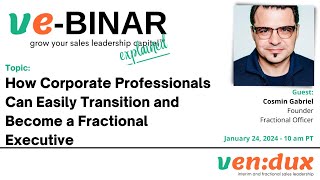
Cosman Gabriel, who held CMO roles at Samsung and GM, explains how to launch a fractional executive business. He recommends targeting B2C SaaS companies with 5-20M ARR, charging retainer fees for 10-40 hours monthly, and using LinkedIn automation and 30/60/90 plans to land clients.
Questions this video answers
January 26, 2024
5–20 million USD annual recurring revenue (ARR)
10 hours per week (approximately 40 hours per month)
Meet Alfred (meetalfred.com) and Expandi (expandi.io)
Within 30 days
Chapters
Good morning, good afternoon, good evening, depending on where you're dialing in from. Welcome to today's Vendux Vibinar. I'm Andrew Miller, one of the partners at the Vendux Group where we focus on helping clients to grow their sales leadership capital. I am thrilled to have Cosman Gabriel today as our guest. I'm going to let him introduce himself in a second at a high level. Kosman is the founder of a growing community of fractional executives based on the Fractional Officer method. It's a program designed for professionals who are looking to supplement or transition into the business of being a fractional exec. Cosman has more than 20 years of experience in the corporate world with the likes of Samsung, Radio Shack, USAA and General Motors. A couple of quick housekeeping notes before we jump in. We'll keep everybody muted for the duration of the webinar. There'll be a Q and A session at the end and you can either use the chat function in zoom or just unmute your mic and feel free to engage with Kazmin directly at the end of the webinar. Also, the webinar is being recorded today and it will be available later today on our socials, our site and on YouTube. So, Cosman, welcome. Great to see you again. Let me pass the floor to you, please, so that you can introduce yourself to, to the audience today. But don't give away too much in the intro because the entirety of the Vibinar today is really, it's about your life as a corporate exec, your transition to the fractional world, the lessons that you have learned and, and now your best practices around operating effectively as a fractional executive with multiple clients. So that's, that's where we are. Welcome and I'll pass the floor to you for that intro.
Thank you so much. Andrew, can you hear me well? Everything good? Perfectly well. First of all, excited to be a part of this v. Banar. First time I've heard of it associated that way. That's fantastic. Thank you to everybody that's joined so far and I'm sure more people will join us throughout this session. But really excited to be here. So you, you took some of my thunder away with the intro there. I have been in corporate leadership and progress, progressive leadership roles like you said, through companies like Samsung, General Motors and so on. So really spent most of my career in the marketing world and so was able to earn my stripes, if you will. Starting off with social marketing, content marketing, expanding to various marketing functions and roles, leading in paid media, creative Operations, et cetera, got to a point where was able to really manage holistic marketing at organizations. And so from a journey, if you will, of how I transitioned to become a fractional CMO, which is my, my specialty after 20 years I, about this time last year and probably a year before that, I was already beginning to get that tingle if you will, of like there's more to this than what I'm doing right now. And more importantly, not that the work wasn't challenging or the companies weren't great companies, but just this, this moment where it's like okay, I want something a little bit more, something with more purpose, maybe something with a little bit more freedom to balance things. And a year ago, as I mentioned, I was with an organization that like many, like many in the past couple of years, found myself in a reorganization and had an opportunity to, you know, basically say okay, it's time to move on. And I found myself where now, what is next? What was the next chapter? And immediately I, you know, from a leadership and goal setting, you know, I said I really want to pursue this idea of a fractional and executive, but it was still somewhat new myself. I didn't want to necessarily be a consultant, even though love consultants, have hired consultants, have worked with consultants. I didn't just want to, you know, take, take something and then provide a recommendation and moved on. I still loved to lead and own and be accountable for, for outcomes at, at companies and organizations. And that's where the, that interesting blend of strategic leadership and being accountable for execution, leading, building teams etc was, was really intriguing. And so I said let me pursue this. And then there was a, you know, two other, two other goals that I, that I pursued as well and really dug in deep, started interviewing, being a marketer, doing market research, talked to a lot of people in my network, have you heard of this idea? Etc and many of them were, were giving me the feedback of cosmen. That is really interesting. You're onto something. And, and so I pursued it, started applying basic principles of okay, I need to start my llc, I need to be able to, you know, what's my prospects, what's my, how do I capture leads, how do I network A lot of the marketing type of mindset, but I was still like how do you, how do I manage this business? Right, because it's a solopreneur service based business and I didn't want to do things will say bespoked for every single client. I wanted to package things that were repeatable, that were solutions and so was fortunate to Sign my first sign on board with the first company as a fractional CMO within 30 days. And, and that's usually how that works, right? When you decide to go on your own, either a, you've already been doing some, some project based work or some consulting work or you know, somebody that needs something or, or somebody within your network immediately, you know, gives you an opportunity, right? And so you get that, that bug, that taste. But the reality is how do you make that a business? How do you make that be more long term, right? And so within 30 days, signed on board. And from the start I wanted to document the experience again. Going back to like all of the conversations that I had with all of my peers and mentors, etc. To, to document how to do this successfully so it can be repeatable and manageable not just for me, but you know, anyone that, that wants to be a part of that. And so that's what I've been doing the past year on a full time basis. And also during that time, about six months ago, launched fractional officer. So fractionalofficer.com where just like me, I was looking for an opportunity to really skip months of trial and error because the reality is that's what we face a lot of times. You know, just so much time and even money on figuring it all out. And so I said, how do I package this to make it easy for any corporate professional to be able to make that transition, to start and have that foundation to get that first client and move on?
There's a lot in there that's, that's a great intro. I know. You know, we have now approximately 700 executives on our sales leadership roster and many of them who are relatively new to the business of fractional. I know that there's, there's often a challenge where they get their first client and they dive in. So even though it's, it's a, it's a fractional relationship, it's not full time, somehow they, they really dived in. And that means there's, there's no time or limited time to look around the corner for their next, for another client or their next client. And so I'm, I'm curious, you know, in when you first started, somehow you had lights that went off in your head about documenting the process and you know, even beginning to think about repeatability and scalability from day one. So how, you know, what, what's your, what's your advice or your insights into helping people to, to do that more effectively.
So, so the question is, you know, once you jump in. How, how do you, before you jump in, how do you really ensure that there's long term success in a way? So from, from the beginning, even with my, my first client, again with the mindset of I want this to be more than just a project, right? Because again, you know, there's a lot of resources out there on what's the difference between a fractional executive, a consultant, et cetera. Right. And so as a fractional executive, I'm a part time executive for this company and I, the difference for me is I'm locked into a certain amount of time right now. I am not hourly based, I'm retainer based. So that's the solution part. And so before I even approach the first client, I, I said, okay, how do I ensure that there's a solution discussion where I'm driving value versus let's explore the scope and then I'll give you a quote, right? And so when I had the discussion with my first client, that's what I did. I said, okay, first of all, maybe you're not ready to commit yet to me and you just want me to do a standard assessment and provide a recommendation, AKA a consulting. Right? But that role was, or that that assignment was intended to help me say, okay, either a, you can do it or B, I am available for, I am available for you to hire me as a fractional executive to see it through. And so when I presented that to the, the c, My first CEO, he's like Cosmon, like, I don't even want to do that. I, I'm going to get that in the committed relationship. I'm like, you're getting it now, right? And so I started at that commitment and in my case I committed myself 10 hours a week, so 40 hours a month. And it allowed me to have that freedom to balance the, the first, the first company have potential for a second company, right? And then still leave me plenty of time to build the business when it comes to how do I, how do I begin to start networking on LinkedIn? How do I begin to start looking at automation of leads and prospects, how do we get all that set up and, and actually have time to have time with my family and pursue other interests and hobbies. And so I quickly bucketed that type of work into my calendar and, and that, and quite frankly, it wasn't too much different than my corporate job. And why do I say that? When I was at for example, usa, I was managing multiple businesses within the same company. And so it was a similar structure and set up and so I just took that corporate experience and applied it and broke it up into my work week to be able to be effective and not just think the first project, but think about it going in, planned for more.
Yeah, that's interesting correlation there. You know, managing multiple processes in businesses and teams or geographies in the corporate world and using those lessons in, in the fractional world. So to that point, you know, you've used the word leadership a couple of times. What, what's your experience in establishing credibility as a leader now with your fractional clients on a fractional part time basis? Issues, challenges, lessons learned, insights.
Yeah, I think from a credibility perspective I approach, I approach the fractional CMO role like I would approach it as a CMO role for a full time company and you know, even discussions with the, you know, CEO that, that I work with. You know, he said, Cosman, like I could never afford you in a full time standpoint. Right. But I can afford you in, in this way. And I, I promised him, I said, you know, for me I'm going to bring you Fortune 500 executive leadership to your small business. Obviously not without the big budgets and everything else, but I'm coming in and applying the same standard. So when I come in from a credibility standpoint, I'm putting together 30, 60, 90 day plan. I'm interviewing all the different stakeholders that I need to have relationships with. I'm looking and assessing my team and I'm putting in one on ones, right. And I am approaching it as a leader within the organization. And also what I want to clarify here, where I think a lot of fractionals struggle with and they're the beginning is small businesses look at fractionals as also we'll say functional professionals. In other words, I'll take marketing for example. They want to build, they want to build a CRM or a funnel, right? That's their problem. And, and they're expecting me as a fractional to come in and actually build that. And so I was very upfront with the CEO from the very beginning. I said, hey, you can pay me, you know, $10,000 a month to build you a funnel or you can hire me to get the right person at a quarter the cost and be able to expand 2, 3 other resources to get you even more than that. Right? You're, you're hiring me more than just for the tactic. And quite frankly, if they're like I just need to find somebody to build me an email funnel, I say o go to these marketplaces like Upwork and Fiverr and all These other ones and hire yourself one for you know, 20% of what I'm going to charge you.
Right.
But you will not have the same long lasting impact. And so that's the type of credibility and the leadership presence that is important. When you begin a relationship as a fractional.
And, and when you can really implement the, those, those kinds of practices as a leader, it also allows you to scale more effectively, do more with that client and take on others.
Absolutely. And in the end as an executive, right, it's the art of delegation. Right. You're establishing the strategy, the vision, the direction. You are managing outcomes and relation and relationships but you're also leading the team and delegating to ensure that we hit those goals and objectives or whatever the outcome is that we're looking for.
So in, in your many years in the corporate world, you've been dealing with multimillion if not billion dollar budgets and initiatives and issues. Do you have any, you know, transferability and insights and perspectives on. Well, I, who, who are, who is your average client? What, what size of a client?
Yeah, yeah. And that's very important. Yeah, that's very important. When you begin and you know the fraction officer method I, you about, you know, what is your niche, what's your brand, you know, what's your value prop. Etc. So it's very important to, you know, define your niche. So in my case I'm a fractional CMO for B2C SaaS tech companies and I focus, you know, heavily on, you know, ensuring that we improve monthly recurring revenue and building effective teams to get there. And the types of companies that I target are 5 to 20 million dollars.
5 to 20 million in revenue.
That's, and, and that's, and that's important, right, because there's some fractionals that, that choose to be part of the startup world. Right. And there's different models there, there's equity models, you know, there's other, other revenue models for the fractional. I choose to be more in that small business because from a core value perspective I want to be able to make a bigger impact, have a greater sense of purpose, of knowing that I'm able to impact that company organization for the short period of time that I'm there for. Long lasting legacy.
So as a marketing professional, how do you get your clients?
Yeah, but I just saw a pop up here on the, in the chat. So it is 5 to 20 million ARR. Annual recurring revenue. Yeah. Yes, I'm, I'm sorry, can you repeat the question quickly?
Sure. So you're, you're a marketing professional, what, what do you do to, for, for your business development to, to develop your pipeline of prospective clients?
Yeah, great, great question. What I'll do is I'll, I'll try and bundle that into some best practices from, you know, starting up and you know, I'll call them mindsets of a fractional when you're looking to transition or you're even looking to scale. Right. So to, to me it's important and what I've seen success and I've helped others is define clear solutions. Right? So if you go to. I actually have a fractional CMO website called +cmo/cmo.com and on my, I have a solutions where it's very, I have four clear solutions and each one of those have a range of cost associated with it that is depending on, you know, the scope and the industry and the conversation. But I'm very specific about the solution and not just what I'm going to get, but more importantly what the company will get because there's a lot of demystifying on the, on the behalf of the companies. Companies still don't really understand where and how to use a fractional and that's a whole other topic. But this way it helps them understand the value, the immediate value they're going to get. So define clear solutions. Another thing from a marketing perspective, I leverage LinkedIn, automating LinkedIn heavily and with so much AI tools out there, that's something where I've implemented from the very beginning and helping me automate introductions and connections and me engaging as a human to personalize the, personalize the responses ultimately to get, to get the conversation of a meeting booked and conversations going, et cetera. And so from right now I've probably engaged with 30 to 50 people just being on this conversation. And I think some people on the call here may know what I'm talking about or may have already set that up. And if you haven't, there's tools like I personally am a big fan of. It's called Meet Alfred. Meet Alfred. I mean M E-E-T-A-L-F-R-E-D.com and then there's also expandee E X P A N D I dot IO So Meet Alfred and expandi IO are two great tools and there's so many others out there, but those are, those are two that I highly recommend to be able to autumn begin to build campaigns where it engages automatically with either, you know, targeted individuals, you can select certain type of industries, etc. But that's a big automation for me because that's where the networking can begin. And I'll put a disclaimer here. You have to be very careful in the language because I am annoyed of people automating things to me and I'll be transparent with that. But at the same time being able to find that balance of, you know, introducing yourself and then adding the human component of, of replying as soon as possible. So that's the second. Another, another thing I would, I would recommend is this idea of like a long tail mindset. So you know, if anybody understands marketing, search engine, right, there's, there's this long tail where you produce something and over time, right, it yields, it yields fruit. And so to me, any type of content marketing that I do, any type of conversations, networking, meetings, etc, it's a long tail mindset, right, where it may not produce fruit now, but it will in the future and it has. And then blocking out my time to be able to manage everything is really critical. And those are some of the initial ideas as a, as a marketer to begin to start building the business.
You couple questions and I want to open up the floor to other questions. One is you recently wrote an article about the top 10 top 10 challenges for fractional executives. So I'd love to get some insights into maybe what the top three challenges are. And then, then I'm going to ask you to just share with us a little bit about the fractional officer method and what's, what's under the hood.
Yeah, totally. I'll, I'll try and be really quick to give us time for questions. So yeah, you can take a look@fractionalofficer.com and slash post. So that's where I have my blog. But more recently, especially the beginning of this year, I've really leaned heavily on, okay, we, we are beginning to define what a fractional it is, how a fractional works. But the reality is there's so much more and more importantly for companies to understand the value and there's also challenges that there's a lot of pluses of being a fractional, but the reality is there's a lot of struggles. And so let's just be transparent and open about that and more importantly, let's provide solutions and work through that together. So some of the key challenges that I've seen, top three, this idea of balancing multiple clients, this continues to be a question that I've, I've seen and heard and been a part of where, you know, it involves blocking out time and involves how Do I build my business? There's so many components where once you get into that, let's say two to three companies or you know, maybe you'll have one company and one project assignment but once you start getting it at two to three, it starts to be a big time focus and it then it reduces your potential to increase and grow your business before, after that. So that's a big one. And then I think you kind of mentioned this and we talked about it establishing that authority and credibility. So and more specifically when you, when you begin, because one thing that I saw when you know, I worked eight years at a company and a lot of my LinkedIn network and a lot of the people that I was close with, I no longer just you're busy on your, on your company. And so you need to start re establishing that authority and credibility and so many questions and challenges there. And then finally when you do begin to start getting into companies as a fractional is how are you adapting to different corporate cultures? Because you're, you're not, it's not just my business, but you're serving multiple businesses with multiple cultures. And you know that that's a challenge. I see it as an opportunity where it's shared, it's a shared learning across those different companies where you can bring some, some additional value to companies that they may not be aware of. Right. So but those are some of the top three and you know, the rest are, are listed there in the blog post.
I love that point about the cultures. When you're working in a multi billion dollar corporation, there's generally one culture and then you shift over to the fractional world and you are dealing with all colors, all stripes, all different kinds of cultures and that ability to balance on the fly at the nine o' clock slot. You're, you're on one call with one culture and then two hours later completely flipped to something else.
Absolutely. You'll be dealing with a CEO that you know, gung ho. You'll be dealing with, you know, a business owner that doesn't know what he's doing. Right. There's so many variant variables there. But that's where you know, there I see it as an opportunity. They're hiring me as that executive leader to, you know, have those soft skills to be able to drive value.
There. There's a comment here from our friend Neil, commenting to your point about automation on LinkedIn. He says no automation at the executive level in my mind. What, what, it's an interesting point. What, what are your thoughts on that?
Let me look at what was. So not automate.
No, automation at the executive level when reaching out, doing business development and kind of building the network.
Yeah.
So your experience with automation, to me.
To me. So I see that automation almost as like building awareness. Right. Where you don't, you know, are billboards annoying? Are ads annoying?
Yes, they are. Right.
If you do them, if you do them right, it captures your attention. Right. And so that's where I think it's. You need to find that balance of how you introduce yourself. Right. And, and, and, you know, we can, we can talk a lot about that, but absolutely, there's that mindset right away where, you know, there's some best practices. You don't want to do. Your introduction to be like eight paragraphs. That's an automatic delete and block for me. Right. Like, so many things going there.
Yeah. Would anybody like to open up their mics and ask or engage with Cosman directly? Cosmo, I got. Yes, there's. Hi, Tracy Cosman.
Thanks for sharing your information with us today. I had a question. I would imagine with the growth of, and the level of interest in it, that community building is coming out of this. And I would imagine that as you put a methodology out there, that it's attracting people who, as you mentioned earlier, want to talk about all the cultural forces that are perhaps hitting them as they enter this kind of work scenario, and they may or may not be ready for that. So I think it's a natural community builder. Clearly, it's probably early stages for you, but I'm curious where you'd like to see that headed.
Yeah.
So, yeah, part of the fraction officer solution experience, like I call it, is having a private community. Right. So once you enroll, there's a private community around that, but there's also public, you know, public community. So I actually have a fractional officer group on LinkedIn that's open to anyone. And that's a great starting point from a networking and idea thought generation. And then there's just a. I'll call them the more established communities out there. And some of, some of. You may already be a part of these or have heard of it. But, you know, communities like Fractionals United, you know, that's one of the, the largest ones. And you know, there's. There's others out there. Right. I think it's called fractional connections. There's. There's a few communities out there where you can, you know, quickly join and, you know, just start observing. Right. And doing your market research on, you know, connecting with others and your fractional Function if you're a as CFO or others.
Thanks.
Great question. Neil is also mentioning Fractional United and I think there's a two there, Fractional United and Pavilion.
That's great. Yeah.
Cosmon, have you, have you encountered the situation where you have clients that are perhaps dangling carrots or asking you directly to join them full time and would you do that or, or not and why and what would be your considerations.
Going back to, you know, when I first looked at the opportunity of being a fractional executive about a year ago, that was my priority. My second was if there is a full time company that like matches my core values and the culture etc, I would consider it. But for now I being a year into it, there's just so much more freedom in doing it this and doing a fractional work that it's going to be extremely hard to be on a full time level. But the options are always open and it's been, yeah, it's always been on the table.
Yeah. So if you had to do it all over again, you know, now you are, you are your corporate self a couple of years ago, is there anything you would do differently? Anything that you could optimize in terms of your processes to, to get to where you are? Yeah, effectively.
Yeah. I, I think I would have, I would have started with having at least two to three companies that would be interested from the gate. Right. I was put in this situation like many others where either I don't have an option or it's going to be a while until I find my full time role. So. Right. But if you're looking, if you currently have a corporate role, you look to build it, look to build some interest up front and let's say that you don't have, you know, you're not in a full time role and you're exploring and transitioning, really focus on those initial network and connections that you have and, and just the personal touch saying hey look, I'm willing to help out and get those first use cases, get those first testimonials in place because those go a long way.
Yeah. Excellent. Anybody else want to chime in? If, if, if not, I am going to pass the floor to you again, Cosman, for any parting thoughts, words, words of wisdom. You, you've provided some resources about your, your blog and your sites, but what's the best way for people to get in touch with you and you know, any other thoughts about your business and offering for anybody on this call today or listening to the recording down the line?
Yeah. So you can find me@fractionofficer.com I'm highly involved on LinkedIn. Like I said, there's a fraction officer group community there where you can just search for the group and please join. That's public and that's actually, we're about, at this, at this moment in time, we're almost 500 there. So it's growing significantly and then you know, anywhere on social Cosmon, Gabriel fractional officer and for, for this initiative and actually the beginning of the year here I am actually offering a 25% off the fraction officer method and I've created a code new u24 so n e w the letter u24. So if you use that discount code, you're able to get 25% off. It's actually the first time in, in the year that I've done it because towards the end of the year and early this year I've noticed that there's such a high demand on it. I just want to make sure that it's, it's available to as many people as possible and you know, it's priced in a way where it's, it's, you know, it's affordable and you get in and it's actually created by a digital avatar of myself which is another component where I use a lot of AI digital tech in the framework and the lessons which allows me to quickly update because the fractional industry is evolving, I'm able to quickly update it with relevant content, resources, etc. Without the additional cost of producing traditional content. And so, you know, would love to see folks here on this, on this webinar or you know, those that are watching, join up and of course email me@cosmanctionofficer.com Wonderful.
Well, it's been a total pleasure. It's eye opener at many levels. Great to hear and learn from your experience. It's really valuable and I, I love the journey that you have been on. So thank you for your time and insight, pearls of wisdom that you have shared everybody here and, and in the future, thank you very much for dialing in and listening and being part of our webinar today. Have a great rest of the week. An awesome 2024 Cosmon and everybody else and we'll talk soon. All the best. Thank you.
More from Henning




ve-BINAR - The Revenue Tornado Methodology: How 3 Power Sources Create Exponential Growth


ve BINAR: Executive Cloning: How AI is Reimagining the Role of the Fractional Executives




veBINAR: Unlock Client Value: Why Compliance is Crucial for the Startups You Serve
