ve BINAR: How Do You Find the Perfect Fractional and Interim Sales Leader
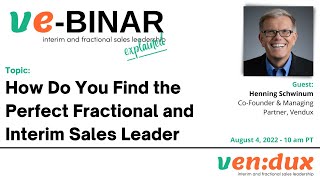
Andrew Miller and Henning Schwinum explain how to hire a fractional or interim sales leader. Skip the traditional job description and focus on what problem you're solving. Use objective criteria like industry fit and change-management skills, then tap a pre-vetted roster for faster matching and structured interviews.
Chapters
Very good. All right, thanks everybody, for joining. This is our August 4th vibinar. As we say, the topic is how do you find the perfect fractional and interim sales leader? It's a great topic. We may have to do this again in a few months, so welcome. My name is Andrew Miller, one of the partners here at the Vendux Group. I'm here with Henning, the managing director, one of the founders of the company. Really excited to have this conversation today. So, just a couple of housekeeping notes. We're going to keep everyone muted for the duration of the webinar and then we've got a Q and A planned at the end. So you can either send in your questions through the chat function here on Zoom, or we'll unmute everybody at the end of the webinar and feel free to chime in and ask your questions directly and perhaps, you know, we can, we can continue the conversation in that way. So that's, that's, that's the basic housekeeping. So. So now onto the topic of today's webinar. Henning, great to have you here. You and I work all day together with clients and they're very typically managed, sorry, narrowly scoped assignments, that's on the one side. And then we work with our executive roster to find the perfect match. So from your perspective, why are we even talking about this today?
Well, you already described what we're doing all day, and we do it because we wholeheartedly believe that the perfect match is the recipe for its success in this phase, bar none. And I know others who think differently. And as a sales leadership practitioner, I can relate to this. And I can take this very personal because I have, as you know, 25 years of sales leadership experience. Chemicals, SaaS, professional services, locally, globally, teams of one, teams of 100. In many of my skills, I believe, travel well and, and I feel I can step into pretty much any sales leadership role and be successful. And when I mentor companies, you know, I work with the companies that represents all different forms of selling and they all benefit from my experience. But that does not make me a perfect fractional or interim executive for every scenario because there are different factors that come to play.
Yeah, for sure. Yep. So then to that point, what makes someone the perfect fit? What are the right success factors and the ingredients for this key question.
Yeah, we can. So we can take this broader and we can start by looking at the things that I believe are not the right success factors before we then talk about what are the ones. And, you know, on this, on the Side of what is not a good factor. There are a few that I've come across in the last three years that I believe don't serve well to find the perfect fit. The first one is location. In today's remote world, you know, being able to work from a specific office location is not a success factor. There are maybe a few cases where it is. If you have a local business that focuses on a particular metro area, you might want your sales leader to be local if they meet all the other factors. So location to me is not a success factor. Another one that I've seen out there is being the friend, the friend of the owner, the founder, the CEO. In my observation in those cases, objective criteria quickly go out the window and friendship is the only thing that counts. Another one that I've seen that I don't think is by itself a good factor is what's labeled culture Fit. My thoughts are that if you are looking for to hire permanently long term into a company, culture fit is absolutely a key criteria. And on the other end of the spectrum, if there is a very obvious misfit to the culture, then that's someone you want to exclude and not bring on board, no matter what the assignment or the engagement looks like. And for the ones that we're dealing with, the temporary part time, project driven, problem driven engagements, I would always look at the long list of objective criteria first. And then if you have multiple candidates that all check all these boxes, then you look for culture Fit.
Yes. Yeah, that's a great point. There's lots of points what not to look for and there's also points what to look for. So you know, in the past, in our past webinars, we've brought in third party research or we've quoted from research to answer some of these questions around fitness. From your knowledge or perspective, is there any research or any particular third party perspectives that have looked at this question of the perfect match in a fractional sales leader?
To my knowledge there isn't any scientific research or at least none that I'm aware of. And anybody listening to this webinar now or later in the recording, if you know of scientific research, please share it because I'd love to include it into our operations here. But there are others out there in this space that have put have put forward their research and their view of how, you know, what, what is the perfect fit? What are the right success factors? And there is a group in the Netherlands that has done fractional interim placements for over 20 years. They're called Van der Groep and Olsterholm, but I guess the name is sort of secondary. But they argue that success factors of any fractional or interim executive assignments are primarily the result of matching the right leader. And that sounds very much like what we believe in. And if I look at the criteria that they put out, the top three, the first one is experience in and knowledge in the markets, in the technology and the product that the company works in. And that's something that I agree with wholeheartedly. And the only thing I would do is put a little qualifier in that says it's the type of technology, the type of product, because it's not so important that it's an exact match. For example, if you're in the CPG space, whether the CPG product you're trying to sell is a smash or a drink is really secondary to the process of placing it through E Commerce, placing it into retailers. And so when we think of the type of products, I like to think of them as groups like services, professional services, for example, durable goods, commodities, direct to consumer goods, the CPG products that I mentioned before. And so that experience is absolutely relevant when it comes to industry sometimes, or it is a double edged sword because sometimes it's absolutely necessary for the success to have had the experience in that space. But sometimes you might want to look for someone that doesn't have that molding, that doesn't have the blinders of having worked in an industry for a really long time. We made a placement in automotive aftermarket manufacturing and they brought game changing technology to the table. And if you bring somebody in that has worked for 30 or 40 years in the space, and you know that it's a very conservative traditional industry, you know, you, you set yourself up for failure and you might want to consider looking outside of that box, you know, so that's one of the criteria that this Dutch group brought forward. Two others are to have a balanced and resolute personality. And those are definitely two very important criteria. And you can add a whole lot more to that list. What personality traits does a perfect fit need to bring to the table? Things like being a great communicator, a problem solver, adaptability, flexibility, positivity. And a third one that they put on their list is that you have an awareness of organizational politics and you're competent in both the leadership as well as your social skills. One that they didn't put on their list that I would add from our perspective, because we put a lot of emphasis on it, is experience in the type of sale that's being Done. And components to that are things like how long is the sales cycle, who are the decision makers, what's the deal size, what is the deal structure, Is this a one time sale, is it a one year subscription, is it a multi year agreement? Whether it's run through an rfp, RFQ process is another part of the type of sale and all these components together define that. And part of our onboarding process for a fractional or interim executive onto our roster is to look at the type of sale or sales that an executive had been responsible for in the course of their career. And that's something that we uncover not through their LinkedIn profile because that's. Or their resume because that's typically not in there, but it's really part of that detailed onboarding process that we go through with our executives.
Yeah, that's. Yep. Great. So it sounds like the successes that you're referring to or talking about there is based on the perfect match. So when you're looking for somebody that's been there, done that, how do you find, how do you get there? How do you actually find that executive?
Yeah, well, we, as you know, Andrew, we call that the scope that we work on together with a client in a more general fashion. What it means is that if you're the owner, the founder, the CEO of a business, you define your needs, the goals that you want to accomplish, the specifics of your sales structure that we just talked about, the nature of your product, your target markets, your target Personas, and if you put that all together, then there is most definitely someone out there who has worked that specific scenario before. And it starts with a scope. That's the starting point for this process. And the scope is not the same as your traditional job description that is used in executive recruiting when you look for a permanent hire. Because the needs that are described in this scope typically arise from a specific situation, a problem. And it's colored by the very immediate short term context in which the executive will operate. Often these moments call for a very specific skill set of reprioritization of those of these activities versus more regular business activities. So many of the roles that we fill have a focus on change management or on hiring or on evaluating and possibly letting go individuals. And so these would be things that typically don't appear in a job description, but they do have to be part of, of the scope document because that's the starting point for finding that perfect match.
Yeah. And presumably even in, in an interview session with a prospective client to come up with that scope document, it's Sometimes not always evident. This, this information needs to be drawn out. So, but perhaps we can come back to that. So now scope document is in place or a scope is in place, then what, what happens on the other side of the table to actually find the right person?
Well, when we talk to business owners they often, their point of comparison is their, their traditional, the traditional executive recruiting process that most people have and what we do is definitely not a hyper fast version of that process because we work with executives that are, that bring this great experience to the table, that are independent by choice or part of that gig economy by choice and they are eager to tackle hands on these projects. And the way that we in particular operate is that we have a pre vetted roster of executives. So we don't go out and scout through LinkedIn to find the right person, but we focus in on the roster that we have. In a more general world, in a more general description, I would say that if you're a business owner, a founder or CEO, you have developed your scope and now you're putting this out there either through an agency or in a different community setting on a marketplace or a platform. I wouldn't expect to see a whole lot of resumes come in. And it shouldn't be that you spend a lot of time interviewing. We're looking for a problem solver here. The problem is imminent and you want the solution as quickly as possible. So you don't want to spend six months interviewing 100 different people. And if you find that perfect match, be thrilled and move on and get that person on board. Don't do what I've seen in executive recruiting happen, which is you always think that the next one is just going to be better. And so you always wait and wait and wait. That's why you establish your criteria at the beginning. 5, 8, 10 factual criteria that you're looking for. And if that person checks all the boxes and it's not a cultural misfit, bring him in and have him go to work. Him or her go to work.
Strike while the iron is hot. So I've got a couple more questions, Henning, but in the meantime I'd like to just, just put out there to the audience. If you've got some questions, you've got some comments, please feel free to start sending them in through the chat function here on Zoom or shortly. When we get to the Q and A session, feel free to chime in and ask your questions directly. So Henning, I just want to get back to. So now you've done the work on Finding that perfect match. And then what?
Well then there is an interview process and in an ideal world you establish beforehand who is going to interview the person. Have a streamlined process, don't make this a 12 person committee, but rather identify the key people that will have to interview and those are typically those that work directly with the individual and manage everybody else and their expectation in that they will not be part of the decision making process. Simply put, it's a moment for leadership. If you're the CEO or founder, you take responsibility for the decision and then move on.
So this sounds almost too easy. And we know, we recognize there's not going to be 100% success among every match and among, among every fractional executive situation that takes place. So what could go wrong? What does go wrong? What have you seen where you would wave yellow or red flags?
Well, a lot can go wrong. We're dealing with humans after all. And like in any human interaction, there are two sides to the story. Right? You know, after an unsuccessful engagement, what we hear from executive often is, you know, unwillingness of the organization to change, unwillingness of leadership to change or setting of unrealistic expectations. And on, on the business owner CEO side, you know, lack of meeting their goals that they set for the executive or not seeing a result or an impact. And frankly that doesn't sound too unfamiliar to those who have done, who've worked in HR or who have hired full time staff. I mean those are some of the exact same reasons why full time employment doesn't work out. Now that end though, when you think of the average tenure of a sales leader in a growth startup scaling business, it's 12 to 18 months. And often that exit after 12 to 18 months is not a planned one. And so with that in mind, in my observation, the rate at which fractional executives successfully complete their assignment is far greater than what I've seen in permanent hires for sales leaders in the startup world.
Okay, cool. So perhaps a final question for the webinar at least. So if I'm the founder, the CEO, a business owner, I'm going to have a lot of options to find a fractional or an interim sales leader. My network, the marketplaces, or through other agencies like Vendox. You know, in this, the final question of the webinar, can you share with us from your perspective why Vendux might be the right choice for a CEO, founder client?
Yeah, let's beat our own drum here a little bit and use this forum. We're a matchmaker, we're an agency. We are boutique in the sense that we provide white glove service. And I think there are a handful of reasons where it makes sense for a founder, owner or CEO to consider vendors. The first one is focus. We only do fractional and interim sales leadership roles. We don't do CTOs, COO, CFOs, CIOs, CTOs. We do none of those roles. Then we have expertise, subject matter expertise. The team at Vendax, we're all sales practitioners. Sales leadership practitioners. You know, I spent 25 years in sales, as you know, and the same is true for all the other members of our team. And that allows us to ask the right questions, relate to the answers and, you know, scope an assignment with a client, vet executives in a way that allows us to then place the right person. We also have a technology component in the center. We started off with off the shelf solutions and none of them worked. And so we built our own algorithm and our own matching platform. And that investment allows us to facilitate a near 100% success rate. In finding the perfect match, we set very detailed criteria together with the client. Something like selling custom software, million dollar deal size, property and casualty insurance, 12 to 18 month sales cycle on an RFP RFQ type process. Those are criteria that describe a sales scenario. We put them into the software and the software delivers us a ranking and scoring of executives. And we can literally go in and pick the top ranking executive. And that is the perfect fit. Just for grins, there is no swiping right or left with our software. And I say this because when we searched for the right tech, it was suggested at one point that we should look towards dating sites as an example. And so I did the math and one of the major dating sites out there, their success rate from date to marriage is 0.00004%. That's not good enough for what we're doing. And the last thing, again, beating the drum for ven ducks. Our roster of executives has grown to over 400 since our founding. And so collectively, that roster covers virtually every industry. Every product type, every sales scenario, every type of decision maker, every deal structure. And at this point, to our knowledge, we have the largest talent pool of vetted, interim and fractional sales leaders in North America.
Very cool. Good. Thanks very much, Henning. Fascinating. So I invite questions from the audience. Now we're in our Q and A session. Feel free to send in questions through the chat function or. Happy to have you come on unmute and ask questions and engage directly. Maybe just to kick things off, I've got a question about a scope so you're working with a prospective client and you're, you know, you were referring to that scoping process where a list of very specific criteria needs to be derived. How often do you find that a prospective client has those criterias clearly defined versus the times that you actually have to work with a client in a bit of a consultative way to come up with a proper realistic scope for, for him or her and that particular environment?
I think you'll like the answer. It's always and never. It is always because they all have something in their head and maybe in a traditional job description. And it often says, you know, 10 years of proven, progressive, progressively increasing responsibilities has to be a team player, great communicator. Now those are things that are important, but they are not objective criteria. This isn't something to look for and it is something that has a highly subjective component to it. So they always have something like this either written down or in their head. What they never have is what we're then uncovering in the scoping conversation with the client, which is those details of from a sales perspective, where are they today? How many clients do they have? What's the average deal size? What's the length of sales cycle that it's taken them, that they've used to find those clients? What's the lead source? What's in place from a marketing perspective? How are they messaging today? What is their icp? Who are their target Personas? Those are the things. And then of course, that status quo. Then where do they want to go? And not in 10 years. We're not asking about the exit vision of a unicorn because that's what all startups want to become. But from a fractional assignment perspective, it's really very important to know what do you want after the first month that the executive is on the assignment? What do you want the result to be? Or three months in, or six months in? Those are the goals that a fractional or interim executive works towards and helps a company develop. And those scope criteria never exist prior to a conversation.
Yeah, yeah, great insight. Here's a question that's come in. It's an interesting question. So you're having a conversation with a prospective client and you're discussing their needs and requirements and environment and so forth. What do you need to hear that tells you, oh, this is the right situation for a fractional sales leader as opposed to something else, like full time, for example.
Yeah, that's a great question. And it's, I think it's best answered through examples because there isn't Like a checklist of five things to look for. You know, the number of direct reports for an executive is something that you know, in my mind is important. If you have in most sales scenarios, seven or eight salespeople in an organization that requires a full time sales leader and so the fractional executive really isn't an option, then something, you know, there has to be the interest and willingness to invest in sales, that to me demonstrates readiness for it. If I hear a startup founder talk about the fact that they have no funds and that the only way they can get anyone in sales on board is on a commission only type agreement, then to me they're not ready to invest in sales. So those are two scenarios that happen frequently. And then we look for other solutions. Then it might be more a mentorship type deal where you bring in a mentor to help the founder generate some sales so that he can get institutional investment on board and then be able to contract a fractional sales leader.
Yeah, great. Here's another question that came in about time commitments. So how you know, in a conversation you're having with a prospective client, how is it determined whether a fractional sales leader is going to come in for a day, a week or three days a week, or something in between or more?
That's another great question. And in my experience now for the last three years, scoping engagements, because that's part of that scoping conversation. You come at it from different angles. There is obviously, if you think of a sales leader coming in and having an impact, if all the client can afford is one or two hours a week, then that is not a fractional sales leadership engagement. That's more like a coaching, maybe training type engagement. We can do this. We have done those before. But that is sort of at one end of the spectrum. Then when it is very clear that the need for the executive and need driven by the goals that the business wants to achieve, requires the executive to be there 60, 70, 80% of the time, then you may as well want to make it a full time engagement. It can still be a contractor, but you want to make that full time. And that's driven by the speed with which the business wants to achieve the goals that they have. Sort of the space in between the question, is it one day, is it 12 hours a week, is it two days, is it 50%? That is often something where we, we set some expectations with the level of investment that's required. Because in that space you could say whether you spend one day or two days, two days helps you get twice as much done. And so you can move twice as fast. And if that is not a requirement, if the plan and the goals and tasks at hand can be achieved with one day a week, then the decision by the business and our recommendation would be start with one day a week. The last point to answer this question would be what we're often looking for is the starting point for the assignment. Because as the assignment progresses and the executive is on the inside of the company, talks to the, to the owner or founder frequently that often results in changes. And that could be a change where an assignment that started out at 50% is cut back because it becomes clear that over a longer period of time, that amount of investment is not required or it gets extended because the, the business owner had tried to find a low risk entry point, but now the executive is there, he or she sees the impact the executive makes and now they want more of the good stuff that we've brought to them.
Yeah, yeah, that was very, very insightful. Maybe one more question to your point point. You just mentioned something about a low risk entry point. So to what extent, when you're speaking with a prospective client and coming up with a scope and understanding their situation, to what extent is, do you feel that a CEO, a business owner, is looking for a try before you buy situation, where in the back of their mind they're thinking, you know, I really, I do want to bring somebody on full time, but let's start with a fractional sales leader, you know, go in two, three, four months, try before you buy, and then if it all works out well, we convert to a full time situation.
Well, as you know, it happens. And in order to make sure that we bring in an executive that's actually available or interested in that conversion, it's important that we make that part of the scoping conversation and understand in that context that that ultimately would become a requirement. Where we would say as a requirement, we want somebody that, if things work out well, is available to come in full time and maybe even become a full time employee of the company. So like so many things, it needs upfront transparency and clarification. Otherwise we'll bring somebody in. All of a sudden the business owner becomes interested, but the executive, from the very get go, doesn't have that interest. So managing expectations is I guess, the keyword here.
Excellent, excellent. Good. So let's see if there's no other questions. I think in the interest of time, we will wrap up today's webinar. I want to thank everybody for participating. There's some really great questions here. Our next webinar is next month. Watch for that. In the meantime, if anybody would like to have a conversation on either side of the table as a prospective business, as a business owner, as a CEO thinking about bringing on a fractional sales leader or if you are an executive and you're a sales leader and you want to have a conversation about opportunities, about possibly joining the roster, then Please, we're@vendux.org Feel free to reach out and schedule an exploratory call. But in the meantime, thanks for participating. It is kind of the end. It's August, it's summertime post Covid. I know lots of people wanted to be here today but they're on vacation, off the grid. But we will have a recording of this and you folks for being here, thank you very much. Great, great to have you. Great to see you and hopefully we'll see you again next month. Thanks Henning. Thanks for your time and insights.
Thank you Andrew. And thank you everybody for joining us.
More from Henning




ve-BINAR - The Revenue Tornado Methodology: How 3 Power Sources Create Exponential Growth


ve BINAR: Executive Cloning: How AI is Reimagining the Role of the Fractional Executives




veBINAR: Unlock Client Value: Why Compliance is Crucial for the Startups You Serve
