ve BINAR: How to Get a Meeting With Anyone
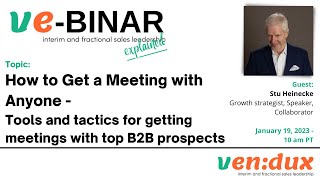
Stu Heinecke, a Wall Street Journal cartoonist, shows how personalized direct mail and unusual gifts get meetings with executives who ignore email. His foam-core cartoons and custom objects outperformed standard outreach by 18x, and work best when you're targeting a small number of high-value accounts.
Chapters
Good.
Let's get started. Welcome everyone to this webinar with for anyone in sales with a really important topic, how to get a meeting with anyone. We will be recording this webinar and posting this later on our website and sharing it by email. We will have a Q and A at the end. So I'll ask everyone to keep their microphones muted during the session and then unmute for the Q and A. Or alternatively go and post your questions in the chat and we will monitor that and ask those questions later. And without further ado, I'd love to welcome Stu Heineke, who is our guest today. Stu was named the father of contact marketing by the American Marketing association. And by virtue of being the father of a marketing strategy, he is a growth strategist. He helps companies have an unfair advantage to get more C level meetings. He has authored two books and we'll touch upon that in the course of the webinar. Three books. I apologize to him. And he's an active editorial cartoonist at the Wall Street Journal. He lives in Langley, Washington, which is a town on, is it Whitbay Island?
Whidbey.
Yeah, Whitby island, just north of Seattle. And the beautiful, obviously a very beautiful part of the world. So welcome Stu, to, to this webinar.
Thank you so much. Great to join you.
Honored to have you so in, in. In the lead up to this webinar, we, we, we use the phrase if you can't get a meeting, you can sell. And I remember that notion myself very vividly from my days at Anova Dex. Because as a sales team, we collectively felt that once we were able to get in front of a client, our chances of closing the business were actually far greater than before. Obviously I experienced this firsthand. But to you, the question what led you to, to write your first book, how to Get a Meeting with Anyone?
Well, oh my gosh, long time ago, I was just starting my career and yeah, I wanted to create direct mail campaigns with, for publishers, for magazine publishers, all those, you probably remember all these mailings that we used to get from, from all the different magazines asking us to subscribe. The fact was they were some of the most sophisticated and biggest users of direct marketing at the time. So I wanted to mix cartooning and direct marketing and personalization altogether. And, and I was fighting a headwind from David Ogilvy and all the people who followed him. David used to say that humor doesn't work, that people don't buy from clowns. All these, all these interesting ways of saying don't use humor. It doesn't work. And all of the, all of his acolytes would stand on stage and say, yeah, here's my list of 10 things you shouldn't do. Or to avoid something like if you, to have a successful campaign, don't do these 10 things. And humor was always used. Using humor was one of the, one of the 10 always. But I was sitting in the audience thinking, these guys don't understand humor and they really don't understand it at all. Because I knew that from readership surveys that cartoons were almost always the best read and remembered parts of magazines and newspapers. And so we're sending something in print, but that's a pretty powerful thing. And, and so I, I got in touch with Rolling Stone and Bon Appetit and I convinced them to test my, my, my, my, my premise. And so we created, I created two test campaigns for, for those, for those two magazines. And both of those test campaigns beat their controls. Does that make sense if I say.
That I don't know sense, but maybe elaborate as to, you know, what, what, what the test, what the reference was that they were testing it against. And exactly.
So, so, so in statistics we're always testing against the control group. And in direct marketing, the control is the most effective thing they put in the mail at that, at that point. And so if you tie a control in that environment, you're tying the record for the most response they've ever generated from a mailing in that, in that slot in their, in their campaign. If you beat a control, you set the new record. And my first two campaigns that use personalized cartoons beat their controls. And it was like, it was like a rookie walking onto the major League baseball field and hitting two grand slam home runs. So that was a big breakthrough. And I thought, okay, great, I need to bring this to the rest. This is my opening. This is how I'm going to get to the rest of the publishing industry. And so what that meant was I needed to reach about two dozen VPs of, of consumer marketing or circulation at the big Manhattan based media or print media company. So Time Inc. Kind in asked Forbes, etc. So there were probably only about 24 people though that I needed to reach. That's kind of, that's interesting because if I reach them, my, my, you know, would launch my business. So I put together a little campaign. I knew it wasn't going to be easy to reach them because they're really at the, at the VP level, which really was sort of the C C level at that point. And, and so I put together a little campaign, didn't know what to call it. I called it a contact campaign. And the campaign consisted of an 8 by 10 print of 1 of my cartoo was personalized to each recipient and it went out with a note that said this is a device I just used to beat the controls for Rolling Stone and Bon Appetit. And I think we should put these to the test for your titles. And well, you know, I, if, if we were live and I, I, I don't see it, I only see you and Andrew. But, but I would ask the audience what they, what they might guess that I got for a response, but I'll, I'll just jump right ahead and say that I got through to all of them. So all of them, all of them responded, all of them agreed to meet, all of them became clients. And I, it was worth millions of dollars and it came from a campaign that went to just 24 people and that, that I spent about a hundred dollars on, which is an extraordinary result. And so, you know, you asked about the books and so I got, I got really excited about them. Like, this is amazing in direct response. We're not supposed to get response rates. They're supposed to be impossible. And in fact I didn't even want to talk to anyone about it because they'd think I was nuts. Like I didn't know what I was talking about. But I broke through to all of them and so I, I just got more and more interested in just this, the problem that we all face. How do we get meetings? Certainly, how do we get meetings with the people who can change everything about our scale and, and our success or, or scale up our careers? How do we get through to these people? Because they're usually well insulated and, and they're, they, so even if they're not insulated by assistance, they're pretty gruff about it. Or they're, let's say they're pretty direct about it. I don't have time or I'm not going to pick up the phone, whatever it is, I'm not going to respond. So what, what's everyone else doing? Because I thought, well, this is so cool. Cartoons do it, they open doors in, in a pretty magical way. And I got, the more I dug into this, the more I realized a few things. One is that people are, people are using the most incredibly clever and audacious ways to get meetings. It's so entertaining when you, when we dig into some of the stories. It's just amazing what they, what they come up with. They're quite ingenious. And, and really there's this shadow form of marketing out there that as I was interviewing people eventually for, for the book, I'm saying, okay, this is great. Thank you for sharing your. Your. Your strategies and tactics with me. What is this, by the way? What is this called, this thing we're doing? And no one. There wasn't a name for it, so. So I called it contact marketing in my first book and how to Get a Meeting with Anyone. And, um. And as you mentioned later, the American Marketing association named me the father of contact marketing because of that. But I just. That's what led to the book was just this. That as soon as I started looking into what everyone else was doing, it became just this fantastic world of. Of marketing. But marketing focused on helping sales gain traction. So it was really quite an interesting. Quite an interesting little ride.
Yeah. Let's. Let's hone in on the cartoons for a moment, because you quoted conventional thinking back then that humor wouldn't work. So what is it about cartoons that you see working in opening doors and getting meetings?
Well, there's a couple of things I mentioned that. That they're almost always the best read and remembered parts of magazines and newspapers, which we got to stop for a moment and realize that's a pretty, pretty dramatic statement because magazines and newspapers are collective works. They're. They're produced. Well, I have a little hesitation now, but they had been produced by some of the smartest people in the world and some of the best writers, some of the best artists and so on. But it was these simple little drawings with some. Some sort of the hook or gag that. That. That caught everyone's attention. And I can remember cartoons from. I don't know, I remember one. I don't remember who. Who drew it, but I remember one that I saw, has to be 40 years ago, or maybe more than that now, of a receptionist in a urology ward. So it says urology ward on the sign above her desk. And she's answering the phone, she's saying, urology. Can you hold? I'm thinking, that's brilliant. That's a funny thing. So we remember these things. So they're quite powerful. And then. And my cartoons are. They're always personalized, so it's always about the recipient. And. And so I've got to be careful then about. The humor has to be very, very carefully directed. But when it is, it's quite powerful because here's the other part of, of the other. The other part of humor is really just that if you think about it, humor is always about truth being revealed in a twist. When we find something funny, well, before we can even stop laughing, we're going, oh my. Like we, we can't even get air in our lungs. We're going, oh my God, that's so true. It is like that because that's what the humor's about. It's about truth. When you laugh at something, next, think about it, because it'll be illustrating something. Will it be doing more than just illustrating something about what you believe to be true? It's actually pointing or planning a point of agreement subliminally, immediately. So I don't know if the urology cartoon is the best example, but I mean, I guess if you, if you wanted to say, if you're a hospital, if you're promoting a hospital and your hospital has no wait lines or no waiting room, maybe, maybe you want to say, maybe it's making the point, why wait? You know? But that, that is what they do. They're sort of like headlines on steroids in a way, because it just causes people to notice them and, and treasure them. And so I'm gonna, I'm gonna grab some, I'm gonna grab a big board. I'm just gonna show you what this looks like.
So.
This is my contact device. I use this a lot. And so It's a cartoon. 18 by 24 inch, quarter inch thick, foam core board. And there's a cartoon about the recipient on the, on the, I call it the front. I'm the cartoonist. So on the front and then on the back there's a message from the sender to the recipient explaining who they are, why they want to meet, and next steps branding is on there and social proof. So, you know, if, if I, if I've sent a cartoon that, you know, that elicits a point of agreement that. Well, I'd say that you agree with that. That really sort of pays homage to you in some way. That's a really powerful device. For example, I just held this one up that the two women are having coffee. This one is telling her friend and I have to personalize it. So I'll just say that when I sent one of these to Mark Cuban, she's saying, Mark Cuban says you could tell a lot about a person just by looking at their Mavs tickets. I tend to agree with. Well, that's true for him, right? I mean, he, he of course is the owner of the Mavericks and she can probably, he probably does judge people by which. Where they're, where their Seats are. And, and so that got framed and up on his wall in his office. So that's why they're, why they're so powerful. They're just incredible devices for not only getting someone's attention but, but then also causing them to say well just sort of, they're going, they're smiling. That's nice. They sort of you, they like you already this, but they're also smiling and probably nodding their head in agreement. And, and that's a great way to step into copy and say hi. Especially copy to say hi. Hope you enjoyed the cartoon. And you know, I think there's a great reason for us to meet. Here's what it is and here's how we can, here's what I'll do next to, to reach out to you. That's a great way to walk into a, a cold introduction.
So for this type of, of entry, to get a meeting in this type of contact marketing, what, what are other vehicles, other things that you've seen work well in this space?
Well, I, one of my favorite, one of my favorite forms is visual metaphors. I, I just love those. And so there's a, there's this really interesting story of Dan Waldschmidt. So Dan is, I don't know if you know him, he's a sales blogger. But he, and he's an ultra competitive athlete, actually runs 100 mile races and wins these things. Pretty crazy. But his, his, his blog is called Edgy Conversations. And so his personal brand is sort of a knife's edge competitiveness. And, and what he does professionally is he's a turnaround specialist. So he has this really interesting method for, for breaking through to CEOs of companies that are, well, that have just announced missed earnings estimates. And when he finds one, he has a sword made and he's connected with the, one of the prop makers who made all the swords for the movie Gladiator. And so he has a custom sword made with the, with the CEO's name engraved on the blade. And he sense that it sends it in a beautiful wooden box felt lined with a handwritten note that says Dear, dear Henning, business is war. And I noticed you a lot of lost a battle recently. I just wanted to let you know if you ever need a few extra hands hands in battle, we've got your back. He's ready to go right, right into battle with you right at your side to help you fight that battle and, and pull your, your company back from the brink. And so you know, I, I will ask what do you Suppose he gets for a response to that campaign, any guesses? And you know, Henning, you can guess if you want, or Stephen, Stephen's the only one who's showing their face. But any, any guesses, you can also pop it into the.
Well, I would, my guess would be it's more than a hundred percent because now the sword is hanging in somebody's office or lying on somebody's desk and then other CEOs who visit see it and say, hey, I have to meet this guy.
You know, oh my gosh, you know, that's, that's a great point. I don't know if that's happened in his case, but he's getting 100 response rate to this campaign. So what that means is all of the CEO' are saying, yeah, of course I'll talk to you. Not all of them become clients. So it's not 100% conversion. But, but again it is really. I mean you had said earlier if you, if you can't get meetings, you, you can't sell. And if you get the meetings, that raises the, the chances significantly. I would say if you can't get through, there's, there's zero chance you're going to sell them. So it's, it's what opens the possibility of, of, of selling at all really. It, it expanded quite a bit beyond zero. So to go to 100 contact rate is just, that's amazing. But Dan is not the only one who's done that. And you know, I will say that, you know, there's, there's one campaign that was done by a startup that they, they invented a dental, dental device, a tongue scraper, just a little plastic piece, but they invented that. They were selling it through YouTube ads for about a year and then they decided, hey, let's, let's go for the big time. Let's break into, let's, let's get this sold in Walmart. And, and that would have been a big development for them. So they went through the usual channels, which are always the crowded channels. They went to the, the purchasing department and nothing happened. So they're the young guys who are kind of loose cannons in their marketing department, decided to run an ad in Facebook. And so it was an ad, little tiny ad like that. And it said Walmart employees have bad breath. And, and then it went on to say, but if you buy our tongue scraper, you won't, something like that. Well, they, they put it into Facebook but of course they, they, they only ran it in the, in the zip code that the Bentonville Arkansas headquarters are for, for, you know, for, for Walmart. So it wasn't going all over the, all over the country or all over the world. It was just, just there and just to the right target demographics within, within that they were just at Walmart. And so they heard from someone at Walmart about 24, four, maybe 48 hours later, and they're saying, are you the ones that have this ad running on Facebook? Yes. Oh my God. Would you please take that down? Well, of course, yeah, we'll take that down. Did that run nationally? No, no, no. We targeted your headquarters really well. You guys are pretty good, pretty good digital marketers, aren't you? Yeah, we are. We're quite good at this. And so a conversation ensued and they were introduced to the dental products buyer. That buyer said, can you now keep in mind, the previous year they'd sold about $1 million worth of product, which was great. That's, that's a great outcome. The product buyer asked if they could, if they could support an order for 750,000 units. That's, that was a million, $1.5 million order. And so that's a, that's a great outcome from a $28 Facebook ad. But it got even better because when I interviewed the CEO, I asked him, well, okay, due to your valuation. Because before, to that, before that point you were selling your device on YouTube videos. Now suddenly you're being rolled out in Walmart. What did that do to your, to your valuation? And he said that he thinks that, that, that was a $20 million outcome based on the order and then the, the jump in their valuation. So a 20 million dollar result from a $28 ad is pretty amazing. The fact is people have done all kinds. People have used, I don't know, full page ads in the Wall Street Journal that was used to reach Larry Ellison at one point. There are all kinds of really interesting, you know, I'm going to grab something. This is one of my favorite little visual metaphors. Just something like this is a great little device to, you know, it's that if you spill your coffee, you're not going to drink it. That's, it's gone. So a great visual metaphor for loss. Myth or risk mitigation. Something about that would be a great piece for, for insurance, but really any, any leakage, any spillage that's happening in the, in the businesses you're reaching out to. What a great metaphor. Not only to, to highlight that but also to say, hey, why don't we, why don't we meet over a Cup of coffee. We can, here's a Starbucks card or let's, let's just meet on Zoom and we'll, we'll have a cup of coffee together. There are lots of different ways that people have, have used their ingenuity to, to create these, these outreach campaigns and, and they're just amazing, amazing little stories.
Yeah. Now I know that you're using books as well in your outreach to, to win clients. And I, I know I've been on the receiving end of one of those, which I greatly appreciate. And it's not just the book. It comes with a card. And because it's about weed and seeds, it also comes with a bag of, than the lion seed. So that, that is obviously something that I, I've seen more people do. Not so many sending out full picture cartoons or full size swords. How do the, the success rates compare for you between a cartoon and a book?
Oh, that's a good question. I don't think I, I don't think I have metrics to offer. I do know that, that authors often use their books. I mean, if you have a book, that's a great, I mean it's a great unfair advantage. First of all, not everyone has a book, so that's wonderful. And if you have a book, I know that a lot of authors use those as their contact device. I, I do know that also that they're, when you're sending it to CEOs, let's say, of the Fortune 500, they're getting a lot of books. So, so you've got to be. So I would say that probably doesn't stand out as much as, as maybe a cartoon about them from one of the Wall Street Journal cartoonists. But, but I think though that if you, if you're, you using a book as a contact device is really interesting I think because if you, if you package it properly, you showed the, you showed the, the, the insides of the, of the package. But here, here, this is the, this is the box that I send that in. And, and even that's kind of conservative. There's some other packaging that, that I'm, I'm going to be using that, you know, but, but anyway, those, those botanical renderings of weed species are pretty cool. And then you open it up, whoops. And, and it almost, it almost looks like it's wrapped in weeds, but it's not. And this, this guy is fun. That's a fun little device because it is, it, it is a seed pack. There are dandelion seeds in there, but the back side of it is, is saying, look, if you don't know what it means to grow like, I mean every, what it means to grow like a weed. But if you don't know what it means to grow like a weed, you can open up the contents of this and spread the seeds out on your lawn and watch in horror. Or you could just use it as a, as a bookmark, which is I think probably what you did.
That's what I did.
I was throwing it.
But you could also hide away from it.
Say, come and join us for a, let's say for, for a roundtable or a webinar with the authority so you can come and discuss these things. You know, if you want to use weed strategy to grow your business, first of all, of course, read the book, I hope you enjoy it. But come and join me as, join me as my guest to meet the, the author. And that can be really, that could be a terrific kind of campaign. And, and I don't, I don't have metrics that I could offer though to say this, these work. These, these produce this sort of inc. Not in cod, but these, this, this sort of response rate. And the cartoons produce. Well, I know what the cartoons produce. And even, even at that the cartoons, it's different. It, it's different with every campaign. So I mean that's the nature of testing as well. We just, we don't know until, until we address your audience with, with the cartoons, we're going to address them with, to know what it's going to be. And, and some, some companies, they have a very, very low contact rate. And so if it goes from, let's say a few percentage points of contact rate, that's kind of a low one. But to, to 10%, well, that's a big multiplier already. So we don't really, we won't know until we test, I guess is sort of the short answer after a long answer.
Good. So now let's put a little bit of a framing around it in the sense that like with everything in marketing, we're looking for a return on our investment. And you know, if you, if you sell, if you sell a widget for 50 bucks, you can't afford to send a $2,000 sword in a wooden box to your client. So how would you frame the, the where contact marketing in the forms that we have described it here is applicable and where is it? Is it not?
Well, I would say first of all, if you're selling a fifty dollar product, you won't be using contact marketing unless you're selling it in bulk and, and there's a great quantity to be sold. But really the contact marketing is. So it's. Contact marketing is not really, it's not consumer marketing and it's not broad based marketing. It's really meant as a, let's say a rifle rather than a shotgun kind of approach. So we're really targeting the people who have. These are just the, I mean, in fact, in how to get a meeting with anyone, I talked about compiling your top 100 list. So these are the top 100 people who have the power to change your scale. If they became, if they were to become a client, let's say a dream client, or if they became a, a, let's say a strategic partner, maybe they're going to open a sales channel to you. Perhaps if they open their sales channel to you, that might have a big effect on your business. But these are the people who, who have the power to change everything about your scale and about, about your business. Those are the ones that you want to be focused on so that you can afford to spend a little bit. And I, you know, I just held this up. This cost $14. So that's, we're not spending a thousand dollars every time we send everything. But they, they, they, they, the price of these, I guess I have to say the price per piece on these, if we're sending something physical, it can be quite high in comparison to, let's say a direct mail campaign per piece. It might be $0.15 per per postcard or something like that. It actually won't be like that. You know, something like in a price like that, it won't be like, it won't be in a price range like that. It'll be. Dan spends a thousand dollars when he sends those custom swords. My big boards cost $250. And, and actually if you were to send one of these, you're going to be, you won't, you'll, you'll be spending about $14 on the actual piece. But if you want to customize it, if you're going to put it in customized packaging and what are you going to put in it? I mean, you won't be spending $14. So I don't want to give the impression that none of this can be done absolutely cheaply. But here's the point. If you're spending a hundred dollars per person and you go into 100 people, that's not an expensive marketing campaign at all. That's quite inexpensive, especially as compared to the possible results that you're going to.
Pull from It, Yeah, so it's most commonly used to target a smaller group of people, those that are at the top of the food chain in an organization, those that are really hard or impossible to reach through digital marketing, email marketing, or anything like that. And, and that maybe aren't, you know, tech savvy and on social media every day and, and seeing a Facebook ad. Is that sort of a phrase to put around it?
I would say we're on overload for all of the things that are on, on Facebook and LinkedIn and, and oh my God, especially email. Those are all crowded channels. And so I think one of, one of the benefits of this is, and I'm not saying you have to send physical pieces, it doesn't always have to be that, but if that's what you're doing, you're even just sending a piece of mail. Just a handwritten letter, perhaps with a stamp on the outer envelope is going to stand out because no one's doing that. And, and a lot of this is about just doing things that other people aren't doing and using uncrowded channels as opposed to, as opposed to crowded ones.
Okay, I have one or two more questions. Just want to encourage the audience to get ready for Q and A. If you have questions, have them ready. We'll switch to Q and A in about three or four minutes. I do want to mention, Stu, that you are listed with your cartoons on our perks page. So for an executive that works with Vendog, there is a program available. If you don't. If you're an executive with us and don't know how to access the perks page, give me a call or an email and I'll send you the instructions, Stu, to close it out. I mean, I already held up one of the two other books that you've written, the one about growing a business like a weed. Tell us a little bit about those other two books, beyond the how to Get a Meeting with Anyone.
Well, so one of the books was a follow up to how to Get a Meeting with Anyone. That was called get the Meeting. And that was a response to a lot of the people who I heard from all over the world who said, I read your book. It changed everything. I mean, a lot of people said it changed everything. Here's how it changed it. I went out and I got out a lot. I, I went out and I read your book and I made $300,000 right away in sales or I, I used some of the devices and I, it caused me to be promoted in my company because I was getting through and no one else was getting through those kinds of things. But a lot of people were saying, I wish I could see what these campaigns look like. So, so I thought, okay, that there is room for another book and that's what get the meeting is about. So it's, it's. There are more techniques or categories of techniques. A lot of them are future looking. I was speculating on how we'd use AI and VR and so forth, but there are a lot of, of case studies in there with pictures and so, so that's what that book brings to the table. And then, and then how to grow your business like a weed is a complete departure from, from getting, getting the meetings books. That's about, you know, I was driving down the Santa Monica Freeway one day and I noticed a dandelion growing out of a crack in the concrete median. And I thought, you know, that's a, that's a site that we see all the time, right? And I mean it's just not an unusual site at all. Weeds inhabit cracks everywhere. They just, they probe every possible opportunity to, to take root and they've got, they're specially adapted to be able to do that. I mean it's significant that it's not. We don't see let's say apple trees growing out of cracks in the, the concrete medians and freeways or petunias. It's weeds. They have this special adapt of several, lots of special adaptations to make that happen. And so this one time I was driving by, it's like, man, that's, that's just amazing. What is it about weeds that cause or enables them to be able to do that? Do they have a model that they all use? And if they do, is it, is it something that we can apply to our businesses? And I, it is, they do have a model that, that we can apply to our businesses. That's what, how to what, what the book is about. How to grow your business like a, like a weed. They do have a model and I think it's actually the theory of everything about growing anything. And in fact I'm applying it to my business. And I, I would say that the, my business in the book and I would say that Wheat strategy really, I, I think the ultimate expression of it is that it transforms your business into a movement. And if you're, if your business is a movement, I mean it's going to thrive no matter what's happening in the economy. It's, it's, it's just, it's sort of self propelled In a way. And, and people just, they want to, they want to do business with you because it makes them feel good or they want to participate in the, in the movement. And so that is sort of the ultimate expression of using weed strategy. They're just amazing, the weeds. I mean, they just, if you, if you watch what they do in just without saying, oh my God, the weeds, what pests they are, look at them in my lawn. I hate them. But if you watch what they're actually doing, watch what they're doing when you try to pull them up or when you try to get rid of them, all of that. Although it's aggravating as the, as the owner of the lawn, it's actually also inspiring if you're looking at, as, as a business owner saying, wait a minute, I want to be more like that in my market. And so that's what the book's about.
Great. Well, Stu, thank you for sharing and to the, to the point of grow your business like a weed. I thoroughly enjoyed reading it and I'm looking to apply some of what I picked up as learnings in my business here. So thank you. Let's open the mics here. Anyone who has a question, just unmute yourself and, and ask and get that way we get, get some dialogue going here with Stu.
I have a question. This has been so enlightening. Really interesting. Love the stories. The Walmart story is amazing. You have certainly reached a level of, of notoriety and famousness. I know that's not a word, but, but you're there. And to the extent that you climb this ladder towards notoriety, do you, do you, don't you find it easier and easier to get meetings? So what about the flip side of the equation? When you're not famous, you have no notoriety. You're a struggling young company trying to get meetings. I'm guessing one of your answers is going to be, well, refer back to my Walmart story. But I'm just curious, you know the, the balance between gaining levels of notoriety and getting meetings versus young startup companies that are trying to get meetings with key customers or partners or game changers in their business?
Well, I think. Well, first of all, I would say that I don't, I don't think I'm really famous. I'm not. I mean, but some people know me or they still see if they, if they, if they associate the book how to get a Meeting with Anyone with me, I think some of them resist. I probably get more resistance than, than someone who hasn't written the book. It's like oh yeah, really? Well, I'm going to show you. And, and so sometimes they're a little more resistant, but. Oh, I know, I, you know, it helps too. I mean it's if, if you're known, if you're known for, for a, I don't know, just sort of certain content that's always helpful. But we were talking off, I mean before we started we were talking about your son and he's entering the, the aerospace field and he's a young guy and he's, he's just, it's just about to head off to college and so he, with, with your tutelage, he's been reaching out to CEOs of, of, I think you said startups but anyway, companies in the aerospace space and, and just asking, you know, hey, I'm a young guy. I would love to get your advice on how I get into your, into, into your industry because I'd love, I would love to work with you too and if you have any spots for internships. And I know that they're saying this is endearing. This is, I mean we're just trying to humanize ourselves. So this is really humanizing because this is a young guy who wants to study to get into our industry. I love the, I love the enthusiasm and the initiative and, and so it's not related to fame at all. It's just, you know, we're just, we're all just people and we've got different things, of special things about each of us and, and it's about bringing those forward while I guess just sort of overcoming people's natural inclination not to want to open their, open their, their time to someone they don't know. Does that make sense?
Yeah, totally.
I think if you present it right on the, and I, and I guess the, the Walmart example and aura brushes, that was the, was the, the company but that probably a pretty good one. Walmart didn't know who they were and Walmart's buying their buying process or their, their process for bringing in new vendors as you can imagine is quite clogged. So it was just a smart thing for them to do and, and they broke through using digital marketing in a way that eventually impressed Walmart. First they were on, I think they, it was a cease and the cyst call but, but then it impressed them and that's what we got to do. We have to stand out as people and we all can do that.
Great, thank you.
Thank you.
Hey Stu, this is Charles Anselm. We are a fintech startup here in Seattle. My Question to you is what are some of the key differences between contact marketing as you have proposed it, versus account based marketing? You know, are there a lot of similarities? Are there differences? You know, if the similarities, what are those and the differences? What are those?
Yeah, I, well, you know, I think account based Mark, I'm not sure who started the term. I, I know one of the founders of Terminus and Sangram Vari is his name and I think, well, Sangram came up with the, with the concept of flipping the funnel and, and, and the concept there was to, rather than pulling the, pulling in leads from, from various markets and then winnowing those, just sort of funneling those down into, into real prospects. He was saying, why don't we know who the prospects are? And, and so why don't we come up with, with methodologies for reaching out to those, to those people that we know we'd love to work with. And there is, there are, so there are a lot of similarities and, or overlaps here because my contact marketing is about reaching out to the people who can change everything. And I would say that account based marketing is similar to that. It's, it's, it's about reaching out to those accounts and, and doing sort of a surround that there's a lot of discovery involved. The process, their process and their, their, their strategy is, is different I would say complementary to what, what it is that I'm doing because they still, they're saying okay, who do we need to reach? Who, who are the influencers? Who are the, the people who are making decisions? How do we, how do we create a sort of a surround campaign so that all of them have been addressed and, and are, are being influenced to, to go forward with a sale. And in my case I'm, I'm just trying to get a hold of the person in charge and I want to do it quickly. I don't want to take a lot of, I don't want to, I don't want to take a lot of time doing it. I want to just break through. I want to have a positive conversation. So they're saying, well, you know, I've never had someone send something like that. We love that we were passing it around. So, and I, and I just have to meet the person behind this because I love the way you think and I think if we can get someone to say I love the way you think, that is the people we're reaching out to, if we can get them to say that, well, I, you know, I guess a lot of the battle is getting the meeting. But the rest of it is if we can get them saying, man, I love the way this person thinks, then, you know, the conversation that you have when you first start out is going to be at a much higher level. And that's, that's the, the goal of contact marketing is to get people to that point. Whereas I think account based marketing is, yeah, it's more of a go, it's more of a go to market strategy, I would say. And, and it's about saying, look, these are the companies that we have to do business with. How are we going to do it? Who do we need to reach? How do we, how are we going to influence them? Does that make sense?
Yeah, it does.
Yeah.
Yeah.
And by the way, I noticed in the, in the text that you're in Seattle, so hello, not very far away.
I am, yeah.
Yeah, I know.
Langley. I have a lot of friends who live in Langley. So, yeah, I, I, I'm doing quite often, so well. Yeah, well, I think what, what you said makes sense. Right. I kind of, from, from what I've learned in this conversation, you know, it seems to me that contact marketing is a component of account based marketing where, you know, that is the, you know, your point of entry.
Right.
So, you know, how do you, how do you get that first meeting with those key decision makers?
Right.
And so that, so you can, you can show to them that, hey, you know, you, you can provide value to, to, to, to solve their problems. Right. And then there follow through.
Right?
Yeah, get them first meeting is great, but then you need to follow through on that and deliver on that promise.
Right.
I think that's where our current marketing really has to, has to shine. So, yeah, I can't look at them as complementary. Right.
I think that that makes sense. They do fit together, certainly. Yep.
Great. Any further questions?
So, Stu, for the, for the millions and millions of companies that are doing email marketing, mass outbound campaigns, LinkedIn, all the various platforms with the basic campaign stuff, the, the, for, you know, the, the drip campaigns, for example. What, what is your broad message? Total waste of time.
Well, we can, we can spot those a mile away. We know when we're, when we're in a cadence.
Right.
Great. We know we're in one of those. I don't think anyone's being fooled by that. Sometimes we want to have contact and I, I have a, my, my inbox is quite full from, from vendors that I want to, I want to be in touch with, but I, I'm not, I'm not buying from them right now. But I don't want to lose contact with them. So there's those. But when, when we're talking about B2B sales and, and someone's trying to break through, I, I think there are a few mistakes that they're making. One is that the copy is way too long. You know, if you get a page of copy from someone you don't know and you can see that they're trying to sell you something, it's an immediate turn off. You're not going to get through it. And so writing all that copy is a waste of time. It's a waste of time for the copywriter or whoever's writing it. It's also a big waste of time for the person they're sending it to or the people they're sending it to. And that's a big. That's a horrible thing to do to. That's a horrible way to start out a relationship, certainly. But because I think it just says I don't value your, your time or I don't understand the concept of valuing your time. And, and, you know, there's a really interesting little anecdote here. When I was interviewing Aaron Ross, Aaron wrote Predictable Revenue and a few other books. But I was, I was interviewing him and, and he said, you know, I once tried. He said, short copy is. He certainly believes in short copy. And he, he said, you know, I once reached out to Mark Benioff, the founder of, of Salesforce, and I kept it under a dozen words. So I wrote to him and I said, we do. This is out of interest. And he said he heard back from mark within 30 seconds. That's probably not happening with anybody's cadence going to Mark Benioff. Right? They're not here. They're not hearing back from him in 30 seconds. And so I thought, I got it. I don't know, I'm pretty mischievous. I thought, okay, I can't resist that. I've got to try it too. And so I didn't say we do this is out of interest, but I wrote, I wrote a little note under, under 12 words. And I heard back from him also within 30 seconds. So I'll bet you anything that the HubSpot and Marketo and all these other sources of these, these, these cadences or these email cadences are not getting through to people like that because. Well, I don't. They're probably going into their spam folder or something, but they're not getting through. And I mean, I don't mean just like it gets into their inbox. Or they happen to open it up. I mean, really breaking through the, to them on a human level. So they say, oh, well, that's kind of interesting. Or even, even if they say, no, we, that we're not in the market for that, at least it's a response. Because I wouldn't think, I would think that most of that doesn't even elicit a response. So I, if you. And I just think in general, you know, we have the choice to either either pursue clogged channels, crowded channels, or uncrowded channels. And I just think it makes a lot of sense to go to the uncrowded channels, do things that people aren't doing. And just by doing that, you stand out. You get to stand out a lot. You have greater chance for standing out for one thing. But I mentioned a moment ago, sending a handwritten letter through to the mail is something nobody's doing. So. And I know people get caught up in, well, that's old school or new school, but I'm. New school or not. Don't get caught up in that. It's not about that. It's about using what works. And, and I think a lot of what, what works is identifying channels that either are uncrowded or, or maybe even starting your own channel, if that makes sense. But doing something that people aren't doing, others aren't doing is just a big way to stand out.
Pearls of wisdom. Thank you.
Wonderful. If I'm just going to artificially cut it off now, even if there are further questions, we're 45 minutes in. We want to keep those webinars to 30 to 40 minutes. If you have further questions or want to contact Stu, what's the best way, Stu, for them to reach out to you?
Well, I mean, you can certainly connect with me on LinkedIn, mention that you, that you saw me on, on or heard heard me. I don't know what if it's audio or video, but, but, but that you saw or heard the, the, the venar. And I'm happy to connect that way. You can go to my author site. That's if you can see my name spelled on, on the screen. It's Stu heinek.com so s t u H-E-I-N-E-C-K-E.com and if you really, if you'd like to work together, because I would love to work with you to help you break, help your, you or your sales teams break through, then you can actually do it right through the Vendex. I think it was called the it's.
On the perks page.
Yeah, on the perks page. Yeah. You can also reach me that way.
Good. Great. Thank you Stu for being our guest. Was a very interesting, very thought provoking vibinar. I really enjoyed having you and hope everyone has a wonderful rest of their day and a wonderful rest of their week. Take care.
Thank you so much.
More from Henning




ve-BINAR - The Revenue Tornado Methodology: How 3 Power Sources Create Exponential Growth


ve BINAR: Executive Cloning: How AI is Reimagining the Role of the Fractional Executives




veBINAR: Unlock Client Value: Why Compliance is Crucial for the Startups You Serve
