ve BINAR How to Scale Using Fractional Operational Talent
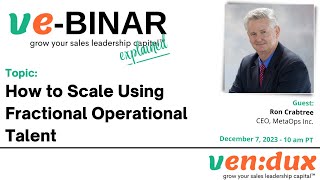
Ron Crabtree from Meta Experts explains why companies hire fractional operational leaders instead of full-time staff. He walks through a 47-point vetting process to match clients with experts in supply chain and Lean Six Sigma, and warns that AI alone won't fix operational problems without fixing people and process first.
Questions this video answers
December 7, 2023
Founded ~22 years ago (Ron states he started the company 22 years ago).
About 12 years ago (Ron: Meta Experts was born ~12 years ago).
Passed the 1,000 certified experts mark in the year of the webinar.
Chapters
Well, hi, welcome to to today's Vendex Vibinar. I'm Andrew Miller, one of Vendex Group, where we focus on helping clients to grow their sales leadership capital. I'm really thrilled today to have Ron Crabtree as our guest and I'll let him introduce himself in a second. At a high level, Ron is one of those ultimate operational yodas. He brings more than 30 years experience in operational excellence in business process improvement, Lean Six Sigma change management and Lean supply chain. Couple of notes before we jump in. We'll keep everyone muted for the duration of the webinar and then there'll be a Q and A at the end. So you can either use the chat function in zoom to submit your questions or just feel free to open up your mics and engage with Ron directly at the end of the webinar. This webinar is being recorded and it'll be available later today on our site and on YouTube. Ron, welcome. Great seeing you. Just take a couple minutes if you will, please tell us a little bit about yourself, meta ops and how you got into this business at a high level and then we'll jump into the guts of today's webinar on how to sell using fractional operational talent.
All right, awesome. Thank you so much. Yeah, just as a bit of background, I grew up mainly materials management and operations, largely in the automotive supply chain. Actually got moved to Metro Detroit back in 96 to work in corporate purchasing for United Technologies Automotive. Ended up getting recruited out to run have a full P and L responsibility for a private equity carve out and after that moved into consulting with Grant Thornton back in 98 and their operations improvement practice and ended up running the Oracle practice at one point. And then I had a stint with the world's largest lean manufacturing consulting company, mainly Echo Yoda folks doing accelerated lean deployment at Ford Motor company and some other large companies around the world and ended up starting our company 22 years ago. Management consulting and company really around training, thought leadership and Lean Six Sigma supply chain and operational excellence. And about 12 years ago, after many requests from clients for an alternative to consulting gigs, you know, hey, we don't need another consulting crop. We were really looking for people that can step in here and do the work. You know, that's how Meta Experts was born. And I'll talk more about that a bit later. So that's the story about how I got here.
Oh, great. That, that's, that's tremendous experience. So let's jump in to operational support and talent and scaling so fast. Forward from all of your experience, you know, 22 years and 12 years ago, over the past couple of years, Covid, big, you know, significant change for everyone at every level. So I'm curious, what have you seen and are you seeing between Covid and now in terms of fractional, the fractional and interim space, this whole sector? What's your big picture view out there?
Well, I'm going to share a couple of slides here just for the purpose of demonstration. And it goes well beyond Covid, right? There's things going on out there that have been accumulating over time. So, for example, one of our partners, edsi, you know, was sharing this with me a while back, and I asked for permission to share and they said, things have really changed, you know, absent Covid, which is how things have changed over history. So just keeping back of our minds that the basis of competition and winning in the marketplace has shifted, for example, in the 1950s and 60s, and some of us are old enough to remember products made in Japan were junk. They were not good products. Right. When the Japanese mastered quality is the basis to differentiate, they started taking on consumer electronics, Toyota entering the car market, et cetera. That's kind of legendary. As we moved out into the 90s, you have the big box stores competing on the basis of cost. Quality is assumed. At this point, you got to have quality. You're not in the game. So what's the next basis cost? Then it moved into the 2000s. We had the Y2K bug and all that good stuff. Now we're moving into digital transformation and digitization of work, which we'll talk more about. But what's the real basis to compete? Now, Google would kind of be a milestone of grabbing and having the very best talent so that they could become the world leader at what they do. So that's really been their base for competition. So what we experienced in Covid has been exasperated, right, by things that are already in play. Here's a really cool piece of data I saw recently. You can go Google. This came from Business Insider, and you got to read this carefully. What's happened to the growth of the US Workforce in North America? You look at the last decade of the 2000s and the percentage of workforce growth as a percentage of total population. Look what's happening, how it's gone down, right? The last, the first decade of the 2000s, the most recent decade, and look at this. It's just continuing to slope away. So the premise of this particular paper, which, if you haven't seen this suggestion, go check it out. It's pretty cool. There are not going to be enough people for all the jobs if we don't change how we do business and how we get things done. So the forever labor shortage is real and it's gotten worse and it's going to continue to get worse absent what happened around the COVID pandemic. And then I saw this just very recently. This is very fresh and relevant. You know, the, this survey work that was done with Fortune magazine, Lala Deloitte, around CEO Insights. And I want to call your attention to this thing over here on the right. 77% of CEOs were reporting issues around talent, the retaining of talent, being a critical differentiator, and the ability to drive whatever their commitments are to serve their markets. And then we'll talk about this a bit more, a little bit later is what about digitization, the acceleration of innovation and what they call gen AI. And I will talk briefly about artificial intelligence and digital transformation a bit later on here. But notice, you know, high correlation here. So these would be all things that we need to be thinking very carefully about. And what, what CEOs are talking about is, you know, what are the three key things that we need to do? And I'm going to touch on that here a bit. But increased digitization of work, right. And moving toward digital transformation, at least faster than your competitors are real high up the list and definitely plays into some of this conversation around talent and what it takes to be successful going forward. So I'll take a breath there.
Yeah, those, those are insightful slides and data points. So then, so what does that mean, going forward? Just, just even with a view of 2024, what, what are the implications of these things, particularly for your business and your clients?
Well, I think there's some pieces to this. I think what we're going to see is a lot more attention around the need to digitize, the digitization of work and people required to do that. And there's three components. You think about business process management. It's people, it's process, it's technology. It's in that order. For a very specific reason. This is the thing that CEOs are really rallying around. That is the shiny object, the technology thing. Sprinkling some artificial intelligence on this makes all our problems go away. It doesn't work that way. You know, digital transformation is death by a thousand cuts. There's lots of elements to it. I'll touch more on that later. And you've got to pay attention to the people part of this first. And if you don't have the buy in, the understanding and the adoption. You're not going to get the benefit of the technology. You should. And the other three themes I'm seeing that, that are really universal. There's three things organizations should be doing if they're not, right. First of all, if they haven't adopted lean, lean manufacturing type thinking where they're eliminating waste, taking away all the things people waste time doing so they get more done with the people they have, shame on them. Right. We need to, we need to get, do better at that. The second piece is you've got to be the employer of choice. If you're not, you got to find another way, right? Are you going to do to have the right talent, the right places to accomplish what you need to get done, your promise to the market? If you can't be the employer of choice, what else are you going to do to make sure you're not going to be shorthanded for the expertise and the bodies to get stuff done? Then digital transformation already touched on that. You've got to be at or slightly ahead of the competition. Well, that's going to be a real problem too.
So, so if I'm a client of yours, so what are the typical client considerations on your side when they're looking at fractional and interim operational support?
Well, it's like anything else, right, Details. So if you're going to look for an organization to help you with solving the fractional talent thing, you got to think about niche provider, right? And ideally there's somebody who's familiar with your industry, they're familiar with the sorts of problems and challenges you face as an industry and understanding what it takes to fix that. And I think, I think, I think that's really important because one of the things I'll mention later is, you know, 93% of CEOs back and there's a PwC study back in 2012, 93% of CEOs felt like, you know, the HR organizations weren't getting the job done and everything. I can tell that opinion hasn't really changed too much. And to some extent that's kind of unfair, right? So if you're expecting your local HR team, for example, or your talent staffing company, as the case may be to really know and be able to bring forward exactly what's needed, really not a fair level playing field because they can't know. They don't know what they don't know. Right. They can't understand what it takes to actually solve those difficult problems. So you really need to be taking a look at, you know, that niche provider that can bring the talent and the expertise stand behind that, if you will, with, you know, in some cases intellectual property insights, what's going on in the marketplace and be a true partner with you in solving those difficult business problems. Be they just. I just need somebody to staff this role or, or somebody's actually going to bring right to help us go get things done. And that's really the bigger business case in many cases for, you know, tapping into fractional part time or full time interim talent is to be able to move the needle much quicker than you ever could with a traditional hiring going and onboarding and going through all the things you do to make a hire. I'll share just a couple of other slides here in a second, but I'll just talk more about being that niche provider. So let me go ahead and throw this back to PowerPoint for a second. Just give me a second while I fumble around here and get this slide back up. So we're actually part of an international consortium, ixpa, where we have joined forces with similar countries, companies around the world. And our common theme is around management, interim management talent, people that can step in and help run the P and L take over a holding for a PE company and that sort of thing, executive level talent. So that's kind of the niche that this particular group that we're part of. I'm actually the chair this year and be hosting the international event in Orlando coming up in November. And then we talk about my company. What do we specialize in our niche. Right. So if you take a look at this list, you know, these kinds of roles from a roles perspective, these are very operationally focused, focused folks the last third of their career typically. And they are very operationally focused. People who make or move product or touch product is what they do is really kind of our sweet spot. People with massive supply chains and supply chain headaches are definitely in our sweet spot. And you know, I can share these slides after we don't have to memorize, of course. This is going to be recorded as well. And the other thing that we built out in our niche is, you know, we have a very rigorous vetting process people go through to get inside our firewall. Right. To be available to our customers on an interim basis. Maybe 5% of the people we look at actually make it through insider firewall, become certified meta experts, which is how we branded this. And inside of that there's layers of talent from Architect grade, the top 10% people that have run A billion dollar P and L people that have sat at the top corporate level driving operational excellence and transformation. Or maybe they've led major functional transformation at the VP level in large organizations around engineering or product development, supply, ch, internal finance and it, mergers and acquisitions, the making and the moving of the stuff. And of course always assuring quality information, product people and process as we go. And then the remaining, you know, two thirds, about, you know, roughly 45% being at the master level. Another remaining 45% a little lower down. Master level folks, 25, 30 years of experience, they can bring it, right? They can run a business unit. They can step in and get a sales, inventory and operations planning system up and running like it should. They can bring a source to pay, pay initiative to fruit, jump in and help you with the quality certification, whatever the case may be. And Then the last 45% for tactical earlier career, maybe semi retired gray beards, not so interested in being hired or moving around a lot. But they love those part time gigs or short term assignments which gives us the ability to provide that on demand talent on an interim part time basis. And we are also offering a contract to hire option where you've got a hole on your chart and you can't wait for a long time for a typical hiring cycle. That can be an option as well. And let's see, what else did I want to say here? I think that was pretty much it here. The other things to think about would be the niche, right? So we have partners who specialize only in finance talent. We have a partner called Vendux that specializes in sales and growth talent. That's what they do, right? HR professionals, people specialize in that sort of talent. We have a partner that specializes in wrench turners, right? People that actually do maintenance work, go into facilities and get their equipment running. We have a partner that, that's all they do is they focus in on helping organizations, industrial organizations have the talent they need to scale right when they're making changes or if they get in trouble for hiring, whatever the case may be. And the list goes on. You know it. Digital transformation support, general workforce development. I mentioned edsi, so I think I'll take a breath there. That's.
Yeah, take a breath. And I was just saying that. Quite a breath. You have the, the other definition. You talk a bit about jumping in to get stuff done. I know in our business when we're going into a new client situation, there's most often there's a, there's an assessment time, there's a need and part of that work is us. We are scoping out the client. We're trying to understand the problem, the framework, the environment, the objectives and the challenges and so forth. But we're just scratching the surface with enough information so that we can find the right person to go into that, that situation. But my question to you is, do you, you have any kind of a framework or a methodology to understand the size and scope and scale of the problems and the challenges before you're bringing people in and, and how much time on the average is taking place with that scoping work and the planning work to make changes before the executive or executives are actually going in to, to run and change and grow and transform. You know that difference between the strategic work and the implementation work?
Yeah. Being, you know, the lean six Sigma master block and all of that. You wouldn't be surprised if we have a process for that. And we have, we call that our 47 point customer alignment worksheet. I've got a page. I'll flip back here for a second here. Go ahead, put this back to slideshow for a sec. I'm just going to pop down here to the top page of that. It's a 47 point alignment process where we have a careful conversation with the customer about what's this role you need accomplished? Who's going to be making this decision? Where do they need to be? Is it part time, is it full time, is it virtual? How long do you think you need this talent? When do you need them? Who needs to talk to them? What's your criterion right to make a decision? And then we work down through and I'm not going to share all the details, it's way too much just to crawl through. But then we have a very careful conversation around situation, what's your current situation? What would good look like? So what is the outcome that we want to accomplish as an organization? How would we measure that? And then we work down 1 to 5. Assessment, criticality. Like what's. What about their ability to do training? What about their ability to do assessment, technical assessment? What about their ability to facilitate? What about their ability to run a project? What about. Right. There's a whole checklist of things we work through, try to draw out from the customer what really matters and what kinds of skills, that mix of skills this person needs to bring. And we talk about industry pedigree. Do they need to have some kinds of certifications in their background to be suitable? Do they need a particular type of engineering degree or whatever the case may be. And then we'll Walk out. Well, what about experience? You know, do they need to have 15 years of experience running a P and L? Well, we need to know that and that sort of thing. Well, even. And then we carve out a very special section in there around soft skills. What about their ability to engage with people, be a real change agent, get people excited about doing stuff that isn't going to be any fun. You know, what about that sorts of skills? And have that careful conversation and we work through budget, right. And you know, what's it going to take to get this done? And then out of that we're able to boil out the criterion, go into our exhaustive CRM database we built on all of our experts. We pull forward a very few expert people. Technically, no question, bring it. And then when the customer talks to them, it's about, oh, okay, now I'm testing for cultural fit. Do I like how this person talks? Do I feel like they would fit in? Would I enjoy working with this person? That's usually what it comes down to, you know, once we get to that point in the process. But yeah, it's a measure twice cut once. We've learned painfully over the years that in some cases it's hard for the customer to articulate what good looks like. So because we are experts in this, we have the ability to sit down and have that quality in depth conversation on a pure level and help them think it through very critically so that we can get it right the first time.
Yesterday I just wrote an article on mind reading in the world of B2B complex sales environments. So often we're running into clients and prospects who don't know they want or need or have a difficult time articulating exactly what they want or need. So just going back to that 47 points checklist there, have you already confirmed that, that the client is the right client for you? That it's a good fit before you go into that process or to what extent do you come out of that checklist process where it's, you know, it's, it's clear that the client is not right for you and you're not right for the client.
Yeah, there's some, you know, telltales in there. You know, if you can't calculate what good is, it's probably a waste of time for starters. Right. And then, you know, you're able to establish good rapport and really talk good. How we're going to measure good. How we're going to hold the expert accountable for the results you're looking for because, you know, you can take a really good skilled person to put them in there, but if they're not supporting them, they're not giving them access to people and they're not giving them access to data, they're not giving them what they need to be successful, then you know that, that dog doesn't hunt either. Right. So it's definitely a two way qualification thing of are they able to actually get the benefit they should from having somebody come in and, and bring a particular kind of expertise or know how can we even, can they even be successful?
Yeah. In a couple minutes I want to open up the floor to questions. So start, start thinking about questions, folks. Ron, let's pivot over to the subject of technology, digital transformation, particularly AI, which we touched on right at the outset. I know we were going to come back to that, so let's do that now. I'm very curious what you're seeing in your major clients and adopting and moving towards digital transformation. I mean, I know it's a constant process, but particularly with, with AI, what, what are you seeing out on the one hand and what are your, your own professional views on the other in, in this new world that we're.
Well, thank you for that. And if you haven't been exposed to, you know, the body of knowledge called, called Industry 4.0. Industry 4.0, Automation Alley and Metro Detroit, one of the leaders in defining that and helping it be understood out there. And one of the things I always caution is, you know, a single tool mentality will get you in trouble. Like, oh, AI, yeah, we need AI. It's going to solve all our problems. Well, the only tool in your bag is a hammer. All your problems look like, right? So you're trying to use a single tool to solve every problem. That's not going to work. So the reality around digital transformation is it's a death by a thousand cuts and there's a lot of components as it happens. We contracted for one of the world's largest online learning companies in the world to develop out, you know, their digital transformation awareness program back in 2020 and today Gartner Magic Quadrant. So I'd like to think we had a hand in that. But when we did that research then, and it's changed dramatically just in the last couple three years, it's, it's changing rapidly. There were more than 30 different key components in digital transformation that you have to be thinking about and they tend to align with different parts of the organization, how you function. So AI, that's kind of a global thing. What about big Data. What about enhanced cybersecurity, additive manufacturing? What is that? Where does that fit? Right. That would be 3D printing, would be an example of how that goes into play about Internet of Things, Iot. What's the short thing for that? Does that have a play in your picture? Blockchain, you know, that's been around for a while. That's a piece of the puzzle. You know, are you in a transactional business, transactional enterprise, where you've got to be able to protect yourself and have really good information? DevOps refers to what's being used in software communities, ties into scrum, Agile methods, very important Robotic process automation or just robotics and automation. So RPA for robotic process automation isn't just the factory. We're talking about everything that can be automated, right? Transactions, financial, et cetera, et cetera, et cetera. You know, things out there called intelligent process automation. You have unified collaboration tools, video capture, recognition. You know, this is a really wide range of things. And I'm just touching the highlight here. And here's the thing, I just have to keep going back to people. Process technology. Don't get caught up in the shiny object of, yeah, if I just do this technology thing, I'm solved. It has to be a very thoughtful process where you're building the business case, right? What's the business. How does the business operate today? How will it, how does it need to operate in the future? What are the gaps between where we are and where we need to be? And then plug in where it makes the difference. The appropriate, I'll call it digital transformation chunks that will move you incrementally to where you need to be. And it's going to be the Pareto analysis, right? There's 80 things good and there's probably eight. It'll give us 80% of the benefit to actually move our performance to where it needs to be. I'll take another breath.
Yeah, I still want to dig into AI. Do, do you see, I mean, from your perspective, are we in this light bulb, electricity, invention of steam engine, industrial revolution, time frame, from an AI perspective, I mean, we, we can go back and, you know, whether it's, you know, the Internet, you know, server architecture at every phase over the last 20, 30, 40 years, we've always said, oh, these are pivotal moments and changes in productivity and society and everything we do out there, like this is going to change everything. You re. You referenced the Millennial bug in two, so we thought the same thing at that time. But the hype right now, the, the perspectives on the, the Potential of AI truly to change everything. You know, I, I have not heard such levels of conversation and introspection and analysis for a long time. What you know, is it truly the one new unique hammer in the toolbox or toolbox that is going to change everything?
Well, the answer is it depends. It depends on your organization and what it is you do and the basis for competition. So if you're an organization that makes fasteners, you still got to put material in machine, you still have to cut fasteners, you still need to get them into a box and move them, fulfill it. What do you need to do that? You need people. So you're going to digitize people out of the process. You can't. AI can't pick up a part, remove it. Yeah, robot could. Right? You know, warehousing operations is a great example of visual intelligence implied. You know, Amazon being a pretty good example. They've invested heavily in, you know, the automation of, you know, the receipt put away and retrieval stuff. And it's largely being driven by robotics, particularly in the, in the sizes of things and the sorts of things that lend that, that sort of hand. So in healthcare, caring for patients, you're never going to digitize away. The, the nurse, the care of a nurse, you're never going to digitize that away. Right. So you have to very carefully pick your battles when you talk about AI, it's the industry you're in, the basis for competition. How can you differentiate something customers want to pay for? Right. What is it you can do to bring more value, Earn your right to be around as a business and then carefully. So how you're going to use those tools like AI? So yeah, it's going to be absolutely transformational in some industries and in some aspect what they do, but it's not a panacea, it's just not.
We could go on for hours on this subject. Quick question then before I open up the floor. Just the practical question of growing your business. How do you get new clients? Where do they come from? What do you do on a day to day, month to month basis to, to grow your client base?
I have a multifaceted strategy, as you might imagine. You know, with a thousand certified experts, you know, all of them are watching out for us. We're growing that all the time. Right. We passed the thousand mark this year. We'll probably hit 1200, 324. We're going to continue to grow that network. Let's face it, that's boots on the ground, that's eyes right out there. In the marketplace, we've worked very hard to develop relationships, more than 30 organizations, Bendux being one of them. Where we don't compete, we play nice in the sandbox. You know, our Venn diagrams, you know, overlap too much, and we got each other back. Right. We're able to, from a single point with partners, be able to offer a very wide perspective. A lot of what I've shared today, I didn't make up. You know, I've learned that from partner relationships, being involved with thought leadership and academia, you know, all of that really matters. Right. The old saying is you can't have. You can't be too rich, too thin, or have too big of a network. Well, we've been working very hard for over 20 years and do just that. Of course we do your traditional outreach. Of course we've got, you know, LinkedIn presence out there. Of course we have web optimization. Of course we're doing things around thought leadership. We're relaunching the better Op brand or on training and development in 2024 with one of our partners. So, yeah, there's lots of pieces to that and don't. And again, no silver bullet. But at the end of the day, it's relationships. You know, you're. If Google has their way, you're never going to get another email delivered. So how are you going to connect with people? And it's going to come down to relationships.
Yes, in the face of AI, the human relationship still reigns supreme and maybe even more so because of. Because of AI. Yeah. Folks, anybody want to chime in here with a question or comments to Ron?
Yeah, Ron, I have a question. Hemming here. You mentioned that you have over 1,000 consultants on your roster. Congratulations for passing that watermark. You also mentioned that they are typically in, I think you called it, the last third of their career. Now, in light of new technologies, AI and everything else you mentioned, how do you, as a provider of talent, ensure that those executives who were at the tail end of their career stay up to date on all the new technologies and developments? Yeah, that's a hard thing to drive. You know, these folks are all independents, right? They're not employees of our company. They're independent contractors that we'll bring in to work with our customers. So for each of them, that's a personal mission. So to help augment that, you know, we're careful about the partnerships we've been building with organizations that specialize in those niches. We have one, one of our partners specializes in robotic process automation AS A service SaaS model provides support for process automation of your business processes. So, you know, I pull in Marcus. Right. And then I'll help skill up folks, if they're going to be involved and we'll get partners involved, et cetera. We have a lot of our meta experts, folks who have actually had the job of leading digital transformation. You know, they're ex cio, CTO level chief technology offer, chief intelligence officer. That's been their job for the last 15, 20 years. Now they're kind of getting into summer retirement. Well, they've got this wealth of knowledge and have personally helped large organizations and small both move through this whole digitization journey, at least up till now, get to tap into them and what they don't know, we can go find out really quick through the network. Great, thank you. Welcome. That was a good question. Thank you. Yeah, I haven't thought about that in a while.
Any other questions from the floor? Any. Do you see anything in the, in the chat bar?
Anything on our side?
I'm curious. It's just something that, as I talk with people and you mentioned about the niche and I think there's quite a bit of value there. But one of the things that, like, for someone like myself, I'm more of a generalist. I, I cross a lot of boundaries. I've played in a lot of different spaces and I've done that. In some cases it becomes a detriment because people want that, you know, special in that one, one small area. But the way my mind works is it. It fuels the innovation. I see the crosshairs that, the similarities, the differences, how you can use something that works over here to maximize the potential over there. Can you think a little bit more about how people like myself would position in those types of scenarios? Especially when people are looking for something very specific, but yet, you know, you could probably add more value if they took that different look or a different approach.
Well, that's a difficult question because you got to meet people where they are and then take them where they need to go. Right. So if where their mind is, I need this, then you've got to bring that to the party, unquestionably. Right. The fact that you can do all these other things is great, but they may not see it. So that's kind of a situational thing. Right. The other thing to think about, Nicole, which that's a very good question, is you do to some extent have to have a personal brand, some kind of niche that you offer, Tom. And just saying I'm a generalist isn't going to get you there. So you do have to have a kind of a sweet spot to really talk about. And what you want to do is get the conversation started and then do discovery. That's what that 47 point checklist is all about is we just ask lots of questions like okay, so, okay, so we need to solve this problem. What about people buying into it? What about the supply chain folks? What about the engineering folks, you know, and lead them into those, those conversations as you did down through it. So they're just, it's isn't until you really get discovery where you know, you really get a chance to open that up and start that conversation. But my advice would be is you got to have some kind of a calling card, a differentiator, a personal differentiator that earns you the right to at least get the conversation underway. I hope that makes sense.
Yeah, that's a, it's a good question. And Ron, I, I agree with you. And maybe the only other thing that Nicole, I would add is you may think of yourself as a generalist generalist, but you're a generalist in something. I have no idea about your background, but you might be a generalist in the world.
I'm a journalist in revenue, so it's the industries. I've played from everything from retail to mostly technical products and services, including SaaS and most recently AI. So for me it's fascinating when people say they need this very specific thing and much like we talked about personal brand and relationships and conversations is I'm a challenger by nature. So I challenge in that discovery conversation. Is that really what you need to solve this challenge? I don't think you're going to get quite where you want to go. If you take that direction you can get there. It's going to take you a different or longer path or you might not quite get as far as you could if you took a broader approach and think more innovatively. And so I think it just get. I agree it does give you an opportunity. I'm just, I was just curious how others approach that because I see that more and more with companies, they want this very narrowly defined thing, not realizing they don't have the broad picture.
And I think that I run into that all the time. I guess I wouldn't ask you a question if I may.
Sure.
Okay. So I was spouting off a little bit there about my views around, you know, the single bullet cure mentality around AI. Would you agree or disagree?
I. Mike, you shared it depends. So, and, and I don't know a whole lot on manufacturing. It's been long since, since I've been in that world. I have friends that I chat with about some of their challenges in there. But when you think about from the technical space or you think about revenue and when I say revenue, it'll touch on product. It could include product, but I'm thinking more sales, marketing, customer service.
Right.
When you think about that, I think that that has the most room for the play of AI.
I happen to agree with you. I happen to agree with you. Principle. Yep. I'm in agreement with that because to the extent where we require fallible human beings to capture and make sense of information or fallible human beings to correctly execute on the outbound. Right. The interaction part, if we can eliminate the human error and the cost of humans doing something that they don't need to be doing anyway, that is a winner. Customer gets a better experience, your quality goes up and your costs go down. What's not to like? As long as you don't, as long as you don't burn the human touch. Right. As long as you don't miss that. The magic. Right. Of that human interaction.
That's, that's what I, what I like about it is you can automate some things that help make the customer's life easier, you make your employees life easier, but then you give the employee time back to get higher value touch to the client. And that I like.
I agree with that completely. I've worked quite a bit and you know, credit unions a long way, retirement services, various financial institutions, actually spent a lot of time working our state government, including the state treasury here in Michigan. So pretty interesting, you know, situations where the most hated department in the state of Michigan is who Treasury. Because they're collecting the money from everybody, you know, they're doling it out. So improving the customer experience was a pretty interesting journey for them.
I think there's a ton of opportunity in government to improve that experience even more, especially with so much AI opportunities there.
There are exactly great observations. Tim, do you want to weigh in with anything here? Tim Kelly, do you want to weigh in with anything here? No, I, I just appreciate the comments and Ron, it's been really interesting to kind of hear your perspective on the operations side of fractional, you know, the fractional role. And I haven't had a chance to look at your website and I'm very interested. So thank you and thanks for your back to your partnership as well. Yeah, back to that whole niche thing. You know, we were very hard to build on our niche as an organization. You can go to when you've got a problem and you, we can help talk that through. You know, is it technology fix, is it a body, is it a specialized provider of some kind? You know, we, if we don't already have them, it's not hard for us to find. Right. Yeah. To me, the, the hurdle is, you know, for. To get that, to get that potential client engaged enough to say, yeah, I do need a fractional or I'm willing to take on a fractional. I think in the CFO world, it's, it's further along and more accepted.
Right.
But I think in the operational space and the sales space, I think we, you know, we're working that. We're plowing that field pretty hard and it is, it is tough to get that, that buy in that convincing. So we're, we're trying to learn that for sure. Yeah. Cool. Thank you, sir. Yeah, thank you.
Excellent. Ron, what, what's the way that people can find out more about you and, or reach out to you personally, either from here live or when they hear the recording?
Reach out to me. Connect through LinkedIn if you like. My email is our crabtreenops.com A million people already have that and my spam filter keeps out the bad guys for the most part. And I can actually put this up for a second if you want to. Of course, we're going to record this too. So let me go ahead and share my screen here and I'll just throw that up for just a second.
Yep.
And let's see here. Right here. Right. So my cell phone's here, email address, and if, if you capture it, you know, you can actually put something in my calendar to talk. So easy enough to track us down. Of course, there's a place to chat when we get to meta Experts too. And you know, if you're interested in looking for a particular kind of talent, you can actually mine for that on the Med Experts website. Search for particular talent solutions, if that's interesting.
Terrific. It's great working with you. Really appreciate your time and expertise and insights here today with us. Have, have a great holiday season, Ron. We don't talk between now and, and the end of the year and thanks again. Wonderful having you here today and thanks everybody for your participation and engagement.
All right, awesome.
All the best.
Thanks so much. Thank you. Thank you. Bye Bye.
Take care.
More from Henning




ve-BINAR - The Revenue Tornado Methodology: How 3 Power Sources Create Exponential Growth


ve BINAR: Executive Cloning: How AI is Reimagining the Role of the Fractional Executives




veBINAR: Unlock Client Value: Why Compliance is Crucial for the Startups You Serve
